What is a cooking class in Montepulciano, and what will you learn to make?
A cooking class in Montepulciano is a guided session in a farm, winery, town kitchen or villa where you make two to four local dishes and then sit down to eat them. Most last between 2 and 5 hours, and most of them teach pici. Montepulciano itself is a walled hill town 605 metres up in the province of Siena, with the vineyards of Vino Nobile on one side and the Val d'Orcia on the other, a valley of cypress-lined ridges listed by UNESCO in 2004 and about 20 minutes away by car. The cooking is the food of sharecroppers, so it leans on flour, beans, bread, sheep's cheese and one very large garlic.
Pici, and why they differ from other pasta shapes
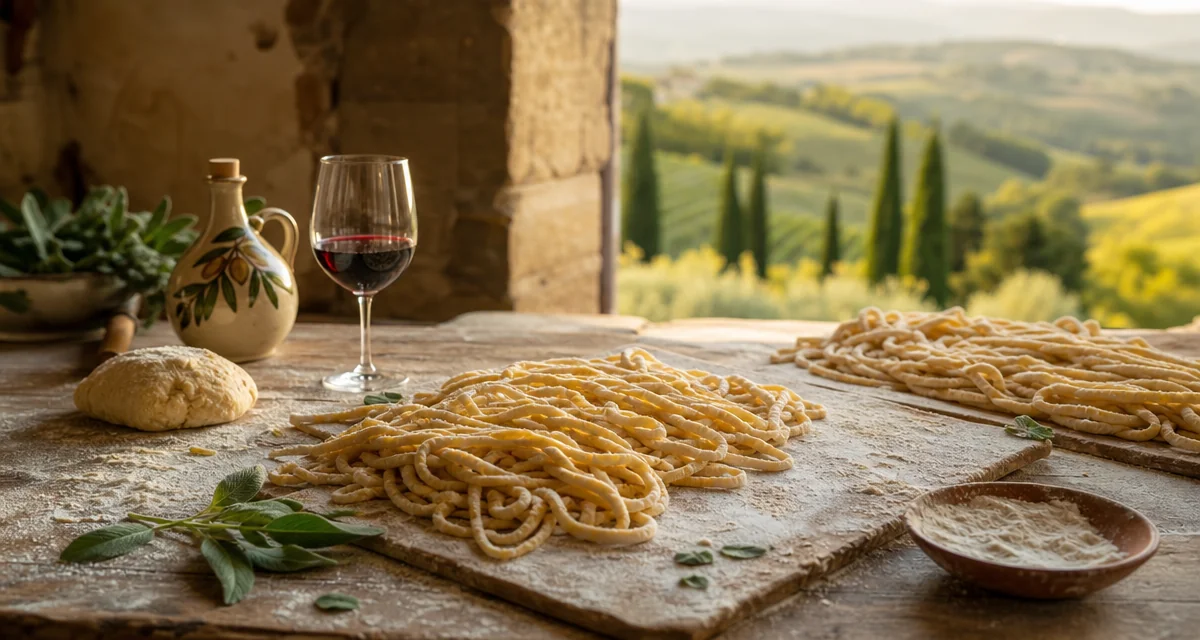
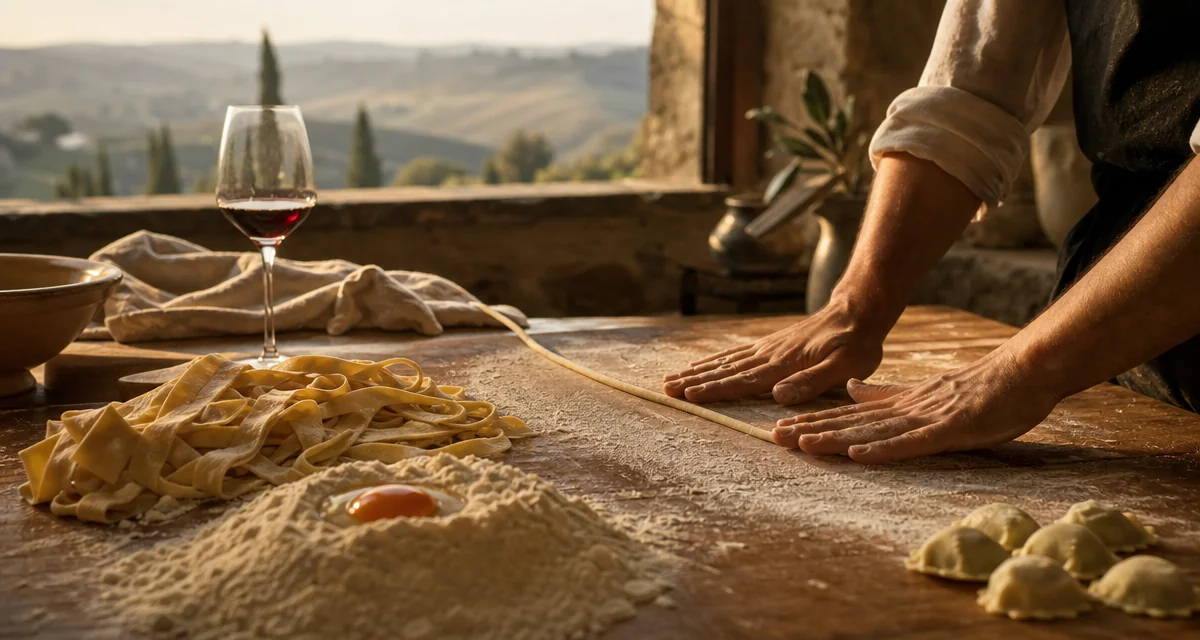
Pici are thick, hand-rolled strands that look like heavy spaghetti, born in the province of Siena and generally made from flour and water alone, with egg left to family habit. Valdichiana locals call the rolling gesture appiciare. Tagliatelle and pappardelle, the ribbons you will also meet on local menus, depend on a thin, even sheet, so the skill there is in the rolling pin. For pici a thick slab is enough: you cut it into strips and roll each one between your palms or against the board, which makes them the friendlier shape for beginners and for children. The thickness is uneven by design, and the sauce clings to the thin parts while the thick parts stay chewy.
Aglione, Chianina and pecorino: the flavours around the pasta
The classic partner is sugo all'aglione, a tomato sauce scented with aglione della Valdichiana, a giant garlic whose bulbs can reach 800 g against roughly 150 g for the ordinary kind, and whose sweet, gentle taste does not linger. Its application for IGP status, the European protected-origin label, was sent to Brussels in May 2026. The second name to know is Chianina, the huge white cattle breed named after the Valdichiana plain below the town and the traditional source of the Florentine T-bone; its certified meat is sold as Vitellone Bianco dell'Appennino Centrale IGP, a label shared with two other central Italian breeds. Then comes pecorino di Pienza, the sheep's milk cheese of the neighbouring town, nutty when young and sharper with age. Despite its fame, it has no DOP of its own; the protected cheese is Pecorino Toscano, which earned that status in 1996. For the wider regional picture, our guide to the dishes that define Tuscan cooking covers the rest of the table.
What is the price of a cooking class in Montepulciano in 2026?
A shared Montepulciano cooking class is priced between €100 and €243 per person in 2026, for the lessons sold in euros, with the meal included and wine included in most cases (at Podere Spedalone it is sold separately). The shortest pasta lessons sit at the bottom of that range, and longer menus with several courses and paired wines sit at the top. The figures below were read in November 2026 on each operator's page or on the booking platform that sells it, in the currency shown there, and they can change with the season, so treat them as a guide and check before you pay. Two names are missing because we could not read a price: the winery class at Avignonesi, which is on request, and the cooking school Toscana in Pentola, which publishes no tariff on its home page.
| Class | Where | Price per person | Length | Group |
|---|---|---|---|---|
| Podere Spedalone, pici and tagliatelle or ravioli | Organic farm near Pienza | €100 | About 2 hours, then lunch | Shared |
| Valdichiana Living, pici and fresh pasta | Farm or shop, Valdichiana | €109 | About 2.5 hours | Shared; groups of 10–30 on request |
| Valdichiana Living, market with the chef | Piazza Grande, Montepulciano | €129 | About 4 hours | Thursday mornings |
| Villa Vetrichina, class and dinner | San Casciano dei Bagni | €135 (€195 with wine tasting) | About 4.5 hours | From 2 guests |
| Mulino Val d'Orcia, mill visit and class | Spedaletto, Pienza | €150 | About 4 hours | €600 voucher for 4 |
| Le Caggiole, pasta menu | Farmhouse outside Montepulciano | From €162 | About 4 hours | 2–8 guests, age 12+ |
| Cookly, pici and pasta | Farm or restaurant, Montepulciano | US$162 | 2.5 hours | 2–8 guests |
| Tiberini, class with cellar visit | Winery, Montepulciano | €180 | About 5 hours | 2–6 guests |
| Le Caggiole, five-course menu | Farmhouse outside Montepulciano | From €243 | About 5 hours | 2–8 guests, age 12+ |
| Cooking Vacations, pasta or full menu | Montepulciano | US$295 (based on 2) | About 2–2.5 hours | From 2 guests |
| Chef On Demand, Pasta Class + Dinner | Your villa or apartment | €150 per adult, €60 per child | 4–5 hours | Private, your group only |
Sources for the table: Podere Spedalone, Valdichiana Living for its pici lesson and its market class, Villa Vetrichina on Winedering, Mulino Val d'Orcia, Le Caggiole for the pasta menu and the five-course menu, Cookly, Tiberini on Winedering and Cooking Vacations. For how these numbers sit against Florence, Chianti and the rest of the region, our comparison of what lessons cost across Tuscany does that job.
Which cooking class formats can you book around Montepulciano?
You can book four formats around Montepulciano: a shared class on a farm, a Thursday market tour followed by a lesson, a winery class with a cellar visit, and a private class at the place where you are staying. They teach overlapping menus, so the real choice is about setting, company and transport. If you are picturing a cooking school in Montepulciano with classrooms and a timetable, adjust the image: most of the lessons we checked happen in working farms, family kitchens and estates, and the ones that publish a limit cap the group at 6 or 8 guests.
Farm classes and cooking classes near Montepulciano
The farm class is the default. Podere Le Caggiole, a farmhouse just outside the old town, runs a 4-hour pasta menu (pici, tagliatelle and tiramisù) and a 5-hour, five-course menu with a Chianina main, for at most 8 guests aged 12 and over. Valdichiana Living sells a 3-hour farm lesson at €129, starting at 11:00 or 17:00, with bruschetta, pici, a sauce and a dessert. If your base is in the Val d'Orcia, a cooking class in Pienza may be closer: Podere Spedalone teaches pici, tagliatelle and cantucci (twice-baked almond biscuits) on Monday, Wednesday, Friday and Sunday, and tortelli with gnocchi on the other days, always at 10:30 and for €100, which makes it the cheapest cooking class in the Val d'Orcia among those we checked. Mulino Val d'Orcia goes a step further back, because the morning starts in a stone mill and ends with pici all'aglione and minestra di pane, a thick bread and vegetable soup. Read the address before you pay, though. 'Near Montepulciano' can also be further than it sounds: Villa Vetrichina is in San Casciano dei Bagni, about 35 km away and reached by a dirt road through woodland.
The Thursday market tour plus class
Yes, this format exists in Montepulciano, on one morning a week. The weekly market sets up on Thursdays in Piazza Nenni, just below the old town, and Valdichiana Living's chef meets guests at 9:30, shops with them for vegetables, cheese and cured meats, then teaches an appetiser, a fresh pasta and a dessert in a historic palace on Piazza Grande, the town's main square. Lunch and a glass of local wine are part of the €129. The whole thing takes about 4 hours. The hamlets of Montepulciano Stazione and Sant'Albino hold Saturday markets, but this class is tied to Thursday, so plan the week around it or drop the idea.
Vino Nobile cellar and class on the same day
Tiberini, a family winery, folds both into about 5 hours: a walk through the vineyards and cellars, a four-course lesson with pici or pappardelle, and lunch with 8 wines, for 2–6 guests at €180. Avignonesi gathers ingredients in its organic garden and cooks a full menu with estate wines; Wine Paths describes a class for 4–10 people of about 5.5 hours, with pici, aglione sauce and a pecorino flan. Or you can assemble your own day, with a morning lesson followed by the 17:00 guided tasting walk through the old town, a 3-hour Montepulciano wine tour in miniature that costs €109 and includes pecorino, pici and a historic cellar. Vino Nobile di Montepulciano DOCG, the wine in those cellars, is a red of at least 70% Sangiovese, known here as Prugnolo Gentile, aged for a minimum of 2 years. It tastes of cherry and plum with a savoury edge, and it suits grilled Chianina and aged pecorino. Do not confuse it with Montepulciano d'Abruzzo, a wine from another region and another grape.
How does a private pasta class at your villa work?
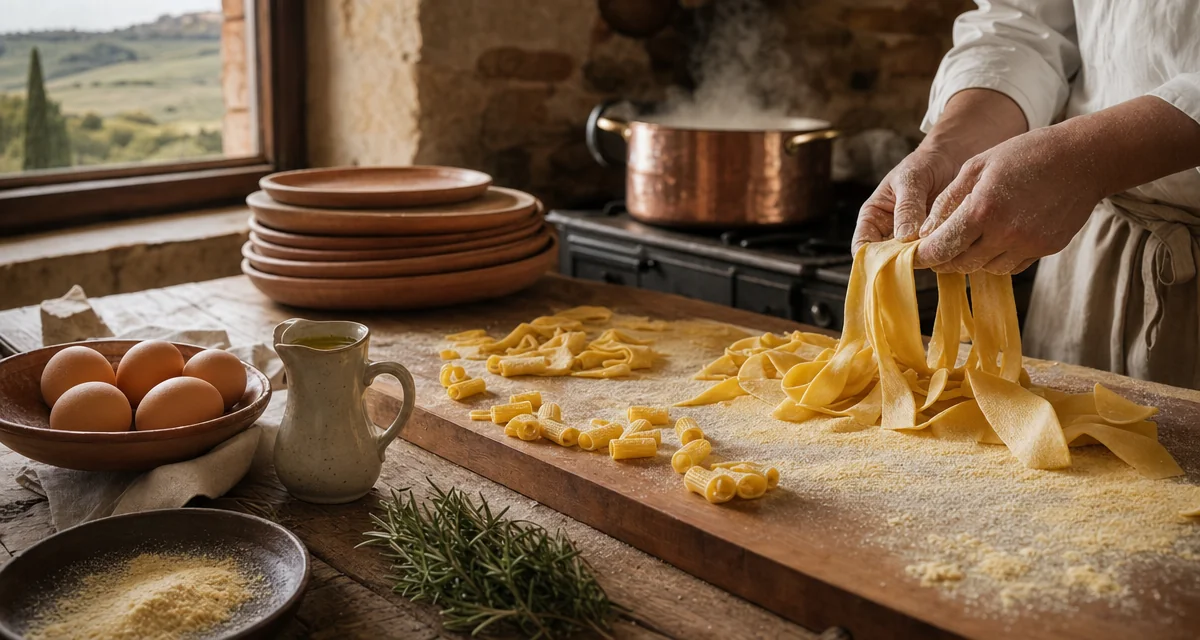
With a private class at your villa, a professional chef comes to the property you are renting, teaches your group for 2 hours in your own kitchen, and then cooks and serves a seated dinner at your own table. That is Chef On Demand's Pasta Class + Dinner, and it takes 4–5 hours from arrival to clean-up. The chef brings the ingredients, boards, rolling pins and pots, and teaches two shapes: one long, which around here usually means pici, and one short, such as maltagliati, the irregular offcuts of a rolled sheet. While the pasta rests on the counter, the chef prepares two sauces (perhaps aglione and tomato for the pici, a slow ragù for the short shape), a few local antipasti and a tiramisù. Then you sit down on the terrace and eat what you made.
The price is €150 per adult and €60 per child, whatever the size of the group, so 2 adults pay €300, 4 adults €600, 4 adults with 2 children €720, and 10 adults €1,500. There is no shared cohort and no drive home: the farmhouse you rented is the classroom, the children can drift in and out, the grandparents who prefer to watch still get dinner, and you pour the bottles you bought at the cellar that morning. The menu adapts to allergies and diets because it is cooked for your party alone. What you take home is the technique itself, the feel of a dough that has had enough water and the rhythm of the rolling. The class does not include a market visit, so if the stalls are the point of your trip, choose the Thursday format instead. You can see the chefs who cook around Montepulciano, and the same service reaches rentals near Pienza and Montalcino, the hill town about 35 km west that gives its name to Brunello, a long-aged red made only from Sangiovese.
A group that learns pici in its own kitchen stops performing after ten minutes. Nobody is watching the clock or the next table, so the slow cooks find their rhythm and the fast ones start teaching the children. Chef On Demand Editorial Team
Which class suits a group of 2, 4, 6 or 10?
For 2 travellers a shared class is usually the better value, while from 4 guests, and especially with children, a private class at your villa starts to make sense. The arithmetic is simple enough to show in full. A shared lesson charges the same rate per head however many you are, and several of them stop at 6 or 8 places, so a party of 10 cannot always book together. Privacy changes the sum as well. Le Caggiole, for instance, says that a private class means reserving all 8 spots, which at the listed €162 would come to about €1,296, whether you are 4 or 8.
| Format | 2 adults | 4 adults | 6 adults | 10 adults |
|---|---|---|---|---|
| Pici lesson, Valdichiana Living (€109, shared) | €218 | €436 | €654 | €1,090 |
| Thursday market and class (€129, shared) | €258 | €516 | €774 | €1,290 |
| Le Caggiole pasta menu (€162, shared) | €324 | €648 | €972 | Maximum 8 guests |
| Tiberini class and cellar (€180) | €360 | €720 | €1,080 | Maximum 6 guests |
| Chef On Demand at your villa (€150, private) | €300 | €600 | €900 | €1,500 |
Children tip the balance. Le Caggiole takes guests from 12 up, Tiberini charges €95 for ages 8–13 and nothing under 8, and at your villa each child costs €60, so a family of 4 adults and 2 children pays €720 for the class and the dinner together. If your group would rather be cooked for than cook, a chef-served dinner for 6 in this area costs about €95 per person for the 4-course Essential menu, €120 for Taste of Italy and €180 for Luxury; for 10 guests the same menus come to €85, €100 and €150. Italian public holidays add 35% to those dinner prices, and Montepulciano carries no premium-zone supplement. Private dining at a Montepulciano villa follows the same at-home logic as the class.
How do you take a cooking class in Montepulciano without a car?
Without a car, choose a class inside the walls or one that comes to you, and reach the town by train and bus. Trenitalia sells a combined ticket to 'Montepulciano Centro': you ride a Regionale train to Montepulciano or Chiusi-Chianciano Terme station, then a bus from the station forecourt to the centre, at €1.70 from the first and €3.90 from the second (prices read in November 2026). Buses can be less frequent on Sundays and holidays, so check the timetable before you fix a lesson. The market class meets in town and cooks on Piazza Grande, so it is the simplest choice on foot. Farm classes generally do not collect you; Le Caggiole offers no shuttle and suggests reserving a taxi for both directions.
By car the distances are short but slow, because the roads wind. Count about 20 minutes to Pienza (13 km), 45–50 minutes to Montalcino, a little over an hour to Siena (67 km) and around 90 minutes to Florence (110 km). If you are sleeping in Siena, it makes more sense to look at lessons at your place in Siena or at a fresh pasta session there than to cross the hills twice in a day. For rentals further off, the same at-home format is described on our page about cooking lessons at Tuscan villas.
When is the best time to book, and what is on the board each season?
The best months for a cooking class in Montepulciano are May, June, September and October, when the farm calendars are open and a kitchen full of boiling water is still a pleasant place to be. Le Caggiole's pasta class, for example, was listed for 2026 from 7 April to 31 October, on Mondays, Thursdays and Saturdays. In 2026 the Consorzio, the growers' association, expected picking for Vino Nobile to start in the second week of September, so a mid-September lesson puts you among the vines at harvest, or vendemmia. It is also the moment for schiacciata all'uva, a flat, sticky bread baked with wine grapes. Late August has its own draw and its own crowds: on the last Sunday the eight districts race 80-kilogram barrels uphill in the Bravìo delle Botti. November brings new oil, which is the subject of our guide to Tuscan olive mills in harvest time.
- Count every guest first, including children and anyone who will only eat, because that number decides which classes can take you.
- Choose the day next: Thursday for the market, or any day that leaves a clear evening for a class at your villa.
- Check the real address on a map, since 'Montepulciano' in a listing can mean a farm 35 km away.
- Tell the organiser about allergies and diets before you pay, because some kitchens need to verify whether a 2-pasta menu can be adapted at all.
- Reserve 7–14 days ahead from June to September, which is the usual lead time across the Chef On Demand network.
- Confirm the cancellation terms in writing, because they run from 24 hours to 30 days depending on who you book with.
Pici are only one of the workshops you can fit into a week here. Our guide to hands-on food workshops for villa stays goes through the other options, and the regional round-up of where to learn fresh pasta sets pici beside the other Tuscan shapes.
Why a cooking class matters on a Montepulciano holiday
Montepulciano is easy to visit in an afternoon. You climb the main street, taste two wines in a cellar that smells of damp brick, photograph the square and drive on to Pienza before dinner. A lesson slows all of that down. For a few hours you stop collecting views and start handling the things the views are made of: wheat from the valley floor, garlic the size of a fist, oil from the slope behind the house. And when you order pici in a trattoria two nights later, you know exactly how long somebody's hands were at work.
Chef On Demand, rated 4.7 out of 5 across 73 Trustpilot reviews, brings professional chefs to the place where you are staying, so the lesson ends at your own table with the lights of the valley coming on below. If that is the evening you have in mind, start from our Montepulciano page, check the dates, and leave room in the bag for a bottle of Nobile. The flour, the boards and the washing-up are somebody else's business.