What does a Tuscan pasta making class actually involve?
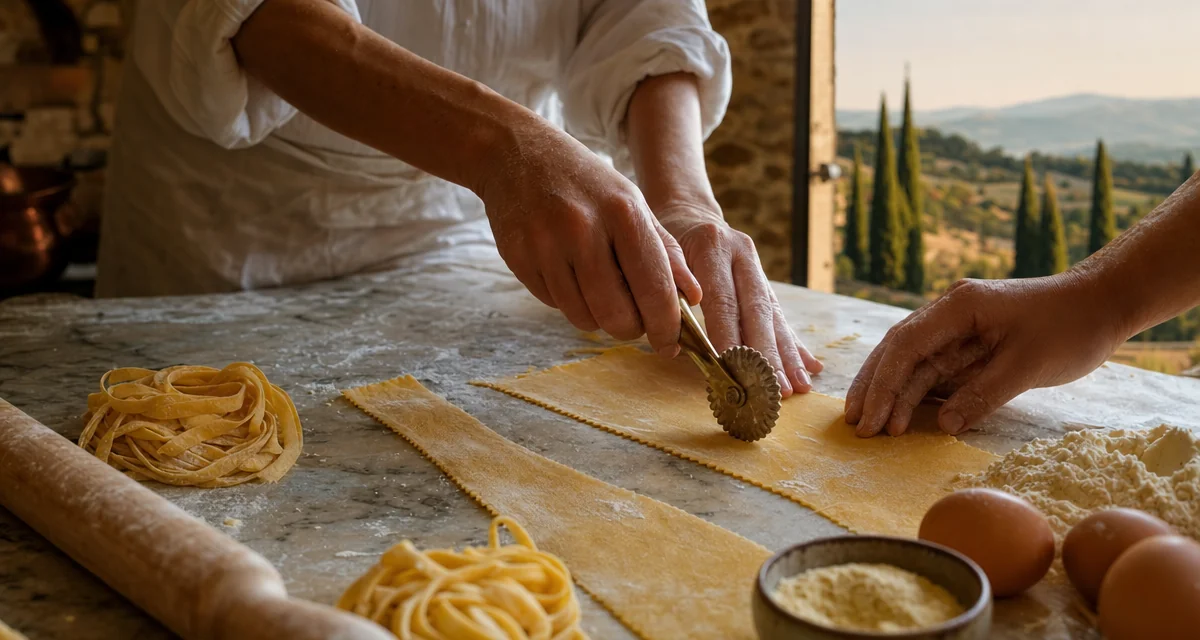
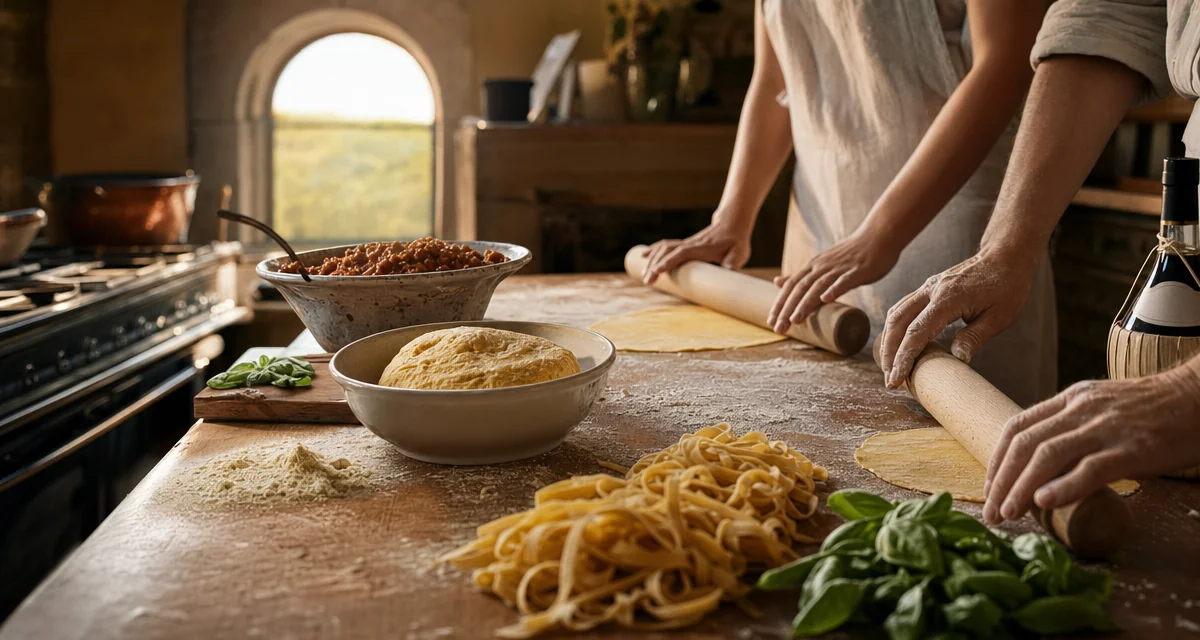
A Tuscan pasta making class is a 2-hour hands-on lesson where a chef teaches you two fresh-pasta shapes, one long and one short, then cooks them into a full dinner. The Chef On Demand format is the Pasta Class plus Dinner Experience, a single 4 to 5 hour booking held entirely at your villa, apartment or holiday rental. The chef arrives with everything: flour, eggs, dough boards, rolling pins, pasta cutters, pots and plates. You start with the class itself, usually around 2pm to 4pm, kneading and rolling under the chef's hands. While the pasta rests on your countertop, the chef builds two sauces (often a meat ragu for the long pasta, a vegetable or seafood sauce for the short), a few regional antipasti, and a homemade tiramisu. Then you sit down at your own table for the seated dinner. The pasta you shaped lands on your plate about thirty minutes after you made it, in the same room, with your own group. The takeaway is not a recipe card. It is the muscle memory of hand-rolling, the feel of the dough at the right hydration, and the four flavours tasted in sequence. What you remember is in your hands, not on paper.
Which Tuscan pasta shapes will you learn?
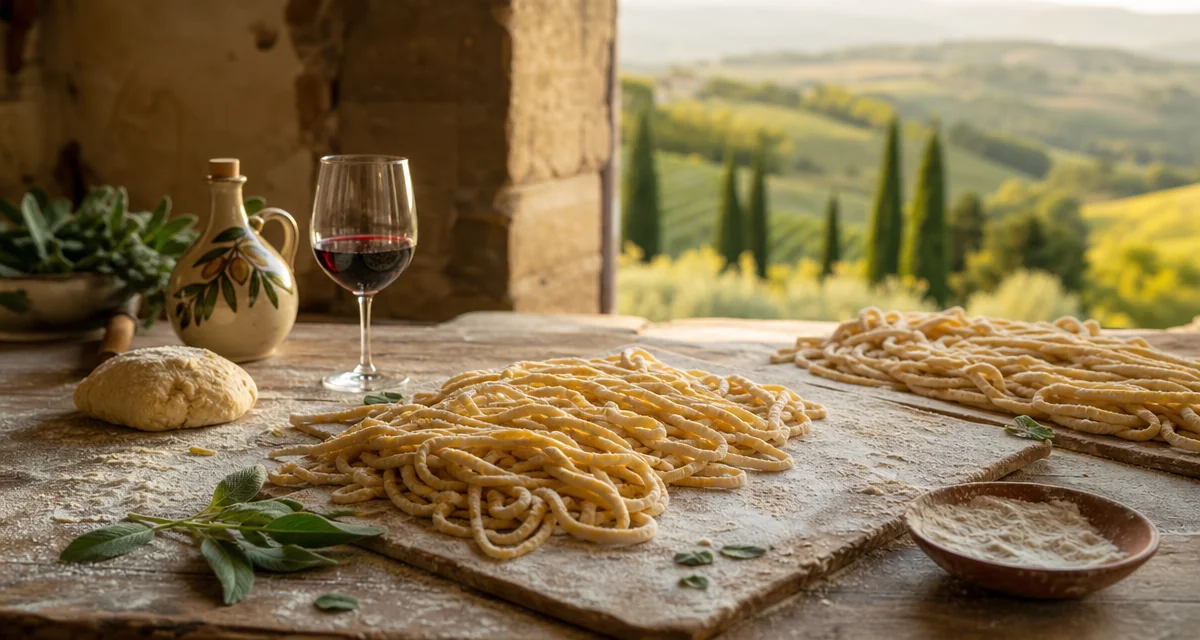
Tuscany makes pasta by hand, and the shapes change as you cross the region. Pici is a thick, hand-rolled spaghetti from the Val d'Orcia and Siena area, made with just flour and water, no egg and no machine, rolled out one rope at a time on a wooden board; it is famously served with cacio e pepe or a garlicky aglione tomato sauce. Pappardelle are wide, flat ribbons cut from an egg-rich sheet, the classic Chianti partner for ragu di cinghiale (wild boar ragu), a slow-cooked sauce that defines the hunting cuisine of inland Tuscany. Tortelli are stuffed parcels, larger cousins of ravioli, filled in the Mugello and Casentino valleys with potato, ricotta and spinach, or in the Maremma with greens and Pecorino Toscano DOP, a sheep's-milk cheese aged in Tuscany and protected by EU origin rules. Ravioli round out the repertoire, smaller filled squares that suit a sage-and-butter dressing. Most classes teach one long and one short shape, so a common pairing is pappardelle plus ravioli, or pici plus a stuffed parcel. If you only have one class, ask for the shape that belongs to the town you are staying in. It makes the lesson feel rooted rather than generic.
Tourists arrive thinking pasta is one thing. By the end they understand that pici is a Sienese ritual, pappardelle is Chianti hunting food, and tortelli changes village by village. That click is worth more than any printed sheet. Chef Lorenzo, Florence-based ambassador of Chef On Demand Tuscany
Where in Tuscany should you book a pasta class?
The best town to book in is simply the one you are already sleeping in, because the chef travels to your villa rather than the other way around. That said, each area has a pasta identity worth leaning into. In Florence and the surrounding Bagno a Ripoli hills, you get the broadest chef network and the classic egg-pasta repertoire; you can book a Florence pasta making class to see who covers your address. Siena and the Val d'Orcia around Pienza and Montalcino, the UNESCO-listed valley of cypress-stippled hills, are pici country, the most hands-on shape of all. The Chianti belt between Florence and Siena, anchored by Greve in Chianti, pairs pappardelle with wild boar and a glass of Chianti Classico DOCG, the Sangiovese-based red bottled with a black rooster seal. San Gimignano adds Vernaccia, Tuscany's benchmark white, while Montepulciano brings its noble red to the table. Wherever you are, a resident chef can usually reach you, which keeps logistics simple and lets you cook surrounded by the landscape you came for. Pick the wine region you want to drink, and the pasta shape tends to follow.
- Confirm your villa has a usable kitchen and a table for your group; the chef brings tools, but needs hob space and a clear worktop.
- Tell the chef your group size and ages up front, since children join the rolling and adults who would rather watch still sit down to the same dinner.
- State any allergies or dietary needs as a clear list, so the chef can adjust dough, fillings and sauces before market day.
- Choose your two shapes, ideally one long and one short, and name the town's specialty if you want a rooted lesson.
- Pick a start time that leaves room for a long, unhurried dinner; 2pm to 7pm is a comfortable arc for a family.
- Book 7 to 14 days ahead in summer, and earlier still for an August stay when villa demand peaks.
| Feature | Pasta Class + Dinner at your villa | Studio class in the city |
|---|---|---|
| Typical price | Around €150 per adult, broadly flat by group size | €59 to €120 per person |
| Who is in the room | Only your group, fully private | Shared with up to 12 strangers |
| Seated dinner | Yes, full meal cooked from what you made | Rarely; often eat at a counter, then leave |
| Menu personalisation | Tailored to your shapes, diets and pace | Fixed menu, fixed cohort |
| Setting | Your terrace, garden or farmhouse table | A classroom in town |
| Transfer needed | None; the chef comes to you | Drive or taxi for the whole group |
| Wine | Your villa cellar, local enoteca, or chef pairings | Often no alcohol on the cooking floor |
How much does a pasta making class in Tuscany cost?
A Pasta Class plus Dinner at your villa costs around €150 per adult, with children at roughly €60, and the per-head figure stays broadly flat as the group grows because it is priced as one experience rather than per dinner plate. So a family of four sits around €600 total, while eight adults land near €1,200, all in: the lesson, the chef's market shopping, the antipasti, two pasta courses with their sauces, tiramisu, service and cleanup. Compare that with the city-studio market, where Tuscan classes commonly run €59 to €120 per person and the more elaborate winery-plus-lunch formats reach €160 to €280 per head, as competitor listings show. The studio looks cheaper per person, but you are buying a shorter, shared session, usually without a private seated dinner. The villa figure is not a class fee with dinner bolted on. It is a single 4 to 5 hour experience for your group only, in your own space. For peak-season weekends in June to September, confirm your date early, since the best Tuscan chefs book out 7 to 14 days ahead and faster in August.
How do you book a pasta class for your villa in Tuscany?
Booking is straightforward: tell us your villa address, dates, group size and any dietary needs, and we match you with a verified chef who covers your area. Chef On Demand operates a verified network of 12+ private chefs across Tuscany, many trained in Michelin-starred kitchens, Gambero Rosso-rated restaurants, MasterChef and Top Chef Italia, with a 4.7/5 Trustpilot rating based on 800+ guests served since 2025. Once matched, you agree the two shapes and the menu directly with the chef, who handles the market shopping the morning of your class. For a region-wide stay, a Tuscany pasta making class can reach Florence, Siena, the Chianti towns, San Gimignano, Montepulciano and the Val d'Orcia, so wherever your rental sits, there is usually a resident chef within a short drive; many groups still anchor the booking around a Florence-based chef when staying near the city. If you are weighing a villa stay against other Italian regions first, our guide to the best cooking classes in Italy and our deeper look at cooking classes across Tuscany are useful companions. The only thing you coordinate on the day is opening the door. The chef brings the rest.
Why this matters for your Tuscan holiday
A villa in Tuscany is already the setting you dreamed about: the olive trees, the long table, the light at six in the evening. The mistake is to drive 40 minutes into town for a fluorescent classroom and trade that setting away for an afternoon. The whole point of a pasta making class on holiday is to fold the cooking into the place you are staying, so the rolling, the resting, the sauces and the seated dinner all happen on the terrace you paid for. That is why we lead with the at-villa format for international guests: it keeps your group together, your children in the room, your wine on the table, and your evening unhurried. Years later it is not the price you remember but the pici you rolled badly the first time and perfectly the third, the wild-boar ragu that smelled like the whole house, and the friends who still make the pappardelle back home from memory. Explore Chef On Demand's private chef experiences in Tuscany, or go straight to a private pasta making class in Florence to start matching a chef to your stay, and let the kitchen come to you. The hills are the reason you came. Cook in them.