What is Tuscan cuisine, really?
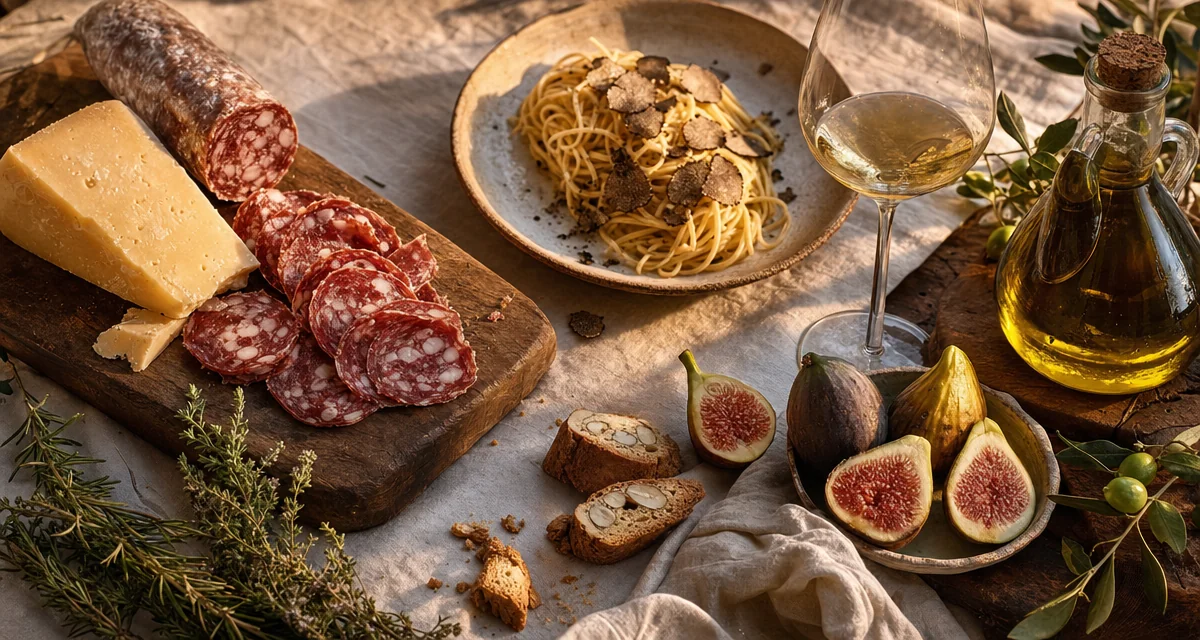
Tuscan cuisine is the codified peasant cooking of central Italy, shaped by ~3,000 years of Etruscan, Roman and medieval Florentine influence and defined by what the land grew. Five staples appear on virtually every traditional menu: extra-virgin olive oil (Tuscany produces around 18,000 tonnes a year, with the IGP Toscano designation in force since 1998), unsalted Tuscan bread, cannellini and zolfino beans (Tuscans are nicknamed mangiafagioli, 'bean-eaters'), black kale (cavolo nero, the blistered cabbage that fills every winter soup), and Chianina beef — the giant white cattle of the Val di Chiana. The technique is deliberately minimal: peposo, a 14th-century beef stew of Chianina shin slow-cooked for 12 hours with whole black peppercorns and Chianti red wine, is essentially 3 ingredients and time. Compared with Emilia-Romagna's butter-and-cream richness or Sicily's Arab-Norman exuberance, Tuscan cooking is austere, almost monastic — and that austerity is the point.
Which dishes should every traveller try at least once?
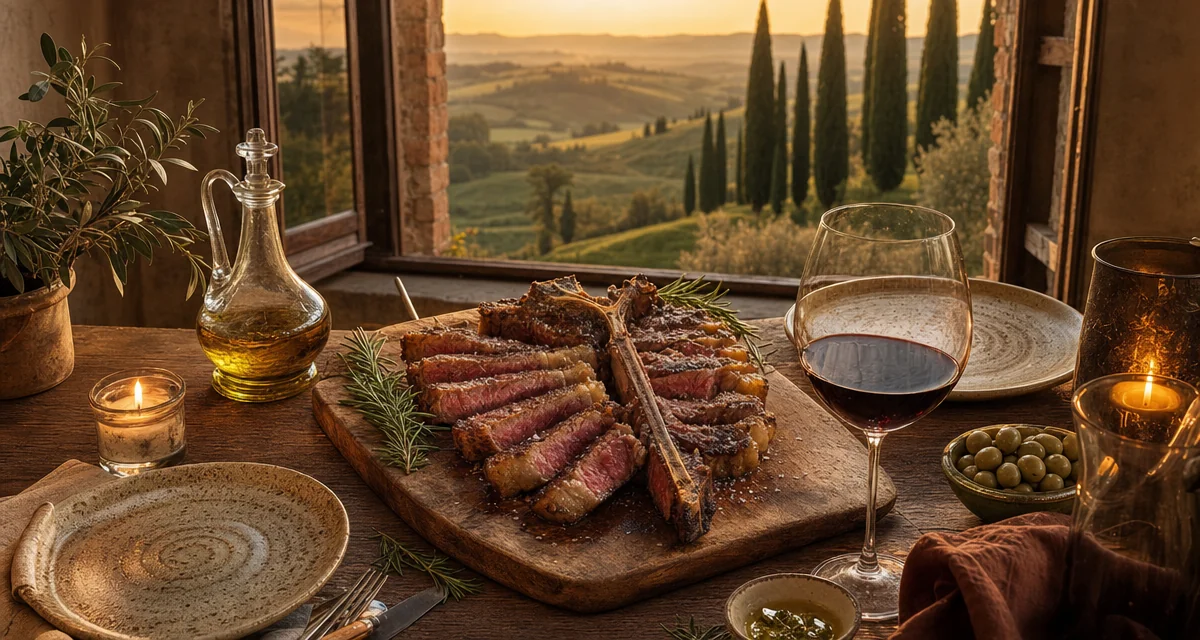
If you have 7 days in Tuscany, these are the 8 dishes that justify a slot on the itinerary. Bistecca alla fiorentina is a thick T-bone steak (1.2-1.5 kg, 4-5 cm tall) from Chianina cattle, grilled over hardwood embers and served rare with salt, pepper and a drizzle of olive oil. Ribollita ('reboiled') is a dense winter soup of stale bread, cannellini beans and cavolo nero, made on a Friday and reheated through the weekend. Pappa al pomodoro is its summer twin — bread, ripe tomatoes, garlic, basil and olive oil cooked into a porridge. Panzanella is the cold version: stale bread soaked in tomato water with red onion and basil. Pici, a hand-rolled eggless pasta the thickness of a pencil, is native to Siena and the Val d'Orcia and served cacio e pepe or with a wild-boar ragù. Pappardelle al cinghiale is the Florentine equivalent. Crostini neri (chicken-liver pâté toasts) open almost every Tuscan lunch, and cantucci with Vin Santo close it.
How does Tuscan food change from province to province?
Tuscany has 9 provinces and at least 7 distinct culinary territories. Florence is the home of bistecca, pappardelle al cinghiale, crostini neri and the street-food classic lampredotto — slow-cooked cow's fourth stomach on a soft roll dipped in its own broth, sold from kiosks around Mercato Centrale for around €5. Siena and the Val d'Orcia (a UNESCO-listed valley — the cypress-stippled hillside on every postcard) are the kingdom of pici and of Pecorino di Pienza DOP, a sheep's-milk cheese aged 20 days to 2 years on the chalky pastures around Pienza. Lucca bakes a wheat-and-Mediterranean cuisine of tordelli lucchesi (meat-stuffed half-moon pasta) and farro della Garfagnana IGP, an ancient hulled wheat grown for over 2,000 years in the valleys north of Lucca. Livorno on the Tyrrhenian coast invented cacciucco, a fiery red fish stew built from at least 5 species — the rule is one species per 'C' in the name. The Maremma, the wild south-western coast in Grosseto province, specialises in acquacotta (peasant 'cooked water' soup of bread, onion, tomato and wild greens topped with a poached egg) and wild-boar dishes. Massa-Carrara in the north-west cures Lardo di Colonnata IGP, pork back-fat aged 6 months in marble basins from the quarries Michelangelo used. One carefully chosen meal in each of Florence, Siena, Lucca and Livorno covers ~80% of the regional repertoire.
- Florence (Firenze) — bistecca alla fiorentina, pappardelle al cinghiale, crostini neri, lampredotto street food.
- Siena and the Val d'Orcia — pici cacio e pepe, pici al ragù di cinghiale, panforte (a dense medieval spice cake), Pecorino di Pienza DOP.
- Lucca and the Garfagnana — tordelli lucchesi, farro della Garfagnana IGP soup, buccellato (anise-and-raisin ring cake).
- Livorno and the coast — cacciucco fish stew, torta di ceci (chickpea-flour flatbread, sold as cinque e cinque in a sandwich), triglia alla livornese.
- The Maremma (Grosseto) — acquacotta, wild-boar pappardelle, Morellino di Scansano DOCG, Pecorino Toscano DOP.
- Massa-Carrara and the Lunigiana — Lardo di Colonnata IGP, testaroli (pre-Roman flatbread-pasta cooked in cast-iron testi and served with pesto), chestnut-flour breads.
- Arezzo and the Casentino — Chianina beef from the Val di Chiana, scottiglia (multi-meat stew), bringoli (Aretine pici).
What wines belong on a Tuscan table?
Tuscany holds 11 DOCG appellations (the top tier of Italian wine law) and 41 DOC zones, almost all centred on Sangiovese. The 4 to know by name: Chianti Classico DOCG, the black-rooster-sealed Sangiovese-led red from the hills between Florence and Siena — entry-level bottles €15-25 in trattorias, the everyday companion to bistecca and ribollita. Brunello di Montalcino DOCG is a 100% Sangiovese red from the hills of Montalcino; aged at least 5 years before release, it sits alongside Barolo as one of Italy's 3 benchmark reds — black cherry, leather, tobacco — pour it with peposo or wild boar. Vino Nobile di Montepulciano DOCG, made from Sangiovese (locally called Prugnolo Gentile), is more aromatic and earlier-drinking than Brunello. Vernaccia di San Gimignano DOCG is the region's only white DOCG — an indigenous variety grown around the medieval towers of San Gimignano, mineral and saline, the right glass for cacciucco or panzanella. Close dinner with Vin Santo del Chianti Classico DOC, a sweet straw-dried dessert wine for dipping cantucci. Guests in our Tuscan chef network's home region typically rotate across these 4 wines through the week.
When is the best time of year to eat Tuscan?
Tuscan cooking is rigidly seasonal — the February and August menus share fewer than 5 dishes. Late September to early November is the headline window: vendemmia (grape harvest), white-truffle season opens around San Miniato (Pisan hill town hosting a national truffle market every weekend in November), olive oil is pressed from late October (olio nuovo — electric green, peppery), and game season begins. Spring (April-May) brings wild asparagus, first artichokes and lamb for Easter; pappa al pomodoro reappears once early tomatoes arrive in late May. Summer (June-August) is the season of cold-bread dishes, coastal seafood around Forte dei Marmi, and village sagre — food festivals dedicated to a single dish. Winter (December-March) is bistecca, ribollita, wild boar and chestnut — the heaviest Tuscan repertoire, eaten in dim trattorias by the fireplace. If you must pick one season, late September aligns harvest, truffle, oil and warm enough evenings for outdoor dining — and our chef network books out fastest in those 8 weeks.
If you taste a Tuscan dish and find it almost too plain, you're tasting it correctly. Cucina povera trusts the ingredient — the Chianina, the unsalted bread, the new oil — to do the work. The chef's job is to stay out of its way. Chef Lorenzo, Florence-based ambassador of Chef On Demand Tuscany
| Wine (DOCG) | Grape & home town | Style | What to pair it with |
|---|---|---|---|
| Chianti Classico | Sangiovese, Chianti hills (Florence-Siena) | Medium-bodied red, cherry & herb | Bistecca, ribollita, aged pecorino |
| Brunello di Montalcino | 100% Sangiovese, Montalcino | Full-bodied red, 5+ years aged | Peposo, wild boar, hard cheese |
| Vino Nobile di Montepulciano | Prugnolo Gentile (Sangiovese), Montepulciano | Medium-full red, aromatic | Pici al ragù, roast pork, hard cheeses |
| Vernaccia di San Gimignano | Vernaccia, San Gimignano | Mineral white, saline finish | Cacciucco, panzanella, fritto misto |
How does eating at home compare with restaurants in Tuscany?
Most travellers split the week between trattorias, one or two higher-end restaurants and one or two evenings at the villa. A traditional Florentine trattoria runs €40-60 per person for antipasto, primo, secondo and house wine. A Michelin-recognised Tuscan restaurant (the region holds 43 Michelin-starred restaurants as of 2026, second in Italy only to Lombardy) sits between €120 and €250 per person. A private chef cooking the same regional repertoire at your villa comes in close to mid-range trattoria pricing once the group is sizeable: around €110-€135 per person for a Taste of Italy menu of 5 courses with 6 guests, dropping to roughly €95-€110 per head at 10 guests — groceries included, no taxi home. A trattoria gives you Florentine atmosphere and the company of locals; a private chef gives you a personalised menu and the stove on the loggia at sunset. We recommend keeping at least 2 trattoria meals (one in Florence, one in a small Chianti village) and booking one private chef night for the evening after a wine-tasting day, when nobody wants to drive.
Where can you book a private chef to cook these dishes?
Chef On Demand's Tuscan network is a verified roster of 12+ private chefs, with residents in Florence, Siena, Lucca, the Chianti villages (including Greve in Chianti) and the Versilia coast. Many come from Michelin-starred kitchens, Gambero Rosso–rated restaurants, MasterChef and Top Chef Italia. The booking flow offers 3 formats. A single dinner (or lunch/breakfast) with the chef arriving at your villa, bringing groceries, cooking on-site and cleaning up. A multi-day stay of 3-7 days with daily market shopping and the meals you select — typically 2-3 dinners plus 1 long lunch over a week — across 3 lodging configurations: chef stays at the property, local chef commutes daily, or chef takes nearby lodging factored into the quote. Or the flagship Pasta Class + Dinner: a 4-5 hour experience where the chef teaches 2 fresh-pasta shapes (one long, like pappardelle; one short, like pici), prepares 2 sauces, antipasti and a homemade tiramisù, then serves the full menu. Average booking lead time is 7-14 days for peak season (June-September); for late September to early November book 2-3 weeks ahead. The companion Tuscany food experiences guide covers truffle hunts and wineries; the logistics of hiring a private chef in Tuscany sit on a separate page.
Why this matters for your Tuscan holiday
There is a version of a Tuscan trip that goes wrong in a polite way: 3 Florence restaurants chosen at the door, a generic Chianti tour, and a dim memory of 'something with bread' on day 5. There is also a slower, surer version — built on having read the menu before the plane took off. You know peposo takes 12 hours and a young Chianti, that the white truffle in San Miniato peaks the second weekend of November, and that pici belong to Siena while pappardelle belong to Florence. Holding that map in your head is what turns a week of meals into a trip you remember a decade later. Our chefs occupy the corner of that picture where the kitchen sits — a Tuesday-night ribollita at your villa in the Tuscan hills, or a Saturday fiorentina the night before you leave. Our EN private-chef hub and our companion guide to Tuscan villa rentals with a chef are the next reads. Trustpilot rating across our network is 4.7/5 from 800+ guests served since 2025.