What does a private chef dinner party menu actually look like in Italy?
An Italian dinner menu is a sequence of five defined slots rather than a starter, a main and a pudding. In order: antipasto (small savoury openers), primo (the pasta, risotto or soup course), secondo (meat or fish), contorno (a vegetable dish served alongside the secondo, never under it), and dolce (dessert). A private chef fills four, five or six of those slots depending on the evening you want.
That architecture, described in detail in the Italian meal structure, is the single most useful thing to understand before you write to a chef, because it turns a vague request into a solvable brief. Saying 'we would like a nice Italian dinner' gives a chef nothing. Saying 'two antipasti, one primo, one secondo with a contorno, one dolce, and we would rather have vegetables than a cheese course' gives them a whole evening. The contorno is where most international guests slip: in Italy it arrives on its own plate at the same moment as the secondo, so a roast chicken does not come 'with' potatoes, it comes next to them. Four courses generally run 2 to 2.5 hours at the table, five run closer to 3, and six will take your group past the three-hour mark, which is wonderful in July and punishing if you have a 6am transfer. If you want to go deeper on how course count changes the night, we unpacked it in how many courses a private chef dinner should have.
How do you match the menu to the occasion?
Match the menu to the reason you are all at the table. A milestone birthday can carry six plated courses and a wine flight; a first night after a long flight cannot. As a rule of thumb, allow one course for every 30 minutes you genuinely want to spend seated, then subtract one if children under ten are eating with you.
Dinner party themes that work best with a private chef
The themes that succeed in a rented villa are the ones that use the room you are already in. A market-driven dinner, where the chef tells you at the table what was good that morning and builds around it, is the most quietly impressive of the lot and costs nothing extra to request. A single-region deep dive works beautifully for groups who have been eating in restaurants all week and want coherence. A long lunch instead of a dinner is the most underrated option in summer, because you eat at two in the afternoon, swim, and still have your evening. Themes that struggle are the ones that fight the property: a twelve-station canapé reception in a farmhouse with one oven is not going to be the night you imagined.
A relaxed family night versus a milestone celebration
For a relaxed family night, four courses served family-style on shared platters is the format we see work best with groups of 6 to 12, because it lets children graze, lets adults talk, and lets the chef cook without a stopwatch. For a milestone, plated service across five or six courses changes the register completely: each plate arrives finished, the pacing is deliberate, and the chef controls the rhythm of the evening. The same chef, the same kitchen, the same budget band, and two entirely different nights. If your group is celebrating something specific, say so in the brief, because a chef who knows there is an anniversary at the table will build a dessert around it.
People ask me for a menu. What I actually need is the occasion, the number of children, and whether anyone has to drive home. Everything else I can solve at the market. Chef Lorenzo, Florence-based ambassador of Chef On Demand in Tuscany
Which regional Italian menu should you ask for?
Pick the region you are staying in and let your chef cook it properly. Italy has 20 regions with genuinely distinct larders, and a menu that stays inside one of them will taste more considered than a tour of four. The three blueprints below are the ones our chefs are asked for most, and each one already balances richness, acidity and weight across the courses.
A Tuscan dinner party menu
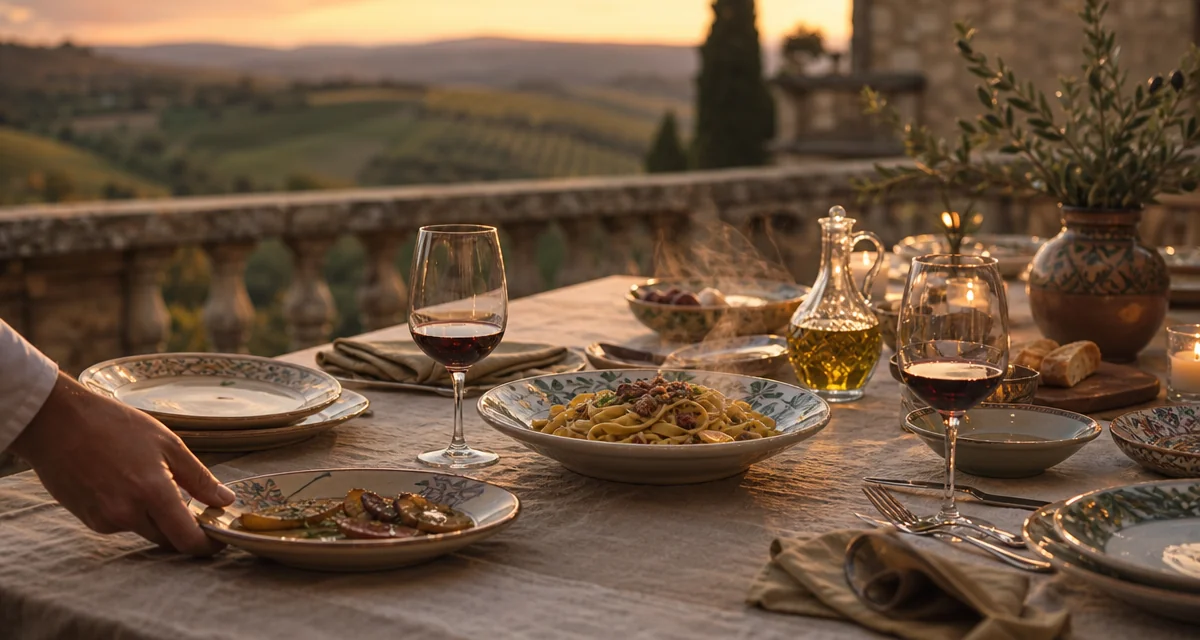
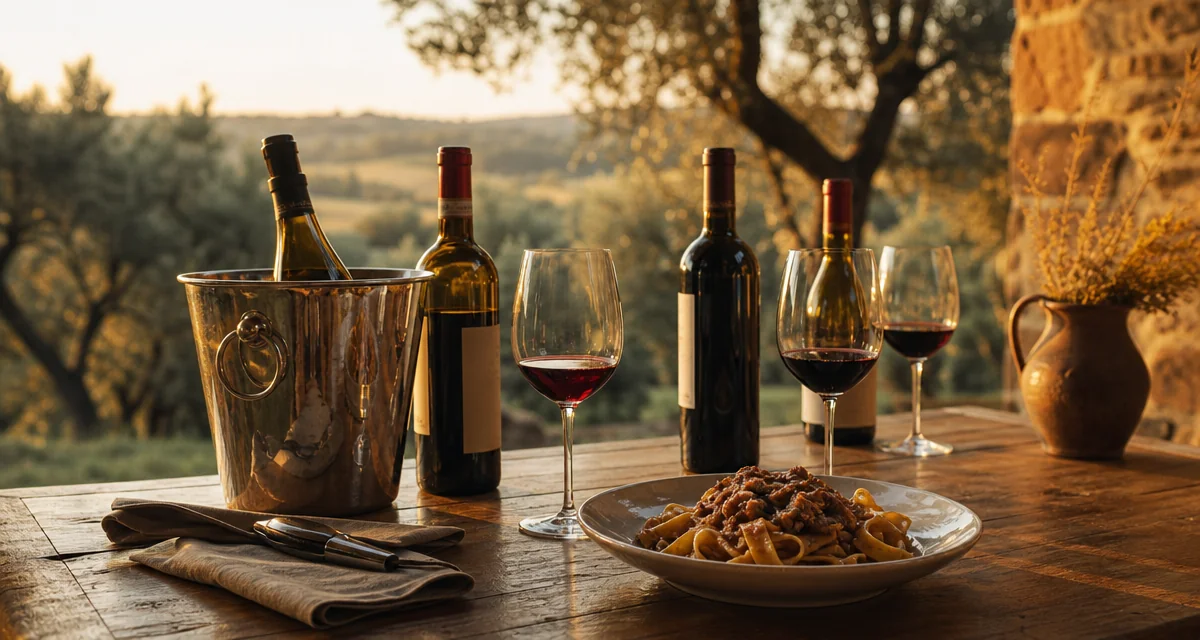
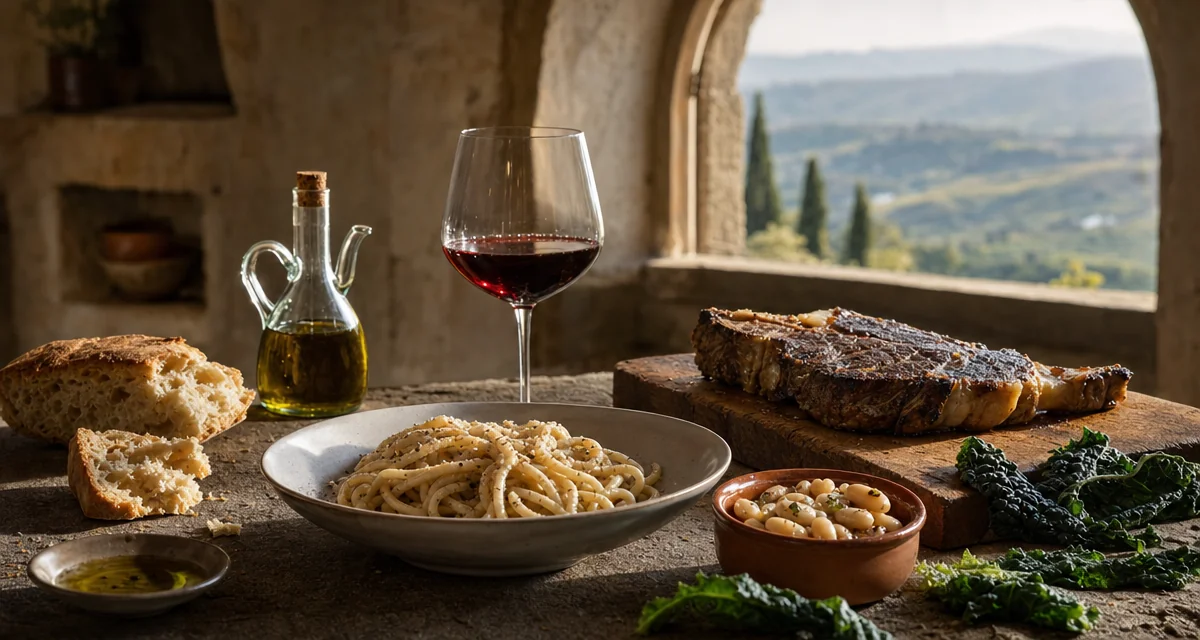
A five-course Tuscan menu that works almost anywhere between Florence and the Val d'Orcia: crostini neri and pecorino di Pienza DOP (a sheep's-milk cheese from the hill town of Pienza, sold young and soft or aged and crumbly) to open; pappardelle al cinghiale as the primo, which is a wide ribbon pasta about two centimetres across dressed with a slow-cooked wild boar ragù, a dish born from hunting season in the Chianti hills; bistecca alla fiorentina as the secondo, a thick T-bone of 1.2 to 1.5 kg cut from Chianina cattle and grilled over embers, served rare on the bone; white beans with sage and olive oil as the contorno; and cantucci with Vin Santo to finish. Pour Brunello di Montalcino DOCG with the steak, a 100% Sangiovese red aged at least five years before release, or Chianti Classico DOCG if you want something brighter and less expensive. Our private chefs across Tuscany cook this menu more than any other, and the chefs based in Florence, Siena and Montalcino will each nudge it toward their own patch.
A Sicilian dinner party menu
Sicily gives you a menu with more citrus and more sea in it, and it suits hot evenings far better than a Tuscan grill. Open with caponata, a sweet-and-sour aubergine relish with celery, capers and vinegar that is served at room temperature, then a raw or lightly marinated fish course. The primo is pasta alla Norma, tomato and fried aubergine finished with ricotta salata (pressed, salted and grated sheep's ricotta), named after the Bellini opera and effectively the flag of Catania. Whole fish baked with olives and cherry tomatoes carries the secondo, and cassata or a granita closes it. Etna Rosso DOC, a Nerello Mascalese red grown on volcanic soil at 600 to 900 metres above sea level, is the pairing worth asking for. Our chefs across Sicily and specifically in Palermo will shop the morning markets for whatever the boats actually brought in.
Emilia-Romagna and the Amalfi Coast
If you are staying north, an Emilia-Romagna menu is the most comforting of the three: Parmigiano Reggiano DOP aged 24 and 36 months tasted side by side, then tagliatelle al ragù, the real Bolognese, which is a hand-rolled egg pasta about 7 mm wide with a slow meat sauce that has been cooking for three hours or more. Chefs in Bologna will make the pasta in front of you. Head south instead and the Amalfi Coast larder rewrites the whole thing around lemons, anchovies and buffalo mozzarella: scialatielli ai frutti di mare as the primo, grilled fish with Amalfi lemon as the secondo, and delizia al limone to close. Many of these small producers are protected as Slow Food Presidia, a programme that safeguards traditional foods at risk of disappearing, and a chef who names one on your menu is telling you exactly where the ingredient came from.
- State the occasion in one line, because a birthday, an anniversary and a first-night-after-the-flight all produce different menus.
- Choose the region before you choose the dishes, and let the chef fill the courses from that larder.
- List every dietary requirement as a bullet, separating true allergies from preferences, and flag children with their ages.
- Decide plated or family-style, since this changes pacing more than the dish list does.
- Name one or two things your group loves and one or two things they will not touch, then stop. Over-specifying every plate removes the chef's best work.
- Confirm the number of guests 48 hours ahead, because per-person cost and the shopping list both move with the count.
- Ask what the chef would cook if the choice were entirely theirs, and read the answer carefully. It is usually the best menu on offer.
How do seasonal menu ideas change from spring to winter?
Seasonality in Italy is not decorative, it decides what the menu can be. Between April and June the markets carry artichokes, broad beans, peas and the first courgette flowers, so the antipasto goes green and the primo goes light. From July to early September, tomatoes and aubergines take over and the classic move is panzanella, a Tuscan salad of stale bread soaked and torn through tomatoes, cucumber, red onion and basil, invented to use bread that had gone hard.
Autumn is the most generous window of the year and the one worth planning a trip around. From late September to November the vendemmia (the grape harvest) fills the countryside, porcini appear, and white truffle season opens in Piedmont and parts of Tuscany, typically running from October to December. A November menu can carry a truffle course that would be impossible in June, and chefs will tell you honestly whether the price is worth it that particular week. Autumn is also when dates get tight, so if you are planning to book a Tuscany private chef experience around the harvest, ask early. Winter turns the larder inward: from December to March the primo becomes ribollita, a thick Tuscan soup of black cabbage, beans and bread that is cooked once, rested overnight, then reboiled, which is literally what the name means. Cavolo nero, chicory and citrus from the south do the rest. Because the same tier of menu buys very different ingredients in February and in October, ask your chef what the market is actually giving them in the week of your booking rather than locking every dish three months ahead.
| Essential | Taste of Italy | Luxury | |
|---|---|---|---|
| Courses | 4 (fixed) | 5 (fixed) | 6 or more |
| Typical shape | One antipasto, primo, secondo with contorno, dolce | Two antipasti, primo, secondo with contorno, dolce | Amuse or extra antipasto, two primi or a fish and a meat secondo, cheese or pre-dessert, dolce |
| Ingredient ambition | Classic regional staples, seasonal vegetables, everyday cuts | Named DOP and DOCG products, hand-made fresh pasta, whole fish | Truffle in season, prime aged cuts, crustaceans, multi-wine pairing |
| Guide price, 6 guests | Around €95 per person | Around €120 per person | Around €180 per person |
| Guide price, 10 guests | Around €85 per person | Around €100 per person | Around €150 per person |
| Time at the table | 2 to 2.5 hours | About 3 hours | 3 to 4 hours |
Two caveats on those figures. They are guide prices for a dinner in Italy and they move with the group size, so a party of 4 pays noticeably more per head (roughly €110, €140 and €200 across the three tiers) simply because the chef's time is divided between fewer people. Premium city zones such as Rome and Milan carry an additional €15 per person, and Christian holidays including Easter carry a surcharge of around 35%. Wine is a separate conversation, and we set out who buys the bottles in our piece on private chef wine pairing at home. For the booking mechanics themselves, lead times and deposits, our guide to hiring a private chef for a dinner party in Italy covers the ground so this article does not have to.
Tasting menu or relaxed dinner: how ambitious should you go?
Choose ambition by counting the evenings you have left, not by counting your budget. A six-course tasting menu on the first night of a ten-day stay is a triumph. The same menu on the last night, after nine days of eating, is a chore your group will politely finish.
The honest trade-off runs like this. An ambitious tasting menu buys you precision, plating and a narrative: each course is small, deliberate and finished at the pass, and the chef is effectively performing for 3 to 4 hours. It works best with 6 to 10 adults, no small children, and a group that likes to sit. A relaxed menu buys you the opposite currency, which is time and noise. Platters land in the middle of the table, people reach across each other, the chef comes out between courses, and the same 800+ bookings tell us this is the format families with children under twelve rate highest afterwards. There is a middle setting that most people never think to ask for: a plated antipasto and dolce with a family-style primo and secondo in between. You get one photograph-worthy opening plate, one properly finished dessert, and two hours of passing bowls in the middle. It costs the same as any other menu in its tier, because the tier is set by course count and ingredients rather than by service style.
What can your villa kitchen actually cook?
The kitchen you have rented sets a real ceiling on the menu, and almost nobody checks it before booking. A chef arriving at a restored farmhouse in Chianti with one domestic oven, four gas rings and no dishwasher can produce a superb five-course dinner for 10, but not one that needs three items finished simultaneously at 200°C.
Send the chef two photographs of the kitchen and one of the dining area when you book, and mention four things: how many hobs there are, whether the oven is domestic or professional, whether there is a barbecue or wood-fired grill outside, and how many people the table actually seats. That last one matters more than it sounds, because a menu for 12 in a house with a table for 8 becomes a standing buffet by accident. Chefs bring their own knives, pans and small equipment as standard along with every ingredient, so you are not expected to own anything special. What they cannot bring is a second oven. A wood-fired grill outside, on the other hand, unlocks a whole category: bistecca, spiedini and whole fish all improve dramatically over embers, and it is worth telling the chef it exists even if you have never lit it. Groups staying a week often go further and book a multi-day arrangement instead of a single dinner, where the chef cooks an agreed set of meals across the stay and shops the local markets each morning. Cost there depends on whether the chef sleeps at the property, commutes daily from nearby, or takes lodging close by, so the quote is built for your specific house rather than sold as a flat per-person rate.
Why this matters for your Italian holiday
You will eat perhaps eighteen dinners on a two-week trip to Italy, and you will remember two of them. One will probably be a restaurant you stumbled into. The other, if you plan it at all carefully, is the night nobody had to drive, nobody had to book a table for eleven, and nobody had to leave when the kitchen closed. That is the real argument for designing the menu yourself rather than accepting a set proposal: the dinner becomes yours, shaped around the people at your table, the region you chose to visit, and what the market had that morning. Our chefs come from Michelin-starred kitchens, Gambero Rosso-rated restaurants, MasterChef and Top Chef Italia, and they hold a 4.7/5 Trustpilot rating from 800+ guests served since 2025, but the thing they actually offer you is a blank sheet and the knowledge to fill it. If you are still choosing where to base yourselves, browse private chefs across Italy, or go straight to our Tuscan chef network if the Val d'Orcia is where you are headed. Send the brief, then put your phone down. The next thing that happens is somebody carrying a board of pecorino out onto a terrace while the swifts go over, and you have absolutely nothing to do about it.