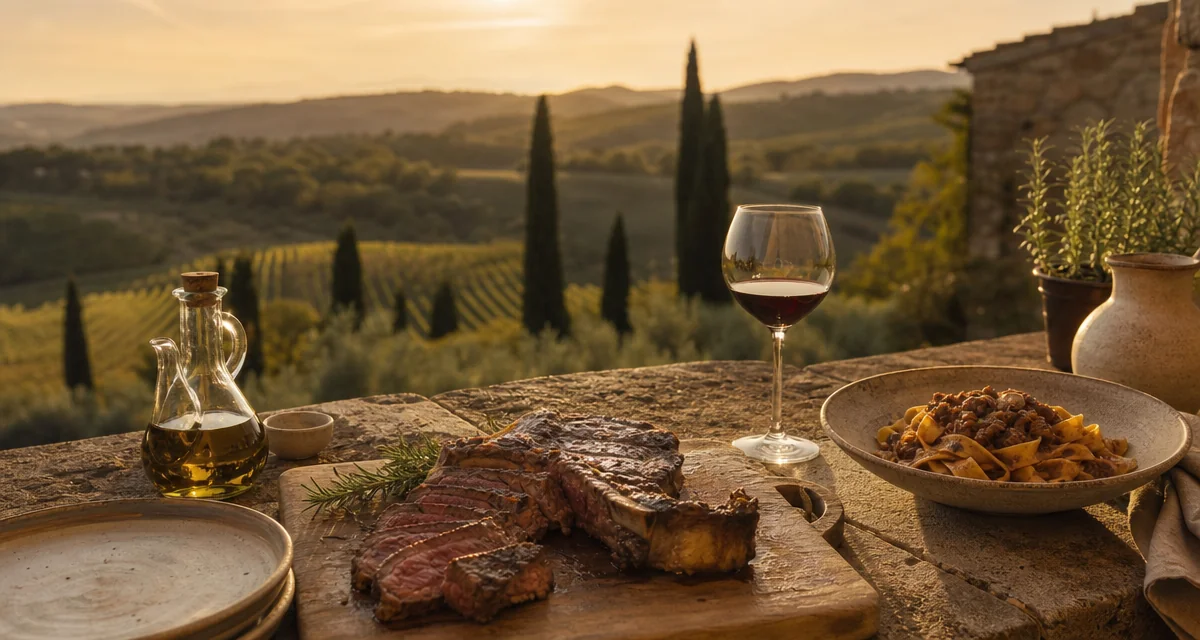
Who actually supplies the wine at a private chef dinner?
In Italy the guest supplies the wine on the large majority of private chef bookings. Your chef shops for every ingredient on the agreed menu, brings it to the property, cooks, serves and clears up, but alcohol sits outside that basket because selling it retail requires a licence a visiting chef does not hold inside your rented villa. That sounds like a limitation and works out as an advantage, because it hands you three clean routes instead of one. The first is the enoteca, the Italian wine shop that doubles as a tasting bar, where a hundred euros buys four bottles chosen by somebody who has tasted every one of them. The second is asking your chef to buy on your behalf during the morning market run and invoice the bottles at cost, an arrangement common on multi-day stays and always written into the quote rather than assumed. The third is the villa itself, since many rental properties in Chianti and the Val d'Orcia, the UNESCO-listed valley of cypress ridges and pale clay hills in southern Tuscany, keep a small cellar of the estate's own wine and sell it by the bottle at the door. None of these routes is exotic. They simply have to be decided before the day, because a chef arriving at 16:00 to prep a five-course dinner cannot also drive 20 minutes to a wine shop and back.
Do private chefs bring their own ingredients?
Yes, and it is worth stating plainly because it is the second thing every guest asks. A private chef booking in Italy is a full service rather than a hire of hands. The chef agrees the menu in advance, shops that morning at a local market or an alimentari (the neighbourhood grocer), arrives at your property two to four hours before service with produce, fish, meat, bread and cheese, and brings the pans, blades and small equipment a holiday kitchen almost never has. Every course is plated and served, and the kitchen is left as it was found. What is not in that basket is alcohol, plus the occasional very specific item you have chosen to source yourself, such as a cake from a particular pasticceria. Everything else belongs to the chef, which is exactly why wine catches people out: it is the single line that stays on your side of the table.
| Route | Who chooses the bottles | Typical price per bottle | Best when |
|---|---|---|---|
| You buy at a local enoteca | You, guided by the shop owner and the menu your chef sent ahead | €12–25 for Chianti Classico DOCG, €35–70 for Brunello di Montalcino DOCG | You have a car, a spare afternoon, and want the shopping to be part of the holiday |
| The chef buys on your behalf | The chef, matched course by course, invoiced at cost inside the quote | Same shelf prices, agreed as a per-bottle ceiling before the day | Multi-day stays, arrival-night dinners, groups who would rather not think about it |
| The villa or wine estate cellar | The property manager, or the estate that owns the surrounding vineyards | €15–40, very often the estate's own label | Agriturismo and wine-estate rentals in Chianti, Montalcino and the Val d'Orcia |
How does wine pairing work, course by course?
Pairing course by course means each wine is chosen for the dish beside it rather than for the meal as a whole, moving from light and sparkling through white and red to sweet at the end. A five-course Italian dinner needs three to four wines, not five, because two courses almost always share a bottle. A worked Tuscan menu makes it concrete, and Tuscany gives you plenty to work with: the region holds 41 DOC and 11 DOCG appellations across its ten provinces. The aperitivo wants bubbles with bite, and Franciacorta DOCG, the traditional-method sparkling wine made from Chardonnay and Pinot Nero in the hills east of Milan, brings more body and bread-crust depth than Prosecco. Antipasti of pecorino, salumi and marinated vegetables need a white with structure, which is where Vernaccia di San Gimignano DOCG earns its keep: a crisp, faintly almond-bitter white grown around the towered hill town of San Gimignano, and famously the first Italian wine awarded DOC status, back in 1966. The pasta course belongs to Chianti Classico DOCG, the Sangiovese-based red from the zone between Florence and Siena that must be at least 80 percent Sangiovese and tastes of sour cherry and dried herb. Then the main event. If it is bistecca alla fiorentina, the 1.2 kg T-bone cut from Chianina cattle and grilled rare over hardwood embers, you want Brunello di Montalcino DOCG from the hills around Montalcino: 100 percent Sangiovese, released 50 months after harvest, all leather, tobacco and black cherry. Dessert takes Vin Santo, the amber wine pressed from grapes dried on straw mats and aged in small barrels, poured beside cantucci almond biscuits.
Italian wine pairing with pasta, the course most people get wrong
The mistake is pairing the pasta shape instead of the sauce, and it is the most common wine error we see at villa tables. Pici, the fat hand-rolled Sienese spaghetti made from nothing but flour and water, tastes of very little on its own. What matters is what goes on it. Pici all'aglione, dressed with a slow-cooked sauce of the giant sweet garlic grown in the Val di Chiana, is low in fat and gently sweet, so a young Chianti Classico with bright acidity slots against it perfectly. The same pici under a wild boar ragù needs more weight and more tannin, and Vino Nobile di Montepulciano DOCG handles that easily: a minimum 70 percent Sangiovese red from the hilltop town of Montepulciano, aged two years with at least one in oak. A seafood pasta on the coast flips the rule and wants Vermentino, the saline, citrus-edged white grown along the Tuscan and Sardinian shoreline. Cacio e pepe and other pecorino-heavy plates are happier with a sharp white than with a big red, because the tannin fights the cheese. Ask your chef which sauce goes with which shape, then buy for the sauce.
Guests always ask me which wine goes with the menu. I ask them which wine they already love, and then I write the menu around it. That order is the whole secret. Chef Lorenzo, Florence-based ambassador for Chef On Demand in Tuscany
How many bottles of wine do you need per guest?
Plan 0.5 to 0.75 bottles per drinking adult for a seated dinner running three hours or more. A 750ml bottle pours six glasses of 125ml, or five generous restaurant measures, so a table of eight adults where six actually drink needs four to five bottles plus one 375ml bottle of dessert wine. The arithmetic then shifts with the shape of the evening. An aperitivo on the terrace adds roughly one sparkling bottle per six guests, because those first pours are the fastest of the night. A long multi-course dinner that runs from 20:00 to midnight pushes the top of the range, while a two-course lunch in the August heat rarely passes half a bottle a head. Children, drivers and non-drinkers come out of the count before you multiply, which is why we ask for the number of drinking adults rather than the number of guests. Then buy 10 to 15 percent more than the sum suggests. Unopened bottles go back to the villa cellar or reappear at tomorrow night's dinner, whereas running dry at 22:30 in the Val d'Orcia is not a solvable problem: the nearest shop closed at 19:30 and it is 25 minutes away by car.
- Count the drinking adults rather than the guests, because children, drivers and non-drinkers come out of the total before you multiply anything.
- Multiply by 0.6 bottles for a standard dinner, or by 0.75 if the evening opens with an aperitivo and runs past 23:00.
- Split the total across three or four wines in roughly a 1:2:3 ratio: one sparkling, two white, three red for a table of eight.
- Add one 375ml bottle of Vin Santo or another dessert wine for every eight guests, since dessert pours are 50ml rather than 125ml.
- Send your chef photographs of the labels at least 48 hours before service so the menu can be tuned to what is already in the house.
- Chill the whites and sparkling for a minimum of three hours, or sink them in a bucket of ice and water 20 minutes before the aperitivo.
What does the wine add to the cost of a chef dinner?
Nothing, in the sense that it never sits inside the menu price. A Chef On Demand quote covers shopping, cooking, service and cleanup for the menu you agreed, so the cleanest way to budget wine is as a second line beside the per-person food cost. Those food costs are published per person and move with the size of the table. In Italy an Essential menu of 4 courses works out at €95 per person for 6 guests and €85 per head at 10. A Taste of Italy menu, the 5-course regional showcase most international groups choose, is €120 per person at 6 guests and €100 at 10. A Luxury menu of 6 or more courses, the one that brings truffle, seafood and aged cuts to the table, sits at €180 per person for 6 guests and €150 at 10. Larger tables cost less per head, because the chef's travel and prep time is fixed however many plates leave the pass. Five well-chosen bottles at €20 for a table of eight adults adds €100 to the evening, about €12.50 a head, which on a €120 Taste of Italy menu is roughly 10 percent on top. Groups who want a vertical of Brunello will triple that without flinching, and the chef fee does not move by a cent. If you would rather compare menus before you compare labels, browse our Tuscan chef network and start from the food.
| Menu tier | Courses | Per person (6 guests / 10 guests) | Wine order that fits |
|---|---|---|---|
| Essential | 4 courses | €95 / €85 | One white and two reds from a single zone. Three to four bottles for eight adults. |
| Taste of Italy | 5 courses | €120 / €100 | Sparkling aperitivo, one white, one red, one 375ml Vin Santo. Four to five bottles. |
| Luxury | 6+ courses | €180 / €150 | A genuine flight: Franciacorta, a structured white, two reds of different weight, a dessert wine. Six to seven bottles. |
Corkage, glassware and the rules inside a rented villa
Rented villas in Italy almost never charge corkage, because corkage is a restaurant convention, a fee for opening a bottle you did not buy on the premises, and it has no place in a house you have paid to occupy. What villas impose are quieter rules: a locked owner's cellar, a counted stemware inventory, and a breakage clause in the rental agreement. Read that clause before the dinner rather than after it. Most Tuscan farmhouse rentals list glasses in the inventory, and a party of ten arriving to find six wine glasses in the cupboard is both a common problem and an avoidable one. Ask the property manager two questions at least 48 hours ahead: how many wine glasses are in the house, and whether there is a second fridge or a chest with room to chill four to six bottles. A villa fridge already holding three days of groceries will not swallow four bottles of Vernaccia, while a bucket of ice and water on the terrace brings a white to serving temperature in about 20 minutes. Temperature is the part guests skip and chefs notice immediately. Sparkling wants 6 to 8°C, whites 8 to 12°C, a young Chianti Classico 14 to 16°C and a Brunello 16 to 18°C. Room temperature in a Tuscan farmhouse in August is closer to 30°C, which flattens a fine red faster than anything else you can do to it, so the reds want 20 minutes in the fridge rather than none at all.
Does a private chef live with you on a multi-day stay?
Sometimes, and it changes what happens with the wine. A multi-day booking, where the chef cooks across a three to seven day holiday and you choose which meals each day, runs in one of three configurations. The chef may stay at the property when it has a spare room, which keeps the daily rate lowest and means the morning market run can quietly include your bottles. A local chef may commute daily instead, normal in dense zones such as Chianti, the Amalfi Coast and Lake Como where resident chefs live within 30 to 45 minutes of most villas. Or the chef books lodging nearby, in which case the surcharge is line-itemed openly in the quote. Multi-day quotes are always built to the group rather than sold at a flat per-person rate, so ask which configuration applies before assuming your chef will be available to make a wine run on day three.
Do you need a sommelier as well as a chef?
For most villa dinners, no. A trained Italian chef pairs a regional menu competently, and the wines that belong beside regional cooking are usually grown within 30 kilometres of the table. A dedicated sommelier earns their fee when the wine, rather than the food, is the point of the evening. The distinction is worth understanding before you spend on it. A sommelier certified through the Associazione Italiana Sommelier or the London-based Wine and Spirit Education Trust is trained in service, cellar management and blind tasting, and will arrive with a structured flight, decanters and something to say about every pour. That is a different product from a chef telling you 'open the Chianti now and the Brunello with the steak', and it is the right product for a milestone birthday or a vertical tasting of one estate across four vintages. Ask for it when you enquire rather than on the day, because sommeliers are booked separately and average lead time across our network runs 7 to 14 days in peak season between June and September. For everything else, brief your chef properly, buy four good bottles, and private chef wine pairing at home looks after itself. You can browse private chefs across Tuscany and describe the kind of evening you have in mind inside the same request, whether you are in Florence or an hour south of it.
Why this matters for your Italian holiday
You booked the villa for the view and the chef for the food, and the wine turns out to be the part that quietly decides whether the evening becomes a story you still tell at home. It costs less and takes less planning than people fear: an hour in an enoteca, a photograph sent to your chef, four bottles chilled properly, and a table that never runs dry. What you are really buying is the version of an Italian dinner that visitors almost never get. Not a restaurant with a 21:00 seating and a taxi booked for 23:15, but a long table on a terrace above the vines, a chef plating pici in your own kitchen, a bottle of Chianti Classico that came from a shop 6 kilometres away and cost €18, and nobody watching the clock. Chef On Demand holds a 4.7 out of 5 rating on Trustpilot from more than 800 guests served since 2025, and the reviews that mention wine hardly ever mention the label. They mention the evening. So plan the bottles a week ahead, in conversation with the person who is going to cook. Read our guide to a Chianti villa stay with a private chef if the Chianti hills are where you are heading, browse the wider Chef On Demand chef network across the country, or book a Tuscany private chef experience and tell us what you like to drink. Then let it get dark, let the candles burn down, and let somebody else worry about the dishes.