What is a cooking vacation in Italy in 2026?
A cooking vacation is a 5 to 10 day Italian holiday built around daily hands-on cooking, regional eating, market visits and one or two cultural day trips. It is distinct from a single-day cookery class taken inside a city break, and distinct from a foodie tour where you eat but do not cook. In 2026 the format splits into three product types you should price separately. Italy hosts 300+ cookery schools and culinary tour operators: Tuscany, Sicily, Amalfi Coast and Umbria capture roughly 70% of the supply; Piedmont and Emilia-Romagna serve the wine-and-cheese specialist niche. Per the Italian Trade Agency, food and wine motivates over 25% of inbound visits to Italy — the marketplace is mature, but crowded enough that the wrong format can cost €2,000+ for a week that doesn't match what you wanted.
The three real formats: group school vs all-inclusive package vs private chef at villa
Format 1, the group cookery school, is the original model: you arrive at a converted villa (Tuscookany at Casa Ombuto, Organic Tuscany, Cookin Umbria are the archetypes), sleep there with 8–14 strangers for 5–7 nights, and a resident chef teaches a fixed curriculum. Cost: €1,800–€3,000 per person. Format 2, the all-inclusive tour package assembled by operators like The International Kitchen, Italy Culinary Vacations or Culture Discovery, layers the cookery class onto a moving itinerary — wine estates, market visits, Michelin lunches, transport included. Cost: €3,000–€6,500 per person. Format 3, the private chef at your own villa, is the format Chef On Demand specialises in: you rent a villa independently (Tuscany, Amalfi, Sicily, Lake Como), and a chef joins your group for cooking lessons and dinners. Villa, schedule and menu are yours; the chef adapts to your dietary preferences. Pricing is custom because the variables — group size, days the chef is needed, lodging configuration — are yours to set.
How much does a cooking vacation in Italy cost in 2026?
A realistic 7-night cooking vacation in Italy in 2026 costs €1,800 to €6,500 per person. The cheapest credible option is a shared-room booking at a group cookery school in rural Tuscany or Umbria from €1,800 per person; the most expensive is a five-star Veneto villa retreat or Piedmont truffle-season package with Michelin-listed restaurants, easily reaching €6,500. Most travellers land in the €2,800–€4,500 mid-range, including 6 nights' accommodation, all meals and wine, 4–5 hands-on sessions, 2 winery visits, market shopping, transfers and one cultural excursion. Flights are almost always excluded. Children typically pay 50% under 12, but several adults-only schools exist. The villa-with-private-chef option is harder to quote per-person because the villa rent is shared: a Chianti farmhouse for 8 guests at €4,500/week works out at €560 per person for lodging, and the chef quote is built on top — bringing the total to €2,200–€3,800 per person depending on how many days the chef cooks. Browse our Tuscan chef network for indicative quotes.
The best cooking vacations are not the ones with the most cooking — they are the ones where the cooking fits the rest of the holiday. Two long lunches at a market and three home dinners with the chef beats five lessons in a row, every time. Chef Lorenzo, Florence-based ambassador of Chef On Demand Tuscany
Which Italian region for your cooking vacation: Tuscany, Sicily, Amalfi, Piedmont or Emilia-Romagna?
Choose the region by the cuisine you most want to learn, then by the landscape. Tuscany dominates cooking-school supply (Chianti, Val d'Orcia, Casentino) and is the safe first-trip choice for fresh pasta (pici, pappardelle), ribollita, bistecca alla fiorentina and Sangiovese reds (Chianti Classico DOCG, Brunello di Montalcino DOCG). Sicily is the most distinct — a layered cuisine carrying Greek, Arab, Norman and Spanish influences, taught around Sampieri, Modica or Palermo — arancini, caponata, pasta alla Norma, pistachio, Marsala and Nero d'Avola. Amalfi Coast is the seafood-and-citrus option, taught in Positano, Sorrento or the lemon terraces above Amalfi — handmade scialatielli ai frutti di mare, delizia al limone, sharp olive oil. Piedmont serves wine-and-truffle specialists from Alba, Barolo and Barbaresco — tajarin with white truffle in October–November, vitello tonnato, Barolo DOCG flights. Emilia-Romagna, the food valley across Bologna, Modena and Parma, is the technique destination — fresh egg pasta (tortellini, tagliatelle al ragù), Parmigiano Reggiano DOP, Aceto Balsamico Tradizionale di Modena DOP, Prosciutto di Parma DOP. Sicily network, Amalfi Coast network, Piedmont network.
- First-time visitors: Tuscany (Chianti or Val d'Orcia base), May–June or September.
- Exotic cuisine that feels like another country: Sicily (Modica, Sampieri or Palermo base), April–June or September–October.
- Coastal scenery and seafood: Amalfi Coast (Positano, Sorrento or the hills above Amalfi), May–June or September.
- Serious wine and truffles, quieter pace: Piedmont (Alba or Barolo base), late September to mid-November.
- Pasta technique and aged cheese / cured meat deep dive: Emilia-Romagna (Bologna or Parma base), April–June or October.
| Group cookery school | All-inclusive tour package | Private chef at your villa | |
|---|---|---|---|
| Price per person | €1,800–€3,000 | €3,000–€6,500 | €2,200–€3,800 (chef + villa share) |
| Group size | 8–16 strangers | 8–14 strangers | Just your party (4–12) |
| Daily schedule | Fixed curriculum | Fixed itinerary, multi-base | Fully customised |
| Cuisine | Chef's set syllabus | Operator's regional showcase | Anything you ask |
| Same setting all week | Yes | No, 2–3 hotel changes | Yes (your villa) |
| Restaurant evenings | Rare | 1–2 nights | Every night you want |
| Children welcome | Often adults-only | Family programmes exist | Always — adapts to all ages |
| Best for | Solo, food-focused couples | Couples wanting curated discovery | Groups of 4–12 |
When is the best time to book a cooking vacation in Italy?
The two best windows for a cooking vacation in Italy are late April through June and September through mid-October. Spring brings asparagus, artichokes and 22–28°C daytime temperatures. Autumn is harvest season: the vendemmia (grape harvest) happens in September across most regions, white truffles arrive in Piedmont from late September through November, the olive harvest runs October–November in Tuscany and Umbria, and many regional sagre (village food festivals) take place. July and August are hot (32–36°C inland), crowded, the most booked-up window — secure your dates 4 to 6 months ahead. November through March is quiet: many group schools close, but private-chef bookings remain available and pricing softens 15–25%. Lead time across our network is 7–14 days for off-peak, 3–6 weeks for June–September; for cooking-vacation-length stays book 4 to 8 months ahead.
How do I book a cooking vacation in Italy step by step?
First, decide the format using the comparison table and the three-question test above. Second, lock the region by cuisine preference plus travel window. Third, if you chose the villa + private chef route, book the villa independently — Tuscany Now & More, The Thinking Traveller, Long Travel and Airbnb Luxe are reliable sources, ideally for 6 to 10 guests so the per-person cost works. Fourth, book the chef: with Chef On Demand, you submit your villa address, dates, party size and dietary preferences; we return personalised proposals within 24 hours; you compare menus and chef bios, lock the booking with a deposit, and the chef coordinates the rest. Many of our chefs come from Michelin-starred kitchens, Gambero Rosso–rated restaurants, MasterChef and Top Chef Italia; the network holds a 4.7/5 Trustpilot rating from 800+ guests served since 2025.
What does a private chef stay across a multi-day cooking vacation actually look like?
The Chef On Demand multi-day service is built bottom-up from your week. For each day, you pick which meals the chef cooks — breakfast, lunch, dinner, or a combination. A common pattern across a 7-night Tuscan or Amalfi stay: 3 dinners at the villa, 1 long Sunday lunch, 1 hands-on pasta-making session, evenings otherwise open for local restaurants. The chef shops daily at the local market — a mercato comunale in Florence, the harbour in Cefalù, the truffle market in Alba — brings the produce to your villa, cooks on-site and cleans up. Three lodging configurations affect cost: (1) chef stays at the property if the villa has chef quarters — lowest day rate; (2) local chef commuting daily from 30–45 minutes away — common in Chianti, Amalfi Coast, Lake Como; (3) chef takes lodging nearby if neither applies — quote line-items the surcharge transparently. Quotes are custom — tell us your villa and dates.
Pasta-making, market days and what cooking sessions actually include
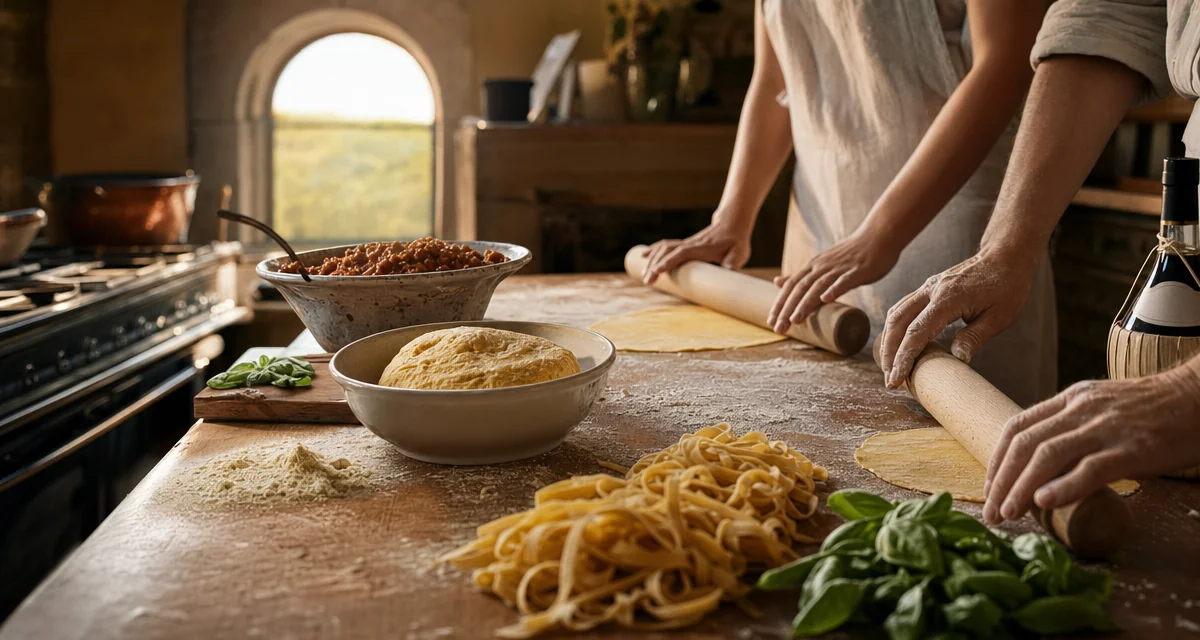
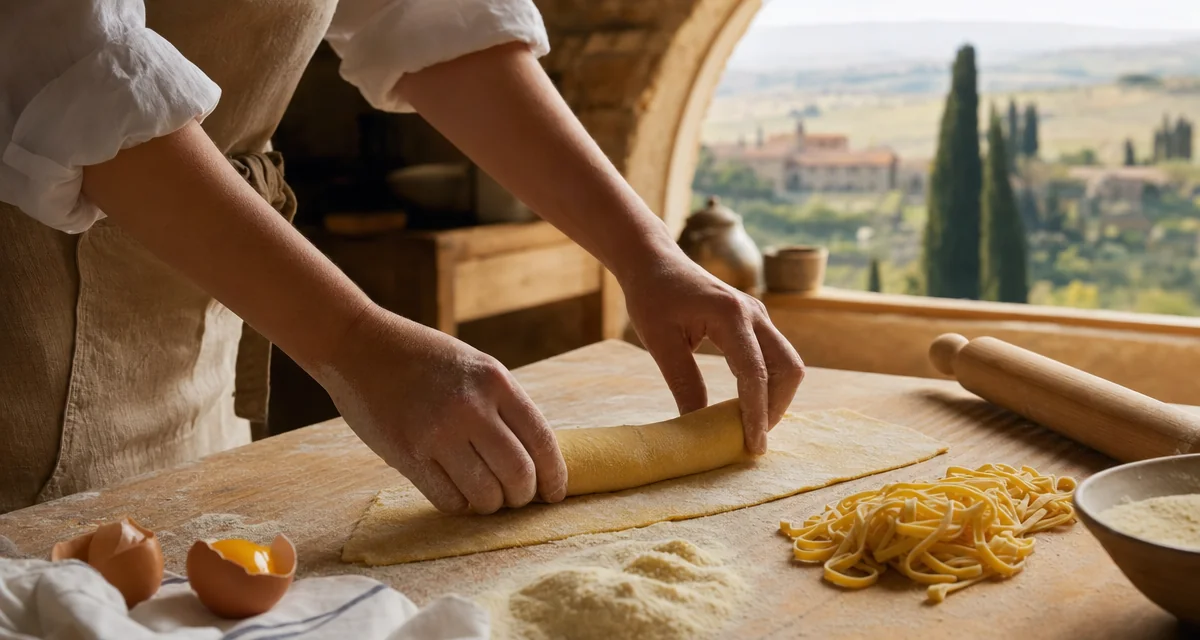
If you want one cooking experience inside a longer stay, our flagship for international guests is the Pasta Class + Dinner Experience — a 4 to 5 hour booking bundling a hands-on lesson with a full seated dinner, all at your villa. Structure: a 2-hour class (typically 2 p.m. to 4 p.m.) where the chef teaches two fresh-pasta shapes — one long (tagliatelle, pappardelle or pici) and one short (orecchiette, farfalle or maltagliati); while the dough rests, the chef prepares two pasta sauces (a meat ragù for the long, a vegetable or seafood sauce for the short), regional antipasti and homemade tiramisù. Everyone then sits down at your table for the menu the group helped make. Indicative pricing: around €150 per adult, €60 per child. The class is delivered exclusively at your villa — the chef brings all ingredients and equipment, privacy is total, the menu is tailored to your group, no transfer between lesson and seated dinner. The deliverable is the experience itself: technique coached under the chef's hands, muscle memory of two pasta shapes and the sauces that pair with them. We do not provide printed or digital recipes, recipe cards, PDFs or follow-up emails — what you take home is the technique, not an artefact. See the cooking-class hub for Italy for regional options.
Why this matters for your Italian holiday
A cooking vacation in Italy is one of the few holidays where the souvenir is a skill, the setting is a vendemmia-flecked countryside or a sea-view terrace, and the dinners across the week become chapters of the trip people talk about for years. The decision is whether to fit your trip into a tour operator's fixed itinerary, share your kitchen with strangers in a group school, or keep the villa, schedule and menu entirely yours and bring the chef to you. For groups of four or more, the third path is almost always the better one — per-person cost lands in the same range, the cuisine is what your party actually wants, dietary needs are taken seriously from day one. Chef On Demand operates a verified network of chefs across every region named here, with on-the-ground support in Italian, English, French and German. Browse our Italy private-chef hub to start by region. May–June and September–October are calling.