What does a Tuscany villa with chef stay actually include?
A Tuscany villa stay with a private chef pairs a rented country property with a chef who comes to the villa for some — not all — of your evenings, plus optional add-ons like a market visit and a cooking class. The standard 2026 booking through Chef On Demand covers the chef's travel within Tuscany, ingredients shopped that morning at a local market, on-site cooking in your villa kitchen, plated service for each course, and a full clean-up before they leave. A typical evening runs 5 to 6 hours of chef presence: arrival around 5:00 pm, dinner served at 8:00 pm, departure by 11:30 pm. The villa provides the kitchen equipment, plates, glassware and table — chefs bring knives and any specialist tools (pasta crank, immersion circulator, smoking gun for a Luxury tier menu). What is not included by default: wine and aperitivo bottles, table linen, table flowers, waiters beyond the chef themselves for groups under 10. For groups of 10+ we typically add a sous-chef or a server at €40–€60/hour, billed transparently in the quote.
What does a typical day-by-day rhythm look like across a 5-day stay?
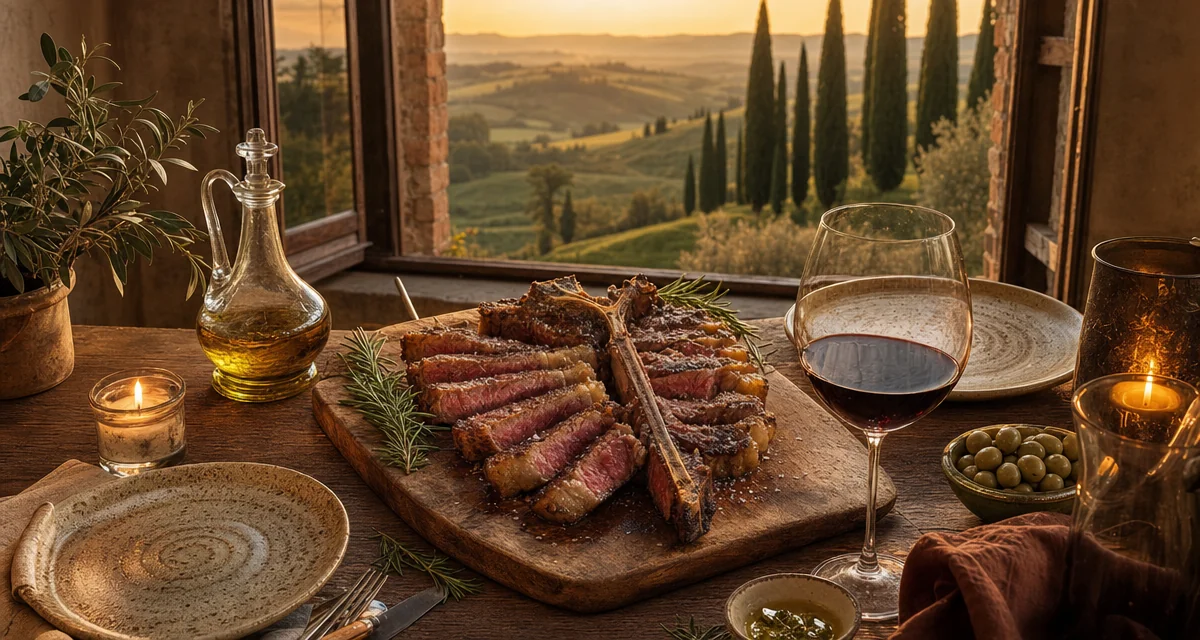
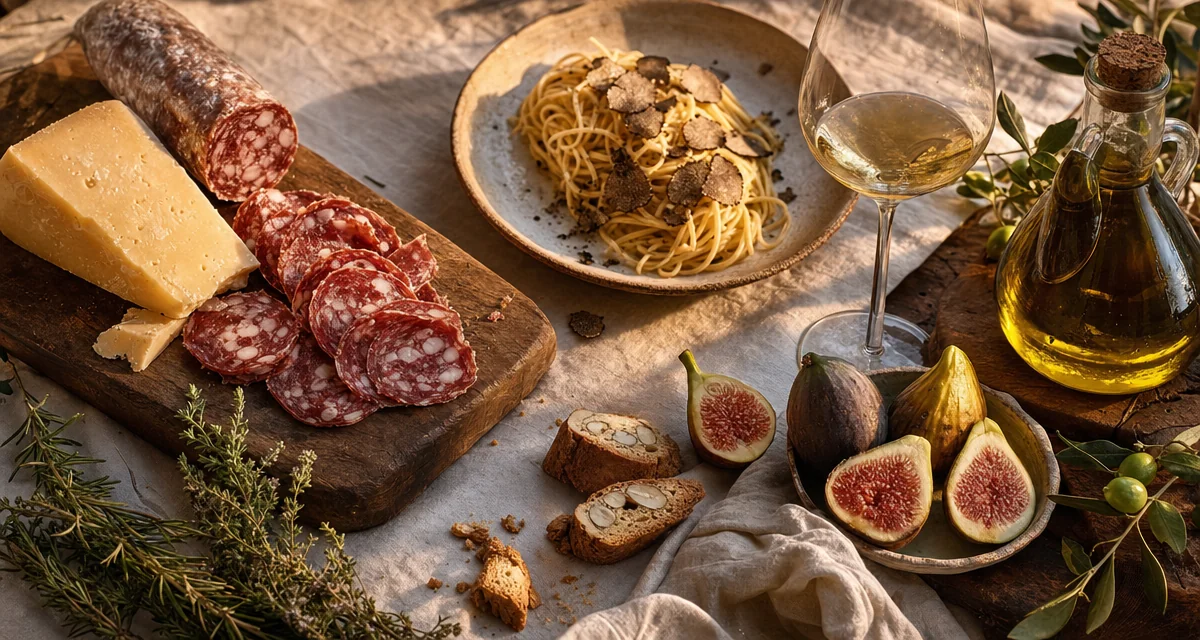
Most groups book 2 to 3 chef dinners across a 5–7 night stay rather than one every evening — both because villa weeks need breathing room and because eating out at a Chianti Classico trattoria is part of the point. A common shape: Day 1 welcome dinner, the chef arrives mid-afternoon, you arrive jet-lagged, and dinner is a 5-course Taste of Italy menu that lets the table relax (think crostini neri — chicken-liver pâté on grilled bread, a Tuscan staple — followed by pici cacio e pepe, then bistecca alla fiorentina, a thick T-bone steak from Chianina cattle grilled rare over hardwood embers, the icon of Tuscan cooking). Day 3 cooking class at 11:00 am, ending in a shared lunch on the terrace. Day 5 farewell dinner, often the more ambitious Luxury menu with white truffle from San Miniato (the Tuscan town famous for tartufo bianco from October to December), aged pecorino di Pienza DOP, and a Brunello di Montalcino pairing — Brunello is a 100% Sangiovese aged at least five years, regarded alongside Barolo as one of Italy's three benchmark reds. Days 2 and 4 the group eats out — a wine-tasting lunch at a Chianti Classico estate, or a long table at a Greve in Chianti enoteca (an Italian wine bar and shop where you taste by the glass and buy by the bottle). Browse our Tuscan chef network by city to see who lists evening service in your sub-area.
The mistake first-time guests make is booking the chef every night. By day four they're saturated. Two dinners and one cooking class is the rhythm that actually leaves room for Tuscany itself. Chef Lorenzo, Florence-based ambassador of Chef On Demand Tuscany
How does the cooking class fit into a villa stay?
The villa cooking class is a 2.5-to-3 hour hands-on session, usually mid-morning so the meal you cook becomes lunch. The chef arrives at 10:30 am with a cooler of pre-prepped ingredients and a clear plan: typically two dishes, almost always fresh pasta (pici, ravioli or pappardelle) plus a Tuscan main like peposo dell'Impruneta — a slow-cooked beef-and-black-pepper stew named after the Renaissance kiln-makers who reportedly cooked it inside their tile ovens. Children from age 6 can join the pasta-making part safely; knife work and hot pans the chef handles. Class price in 2026 is typically €150 per adult and €60 per child for up to 8 participants, billed separately from a dinner service. After 800+ bookings, the cooking class is the single experience guests remember a year later, more than the most ambitious tasting menu. Browse our private chefs across Tuscany by city to see who lists cooking classes, and request a quote that bundles class + dinner if you want both.
- Confirm villa kitchen equipment with the rental agency: working oven, hob with 4+ burners, fridge volume, pasta colander, 6+ matched dinner plates per guest.
- Decide on 2–3 chef dinners across your stay (welcome + farewell + one mid-week), not one every evening — the rhythm matters more than the count.
- Pick one tier and stick to it for the week — mixing Essential and Luxury across two dinners dilutes the chef's signature.
- Add the cooking class on day 3 or day 4 — guests are over the jet lag but not yet packing, and the terrace lunch becomes the social anchor of the week.
- Order wine separately from a local enoteca or directly from a Chianti Classico estate — the chef recommends pairings but won't typically buy and mark up bottles for you.
- Brief the chef on allergies and strong dislikes 72 hours ahead — Tuscan cuisine leans heavily on pork (lardo di Colonnata, finocchiona) and wild-boar ragù, all of which need flagging early.
- Confirm whether you want plated-at-the-table or buffet-from-the-kitchen service — a Luxury 6-course menu plates better at the table, an Essential 4-course works either way.
- Pay a 30–50% deposit at booking and the balance 7 days before service — the standard split across our network.
| Tier | Course count | Per-person price (6 guests) | Per-person price (10 guests) | What you get |
|---|---|---|---|---|
| Essential | 4 courses | €95 | €85 | Classic Tuscan set menu — crostini, fresh pasta, secondo, dolce. Ingredients sourced same day from a local market. |
| Taste of Italy | 5 courses | €120 | €100 | Curated regional showcase — antipasto board, two pasta tastings, a signature secondo (often bistecca), cantucci with Vin Santo. The brand's signature mid-tier. |
| Luxury | 6+ courses | €180 | €150 | Premium menu with white truffle (in season), Chianina beef tartare, multi-course wine pairing flight option, often a sous-chef included for groups of 10+. |
Where in Tuscany does the villa-with-chef format work best?
The villa-with-chef format is densest in three sub-areas, each with a different character. Chianti Classico — the wine zone between Florence and Siena, marked on every bottle by the black rooster (Gallo Nero) seal — is the most popular: villas around Greve in Chianti, Castellina in Chianti, Radda in Chianti and Gaiole in Chianti sit inside the production zone, so wine pairings are walking-distance authentic. Val d'Orcia, the UNESCO-listed valley south of Siena (the cypress-lined hillside on every Tuscan postcard), pulls a quieter clientele — villas near Montalcino, Montepulciano and Pienza add Brunello di Montalcino DOCG, Vino Nobile di Montepulciano DOCG and pecorino di Pienza DOP within a 30 km radius. Versilia and Lucca-Lucchesia on the coast — including Forte dei Marmi and Lucca — flip the menu toward seafood and Vermentino. For background on the region's signature dishes, see our guide to Tuscan food experiences; for the broader picture, our private chef Tuscany overview covers the basics. Many of our Tuscan chefs come from Michelin-starred kitchens, Gambero Rosso–rated restaurants, MasterChef and Top Chef Italia.
How do you book a private chef once your villa is confirmed?
The booking sequence we see work for 80% of villa weeks since 2025: lock the villa first, then the chef, in that order. With the villa confirmed you have an exact GPS pin, kitchen photos and arrival/departure times, all of which the chef needs to quote accurately. Submit your details through our booking form with the villa address, group size (adults plus children), the dates of the dinners and the cooking class, any allergies or strong dislikes, and the tier you're aiming for (Essential, Taste of Italy or Luxury). A concierge from our team replies within 24 hours with 1–3 chef profiles matched to your sub-area, each with sample menus and a quote. After 800+ bookings the friction point is rarely price — it's calendar overlap during peak season (June, July and the first two weeks of September), so the earlier you submit, the wider the chef shortlist. Currently 4.7/5 on Trustpilot based on 800+ guests served since 2025. If you're still picking a villa, our companion guide to Tuscany villa rentals with chef covers what to ask the rental agency before you sign — and you can always book a Tuscany private chef experience separately once the villa is locked.
Why this matters for your Tuscan holiday
A villa week in Tuscany is, in the end, a question about what you want the evenings to feel like. Restaurants in Chianti close at 9:30 pm, the drives home are dark and twisting, the kids melt down by the second course. A private chef changes the geometry — dinner becomes the centre of gravity of the day, not a logistical sortie. The cooking class on day three becomes the moment somebody in your group will still be talking about at Christmas. The market visit on day five — pecorino at the Pienza fromagerie, a bottle of Brunello chosen by hand at a Montalcino enoteca — becomes a small adventure rather than a chore. That is what the price covers: not just food on a plate, but a different shape to the week. Browse our full private chef network across Italy for your dates, or request a quote and let our concierge build the rhythm for you. The cypresses will still be there. The Brunello will still be there. What changes is whether the dinner is something you organised, or something you experienced.