What does a cooking class in Venice actually involve?
A typical Venice cooking class is a 2-to-3-hour hands-on session where a host teaches you one or two regional dishes, you cook alongside them, and you sit down to eat the result with local wine. The format matters more than the marketing photos, so it helps to know the four shapes it usually takes. The most common is the fresh-pasta class: you mix and roll dough, learn a long shape and sometimes a short one, then taste it with a sauce and finish with tiramisu (the layered coffee-and-mascarpone dessert that, fittingly, was popularised in nearby Treviso in the Veneto region). The second is the cicchetti class, built around Venice's small bar snacks. Cicchetti are bite-sized plates, things like baccala mantecato (whipped salt cod), polpette and crostini, eaten standing up in a bacaro (a traditional Venetian wine bar) with a glass of wine. The third is the market-tour-plus-cooking format, which begins at the Rialto Market, the centuries-old fish and produce market beside the Grand Canal, where the host walks you through the morning's catch before you cook it. The fourth is the private lesson, reserved for your group alone, with a menu set in advance. Whichever you choose, expect to be on your feet, hands in the dough, for most of the session, and to leave full rather than just informed.
How much does a cooking class in Venice cost in 2026?
In 2026, a group cooking class in Venice costs roughly €60 to €120 per person, while private classes and market-tour formats run €150 to €190 per head. The spread is wide because three things move the number: group size, whether a Rialto Market tour is bundled in, and whether the class is shared or exclusively yours. A shared 2-hour pasta-and-tiramisu class sits at the bottom of the range, around €60 to €90. Add a guided market tour and a host who buys the ingredients in front of you, and you are looking at €130 to €190, because you are paying for an extra hour and a curated shop. Cicchetti experiences that start with a bacaro crawl and finish with an aperitivo of Venetian small plates tend to land between €90 and €150. The most expensive listings are not always the best value: a €189 private session can be worth it for a group of four (that is under €50 a head), while a €69 group class can feel thin if 14 people are sharing one host. Always divide the price by your headcount and by the hands-on hours before you compare. Children's rates, where offered, usually run about half the adult price.
Tourists ask me for 'an Italian cooking class', but in Venice that phrase means nothing. We cook with the lagoon: sarde in saor, risotto with the day's fish, cicchetti you would never find in Rome. The dish should taste of this city, or what is the point of learning it here. Chef Alvise, Venice-based ambassador of Chef On Demand Veneto
Is a Venice cooking class with a market tour worth it?
A Venice cooking class with a Rialto Market tour is worth the €40 to €80 premium if you care about provenance and want to understand Venetian ingredients, but it adds 45 to 60 minutes and works best for groups who enjoy walking and shopping before they cook. The Rialto Market has supplied Venice with fish and produce for roughly a thousand years, and a good host turns the visit into a lesson in itself: how to spot a fresh moeche (the prized soft-shell crab of the lagoon), why sarde in saor (sardines marinated with onions, raisins and pine nuts) was a sailor's preservation trick, which radicchio comes from nearby Treviso. You then carry your ingredients back to the kitchen and cook them. The trade-off is time and pace. If you have small children, mobility limits, or only a half-day, the tour eats into your hands-on cooking. For curious food lovers with a spare morning, it is the most memorable version of the day. One honest caveat: the market is busiest and best before 9am, so the early start is part of the deal. If you would rather skip the crowds entirely, a private chef can shop the market for you and bring the ingredients straight to your rented apartment, which is exactly how our Venice network handles a private chef experience in Venice.
- Confirm the group size cap: 6 to 8 keeps the class hands-on; 12-plus means you will watch more than cook.
- Check what is included: ingredients, an apron, wine, and the sit-down meal should all be covered, with no surprise drinks bill.
- Ask which dishes you will make by name, and look for Venetian specifics (cicchetti, risotto, sarde in saor) rather than a generic 'pasta and sauce'.
- Clarify the start time and whether a market tour adds an early morning to your schedule.
- For groups over six or anyone with serious allergies, request a private format so the menu and pace bend to you, not the cohort.
- Note the cancellation window: most reputable classes allow changes up to 24 hours before.
Group class, private class, or a private chef at your apartment?
There are three real options once you decide you want to cook in Venice, and they suit very different travelers. A shared group class is the cheapest and the most social: you meet other visitors, the host runs a fixed menu, and you pay per head. A private class at the host's kitchen or studio gives you the venue to yourselves and a menu you can tweak, but you still travel to them, often across a maze of bridges with a tired group in tow. The third option is the one most people overlook: a private chef who brings the entire experience to the apartment you have rented. With Chef On Demand's signature Pasta Class + Dinner, delivered by our Venice chef network, the chef arrives at your door with all the ingredients and equipment, runs a 2-hour pasta-making class teaching one long shape and one short shape, then cooks a full seated dinner of antipasti, both pastas with their own sauces, and homemade tiramisu, all on your own table. There is no transfer, no shared cohort, no rigid finishing time. For a family or a group of friends staying near San Marco, out on the Giudecca, or even on the glassblowers' island of Murano, that means you experience the apartment you are already paying for, the children can drift in and out, and the wine is whatever you bought at the local enoteca. The table below lays the three side by side.
| Feature | Shared group class | Private class (host's venue) | Private chef at your apartment |
|---|---|---|---|
| Typical 2026 price | €60 to €120 per person | €150 to €190 per person | Around €150 per adult, your whole group |
| Who is in the room | You plus 6 to 14 strangers | Your group only | Your group only, at home |
| Where it happens | Host's kitchen or studio | Host's kitchen or studio | Your rented apartment or villa |
| Transfer needed | Yes, you travel to them | Yes, you travel to them | No, the chef comes to you |
| Menu flexibility | Fixed for the cohort | Adjustable in advance | Fully tailored to your party |
| Best for | Solo travelers, couples on a budget | Couples wanting privacy on a set day | Families and groups of 4 to 12 |
What's included in a private chef Pasta Class + Dinner in Venice?
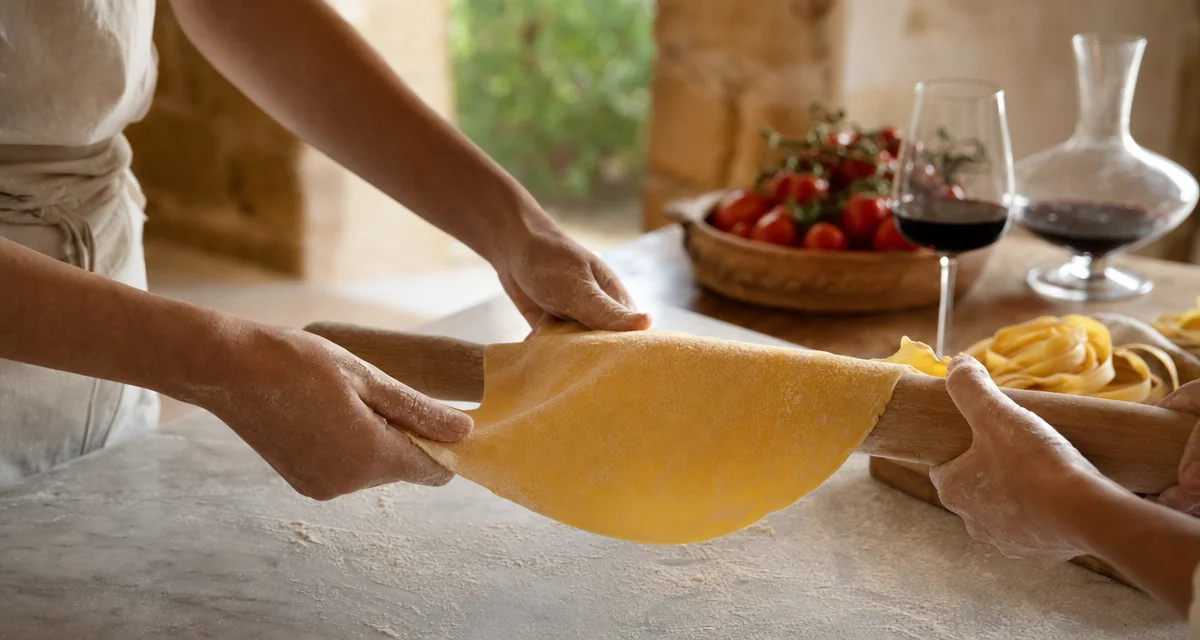
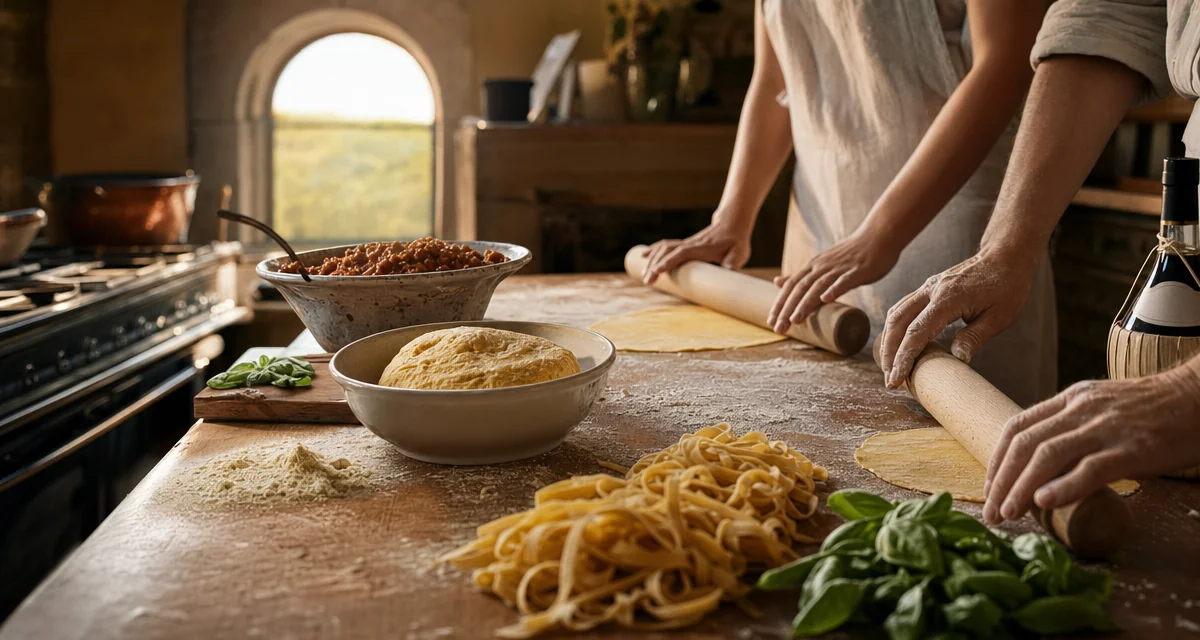
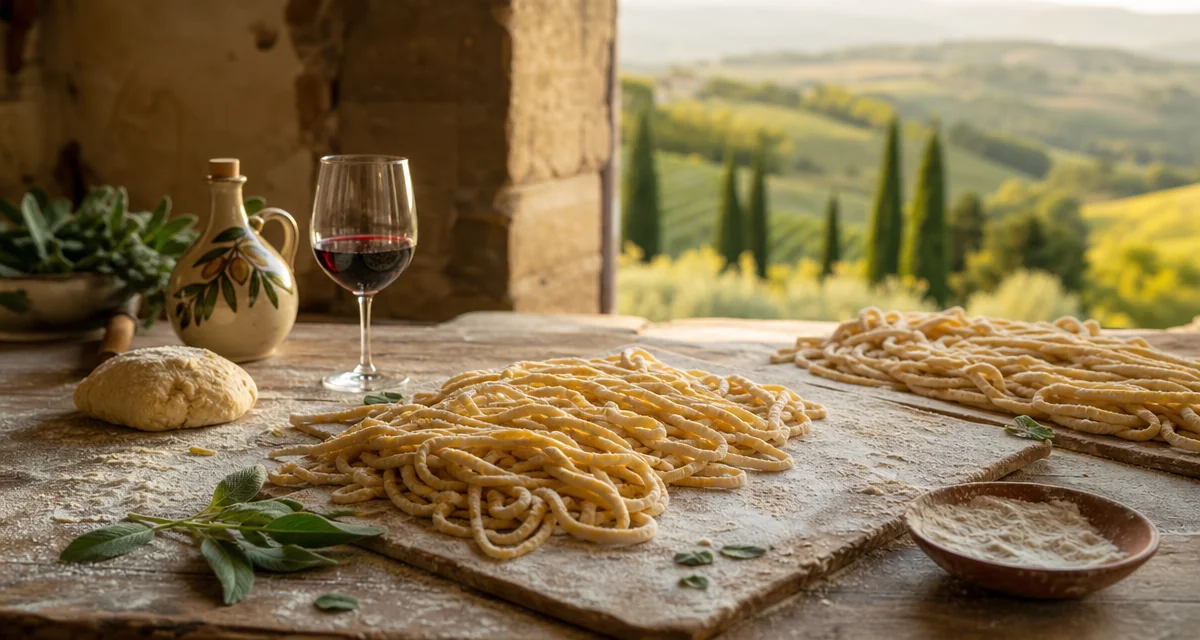
A Chef On Demand Pasta Class + Dinner in Venice is one booking with one chef at your apartment: a 2-hour pasta class teaching two fresh shapes, followed by a seated dinner the chef cooks from what you made. It typically runs 4 to 5 hours start to finish. The class teaches one long pasta (think tagliatelle or bigoli, the thick whole-wheat Venetian noodle traditionally pressed through a torchio) and one short shape, so you knead, roll and cut under the chef's hands. While the dough rests on your counter, the chef prepares two sauces (one for each pasta), a selection of two or three Venetian antipasti, and a homemade tiramisu for dessert. Then everyone sits down at your own table for the full menu, with wine pairings if you want them, and the chef handles the clean-up before leaving. The price is around €150 per adult and €60 per child, billed as one experience for the group rather than a separate class fee plus a restaurant bill. What you take home is not a stack of paper but the muscle memory of shaping pasta with your hands, the timing of a risotto, the sequence of a proper Venetian dinner, plus whatever photos you snap yourselves. It is the only format where the cooking lesson and the dinner happen in the same room, on the same evening, for your party alone.
When is the best time to book a cooking class in Venice?
The best time to book a Venice cooking class is 2 to 4 weeks ahead for the quiet seasons and 4 to 6 weeks ahead for peak months, because the good hosts and chefs fill up fast. If you would rather skip the listing roulette altogether, you can book a private chef experience in Venice and have proposals sent to you instead. Venice has two clear high seasons: late spring through early autumn (roughly April to October) and the Carnival weeks in February, when the city is at its busiest and the best slots vanish first. If you are visiting then, lock in your date early. Across our network the average booking lead time is 7 to 14 days for peak season, but cooking experiences specifically tend to need a little more runway because they hinge on one chef's calendar rather than a large team. Spring and early autumn also bring the most interesting ingredients to the Rialto Market (much of the lagoon's fish comes in from the working fishing town of Chioggia at the southern end of the lagoon), from soft-shell crabs in spring to game and radicchio in autumn, so the seasonal classes are genuinely better, not just less crowded. If your dates are fixed and central, treat the booking like a restaurant reservation in a popular city and sort it before you arrive rather than hoping to walk in. Last-minute bookings are possible in the deep off-season (November to January, outside the holidays), when both prices and availability ease.
Why this matters for your trip to Venice
Venice is a city you can spend a fortune visiting and still feel you only saw the surface, queueing for the same views as everyone else. A cooking experience is one of the few things that flips that. For a few hours you are not a tourist watching Venice happen; you are at a counter with your hands in the flour, learning why this lagoon city cooks the way it does, and then sitting down to eat the proof. Choose well and it becomes the afternoon your group still talks about long after the gondola photos blur together. The honest summary is this: a shared group class is a warm, affordable taste; a private class buys you the room; and a private chef Pasta Class + Dinner buys you the room, your own apartment as the setting, and a proper seated meal with no transfer and no strangers. If you are leaning toward the last, our verified Venice chefs cook this format week in and week out, and you can see how it works across the rest of the country through our wider network of private chefs in Italy. Whatever you book, ask the right questions about group size and what is included, name the Venetian dishes you actually want to make, and you will come home knowing how to fold a tagliatella and why sarde in saor tastes of the sea and the sweet onions of the lagoon. That, more than any souvenir, is what stays with you.