What is a cooking class in Italy for tourists, exactly?
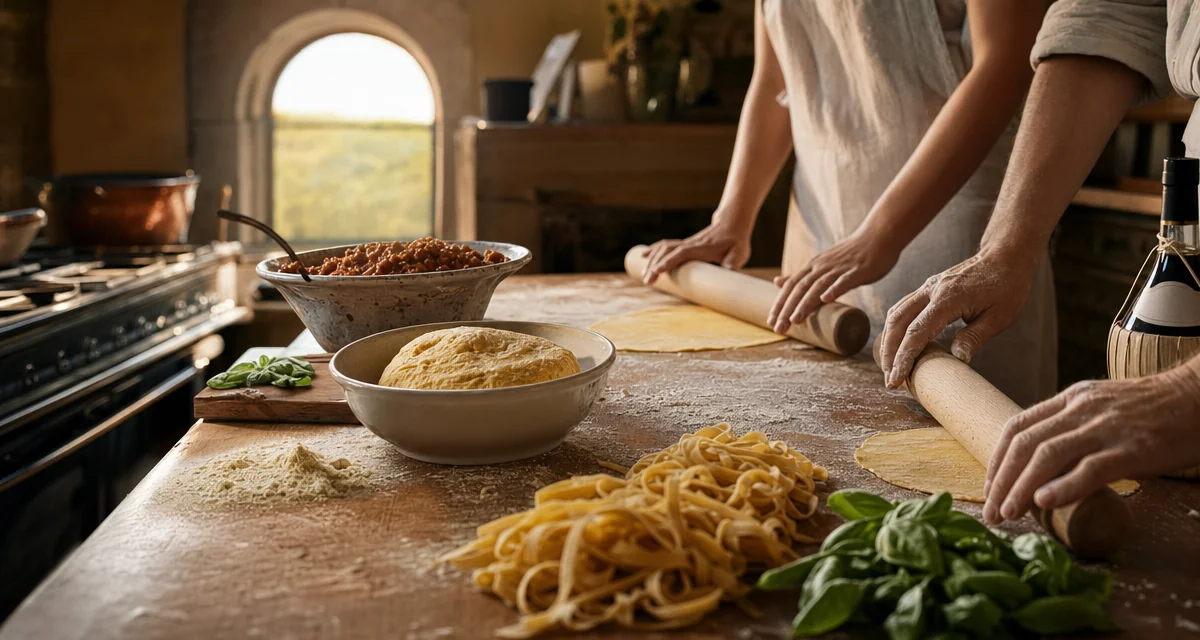
A cooking class for tourists is a 2–5 hour hands-on session, taught in English, where a local chef walks you through 2–4 regional dishes you then sit down and eat. The format is interactive: you knead dough, shape pasta, taste reductions, plate your own course. Most classes close with the meal you produced, paired with a regional wine such as Chianti Classico DOCG (a Sangiovese-based red from central Tuscany, aged at least 12 months — the everyday red of the region) or Falanghina (a crisp, dry white from Campania, the natural pairing for pizza and seafood menus). Group sizes range from 2 to 25 depending on format. Children are often welcomed from age 8 upward. Aprons, ingredients, equipment and cleanup are always included; recipe handouts are not. The defining variable is not the city — it's whether the class happens in a school kitchen with strangers or in the property you're staying in, just for your group.
How much does a cooking class in Italy cost in 2026?
In 2026, expect $40 to $150 per person for a group studio class (2–3 hours, 8–12 participants, city centre — Florence, Rome, Naples), €110–€135 per person for a small-group farm-to-table half-day in Tuscany or Umbria including a market visit, and €150 per adult / €60 per child for a private Pasta Class + Dinner Experience at your villa, the flagship format Chef On Demand offers across Italy. Multi-day cooking holidays at dedicated schools (Tuscookany, Anna Tasca Lanza in Sicily, Mama Isa near Venice) run €1,500 to €4,500 per person for 5–7 nights including accommodation, meals, transfers and wine. Three drivers explain the spread: (1) location — central Rome and Florence command a 20–30% premium over Bologna or Lecce; (2) group size — a 4-guest private experience costs roughly twice per head what a 10-guest one does; (3) inclusions — market tour, wine pairing, instructor-to-guest ratio. For a private villa class for 6 adults, your 2026 total sits around €900 all-inclusive, with the chef arriving at your rental with ingredients, equipment and a 4-hour programme.
Group studio, private villa, farm-to-table or cooking holiday: which class type?
Match the format to your travel party and trip length. A solo traveller or couple staying 4 nights in a city hotel will likely get the best value from a group studio class — you meet other travellers, logistics are zero, the price is contained. A family of 4–6 renting a villa in Tuscany or on the Amalfi Coast for a week is the natural audience for a private villa class: no transfers, kids can join the kneading then nap, grandparents who don't want to cook still sit at the same table. A serious food enthusiast travelling specifically to learn — and willing to anchor the whole trip around it — wants the 5-day cooking-holiday format at a dedicated school (Tuscookany in Chianti, the Veneto Cooking School with Giuliano Hazan). Farm-to-table half-days suit travellers staying in an agriturismo — a working farm that also rents rooms and serves meals from its own produce; Italian law requires a minimum share of revenue to come from farming, so the kitchen is genuinely the kitchen of the property.
Tourists ask me 'what's the difference between a class in town and one at my villa'. I tell them: in town you learn pasta. At your villa, you learn your pasta — the menu the chef cooks is the one your party would order at a restaurant, except now you cooked it. Chef Lorenzo, Florence-based ambassador of Chef On Demand Tuscany
Which Italian regions deliver the most authentic cooking class for a first-time traveller?
Three regions consistently deliver the highest authenticity-to-accessibility ratio for international travellers: Tuscany for fresh-pasta technique (pici, pappardelle, ravioli) paired with Chianti Classico DOCG or Brunello di Montalcino DOCG (a 100% Sangiovese red from the hills of Montalcino in southern Tuscany; aged at least 5 years before release, one of Italy's three benchmark reds alongside Barolo); Emilia-Romagna for the canonical egg-pasta workshops (tagliatelle, tortellini, lasagne) in and around Bologna — the region where Italians themselves go to learn pasta; and Campania for Neapolitan pizza, hand-pulled mozzarella and the seafood-driven Amalfi Coast menu, often paired with Falanghina or Greco di Tufo. Rome works as a first stop for logistical reasons — every traveller goes through Rome anyway, and classes there teach the cucina romana classics (cacio e pepe, carbonara, amatriciana). Sicily and Puglia are growing fast for second or third trips; both have authentic nonna-led farmhouse classes but require a longer transfer from main airports. Browse our private chef network across Tuscany if you're anchoring the trip around a villa stay.
- Verify the instructor — not just the host or booking concierge — speaks English fluently. Ask: 'will the chef teaching the class speak English, or only the assistant?'
- Confirm group size in writing before paying. 'Small group' means 12 at a school and 4 at a private booking — the difference is roughly €60 per person in attention.
- Ask which dishes you'll cook, not just 'pasta'. A class teaching two shapes (one long, one short) plus two sauces and a dessert is materially different from a single-pasta one-sauce session.
- Confirm the meal at the end is the menu you cooked — some city studios cook 30 minutes of pasta then serve a separate buffet of pre-made dishes.
- If you're booking for kids, confirm the school accepts children under 12 and provides a shorter parallel activity (some don't).
How to choose between a studio class, a private villa class and an agriturismo cooking class
The decision usually comes down to five criteria, and weighing them honestly saves you the most common disappointment: paying premium for a format that doesn't fit your trip. Group composition is the first filter: a solo traveller or couple wanting to meet other travellers gets natural social energy from a 10-person studio class, while a family of 6 in a villa wants the intimacy of a private booking where children, grandparents and the cousin who hates cooking all participate at their own pace. Budget elasticity is the second: $40–$150 per person at a studio in Rome versus €150 per adult for a private villa Pasta Class + Dinner versus €1,500+ per person for a multi-day school — three orders of magnitude, three different products. Authenticity preference is the third: a studio class in central Florence is a well-rehearsed performance optimised for tourists (which isn't a criticism — the technique taught is real), while an agriturismo cooking class an hour outside Bologna feels closer to a working farmhouse kitchen, with the kitchen garden 20 metres away and the pecorino aging in the cellar. Language confidence is the fourth: travellers nervous about Italian will find studios and the Chef On Demand network equally English-fluent, but a remote agriturismo run by a 70-year-old nonna may rely on her granddaughter's translation — charming, but pace-changing. Logistics tolerance is the fifth: a studio in town means a 15-minute walk from your hotel; an agriturismo or rural villa means a 30–45 minute drive each way for the group, often with a car needed at both ends. For families staying a week in a villa across Tuscany, Umbria, the Amalfi Coast or Lake Como, the maths almost always favours bringing the chef to you — the price-per-adult premium over a studio class is real (roughly +€30–€60 per head) but it absorbs the cost of taxis for 8, dissolves the rigid end-time, and folds the experience into the property you're already paying €4,000–€10,000 a week to enjoy.
When in your Italy trip should you book the cooking class?
Day-of-arrival cooking classes almost always disappoint, and the pattern is so consistent across our 800+ bookings since 2024 that we now actively discourage them. Jet-lag from a 9-hour transatlantic flight collides with a 9 a.m. market visit; the body wants horizontal, not a 4-hour Italian afternoon on its feet. The mid-trip slot — day 3 or 4 of a 7-night stay — is the consistent sweet spot. By then you've eaten at 3–4 restaurants, walked through a market or two, tasted Chianti at the villa, and the chef's phrase 'this is the same pecorino you had at dinner Monday' actually lands. You also still have 3 days left to reapply the technique informally at the villa kitchen or seek out a regional dish you missed. The grand-finale slot — the night before departure — works only for travellers who genuinely don't mind a 4-hour seated dinner with wine the evening before a 6 a.m. flight; in practice most groups regret it. Market-timing matters too: farmer's markets in Tuscany (Greve in Chianti on Saturday morning, Pienza on Friday, Florence's Sant'Ambrogio every morning except Sunday), in Emilia-Romagna (Bologna's Mercato delle Erbe daily, closed Sunday afternoon) and on the Amalfi Coast (Amalfi town centre Wednesday and Saturday morning) follow strict regional rhythms. A farm-to-table class booked for a Sunday or Monday in many Italian regions will use the previous Saturday's produce; the chef knows, but you pay tourist-Sunday prices for a slightly tired ingredient basket. Weekday versus weekend: Tuesday to Thursday classes are calmer, instructor attention is higher, and price is often 10–15% lower than Saturday slots which the local domestic market also competes for. If your itinerary is fully fixed and only the weekend is free, a private villa booking sidesteps the issue entirely — the chef and ingredients come to you, market or not.
| Format | 2026 price (per person, indicative) | Group size | Duration | Best for |
|---|---|---|---|---|
| Group studio class (Florence, Rome, Naples) | $40–$150 | 8–12 strangers | 2–3 hours | Solo travellers, couples, city-only trips |
| Farm-to-table half-day (Tuscany, Umbria) | €110–€135 | 6–10 guests | 4–6 hours (incl. market) | Travellers staying at an agriturismo |
| Private Pasta Class + Dinner at your villa | €150 / adult, €60 / child | Your group only (4–10) | 4–5 hours | Families and groups in a villa rental |
| Multi-day cooking holiday (Tuscookany, Mama Isa, Anna Tasca Lanza) | €1,500–€4,500 (5–7 nights, all-incl.) | 8–16 enrolled | 5–7 days | Dedicated food travellers anchoring the trip |
Will the cooking class be in English? (And what to verify before booking)
Yes — across the tourist-facing market in Italy in 2026, English is the default teaching language. Cesarine, Cookly, Walks of Italy and most independent schools in Florence, Rome, Bologna and Sorrento run classes in English. The risk isn't the school — it's mismatched expectations on instructor vs. assistant. Some schools market the class as 'in English' because the front-of-house host is fluent, while the chef demonstrating runs through technique in Italian and is translated live. That isn't bad, but it slows pacing. Three verifications worth doing in writing: (1) is the chef teaching also the chef speaking English, (2) what is the maximum group size on your specific date, (3) is the menu fixed or adjustable for allergies and dietary restrictions. Coeliac, vegan and shellfish-allergy travellers should always confirm 48–72 hours before — most chefs in the Chef On Demand network can fully adapt the menu, but a group-studio class with a fixed lasagne menu cannot pivot mid-class.
When is the best time to book a cooking class in Italy?
Mid-week (Tuesday to Thursday) in May, June, September or early October is the sweet spot. Markets are at their best, kitchen temperatures workable, and the high-season tourist crush eases. August is the worst month: many independent schools close 1–20 August, and a Roman or Florentine kitchen at 35°C is genuinely unpleasant. November to March suits cold-weather cooking (ragù, ossobuco, risotto Milanese) and offers 20–30% off summer prices. Book 4–8 weeks ahead for May–October dates; same-week bookings are usually possible in shoulder season but you lose the menu-personalisation window. Chef On Demand's average booking lead time is 7–14 days for peak-season private villa experiences (June–September), with a verified network of 12+ chefs in Florence, Rome and the Tuscany region — enough capacity to confirm proposals within 24 hours even in July.
How does the Pasta Class + Dinner experience at your villa actually work?
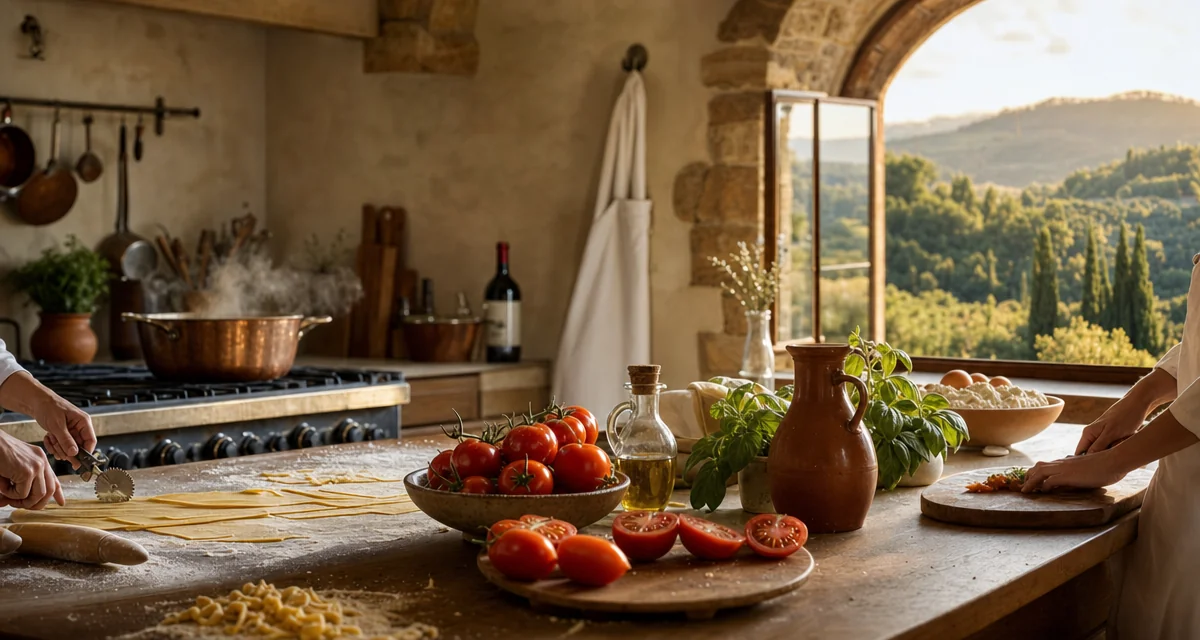
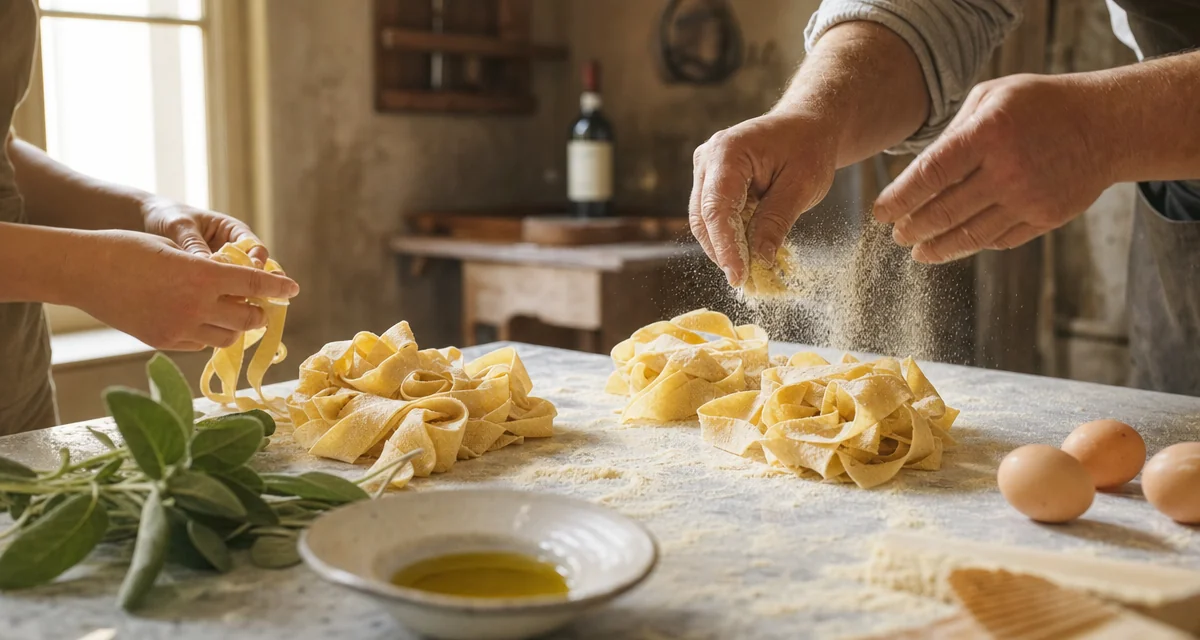
It's a single bundled booking — one chef, one location, one 4–5 hour experience. The chef arrives at your villa, apartment or holiday rental with all ingredients, dough boards, rolling pins, pasta cutters and finishing touches. The class itself is 2 hours: you and your party learn two fresh-pasta shapes — one long (tagliatelle, pappardelle or pici) and one short (orecchiette, farfalle or maltagliati). Hands-on, in your kitchen. While the pasta rests, the chef prepares two sauces (typically a meat ragù for the long pasta, a vegetable or seafood sauce for the short), plus 2–3 antipasti and a homemade tiramisù. Then dinner: at your dining table, terrace or garden. The chef cooks the pasta you shaped, plates, serves and cleans up. The entire experience happens at your location, never at a cooking school. No transfer, no driving 40 minutes back from a class venue, no rigid 6 p.m. end time. The setting — your Tuscan farmhouse, your Amalfi terrace, your Lake Como garden — becomes part of the memory. Children can join the kneading then play next door; older relatives sit down to the same dinner without cooking. This is the format Chef On Demand built specifically for international travellers in Italy.
Why this matters for your Italian holiday
A cooking class is the one experience on an Italy itinerary that survives the trip. You forget the queue at the Uffizi, the rain in Venice, the connecting flight. You don't forget the afternoon someone showed your group, in their own kitchen, how a forkful of fresh tagliatelle is supposed to feel under tooth. Many of our chefs come from Michelin-starred kitchens, Gambero Rosso–rated restaurants, MasterChef and Top Chef Italia, but the experience they deliver in a private villa is deliberately the opposite of formal: the kitchen of an Italian grandmother, scaled for a holidaymaking family. Across our verified network of private chefs across Italy, the most-requested format for international guests is, by a wide margin, the Pasta Class + Dinner Experience. It compresses the country's signature culinary memory — fresh pasta, regional wine, a long table on a warm evening — into a single afternoon at the villa you're already paying for.