What does an Umbria villa rental with a private chef actually include?
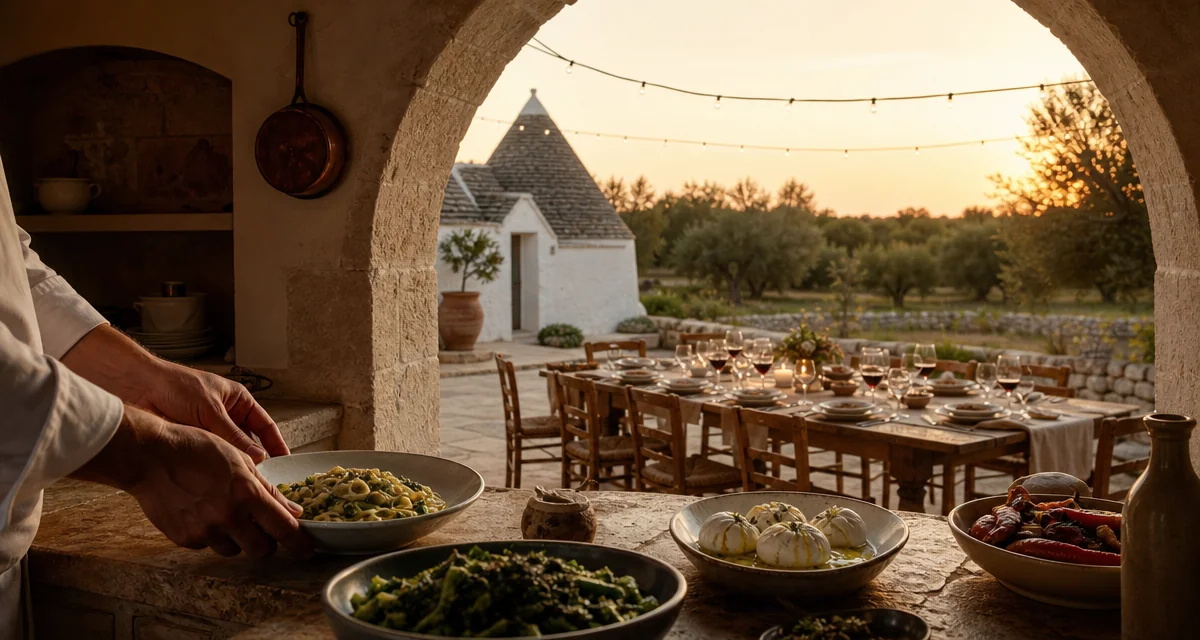
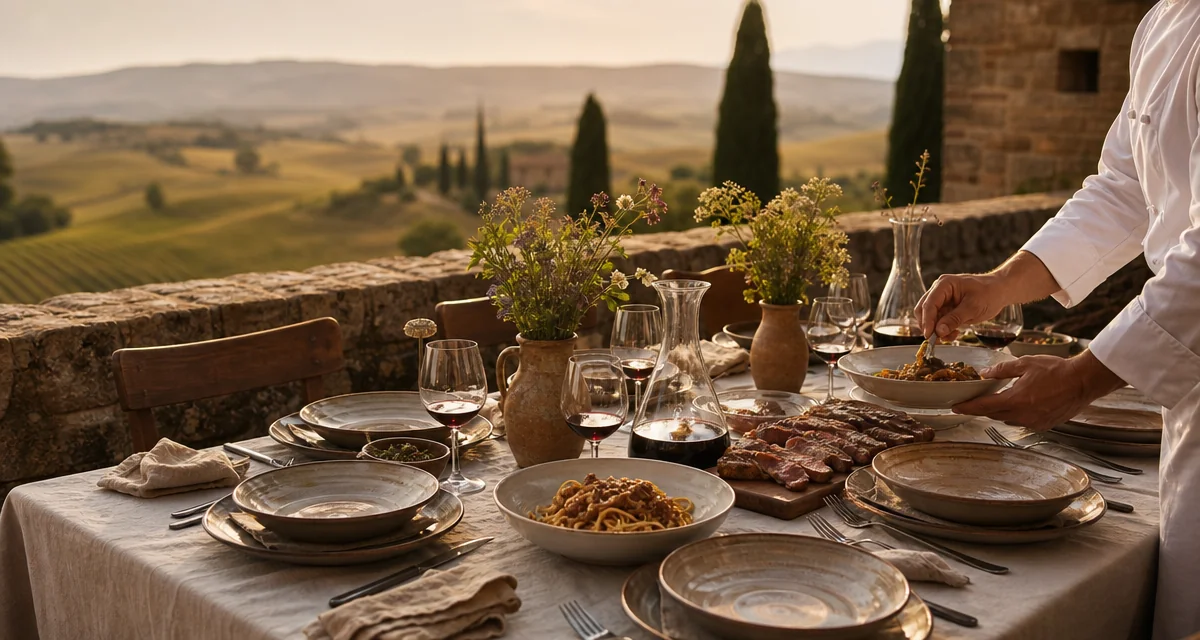
It means renting a self-catering property, usually a restored farmhouse or a working agriturismo (a farm that also rents rooms and serves meals from its own produce, a format Italian law ties to real agricultural activity), then bringing a professional chef to cook inside it. The chef arrives with the groceries, cooks in your kitchen, plates and serves each course, then cleans up before leaving. You supply the setting and the appetite; the chef supplies everything else. This is the appeal of an agriturismo with a private chef: you get the farmhouse-kitchen intimacy without lifting a pan. At Chef On Demand's Umbrian chef network, the most common booking is a single seated dinner for a group of 6 to 12 guests, served over a window of 2 to 4 hours on a terrace or in a vaulted cantina (the cool stone cellar most casali keep for wine and long lunches). Beyond a one-off dinner, guests can book lunch or a lighter breakfast on the same on-site model, or a multi-day arrangement where the chef cooks a chosen set of meals across the whole stay. Whatever the format, the defining feature is that the food comes to your villa rather than you going to a restaurant, which in the Umbrian countryside, where the nearest good trattoria can be a forty-minute drive of hairpin bends, is worth more than it sounds.
How much does a private chef cost in an Umbrian villa in 2026?
A single dinner runs roughly €85 to €180 per guest depending on the menu tier and how many people sit down. The per-head price drops sharply as the group grows, because the chef's time and travel are shared across more plates. For a dinner of 6 guests, an Essential four-course menu of Umbrian classics is around €95 per person, a Taste of Italy five-course showcase is around €120, and a Luxury six-plus-course menu with black truffle, aged cuts and a wine flight is around €180. Take the same three menus up to 10 guests and they settle at roughly €85, €100 and €150 per head respectively. Those figures cover the chef's shopping, cooking, service and cleanup; wine you buy locally or draw from the villa cellar sits outside them. Compared with the platform pricing we see for the same tiers in Tuscany or on the Amalfi Coast, Umbria lands at the gentler end, which is exactly why the region reads as such good value. If you want the interactive option, a Pasta Class plus Dinner experience at your villa is €150 per adult and €60 per child, all-inclusive, for groups of 4 to 10 guests. This is the honest range for private chef cost in Umbria: no restaurant markup, no cover charge, no surprise service fee.
| Menu tier | Courses | 6 guests (per person) | 10 guests (per person) |
|---|---|---|---|
| Essential | 4 courses, classic Umbrian set menu | around €95 | around €85 |
| Taste of Italy | 5 courses, curated regional showcase | around €120 | around €100 |
| Luxury | 6+ courses, truffle, aged cuts, wine flight | around €180 | around €150 |
How does a multi-day chef stay work across a week in the countryside?
For a week in a casale, most groups do not want three cooked meals every day. A typical multi-day rhythm is two or three dinners plus one long lazy lunch across seven days, leaving room for restaurant nights in town and market picnics by the pool. For each day you keep, you choose which meals the chef cooks, and the chef shops fresh at local markets each morning, so no two menus repeat unless you ask. The cost is built from the per-meal price above plus a per-day chef retainer, and that retainer depends entirely on lodging. There are three configurations, and each one moves the number. First, the chef stays at the property, in a spare room or chef quarters, which gives the lowest day rate because you absorb the lodging. Second, a local chef commutes daily, which works beautifully in Umbria's denser pockets around Perugia, Assisi and the Spoleto valley where the network has resident chefs, and carries no accommodation cost at all, which is where a resident chef from our network across Umbria earns its keep. Third, if the villa has no chef quarters and no local chef is available, the chef books a room nearby and that surcharge is line-itemed transparently in the quote. Because these variables are real, we never quote a single flat multi-day per-person rate; every week is priced from the ground up around your property and your chosen meals.
Umbria or Tuscany: which is better for a villa with a chef?
If your priority is a quiet, personal countryside table, Umbria wins on almost every practical axis. Umbrian villa rentals are typically larger, calmer and more affordable than the equivalent Tuscan property, and the region stays noticeably quieter even in July and August. The food tradition is arguably more distinctive, not less: this is the land of black truffle, Norcia pork butchery and Sagrantino, flavours you cannot get with the same authenticity a few valleys west. Tuscany still has the name recognition, the Chianti label and the postcard cypress avenues, and for a first-ever trip to Italy that pull is real. But once you have seen the crowds around a famous vineyard in high season, the calculus shifts. The Umbria versus Tuscany villa question, in our booking data, increasingly resolves in Umbria's favour for repeat visitors and multi-generational family groups who want the chef, the pool and the silence more than they want the famous postcard. If you already know and love Tuscany, our Tuscany villa rental with a chef guide covers that region in the same detail.
| Factor | Umbria | Tuscany |
|---|---|---|
| Crowds | Noticeably quieter, even in peak season | Busy in high season around famous towns |
| Villa value | Often larger and cheaper for the money | Premium pricing, strong demand |
| Signature flavours | Black truffle, Norcia pork, Sagrantino | Bistecca, pecorino, Chianti Classico |
| Name recognition | Underrated, discovery feel | World-famous, first-trip favourite |
| Chef availability | Strong around Perugia, Assisi, Spoleto | Very dense network region-wide |
In Umbria the chef becomes part of the house for the week. You wave from the pool as I come back from the Assisi market with the bread still warm, and by evening the same table is set for eight. In Tuscany people rush; here they let the meal take the whole night. Chef Lorenzo, Assisi-based ambassador of Chef On Demand Umbria
Which Umbrian towns make the best base: Perugia, Assisi, Orvieto or Todi?
Umbria is compact, so almost any casale puts you within an hour of the region's headline towns. Choosing a base is really about which valley and which flavours you want on your doorstep. Here is how the main clusters compare when you are picking where to stay in Umbria for a villa holiday with a chef.
Perugia and Assisi: the green heart
Perugia, the regional capital, is a lively university city famous for chocolate and a hilltop old town that never feels touristy in the way Florence does; it makes a practical, well-connected base with the region's densest chef network. Just 20 minutes away, Assisi is the pink-stone pilgrimage town below the frescoed Basilica di San Francesco, a UNESCO World Heritage site, and the surrounding Subasio slopes are dotted with casali that feel a world away yet sit minutes from a market. This is the easiest part of Umbria to arrange a chef who commutes daily, which keeps a multi-day quote lean. Browse private chefs around Perugia or chefs serving villas near Assisi to see who works your valley.
Orvieto and Todi: the southern hill towns
Orvieto sits dramatically on a plug of volcanic tufa, its cathedral facade glittering above the plain, and it gives its name to Orvieto DOC, a crisp dry white wine made largely from Grechetto and Trebbiano grapes that pairs beautifully with lake fish and antipasti. An hour north, Todi is a perfectly preserved medieval hill town wrapped in three rings of walls, quiet, elegant and beloved by those who want Umbria at its most unhurried. Both make lovely southern bases within easy reach of Rome. A chef here will lean into lighter, wine-friendly cooking. See chefs near Orvieto and private chefs around Todi.
Norcia and Montefalco: truffle and Sagrantino country
For serious eaters, the eastern and central hills are the prize. Norcia, cradled in the Sibillini mountains, is the historic capital of Italian pork butchery, so much so that norcineria became the national word for the craft, and its winter black truffle (tartufo nero) is the region's edible crown. Montefalco, known as 'the balcony of Umbria' for its long views, is the home of Sagrantino di Montefalco DOCG, a deep, tannic red from the local Sagrantino grape, aged for years and built to stand up to game and aged cheese. A chef basing your stay here can weave in a morning of truffle hunting in Umbria with a local tartufaio and his dog, then cook what you find. Explore chefs near Norcia and private chefs around Montefalco.
What will the chef actually cook, and what should you ask for?
Umbrian cooking is rustic, generous and built on a short list of superb ingredients, which makes it perfect for a private table. Start with strangozzi, a hand-rolled eggless pasta shaped like a shoelace (the name nods to a bootlace), traditionally dressed simply so the sauce or the truffle can sing. In truffle season, ask for it with grated tartufo nero di Norcia, the earthy winter black truffle that grows wild in the Sibillini hills. For a shared centrepiece, porchetta is the classic: a whole pig boned, herbed heavily with wild fennel and garlic, rolled and slow-roasted until the skin shatters like glass. Alongside, look for lenticchie di Castelluccio, the tiny prized lentils grown on a high plain that blazes with wildflowers each June and carries a protected Slow Food status, and a drizzle of olio DOP Umbria, the region's protected extra virgin olive oil, peppery and green, best tasted on warm bread. To drink, a bottle of Sagrantino for the reds and Orvieto for the whites covers the whole meal. If your group wants to get hands-on rather than just eat, the pasta class at your villa teaches you to roll two shapes, one long and one short, before the chef turns the rest of the menu into a full seated dinner on your own terrace. It is the single best way to take Umbria home in your hands rather than your suitcase.
- Send the chef your villa's exact location and kitchen photos, so the menu is matched to the equipment and the local markets.
- Flag every allergy and dietary need as a clear bullet list, not buried in prose, at least 48 hours before service.
- Decide your meal pattern for a multi-day stay early: which days, which meals, how many restaurant nights you want to keep.
- Ask which lodging configuration applies to your property, so the multi-day quote holds no surprises.
- Request one truffle-season dish and one Sagrantino pairing if you visit between October and December.
- Confirm your headcount a week ahead, because per-person pricing shifts with group size.
Why this matters for your Umbrian holiday
The whole reason to rent a villa rather than book hotel rooms is to make the house the centre of the holiday, and nothing does that faster than a chef in the kitchen. The pool afternoons run long because no one is watching the clock for a restaurant booking. The children eat early and the adults linger over Sagrantino as the hills go from gold to blue. Grandparents who cannot manage a night out in town still sit down to the same table. That is what an Umbrian casale with a chef buys you: not a meal, but an evening that belongs entirely to your group, in a landscape that has stayed itself while the more famous valleys filled up. Chef On Demand runs a verified network of chefs across Umbria, many trained in Michelin-starred and Gambero Rosso-rated kitchens, and holds a 4.7 out of 5 Trustpilot rating from 800+ guests served since 2025. If you are weighing where in Italy to spend a slow week, start with the food and the setting, then book an Umbria private chef experience or browse the wider network through our private chef hub and our companion guides on accommodation with a private chef in Italy and multi-day private chef stays in a villa. Umbria is the answer more people are quietly arriving at, and the terrace above the olive groves is waiting.