Which Italian accommodation types can actually host a private chef?
Almost all of them. Any property with a domestic kitchen, running water and a table can host a private chef in Italy, which covers villas, farmhouses, apartments, holiday rentals and most historic conversions. The exceptions are structural rather than legal: cruise cabins, hostel dorms and hotel rooms without a kitchen cannot work. Everything else is a question of degree. A restored villa in the Chianti hills with a six-ring range and a garden table for twelve is the easiest brief a chef can receive. A cliff-side apartment above the Amalfi Coast with two gas rings and a balcony that seats four is harder, but harder is not impossible, and it is very much the sort of thing our chefs solve weekly by shifting the menu towards dishes that reward a small hob rather than fight it. The useful mental model is this: the kitchen sets the menu, and the dining space sets the service. Neither of them sets whether the booking can happen. Below is how the main Italian property categories compare once a chef is in the room, and it is worth reading the permission column carefully, because that is where the genuine friction lives.
| Property type | Can it host a chef? | Kitchen reality | Permission friction |
|---|---|---|---|
| Private villa (rented whole) | Yes, the easiest case | Usually a full range, oven, generous prep surfaces, table for 8–14 | Low. Owner or agency almost always approves, often suggests it |
| Agriturismo | Usually, with one caveat | Guest kitchens vary; some units have a kitchenette only | Highest. If the farm runs a licensed restaurant it may decline outside chefs |
| Masseria (Puglia) | Yes | Often large vaulted kitchens built for feeding farm workers | Low to medium. Estate-managed masserie may route the request through staff |
| Trullo (Itria Valley) | Yes, with menu adaptation | Small, characterful, limited counter space and often a compact hob | Low. Usually privately let |
| Borgo apartment or historic village house | Yes | Compact but complete; ovens are common, dishwashers less so | Low. Occasionally a shared-courtyard noise consideration |
| Airbnb or short-let apartment | Yes | Highly variable; the single biggest reason to send photos | Medium. House rules on guest numbers matter more than the chef |
| Hotel room or suite without kitchen | No | No cooking facilities, and hotel F&B licensing conflicts | Blocking. Book a serviced apartment instead |
Can you hire a private chef at an agriturismo?
Usually yes, but the agriturismo is the one Italian property type where the answer is genuinely not automatic, and it pays to ask before you book anything. An agriturismo is a working farm that also rents rooms and serves meals from its own produce, and Italian law requires a minimum share of its revenue to come from farming rather than hospitality. That legal shape is exactly why the friction exists. Many agriturismi hold a restaurant licence and employ their own cook, so an outside chef is not a logistics problem for them, it is a commercial one, and a polite decline is a reasonable business decision rather than an obstruction. The ones that welcome outside chefs are typically the self-catering units: a converted barn or a farmhouse apartment let with its own kitchen and no on-site dining service. If that describes your booking, you are almost certainly fine. If the farm advertises half-board or a nightly set menu, ask first, and ask early enough that you can pick a different night or a different property. We have had guests discover this on arrival day, which is a bad day to discover it.
Do you need the property owner's permission to bring in a chef?
In practice, yes, and it takes one message. There is no Italian law that prevents you from inviting a professional cook into a property you are lawfully renting, and no chef in our network has ever been turned away at a villa gate. But the rental agreement sits between you and the kitchen, and reputable chefs confirm access with the owner or the housekeeper before service rather than turning up unannounced. This is not bureaucracy for its own sake. The housekeeper needs to know that someone will arrive with crates of produce two to three hours before dinner, the owner may want the good glassware used rather than the everyday set, and in a borgo, meaning a small fortified hilltop village where houses share courtyards and staircases, your neighbours have opinions about a party of twelve at eleven at night. Ninety seconds of warning solves all three. The message that works is short and specific: the date, the arrival time, the number of guests, and the fact that the chef brings ingredients and equipment and leaves the kitchen clean. Owners hear that and relax, because what they were quietly worried about was a mess, not a menu.
How much does adding a private chef to your accommodation cost in 2026?
Between €85 and €180 per guest for a single dinner in Italy in 2026, and the number moves with two things: how many courses you want and how many of you there are. Group size matters more than travellers expect, because the chef's travel, shopping and setup are fixed costs that spread across heads. A Taste of Italy menu of 5 courses costs around €120 per person for 6 guests, and the identical menu drops to roughly €100 per head once the table reaches 10. The Essential menu of 4 courses runs about €95 per person at 6 guests and €85 at 10, while Luxury, which is 6 courses or more and brings in truffle, seafood and aged cuts, sits near €180 per person at 6 and around €150 at 10. Two more variables are worth knowing before you compare quotes. Premium zones such as Rome and Milan add roughly €15 per person, reflecting what produce and parking genuinely cost in those cities. Christian holidays, Easter and Christmas among them, carry a 35 percent uplift, because a chef working Easter Sunday is not working their own family lunch. Set against a villa rental that can run from about €2,500 a week for a modest property to well beyond that in Tuscan high season, the chef is rarely the line that breaks the budget. If you are pricing a stay in the region, you can book a Tuscany private chef experience against the exact town and dates you have already committed to.
| Tier | Courses | 6 guests | 10 guests |
|---|---|---|---|
| Essential | 4 courses | €95 per person | €85 per person |
| Taste of Italy | 5 courses | €120 per person | €100 per person |
| Luxury | 6+ courses (truffle, seafood, aged cuts) | €180 per person | €150 per person |
People send me the address and ask what I can cook. Send me the kitchen instead. I have made a better dinner on two gas rings in a trullo than in villas with equipment I never touched. Chef Lorenzo, Florence-based ambassador of Chef On Demand Tuscany
Villa, agriturismo or Airbnb: what actually changes for the chef?
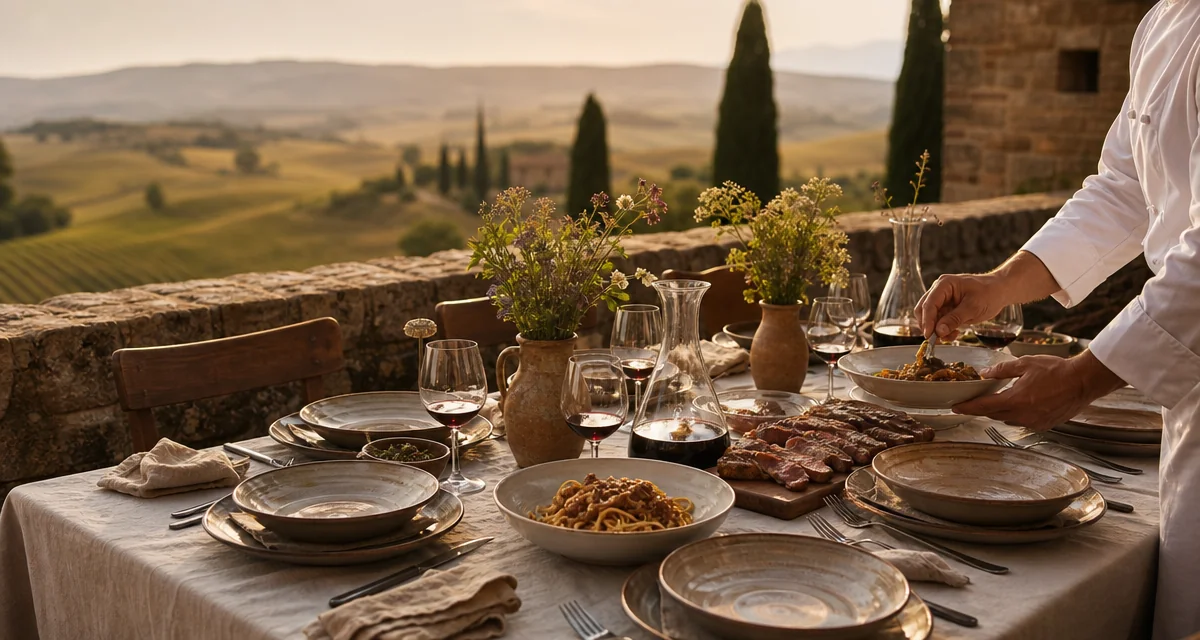
The menu changes, and very little else does. A chef arrives at your property two to three hours before service with the shopping already done, cooks in your kitchen, plates at your table, serves your group and leaves the room cleaner than they found it. That shape holds across a Tuscan villa, a Puglian masseria and a one-bedroom flat in Trastevere. What shifts is what the room can produce. A masseria, which is a fortified Apulian farmhouse built around a courtyard, often has a vaulted kitchen originally designed to feed farm workers, and chefs love them for exactly that reason. A trullo, the conical drystone dwelling of the Itria Valley with walls a metre thick and a footprint to match, is charming and small, so the menu leans towards dishes finished in one pan rather than three. If you are weighing a specific Tuscan property, our guide to Tuscany villa rentals with chef goes deeper on the rental side, and you can browse private chefs across Tuscany by the town you are actually staying in.
What a villa kitchen actually needs for a chef to work
Less than you would think. The working minimum is a heat source with at least two rings, a sink with hot water, roughly one metre of clear prep surface, and a fridge with space cleared before the chef arrives. That last one is the most common oversight, because a fridge packed with a week of groceries is a fridge the chef cannot use. An oven unlocks a great deal, notably roasted meats and the slow-baked side of Tuscan cooking, but its absence removes options rather than the booking. Chefs bring their own knives, boards and finishing equipment as a matter of course, so you are not expected to own anything professional. Two practical notes from the field: dishwashers are far rarer in Italian rentals than northern European travellers assume, which matters for cleanup timing rather than for you, and outdoor tables are a genuine asset, since a garden table for ten in the Val d'Orcia is worth more to the evening than any appliance indoors.
Fully staffed villas versus booking the chef yourself
These are two different products and they are priced differently. A fully staffed villa bundles a resident cook, housekeeping and often a butler into the weekly rate, which is convenient and typically sits at the top of the market, since you are renting the staff alongside the walls. Booking the chef yourself keeps the property decision and the food decision separate, which is why most of our guests do it: you rent the house you liked in the village you wanted, then add exactly the meals you want on the nights you want them. It also means you choose the chef rather than inheriting one, and you keep the option of cooking for yourselves or walking into Siena for dinner on the nights you feel like it. Villas with cooks in Italy are a real and respectable category, and if you want zero decisions they are a good answer. If you want a specific chef, a specific menu and a specific number of nights, unbundling almost always costs less and delivers more.
- Confirm with your host or agency that an outside chef is welcome, ideally before you pay the accommodation balance.
- Photograph the kitchen on arrival, or request photos from the listing, and send four shots: hob and oven, fridge interior, prep surface, dining table.
- Count the table, not the beds. A villa sleeping fourteen with a table for eight changes the service plan and sometimes the menu.
- Declare allergies and dietary needs as a bulleted list rather than buried in prose, and do it at the quote stage rather than on the day.
- Choose your nights early. Peak season across our network runs 7 to 14 days of lead time from June to September, and the good chefs go first.
- Clear one fridge shelf and one metre of counter before the chef arrives, which takes two minutes and saves twenty.
How does a multi-day chef work when you have booked the property for a week?
A multi-day chef accompanies your group for the whole stay, typically 3 to 7 days, and you choose meal by meal which ones the chef cooks. Breakfast, lunch, dinner or any combination, and the realistic pattern is not three meals a day. Most groups land on two or three dinners plus one long lunch across a week, because part of a holiday in Italy is still wandering into town and finding your own trattoria. The chef shops at local markets each morning, cooks at the property, personalises the menu across the days so nothing repeats unless you ask for it, serves and cleans up. Where the property genuinely does drive the cost is lodging, and there are three configurations. First, the chef stays at the property, which needs a spare bedroom or dedicated chef quarters and produces the lowest day rate, because you are absorbing the accommodation. Second, a local chef commutes daily from home, which adds no lodging cost at all and works beautifully in dense areas such as Chianti, the Amalfi Coast and Lake Como where our network has resident chefs. Third, the chef books lodging nearby when the villa has no spare room and no local chef is available, and the quote line-items that surcharge openly. Multi-day quotes are built bottom-up from the per-meal cost plus a day retainer, so there is no single per-person rate to quote you honestly. Our multi-day private chef guide walks through a full week.
Where in Italy can you actually get a chef at your accommodation?
Coverage follows tourism density, so the honest answer is that the regions you are most likely to have booked are the regions best served. Tuscany is the deepest market in our network, and within an hour of Florence you are in reach of chefs who cook bistecca alla fiorentina, a thick T-bone of 1.2 to 1.5 kg cut from Chianina cattle and grilled over embers, served rare with Tuscan olive oil, alongside pici, a hand-rolled fat spaghetti from Siena province that predates the fork, and ribollita, a twice-cooked bread and cabbage soup born from peasant thrift. Wine follows the same map: Chianti Classico DOCG, the Sangiovese red from the hills between Florence and Siena marked by its black rooster seal, and Brunello di Montalcino DOCG, a 100 percent Sangiovese aged at least five years before release and ranked beside Barolo among Italy's benchmark reds, which you can drink where it is made if you have rented near Montalcino. Puglia has grown quickly, with masserie around Ostuni and trulli near Alberobello. Lake Como, the Amalfi Coast and Rome are all well covered. Rural Basilicata and inland Molise are thinner, and we would rather tell you that now than after you have booked. If Tuscany is your destination, browse our Tuscan chef network by town, and note that Tuscany also carries one of the densest MICHELIN Guide selections in Italy, which is where a good share of our chefs trained. Many regional ingredients you will meet are Slow Food Presidia, small-scale products the foundation protects from disappearing.
Why this matters for your Italian holiday
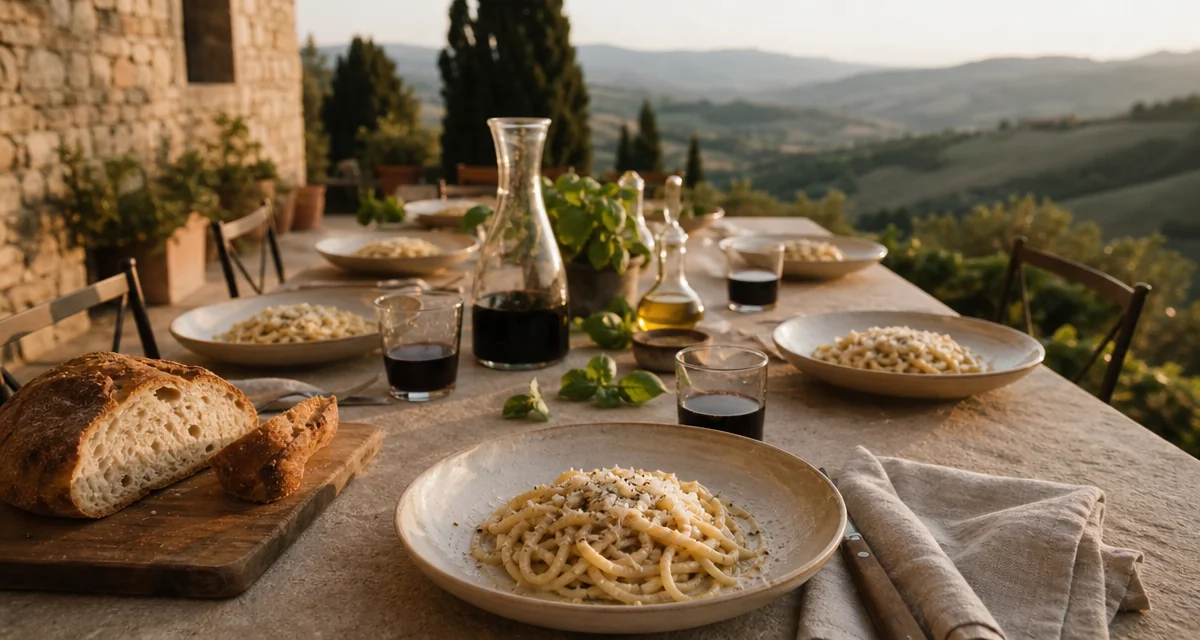
You chose the property for a reason. Maybe it was the terrace with the view down the Val d'Orcia, the UNESCO-listed valley in southern Tuscany whose cypress-lined ridges appear on every postcard and which produces pecorino di Pienza, Brunello and Vino Nobile within a thirty kilometre radius. Maybe it was the courtyard of a masseria, or a trullo that looked like nowhere else on earth. Whatever it was, you are paying for it every night of the stay, and the strange thing about how most groups holiday is how little time they spend inside the thing they paid for. Dinner becomes a drive: someone stays sober, everyone dresses, you sit in a room you did not choose, and you are home by eleven having seen the inside of a restaurant you will not remember. Hiring a chef inverts that. The terrace becomes the dining room, the children fall asleep upstairs instead of fidgeting through four courses, the wine you carried back from the enoteca, the local wine shop, gets drunk where you bought it. Nobody drives. Nobody rushes. The evening ends when your group decides it ends, which is the one thing no restaurant in Italy can sell you. That is what our chefs do, whether you have rented a farmhouse in Chianti or two rooms above a harbour, and you can start with our private chef network across Italy. The best table in Italy is often the one you have already rented. It just needs someone in the kitchen.