What is a Tuscany food market — and how is it different from a supermarket?
A Tuscany food market (mercato alimentare) is a public selling point — either a permanent covered building or a weekly open-air gathering — where producers and small traders sell directly to the public, with seasonality and provenance as the organising principles. Unlike a supermarket, prices are negotiated lightly, products are unpackaged, and the merchant will tell you which farm in the Mugello the chestnuts came from this morning. The format is regulated under Italian law (D.lgs. 114/1998) which protects market days and traders' historic stalls. As of 2026, Tuscany counts more than 80 recurring food markets across its 273 municipalities. The biggest — Florence's Mercato Centrale in San Lorenzo, designed by Giuseppe Mengoni and opened in 1874 — has two floors: ground level for fresh produce, butchers and fishmongers (open Monday–Saturday 7 a.m.–3 p.m.), and an upper food hall with 24 artisan vendors open daily until midnight. Tuscan farmers' markets, signposted as Mercato della Terra or Campagna Amica, sell exclusively zero-kilometre produce vetted by Slow Food or Coldiretti.
Which Tuscan food markets are worth a detour?
Eight markets cover the full geography of the region. Mercato Centrale (Florence, San Lorenzo) — daily indoor market plus a 24-vendor food hall, 90 minutes is enough. Mercato di Sant'Ambrogio (Florence, Piazza Ghiberti) — Monday–Saturday 7 a.m.–2 p.m., smaller and more local, with 30+ open-air produce stalls outside the iron-and-glass hall; where Florentine grandmothers shop. Mercato della Lizza (Siena) — Wednesday morning, 400 m from Piazza del Campo. Mercato del Carmine (Lucca) — the 18th-century covered market in central Lucca, open daily, strong on cured meats and Tuscan bread. Logge del Grano (Arezzo) — Saturday morning farmers' market overlapping with the famous Antiquaria antiques fair (first weekend of every month). Mercato Settimanale (Pistoia) — Wednesday and Saturday in Piazza della Sala. Mercato di Forte dei Marmi — Wednesday and Sunday morning in Versilia, famous for Tyrrhenian fish landed at dawn (5 a.m.). Mercato di Pietrasanta — Thursday morning, smaller but with the best focaccia in northern Tuscany. Browse private chefs across Tuscany if you want one to meet you at any of these.
Take me to Sant'Ambrogio at 8 a.m. and I'll plan your dinner from what's at the stalls. By 9.30 we have the artichokes, the pici, the cinta senese pork — by 8 p.m. you're eating your Tuscany on a plate, in your own villa garden. Chef Lorenzo, Florence-based ambassador of Chef On Demand Tuscany
What should you buy at a Tuscan food market?
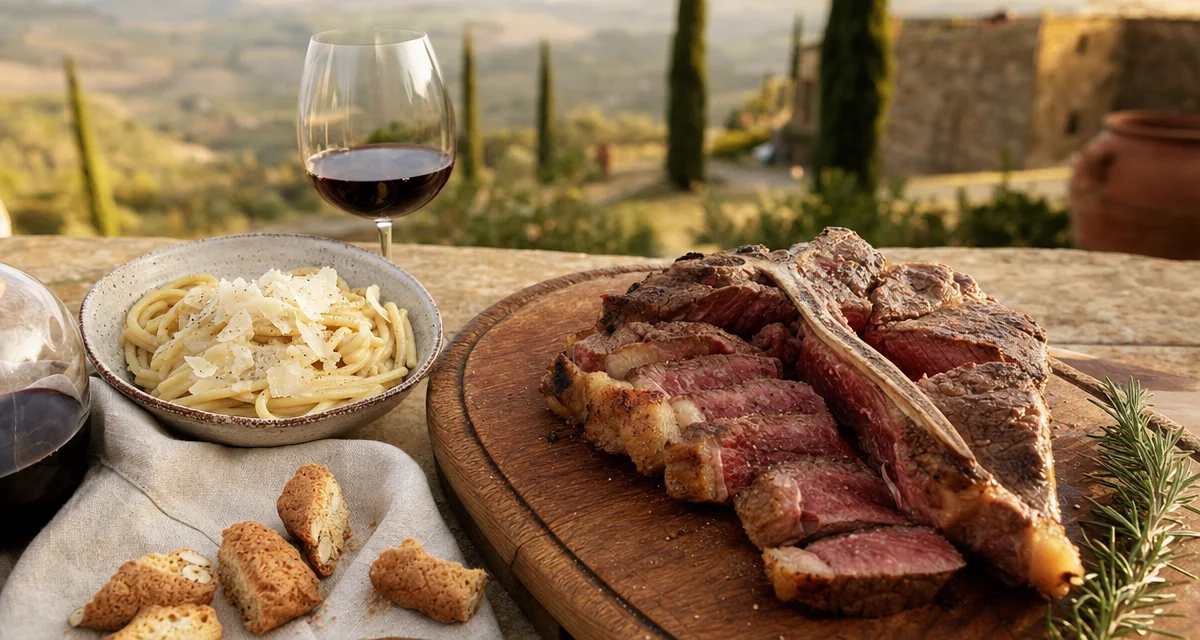
Build your basket around the region's protected products. Pecorino di Pienza DOP — a sheep's milk cheese from the Val d'Orcia, a UNESCO-listed valley in southern Tuscany; buy a young fresco wedge (€18–€22 per kg) for grating over pici and a 6-month aged stagionato for the cheese course. Chianina beef — the breed used for bistecca alla fiorentina, a 1.2–1.5 kg T-bone steak grilled over hardwood embers; ask the butcher for a 4 cm-tall cut (€55–€70 per kg). Finocchiona — a fennel-seed salami unique to Tuscany, sliced paper-thin (200 g feeds 4 people). Pici — hand-rolled thick spaghetti from the Siena hills, sold fresh from market pasta stalls (€8 per kg). Cantucci — twice-baked almond biscuits from Prato, the dunking partner of Vin Santo dessert wine. Tuscan extra-virgin olive oil from the November frantoio (mill) — the oils released between November and January are the spiciest. Brunello di Montalcino DOCG — a 100% Sangiovese red aged at least 5 years, available at most market enoteche from €35 a bottle. For families and groups in Florence, Siena, Lucca and Forte dei Marmi, our chefs either meet you at the market or send a shopping list keyed to that morning's seasonal availability.
- Arrive before 9 a.m. — produce is freshest, parking is easier (most Tuscan towns close historic centres to traffic from 10 a.m.).
- Bring cash in small denominations — many stalls don't take cards, and €10/€20 notes speed up the queue.
- Ask for the day's special (la specialità di oggi) — fishmongers and butchers lower the price after 12.30 to clear stock.
- Taste before you buy — at cheese and salami stalls a slice is always offered; at olive-oil stalls dip a piece of bread.
- Carry a cool bag — Tuscan summers hit 35 °C; cured meats and cheese deteriorate fast in a hot car between market and villa.
- Note the market day — most weekly markets run only one or two mornings; check before you build your itinerary.
- Ask about the producer — Tuscan vendors are proud of their farm; you'll often hear the postcode of the field the vegetable came from.
How does pairing a market visit with a private chef work?
There are two ways to combine a Tuscan market with a private chef. Format A — single-event dinner: the chef meets you at the market at 8.30 a.m., walks you through 5–6 stalls (cheese, butcher, pasta, vegetables, bakery, enoteca) over 90 minutes, explains what's seasonal, and helps you build the basket for that evening. The chef then arrives at your villa at 4 p.m., cooks for 3 hours, plates and serves at your dining table or terrace, and cleans up by 11 p.m. Pricing follows our Essential / Taste of Italy / Luxury tiers — for 6 guests in Tuscany expect €95 per person for Essential (4 courses), €110–€135 per person for Taste of Italy (5 courses, our signature mid-tier), or €180 per person for Luxury (6+ courses with truffle, seafood or aged cuts and a wine flight). At 8 guests the same Taste of Italy menu drops to roughly €110 per person; at 10 guests, €90–€110. Format B — multi-day stay: the chef joins your party for 3–7 days. You decide which meals each day the chef cooks (typical pattern: 2–3 dinners + 1 long lunch per week), and market shopping happens daily. Three lodging configurations exist — the chef stays at the property if there's a spare room, commutes daily from home (within 30–45 minutes) where our Tuscan chef network is densely covered (Chianti, Versilia), or books nearby lodging factored transparently into the quote. Multi-day quotes are always custom.
| Tier | Courses | Price per person (6 guests) | Best for |
|---|---|---|---|
| Essential | 4 courses | €95 | Approachable Tuscan classics — pappa al pomodoro, pici, bistecca, cantucci |
| Taste of Italy | 5 courses | €110–€135 | Curated regional showcase — our signature mid-tier most groups choose |
| Luxury | 6+ courses | €180 | Premium ingredients — white truffle, Tyrrhenian seafood, aged Chianina, multi-pairing wine flight |
When is the best time of year to visit Tuscan food markets?
Every season has a market signature — and Tuscan menus rotate accordingly. Spring (March–May) brings the first artichokes, fava beans, wild asparagus and salt-cured spring lamb; markets feel calm and trader queues are short. Summer (June–August) peaks with tomatoes, courgette flowers, peaches from the Lucchesia and Tyrrhenian fish — but markets in tourist towns get crowded between 10 a.m. and noon, so go early. Autumn (September–November) is the connoisseur's season: porcini from the Mugello, white truffle from San Miniato (the truffle fair runs 3 weekends in November), new olive oil from the frantoio, and chestnuts from the hills around Pistoia. October's vendemmia (grape harvest) coincides with sagre — village food festivals — across Montalcino, Montepulciano, Greve in Chianti and San Gimignano. Winter (December–February) brings cavolo nero, Cinta Senese pork and ribollita season — quiet markets where you can talk to traders without queueing. Average booking lead time across our network: 7–14 days for peak season (June–September), 3–7 days off-peak.
How do Tuscan food markets compare with restaurants and cooking schools?
A market doesn't replace a restaurant or a cooking school — it sits between them. A restaurant gives you a finished plate; a cooking school takes you to a fixed venue with a fixed menu and a cohort of 12 strangers; a market puts the raw ingredients in your hands. The most powerful pairing is market + private chef at your villa: you choose the produce, your group has the property to itself (no transfer logistics, no shared cohort, no rigid 6 p.m. to 9 p.m. shift), and the dinner format flexes to children, older relatives and guests who want to linger over wine. Browse our Tuscan chef network — 12+ verified private chefs, 4.7/5 Trustpilot rating based on 800+ guests served since 2025, with many trained in Michelin-starred kitchens, Gambero Rosso–rated restaurants, MasterChef and Top Chef Italia. In our network's data, the at-villa format is the single biggest reason groups rebook us in subsequent years (43% of Tuscan bookings in 2025 were repeat guests).
Why this matters for your Tuscan holiday
Tuscany is one of the few European regions where the daily food market is still the centre of civic life — not a tourist artefact but a working trading floor that has existed for over 150 years. To shop at one is to participate, briefly, in the rhythm that produced the cuisine the rest of the world copies. To then cook from that basket — at the villa you've already paid to rent, with your own group around you and a chef who knows the producers by name — is the moment most travellers describe as when Tuscany finally clicks. That's the booking philosophy behind Chef On Demand: every chef in our Tuscan network knows their local market, shops there weekly, and builds dinner around what was best that morning rather than a printed menu. The market is the where; the chef is the how; your villa is the stage.