Which food delivery apps actually work in Tuscany?
Four platforms compete in Tuscany in 2026: Glovo, Deliveroo, Just Eat and Uber Eats. All four cover Florence — Tuscany's only large city — with 30–45 minute deliveries from a wide pool of restaurants, including pizza, sushi, vegan kitchens and a handful of Michelin-adjacent fine dining. Pisa, Siena and Lucca have working Glovo and Deliveroo footprints within 4–6 km of the historic centre; smaller cities like Arezzo and Grosseto have lighter coverage with 50–70 minute windows. Glovo is the most versatile: alongside restaurant meals it delivers groceries and from local convenience stores. Pricing averages EUR 2.50–5 delivery per order, plus a 10–15 percent service fee. The catch is geographic: each app draws a coverage polygon around the city, and the moment your villa pin sits outside it, the app simply shows no restaurants. In central Florence, Pisa or Siena, app delivery is as good as London or Berlin. Anywhere further out, treat the apps as a city-day tool, not a villa solution.
Why rural villas are usually a delivery dead zone
Tuscany's most coveted accommodations sit in the countryside on purpose: villas (working farms that also rent rooms — Italian law requires a minimum share of revenue from farming, so the experience feels closer to a farmhouse kitchen than a hotel), restored stone farmhouses, and hilltop villas surrounded by vineyards or olive groves. The same isolation that makes the photos magical puts you 15–45 minutes from any town with active delivery riders. In Chianti, most properties are reached by unpaved strade bianche (white gravel roads) where scooters struggle and food arrives cold. In Val d'Orcia around Montalcino and Pienza, distances between hamlets stretch to 8–12 km and many addresses do not appear on app maps. The Maremma — Tuscany's wilder southern coast and inland — is even sparser, with delivery effectively non-existent outside Grosseto's immediate ring. If you've chosen a remote villa for the views and the silence, accept that ordering a pizza is not part of the package, and decide your food strategy before arrival — across the Tuscan chef network we see this become the difference between a relaxed week and an exhausted one.
How does grocery delivery work for a Tuscan villa stay?
Online supermarket delivery in Tuscany is built around two giants — Esselunga a Casa and Coop Online — which reach a far wider area than the restaurant apps because they use vans rather than scooters. Esselunga covers most of central and northern Tuscany including Florence's hinterland, parts of Chianti, the Lucca plain and the coastal strip; Coop covers similar zones and is stronger in Siena province. Delivery fees in 2026 run EUR 5.90–9.90 per order with a EUR 50–80 minimum basket, and slots open 24–72 hours ahead — order before you fly, not on arrival. For villas near private chefs across Tuscany, the regional service Sangifood reaches San Gimignano, Siena and Castellina in Chianti with local meat, cheese, salami, wine and produce for around EUR 5.80 per delivery. The trade-off is obvious: you stock the villa for breakfast, lunch and aperitivo, but someone still has to cook dinner — which is where holiday energy often runs out by night three.
- Confirm your villa address has road access for a delivery van — narrow gravel tracks sometimes get refused.
- Order from Esselunga a Casa or Coop Online 48–72 hours before arrival; book the delivery slot for the check-in day.
- Add 30 percent more than your city instinct — fridges in Tuscan villas are often smaller, but you'll cook more meals than you expect.
- For specialty items (truffle butter, Cinta Senese salami, pecorino di Pienza — a sheep's-milk DOP cheese from southern Tuscany aged 30–90 days, prized for its grassy, slightly piquant finish), order from Sangifood or directly from caseifici (cheese-makers).
- Keep one slot for a local market visit on day two — every Tuscan town has a weekly market with seasonal produce app delivery cannot match.
What about specialty food and wine shipping to your villa?
For truffle, olive oil, aged pecorino, salumi or a few bottles of Brunello di Montalcino — a 100 percent Sangiovese red from the hills of Montalcino, aged at least five years before release, considered alongside Barolo as one of Italy's three benchmark reds — the right channel is direct producer shipping. Most Tuscan estates and Slow Food–accredited producers ship in 24–72 hours, fees EUR 8–15 per box. Wineries in Chianti Classico DOCG (the historic heart of Chianti, requiring a minimum 80 percent Sangiovese) and Vernaccia di San Gimignano DOCG (Tuscany's only white DOCG) ship 6-bottle cases for EUR 80–250. White truffle of San Miniato ships fresh in season (October–December) for EUR 2–4 per gram. This is the right channel for arrival-day stocking, gifts, or supplementing a chef's pantry — but not a dinner solution by itself.
When guests arrive at a villa in the Crete Senesi, they often expect Florence-style delivery. By the second night they understand: out here, dinner is something you cook with your hands or someone cooks for you in your kitchen. There's no third option that doesn't involve a 40-minute drive each way. Chef Lorenzo, Florence-based ambassador of Chef On Demand Tuscany
Private chef vs food delivery in Tuscany: which is better for a villa?
For a one-evening city stay, food delivery wins on price and speed. For a holiday in a Tuscan villa, the comparison flips because delivery often does not exist at the address. An in-villa private chef from Chef On Demand's Tuscan network brings groceries shopped that morning at a local market, cooks at your villa, plates a 4 to 6-course menu on your terrace, then cleans up. According to Chef On Demand's data of 800+ bookings since 2024, the typical group is 4–12 guests with a 2–4 hour service window, and the platform operates a verified network of 12+ private chefs across Tuscany. Pricing depends on tier and group size — a Taste of Italy menu (5 courses, the brand's signature mid-tier) is around EUR 120 per person at 6 guests and drops to roughly EUR 100 per head at 10. The real comparison is not 'pizza delivery vs chef': it is 'a EUR 60 attempted delivery that may not arrive vs a planned on-site Tuscan dinner with no logistics on your side'. For one quick evening in Florence, open Glovo. For a week in a Chianti villa, brief a chef.
| Option | Best for | Where it works | Approx cost |
|---|---|---|---|
| Restaurant delivery apps (Glovo / Deliveroo / Just Eat / Uber Eats) | Quick city evenings, late snacks | Florence, Pisa, Siena, Lucca centres | EUR 12–25 per person + EUR 3–5 delivery |
| Grocery delivery (Esselunga a Casa, Coop Online, Sangifood) | Stocking a villa, breakfast and lunch self-catering | Most of central and northern Tuscany, plus rural addresses with road access | EUR 50–80 basket + EUR 5.90–9.90 delivery |
| Specialty producer shipping (truffle, wine, olive oil, cheese) | Arrival-day stocking, gifts, supplementing a chef pantry | All of Tuscany within 24–72 hours | EUR 8–15 shipping per box |
| Private chef Essential (4 courses) | Approachable in-villa dinner, classic Italian set menu | Anywhere in Tuscany, including remote villas | EUR 95–110 per guest at 6–8 people |
| Private chef Taste of Italy (5 courses, signature) | Curated Tuscan showcase dinner with wine | Anywhere in Tuscany | EUR 100–135 per guest at 6–10 people |
| Private chef Luxury (6+ courses with truffle, seafood, wine flight) | Special-occasion dinner, milestone celebrations | Anywhere in Tuscany | EUR 150–180 per guest at 6–10 people |
How does an in-villa private chef actually work in Tuscany?
An in-villa private chef booking is one experience with one chef and one location: yours. For a single dinner or lunch, the chef arrives 2–3 hours before service with groceries shopped that morning at the closest market. They cook in your kitchen, plate course by course on your dining table or terrace, serve, and clean up. A typical service window is 2–4 hours. Most groups sit between 4 and 12 guests and the lead time for peak season (June–September) is 7–14 days. For longer stays, our multi-day format places a chef alongside your group for 3–7 days; you pick which meals on which days (a typical pattern is 2–3 dinners and one long lunch over a week) and the lodging configuration shapes the cost — chef stays at the property if it has a spare room, commutes daily from home if local, or books nearby lodging factored transparently into the quote. The Pasta Class + Dinner Experience bundles a 2-hour pasta class teaching two fresh-pasta shapes (one long like pici — a hand-rolled thick spaghetti from southern Tuscany — and one short like maltagliati) with a full seated dinner of antipasti, both pastas with their sauces, and homemade tiramisù — entirely at your villa, never at a cooking school.
How to plan food for a 7-day Tuscan villa stay
Working backwards from check-in, here is how most well-fed villa stays are structured. Three to four weeks before arrival, lock the chef bookings — typically 2–3 dinners across the week (arrival night, mid-week, and a 'last night' celebration), plus optionally one Pasta Class + Dinner on day three or four. One week before, place a grocery order with Esselunga a Casa or Coop Online for delivery on the check-in afternoon: bread, eggs, milk, fruit, vegetables, pasta, coffee, water and a few bottles of wine. Two days before, ship specialty items — truffle if in season, a 6-bottle case from a cantina (cellar / wine producer) in Montepulciano or Montalcino, olive oil from a Chianti producer. On the day, save the urban apps for town-day evenings — a Glovo pizza in Florence after a museum, sushi in Siena after a market morning. Mid-week, top up at a town market — the markets in Greve in Chianti (Saturday) and Pienza (Friday) are themselves part of the holiday.
Why this matters for your Tuscan holiday
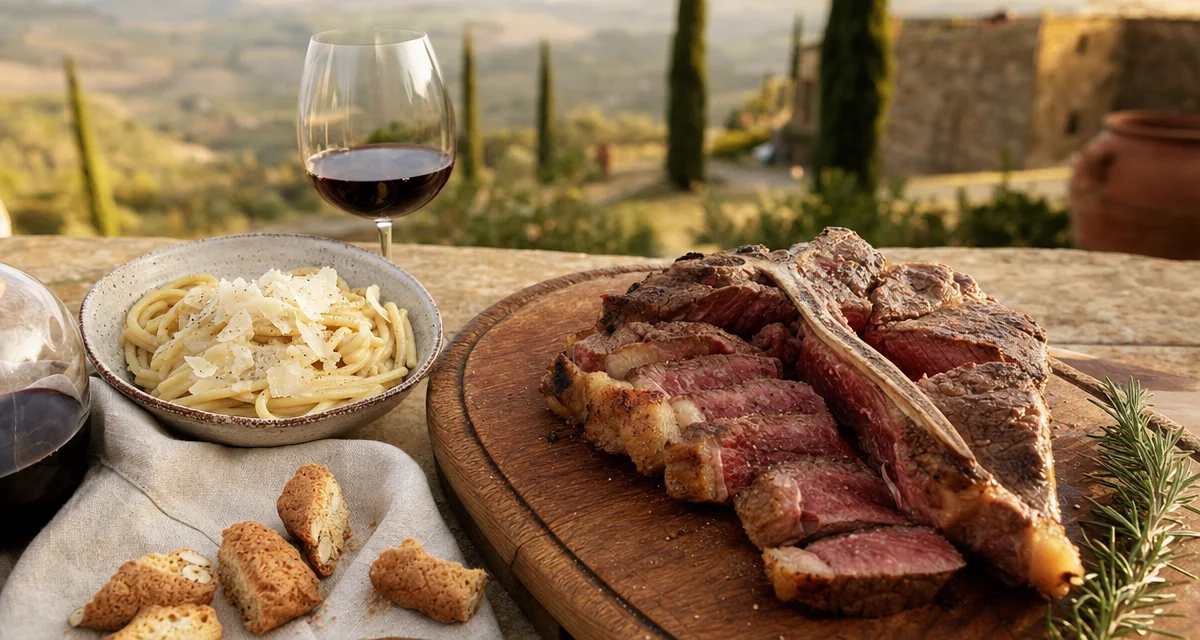
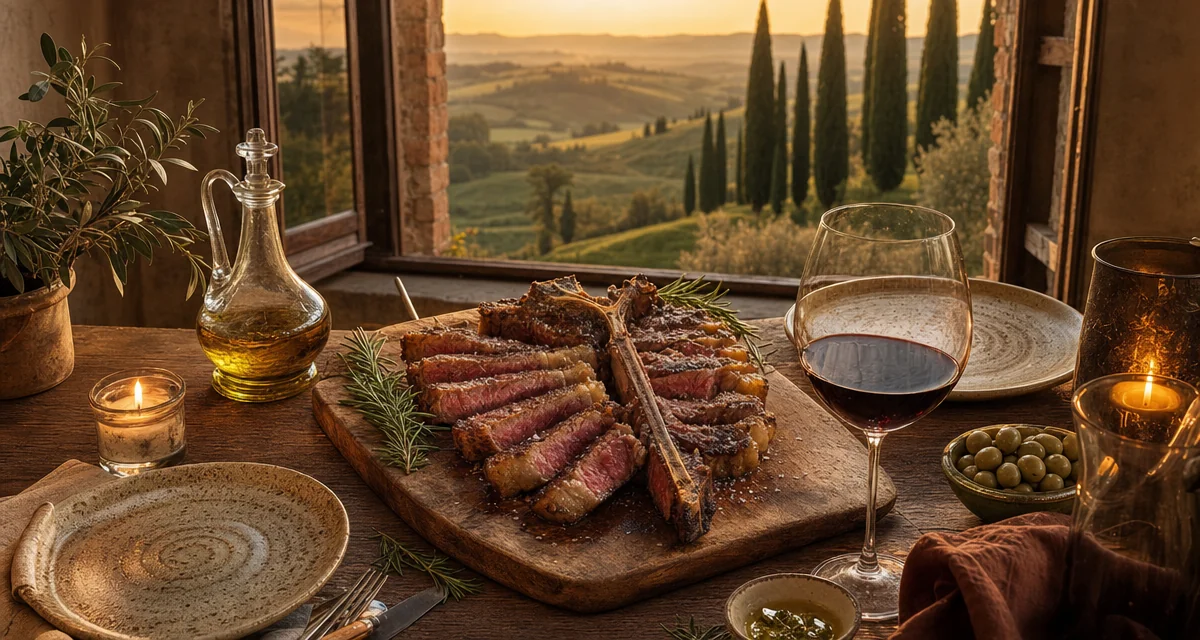
The most common feedback we receive at the end of a Tuscan villa week is some version of 'we wish we'd booked more chef nights and stressed less about food earlier'. The mental model that doesn't translate from city travel is the assumption that food access scales smoothly: it doesn't. Tuscany rewards the opposite — letting an in-villa chef shop the morning market, cook the ribollita (a thick Tuscan bread-and-bean soup) or the bistecca alla fiorentina (a thick T-bone steak, 1.2–1.5 kg, cut from Chianina cattle and grilled rare over hardwood embers) on your terrace, and pour Vin Santo (a sweet Tuscan dessert wine from dried grapes) over cantucci almond biscuits. App delivery has its place for the city-day pizza, grocery delivery for the breakfasts, specialty shipping for the cellar — and the chef has the place that matters most: dinner with your group, in your villa, with no one driving anywhere afterwards. Our private chef hub at chefondemand.it/en-it/private-chef/region/tuscany walks through every region. The view from the terrace is yours. The dinner doesn't have to be your problem.