What is truffle hunting in Tuscany, and who actually leads it?
Truffle hunting in Tuscany is a guided outing with a tartufaio, a local truffle hunter who holds a regional foraging licence, and a dog trained to smell ripe truffles growing 5 to 30 centimetres underground. A typical hunt lasts 1.5 to 3 hours, covers 2 or 3 kilometres of woodland and ends with a tasting. You walk, watch and hold the lead; the hunter does the digging, because a careless spade can ruin the patch for years. The licence, called the tesserino, is the reason every hunt sold to visitors is led by a local rather than run as a self-guided walk.
The dog is almost always a Lagotto Romagnolo, a medium-sized, curly-coated water dog from the Romagna lowlands that was bred over centuries to retrieve ducks and later turned into the specialist truffle breed. It has a superb nose, a tireless work rhythm and, crucially, no interest in eating what it finds, so the hunter swaps each truffle for a biscuit. People often search for truffle hunting in Tuscany with pigs, but you won't see one: according to the Wikipedia entry on truffles, Italy has banned pigs from truffle hunting since 1985 because their digging damaged the underground mycelium and cut yields for years afterwards. The craft itself carries real weight, since UNESCO added Italian truffle hunting and extraction to its list of intangible cultural heritage in 2021.
When is truffle season in Tuscany?
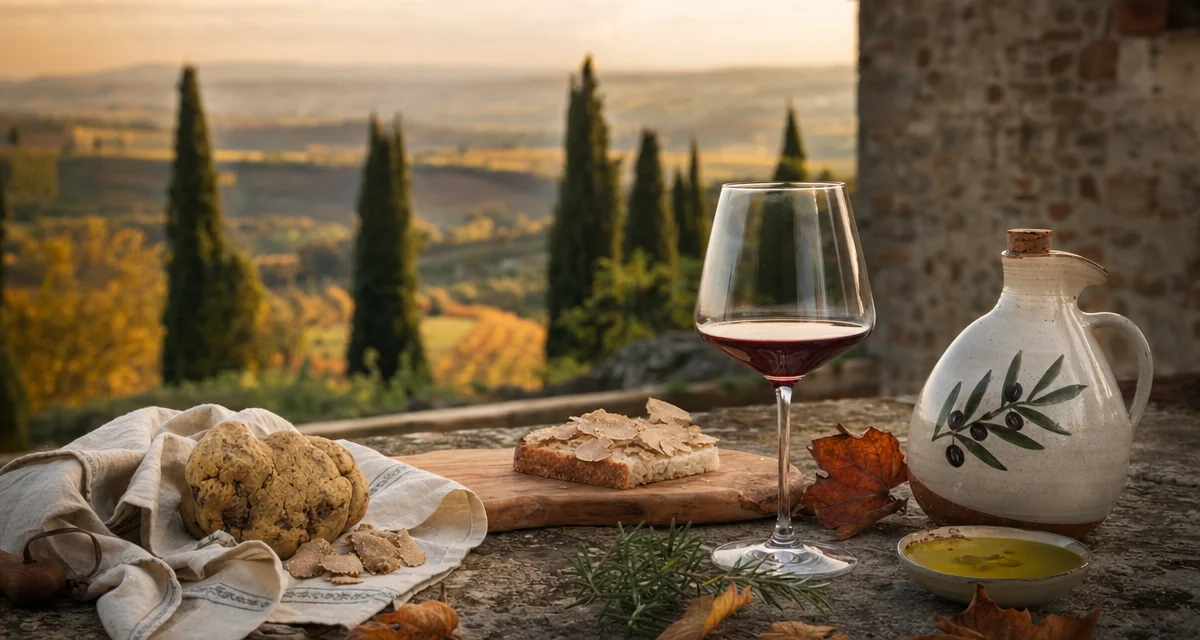
Truffle season in Tuscany never really stops, because four commercial species ripen one after another through the year, but the white truffle season from October to December is the one worth planning a trip around. According to Visit Tuscany's truffle guide, the white truffle (Tuber magnatum, the tartufo bianco pregiato) runs from October to December, the precious black winter truffle from November to March, the marzuolo from January to April and the summer scorzone from May to August. So a hunt in Tuscany in April or September is perfectly possible, just with a different truffle on the end of the spade. The white truffle is the prize because it cannot be cultivated, lives only a few weeks once ripe and loses its perfume within 7 to 10 days of leaving the ground, which is why it is eaten raw, shaved paper-thin, within a day or two of the hunt.
| Truffle | Species | Season in Tuscany | Where it grows | How a chef uses it |
|---|---|---|---|---|
| White truffle (tartufo bianco pregiato) | Tuber magnatum | October to December, best in November | San Miniato hills, Crete Senesi, Mugello, Casentino, Valtiberina | Shaved raw over tagliolini, fried eggs or risotto, never cooked |
| Black winter truffle (tartufo nero pregiato) | Tuber melanosporum | November to March | Oak and hazel woods across inland Tuscany | Grated into sauces, butter and crostini; gentle heat opens its flavour |
| Marzuolo or bianchetto | Tuber borchii | January to April | Pine woods along the Pisa, Livorno and Maremma coast | Shaved or folded into pasta; sharper and more garlicky than the white |
| Summer truffle (scorzone) | Tuber aestivum | May to August | Woodland throughout the region | Sliced thick over carpaccio and salads; mild and nutty |
Truffle hunting in October and November
If you can choose, go in the second half of October or anywhere in November. October hunts tend to be drier and warmer, around 15–18°C at midday, and the first white truffles are smaller and cheaper; November brings mist, mud, the best aromas and the festivals, with prices climbing week by week. Hunts usually start between 9am and 10am, once the dew has lifted enough for the dog to work, so you are back at your villa by early afternoon with the whole evening still ahead.
Where are the best places for truffle hunting in Tuscany?
The best places for truffle hunting in Tuscany are the San Miniato hills between Florence and Pisa, the Crete Senesi south-east of Siena, and the wooded valleys of the Mugello and the Casentino, all of which Visit Tuscany lists as white truffle country. Each has a different landscape and a different drive from the villa districts, so the choice often comes down to where you are staying.
San Miniato and the San Miniato truffle festival
San Miniato is a hilltop town of brick towers about 41 km west of Florence, in the province of Pisa, and it is Tuscany's white truffle capital: the record truffle found near the hamlet of Balconevisi in 1954 weighed about 2.5 kg and was sent as a gift to a US president. The woods along the Egola and Elsa streams, full of poplar, willow and oak, are where most hunts happen. Every November the town hosts the Mostra Mercato Nazionale del Tartufo Bianco, the national white truffle fair, and the 2026 edition is the 55th. According to Italia.it it runs over three weekends, 14–15, 21–22 and 28–29 November, with stalls in Piazza del Popolo selling truffles by the gram, so as of today two weekends are still to come. Our month-by-month calendar of Tuscan food festivals lists the other autumn fairs nearby.
The Crete Senesi and San Giovanni d'Asso
The Crete Senesi are the bare, rolling clay hills south-east of Siena, pale grey in winter and green in spring, dotted with cypress-lined farm tracks and the abbey of Monte Oliveto Maggiore. Their white truffle town is San Giovanni d'Asso, a small village now part of the Montalcino municipality, whose Crete Senesi White Truffle Fair reached its 40th edition on 7–8 and 14–15 November 2026. Hunts here suit anyone staying around Siena, Montalcino or Pienza, all within a 25–40 minute drive, which also answers the common question about truffle hunting near Montepulciano and the Val d'Orcia.
The Mugello and the Casentino
The Mugello is the broad green valley 30 km north of Florence, ringed by Apennine chestnut woods, known for its chestnuts, its tortelli di patate (potato-filled pasta parcels) and its quiet white truffle woods; one Mugello hunt reviewed by The Common Wanderer lists €160 per person including a home-cooked lunch. The Casentino, the upper Arno valley in the province of Arezzo, is wilder still, with beech and fir forests, medieval castles and a white truffle season that Tuscans themselves rate highly. Further west, Volterra hosts its Volterragusto white truffle fair in late October, alongside the Palio dei Caci cheese race.
Truffle hunting near Florence
Truffle hunting near Florence usually means San Miniato or the Mugello, both 40–50 minutes by car, and most day tours from the city bundle transport, a hunt and a lunch for around €229–400 per person. If you are staying in a villa outside Florence, booking the hunt directly and driving yourselves is cheaper, and you get to carry your truffle home rather than eat it at someone else's table.
How much does truffle hunting in Tuscany cost in 2026?
Truffle hunting in Tuscany costs between about €50 and €180 per person in 2026 for the hunt alone, depending on whether you share it with other visitors or book the hunter and dog for your group only, and €150–400 per person once a lunch, a cooking session or transport from Florence is added. Two operators publish their 2026 prices clearly. Casole Truffle, near Casole d'Elsa in the province of Siena, lists a shared hunt of about 1.5 hours from €50 per person and an exclusive two-hour hunt from €180. Truffle Hunting Tuscany, near San Gimignano, lists €80 per adult for a hunt, €130 per adult for a private hunt and €220 for a hunt with a cooking class and lunch. The truffle is a separate matter. La Nazione reported on November 11, 2026 that white truffle at San Miniato started at around €2,000 per kilo and doubled for the finest pieces, and il Resto del Carlino put top white truffle at the big autumn markets at €2,000–5,000 per kilo this season, with the autumn black truffle at around €800.
What is a truffle hunt with a tartufaio and his dog really like?
A truffle hunt with a tartufaio is slower, muddier and more absorbing than most people expect: two hours of walking at the dog's pace through damp woodland, long silences, a sudden burst of digging and, if the morning is kind, two or three truffles between 10 and 60 grams. The hunter talks while you walk, about which trees the white truffle likes (poplar, willow, lime, oak), why a good spot is a family secret and why he fills every hole back in. Children over 6 usually love it, and wellingtons matter more than any jacket in November. Is truffle hunting in Tuscany worth it? For anyone who cares about food, yes, because you finally understand why a few grams cost what they do, though on a dry morning the dog may find nothing at all and a good hunter will say so honestly.
The rule most Tuscan cooks follow with a white truffle is simple: warm butter, fresh egg pasta and no direct heat on the truffle itself. Everything else on the menu is there to step aside for it.
How does the day end with a truffle dinner at your villa?
The day ends best with a truffle dinner cooked at your villa: a chef arrives two to three hours before you sit down, brings the groceries and equipment, builds a menu around the truffle you bought in the woods, serves every course and leaves the kitchen clean. Chef On Demand does not run truffle hunts; the hunt is booked with a local operator, and the dinner afterwards is our service. You can book a private chef at your Tuscan villa for a 2–4 hour dinner or a long lunch, and many of our chefs come from Michelin-starred kitchens, Gambero Rosso–rated restaurants, MasterChef and Top Chef Italia, with guests rating the service 4.7/5 on Trustpilot. The truffle itself is always quoted separately, per gram or per dish, at that week's market price, because no honest chef can fix a truffle price in advance.
What a Tuscan truffle menu looks like
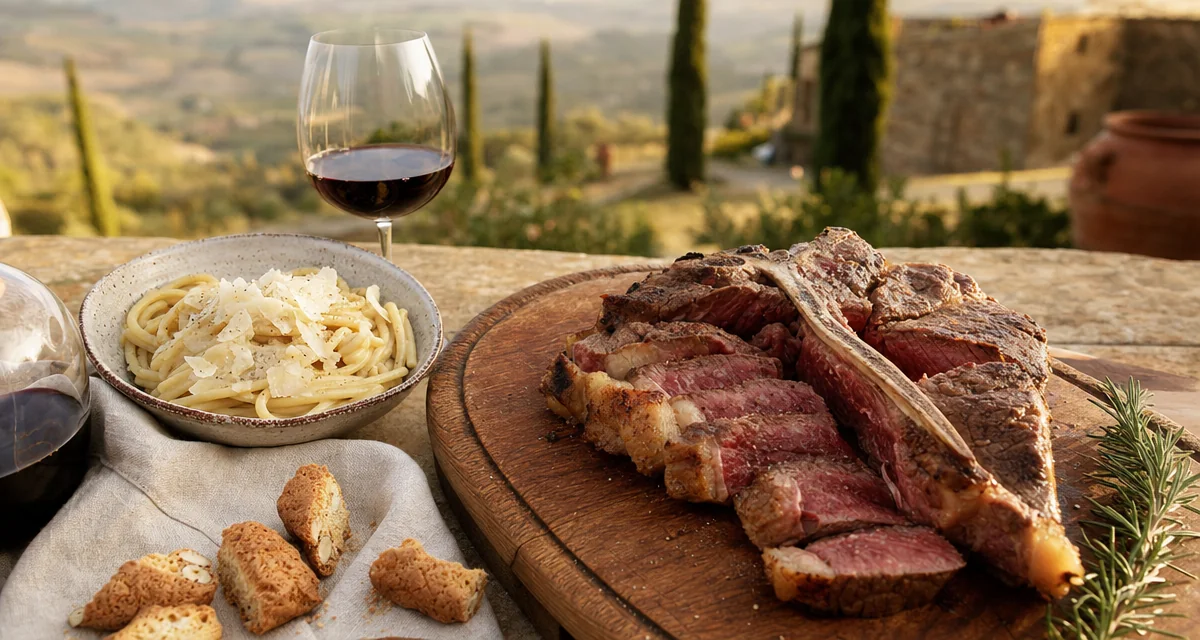
A classic menu starts with crostini of chicken liver and a few slices of black truffle, moves to an uovo al tegamino (an egg fried gently in butter, with the white truffle shaved over the soft yolk), and peaks with tagliolini al tartufo: thin ribbons of fresh egg pasta, about 2 mm wide, tossed in butter and a spoonful of cooking water, then covered at the table with 5 to 8 grams of white truffle shaved paper-thin. It works because the butter and the warm pasta carry the aroma without ever cooking it. To drink, ask for a Tuscan classic such as Brunello di Montalcino, a 100% Sangiovese red from the hills of Montalcino aged at least five years before release, with notes of cherry, leather and dried herbs that hold up to truffle without drowning it. The chefs we work with across the region often source eggs, butter and cheese from the producers described in our Slow Food guide to Tuscany.
| Menu tier | Courses | 6 guests | 10 guests | Where the truffle goes |
|---|---|---|---|---|
| Essential | 4 courses | €95 per person | €85 per person | One truffle course, usually tagliolini |
| Taste of Italy | 5 courses | €120 per person | €100 per person | Two truffle courses, for example the egg and the pasta |
| Luxury | 6 or more courses | €180 per person | €150 per person | Truffle through the menu, with wine pairing on request |
A Taste of Italy menu of 5 courses for 6 guests in the Siena countryside costs around €120 per person, and the same menu drops to roughly €100 per head at 10 guests. In practice, 6 guests with 6 grams of white truffle each need about 36 grams, which at San Miniato's November 2026 range of €2–4 per gram adds roughly €72–144 to the evening for the whole table. Italian public holidays carry a 35% uplift on the menu price, and 24–26 December, 31 December and 1 January are quoted as fixed group prices instead.
If your group would rather make the pasta than watch it being made, our Pasta Class + Dinner Experience takes place entirely at your villa or the apartment you've rented: a 2-hour hands-on class where you learn one long shape (tagliatelle or pici) and one short shape (maltagliati or farfalle), while the chef prepares two sauces, a few regional antipasti and a homemade tiramisù, then a seated dinner of everything you shaped. In truffle season one of the two sauces can simply be butter with your truffle shaved over the top. Nobody drives anywhere, children can join or drift off to play, you choose the wine from the villa's cellar, and the pasta you rolled is on your own table 30 minutes later.
How do I plan a truffle day in Tuscany?
Planning a truffle day in Tuscany takes six small decisions, and the order matters because the white truffle is perishable and the best November dates fill up early. For the dinner, our average booking lead time is 7–14 days in peak season, and two weeks ahead is a safe margin in November too, whichever of the chefs we work with across Tuscany you end up with.
- Choose the truffle first: October to December for white truffle, November to March for black, May to August for the summer scorzone.
- Pick the area closest to your villa: San Miniato from Florence or Pisa, the Crete Senesi from Siena or the Val d'Orcia, the Casentino from Arezzo.
- Book a morning hunt of 1.5–2 hours, shared from about €50 per person or private from €130–180, and confirm that you can buy what the dog finds.
- Request your dinner date with Chef On Demand at least 7–14 days ahead, stating group size, dietary needs and that the menu will be built around truffle.
- Agree a price per gram with the tartufaio, then send the chef the truffle's weight and a photo the same afternoon.
- Plan the timing: the chef arrives two to three hours before dinner, and you sit down to tagliolini while the truffle is less than 12 hours out of the ground.
Why this matters for your Tuscan holiday
Most travellers meet the white truffle on a restaurant menu, as a supplement of €30 or €50 shaved over a plate by a waiter in a hurry. Spending a morning in the woods with a hunter and his dog changes that completely: you see how rare a ripe truffle is, how hard it is to find, how quickly it fades. Bringing it home to be cooked the same evening closes the circle, and it turns a food experience into the evening your group still talks about years later. Our typical group is 4 to 12 guests in a private villa, and November, with its mist over the vineyards and fires lit in the evening, is one of the loveliest months to do it. Whether your villa sits in the Crete Senesi, the Chianti hills or the Mugello, you can browse our Tuscan chef network, or start from the Chef On Demand home page if you are planning dinners in more than one Italian region. Picture it: boots drying by the door, the dog long gone home, and a plate of tagliolini arriving under a cloud of shaved white truffle.