What is a Tuscan sagra and why plan a trip around one?
A sagra is a town or village food festival celebrating one specific local product or dish — wild boar, white truffle, new-pressed olive oil, a particular pasta shape — organised by the local pro loco association and held over a long weekend in the historic centre. Most sagre follow the season rather than a fixed calendar date. The appeal is twofold. First, you eat the regional specialty at festival prices (€10–€30 per dish), often cooked by local volunteers using recipes that don't appear on tourist menus. Second, you see Tuscany doing what Tuscans actually do on a Saturday night. The trade-off is logistical: parking is chaotic, cash is often required, English is rare. Staying in a villa within 20–40 minutes of the festival town — and having a private chef handle the rest of your meals — turns a hectic day trip into a relaxed festival-by-day, chef-led-by-night rhythm.
When are the major Tuscan food festivals in 2026? (Month-by-month calendar)
The 2026 calendar runs the full 12 months but clusters into three blocks. March–May is wine-fair season, anchored by Cantine Aperte on the last Sunday of May. June–September is hyper-local sagra season: every village runs a festival around its signature dish. October–December is harvest season — chestnuts, olive oil and white truffles, with the Sagra del Tartufo Bianco di San Miniato (last three weekends of November 2026) the headline event of the year. Below, a month-by-month roundup with the closest rental towns. Confirm exact dates 4–6 weeks before your trip via the official Visit Tuscany calendar.
January–April: low season, citrus and the first wine fairs
January and February are quiet but ideal for vineyard visits without crowds. March brings Anteprime di Toscana — tastings in Florence where the regional consortia pour new vintages of Chianti Classico DOCG (Sangiovese-based red from the hills between Florence and Siena), Vino Nobile di Montepulciano DOCG, Brunello di Montalcino DOCG and Vernaccia di San Gimignano DOCG (Tuscany's only white DOCG, made from the indigenous Vernaccia grape) before commercial release. Sagra del Prugnolo in Pieve Santo Stefano (May 15–17, 2026) celebrates the prized St George's mushroom hunted in the Apennine forests.
May–June: wine festivals open the season
May is when the Tuscan calendar gets serious. Radda nel Bicchiere (May 23–24, 2026) turns the medieval centre of Radda in Chianti into an open-air enoteca (a wine bar set up across town squares) with 30+ Chianti Classico DOCG producers pouring tastings and stands serving pici al ragù. Cantine Aperte (last Sunday of May 2026), organised by the Movimento Turismo del Vino, is the most important wine event of the year: hundreds of Tuscan wineries open cellars for tastings with light food pairings. Anchor villa towns: Greve in Chianti, Castellina in Chianti, Gaiole in Chianti and Radda in Chianti, all within 15 minutes of dozens of participating cantine. This is when private chefs across Tuscany become indispensable: you taste all afternoon and let someone else cook dinner.
July–August: hyper-local sagre and a starlit wine night
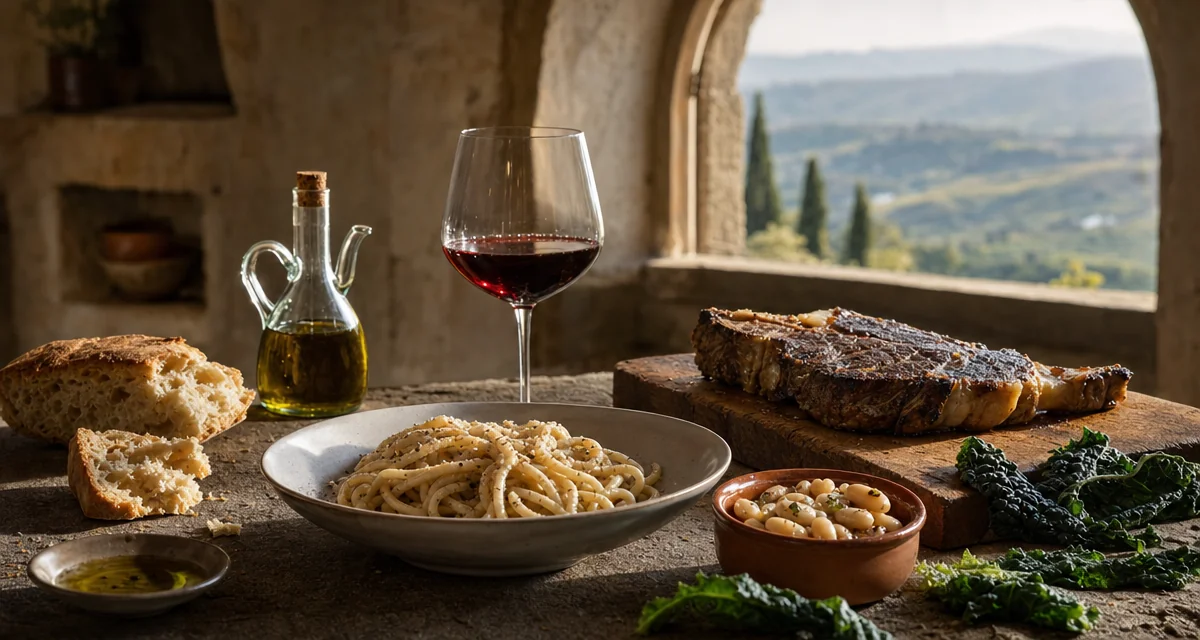
Summer is when every Tuscan village runs a festival. The picks for international travellers: Sagra dei Maccheroni di Sillicagnana in Garfagnana (July 10–12 and 17–19, 2026) — hand-rolled fresh pasta, dinner service with live music in the village square. Calici di Stelle on the night of August 10, 2026 (San Lorenzo, the night of the Perseid meteor shower) — Tuscan cantine and town squares pour wine under the stars. The most atmospheric settings are Montepulciano's Piazza Grande, San Gimignano's medieval towers and the cellars of Montalcino. Sagra della Bistecca alla Fiorentina in Cortona (third week of August 2026) celebrates Tuscany's defining dish: a thick T-bone steak (1.2–1.5 kg, 4–5 cm tall) cut from Chianina cattle, grilled rare over hardwood embers and served on the bone with Tuscan olive oil. Cortona fires up dozens of grills in the public garden — book a villa in Val di Chiana within 25 minutes.
September: harvest, wild boar and the great Chianti vintage
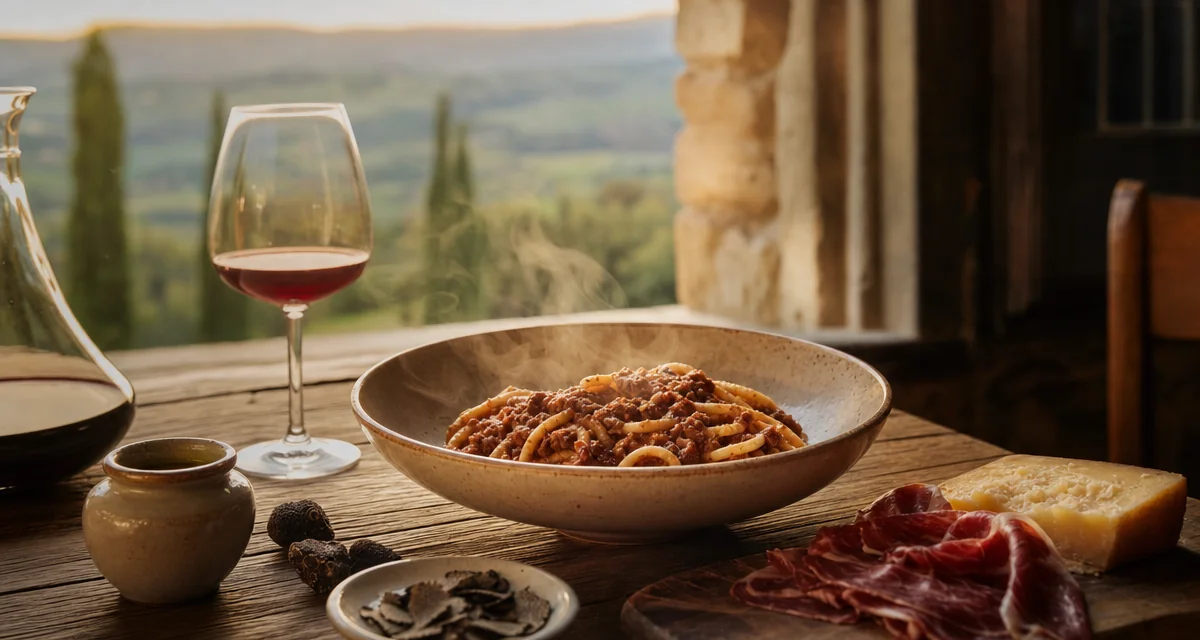
September is the richest month. Sagra del Cinghiale di Suvereto (September 9–13, 2026) in Maremma (the wild coastal-and-inland region of southern Tuscany) — wild boar as ragù on pappardelle, in stews, grilled, paired with local Val di Cornia DOC reds. Suvereto sits 30 minutes from Forte dei Marmi coastal villas. Mostra Mercato del Vino di Greve in Chianti (second weekend of September 2026) — 80+ Chianti Classico producers pour for three days in Greve in Chianti's Piazza Matteotti. The vendemmia (grape harvest) is in full swing: many wineries offer harvest lunches in the vineyards. Pitigliano Wine Festival animates the volcanic-tuff village of Pitigliano celebrating the local Bianco di Pitigliano DOC. According to Chef On Demand's network data of 800+ bookings since 2024, September is the busiest month for villa-with-chef requests in Tuscany — book four months ahead.
October–November: chestnuts, new oil and the white truffle
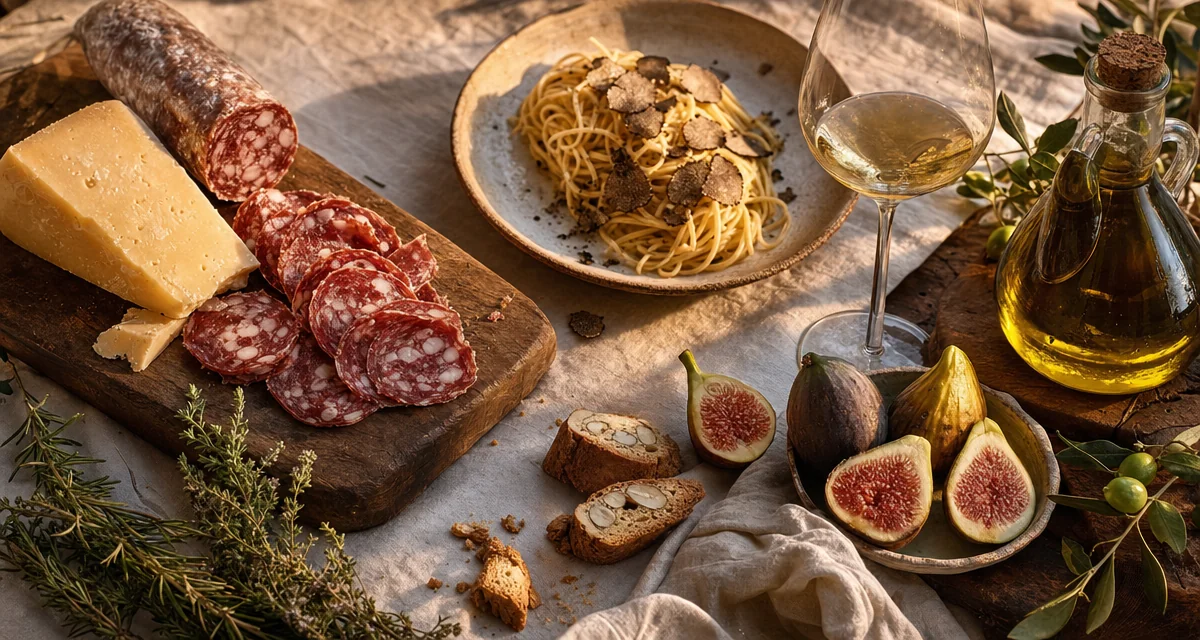
Autumn opens with chestnut sagre across the Apennine villages. Sagra della Castagna di Marradi (every Sunday of October 2026) in the Mugello mountains north of Florence celebrates the IGP-protected chestnuts of the Tuscan-Romagnol Apennines: castagnaccio (chestnut flour cake), marrons glacés, chestnut beer. November is olive oil season: Festa dell'Olio Nuovo a Lucca (third weekend of November 2026) showcases the early-pressing extra-virgin olive oil from the Lucca DOP zone — pungent, peppery, vivid green, drizzled on warm bruschetta. Stay in Lucca or the surrounding hills. The crown of the year is Sagra del Tartufo Bianco di San Miniato (Nov 14–15, 21–22, 28–29, 2026), whose territory produces around 25% of Italy's white truffles. Book a villa in Florence (50 minutes), Lucca (40 minutes) or San Gimignano (45 minutes) and drive in for the festival days.
December: Christmas markets and Brunello in the cellar
December is quieter but wine cellars stay open. Montalcino producers (home of Brunello di Montalcino DOCG, a 100% Sangiovese aged at least five years before release — black cherry, leather, tobacco, pairs with aged pecorino) and Montepulciano (home of Vino Nobile di Montepulciano DOCG, a softer Sangiovese aged at least two years) welcome visitors for tastings. Christmas markets in Siena, Lucca and Arezzo run from late November through Epiphany. For chef bookings on December 24–26 and December 31 / January 1, the platform applies fixed group pricing rather than per-person rates — confirm 6–8 weeks ahead because availability collapses fast.
How does a private chef fit into a festival trip?
The honest reason most travellers add a private chef to a festival trip isn't fine dining — it's logistics. Sagre run all afternoon and late into the evening; by the time you've parked, queued and tasted, you don't want to drive 30 minutes back and cook. A private chef solves three problems. One: shopping. Many of our chefs spend the festival morning at the same market as the visitors — fresh truffle from San Miniato vendors, new oil from the Lucca cooperatives, Chianina beef from Val di Chiana butchers — so the night's dinner uses the same product the festival celebrates. Two: cooking on-site. The chef works in your villa kitchen, brings groceries and equipment, plates and serves, then cleans up. Three: pace. You decide when to eat, when to open the next bottle, when to stop. The typical festival-week booking is 3–5 nights of villa stay with the chef cooking 2–3 dinners and 1 long lunch across that span — most groups still want a few independent restaurant nights to vary the rhythm.
When guests come for the truffle festival, I shop with them at San Miniato in the morning, then cook the same tartufo on a 36-month Parmigiano fonduta back at the villa that night. The truffle is fresher than anything they ate at the festival — that's the whole point of the format. Chef Lorenzo, Florence-based ambassador of Chef On Demand Tuscany
What does the multi-day chef format actually include?
For a festival trip, the right service to book is the multi-day stay: the chef accompanies your group across 3–7 nights and you choose which meals they cook each day — typically 2–3 dinners plus a long lunch, leaving evenings around the festival itself untouched. Daily market shopping is included, menus are personalised meal-by-meal, and service plus cleanup is part of the quote. There are three lodging configurations, and which one applies materially affects the cost. Configuration 1 — chef stays at the property: cheapest day rate because the villa has spare quarters and you absorb the lodging. Configuration 2 — local chef commuting daily: the chef lives within 30–45 minutes, drives in for service and returns home — no lodging cost. Best in dense regions like Chianti or Val d'Orcia (a UNESCO-listed valley in southern Tuscany — the cypress-stippled hillside on every Tuscan postcard, producing pecorino di Pienza DOP and Brunello di Montalcino DOCG). Configuration 3 — chef takes nearby lodging: when no local chef is available, the chef books a room nearby and the surcharge is line-itemed transparently. We don't quote a single multi-day per-person rate because the configuration genuinely changes the maths — the quote is built bottom-up.
- Pick your anchor festival first, then choose the villa town within a 20–40 minute drive.
- Confirm the 2026 festival dates 6–8 weeks before with the official Visit Tuscany calendar.
- Submit your booking request 3–6 months ahead for September–November festival weekends.
- Tell us which lodging configuration applies (chef stays at villa / local chef commuting / chef takes nearby lodging) so we quote the multi-day stay accurately.
- Plan 2–3 chef dinners + 1 long lunch across a 5-night stay, leaving 1–2 evenings unstructured.
- Ask the chef to shop the festival market — fresh truffle, new oil, Chianina beef — so the menu echoes what you tasted that day.
| Tier | Course count | Price per person (6 guests) | Price per person (8 guests) | Best fit for |
|---|---|---|---|---|
| Essential | 4 courses | around €95 | around €85 | Comfortable festival-day dinner: simple regional menu, classic Tuscan format |
| Taste of Italy | 5 courses (signature) | around €120 | around €110 | Most festival weeks: curated regional showcase echoing the day's product |
| Luxury | 6+ courses | around €180 | around €160 | Truffle fair / Brunello weekend: white truffle, aged cuts, multi-pairing wine flight |
Where should you base yourself for each festival?
Geography decides everything. Tuscany's festival clusters break into four base zones across our verified Tuscan chefs. Chianti Classico zone — base in Greve in Chianti, Castellina, Gaiole or Radda for May wine fairs and the September Mostra Mercato del Vino. Val d'Orcia — base in Montalcino, Montepulciano or Pienza (a UNESCO-listed Renaissance town producing pecorino di Pienza DOP) for Brunello and Vino Nobile visits, Calici di Stelle in August, and chestnut sagre in October. Lucchesia — base in Lucca for the November olive oil festival and the Garfagnana pasta sagre in July. Maremma and southern coast — coastal villas or villas inland (working farms renting rooms and serving meals from their own produce) for the Suvereto wild boar sagra and Pitigliano Wine Festival. Chef network density is highest in Chianti and Val d'Orcia, lighter in deep Maremma — which affects whether the local-chef-commuting configuration is available.
Why this matters for your Tuscan holiday
There are two kinds of trips to Tuscany. The first orbits around restaurants — booking tables in Florence and Siena, queueing for the bistecca, ticking off Michelin entries. The second orbits around the seasonal product — the same truffle, the same olive oil, the same wine Tuscans themselves eat that month — and meets it at the source: the village square where the sagra unfolds, the cellar where Cantine Aperte pours, the market where trifolau (truffle hunters) weigh the morning's tubers. Adding a private chef turns that trip into something achievable: someone who shops the festival, cooks the regional menu, and gives your group an unhurried evening at the villa. With a 4.7/5 Trustpilot rating across 800+ guests served since 2025 and a verified network of 12+ chefs across our Tuscan and broader Italian destinations, this is the format we've built around. Read more in our guide to traditional Tuscan dishes, our overview of Tuscan food experiences, and our food tour guide. Plan the anchor festival first and let the villa orbit around it.