What does a private chef for families with children actually do differently?
A private chef for families with children plans two service windows instead of one, builds the children's plate from the same market shopping as the adult menu, and calibrates portion, seasoning and plating to each child's age rather than to the headcount. Everything else is identical to any other booking: the chef arrives with the groceries and the equipment, cooks in your kitchen, serves, and cleans up.
What changes is the planning. With 8 adults and 3 children in the house, the chef is running two menus off one shopping list, so the questions we ask at booking are different. Ages, not just numbers. Whether the children eat pasta with sauce or only in bianco (plain, with butter and grated cheese). Whether anyone has an allergy, because a trace of pine nut in a pesto is a different problem when the person eating it is six. Whether the villa has a high chair, because most Tuscan farmhouses and Umbrian agriturismi do not: an agriturismo is a working farm that also rents rooms and serves meals from its own produce, so the kitchens are charming and the child-friendly hardware is missing. Across the family bookings we coordinate for private chefs across Tuscany, the pattern holds: parties who send these details 7 to 14 days ahead get a menu that works on the night, and parties who mention the children while the chef unpacks get an improvised bowl of pasta.
Private chef for kids: what actually changes in the kitchen
The mechanics are less dramatic than parents expect. A chef cooking for children does four things differently. The children's course is cooked and plated before the adult mise en place goes near the heat, so it can leave the kitchen at 18:00 without rushing the rest. Salt goes in at the end rather than through the cooking, and any sauce built on a wine reduction gets a separate small pan made without it. Sauces, chilli and strong cheeses are served alongside rather than stirred through, the highest-yield trick anyone has found with a suspicious seven-year-old. And the plate is smaller: two components rather than five. None of this needs a second chef, and none of it is an upsell. It needs about 20 minutes of extra planning and one or two extra items on the market list. What it changes is the shape of the evening, because a chef in a villa can run an 18:00 children's service and a 20:30 adult dinner off one kitchen, which no restaurant in Florence or Rome will do for you in August.
Kids' menu or adapted dish? Three ways to feed the table
There are three workable ways to feed children at a private chef dinner, and the right one depends almost entirely on age. A parallel kids' menu suits children between 2 and 7 years old, an adapted version of the adult dish suits 8 to 14, and a half portion of the full menu suits teenagers, usually the most adventurous eaters at the table once nobody is watching them.
The parallel menu is what most families picture, and in Italy it is easy to do well because the classic children's repertoire here is genuinely good food rather than a compromise. Pastina is the family of tiny pasta shapes (stars, rings, grains of rice) that Italian children are raised on, served in broth or with butter and grated cheese, and it is the default first food from Milan to Palermo. Pasta al pomodoro, spaghetti or penne in a plain tomato and basil sauce cooked in 20 minutes, is the second. Neither is a step down, and both come out of the pan the adults' primo comes from. The adapted dish is more elegant once children are curious enough. The chef cooks one thing and splits it: the adults get pici, the thick hand-rolled Tuscan spaghetti of flour and water dressed with a slow wild boar ragù, while the child gets the same pici with the sauce in a bowl on the side and a spoon of grated Parmigiano Reggiano DOP, the hard cow's-milk cheese from Emilia-Romagna aged at least 12 months.
| Approach | Works best for | What the child eats | Service timing |
|---|---|---|---|
| Parallel kids' menu | Ages 2 to 7, or a table with a wide age gap | Pastina in broth or pasta al pomodoro, a plain grilled protein, fruit or gelato | Served at 18:00 or 18:30, before the adult sitting |
| Adapted adult dish | Ages 8 to 14 who eat most things | The same dish, with sauce, chilli and strong cheese served on the side | At the adult table, usually first two courses only |
| Half portion, full menu | Teenagers and confident eaters | The identical menu at roughly half portion, nothing removed | Seated with the adults for the whole dinner |
What time do children eat when a private chef cooks in Italy?
In Italy dinner starts late. Kitchens across Tuscany and Lazio open around 19:30 and Italian families sit down between 20:30 and 21:00, which is two to three hours after most British, American and Australian children are used to eating. A private chef resolves this by splitting the service rather than compromising it.
The standard pattern runs like this. The chef arrives between 16:30 and 17:00, unpacks the market shop and cooks the children's course first. The children eat at 18:00 or 18:30, at the kitchen table or by the pool, and are done in about 30 minutes. The adults sit down at 20:30 for the full menu, by which point the younger children are in bed and the older ones have drifted back for dessert. The chef's window stretches to 5 or 6 hours rather than the usual 3 to 4, which is worth stating when you request the quote. One cultural detail helps more than it should: the merenda, the mid-afternoon snack Italian children eat around 16:30, usually bread with olive oil, fruit or a slice of focaccia (the dimpled, olive-oiled flatbread sold by weight in every Italian bakery). Ask the chef to leave a merenda out on arrival and you buy 90 minutes of calm. Families around Sorrento often push the whole thing an hour later.
Parents apologise to me for their children as though the kids were the complication. They are the easiest part of the evening. What is complicated is being told at seven o'clock that there are three of them. Chef Lorenzo, Florence-based ambassador for Chef On Demand in Tuscany
How much does a private chef cost for a family with children?
Pricing in Italy is per person, per tier, and calculated on the adults at the table. A four-course Essential dinner for 6 adults is quoted at around 95 euro per adult, easing to roughly 85 euro per adult at 8 guests or more. A five-course Taste of Italy menu, the middle tier and the one most families book, sits near 120 euro per adult at 6 and 110 euro at 8, settling around 100 euro per adult from 9 upwards. The Luxury tier, six or more courses built on truffle, seafood or aged cuts, runs about 180 euro per adult at 6 guests and 160 euro at 8.
The number that matters most to families is this one: in Italy those per-person bands are applied to the adults in the party, and children are not added to the per-person count. A table of 6 adults and 3 children is quoted on 6, not on 9. That is the main reason a chef in a villa frequently works out gentler on the budget than a restaurant for the same group, where every child occupies a cover and orders from a menu written without them in mind. Two adjustments are worth knowing before you compare numbers. Premium city zones, which include Milan and Rome, add about 15 euro per person. Christian holidays such as Easter carry a surcharge of roughly 35% in Italy, and the days around Christmas and New Year are priced as a fixed group total rather than per head. On menu length, our piece on how many courses a private chef dinner runs to works through the arithmetic.
Private chef cost per day on a multi-day family stay
Multi-day is the format most family villa holidays actually want, and it is quoted differently. Instead of a per-person dinner rate, the chef accompanies your party for the length of the stay, typically 3 to 7 days, and you choose meal by meal which ones they cook: breakfast, lunch, dinner or any combination. A common weekly pattern is two or three dinners plus one long lunch, because most families still want a few independent nights out. Three lodging configurations drive the daily rate. If the chef stays at the property, in a spare room or chef's quarters, the rate is at its lowest, because you are absorbing the accommodation. If a chef from our Tuscan chef network, or from a dense region such as the Amalfi Coast or Lake Como, lives within 30 to 45 minutes and commutes daily, the rate stays low because there is no accommodation to factor in. If the property has no chef's quarters and no resident chef is nearby, the chef takes a room within a short drive and the quote line-items that surcharge openly. Daily market shopping is included in all three.
Can the children join a pasta class at the villa?
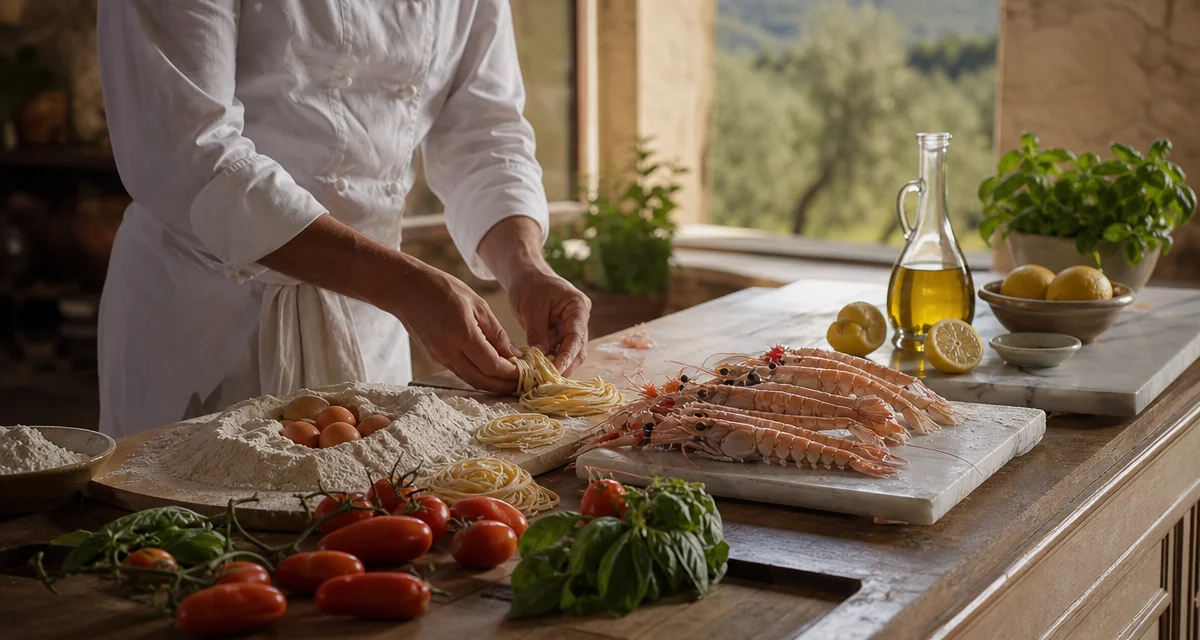
Yes, and it is the format families with children ask for most. The Pasta Class + Dinner Experience is a single booking of 4 to 5 hours that happens entirely at your villa, apartment or holiday rental. The chef travels to you carrying every ingredient and every tool: dough boards, rolling pins, pasta cutters, pots, plates. You do not go to a cooking school, a restaurant kitchen or a culinary academy, and there is no transfer between the lesson and the meal, because both happen in the same kitchen and at the same table.
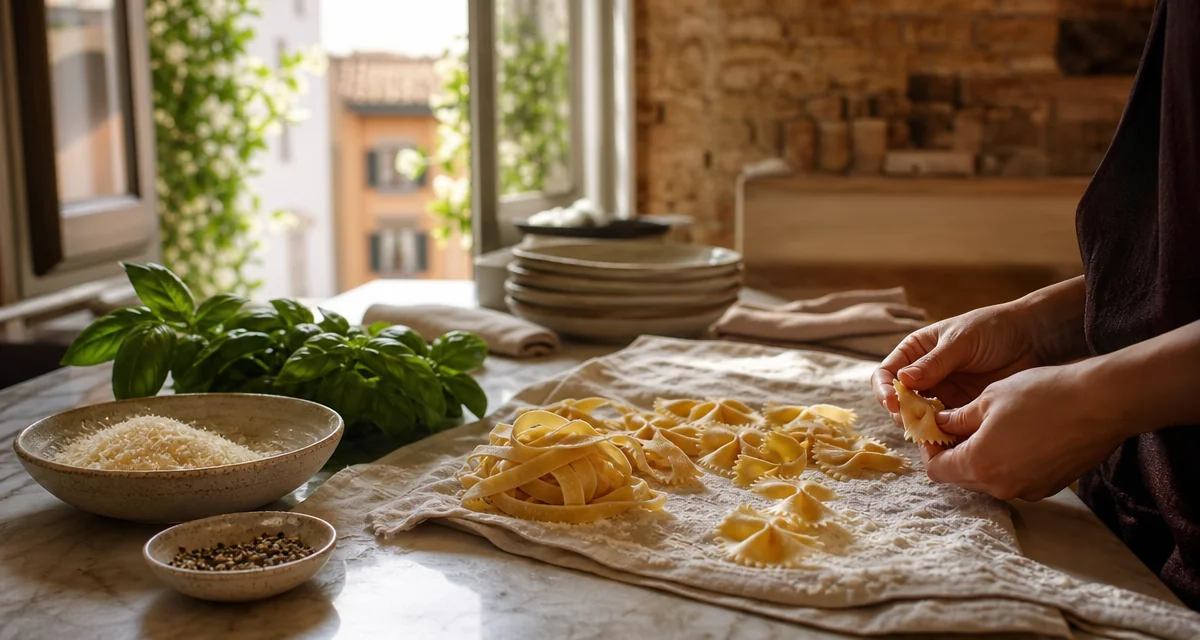
The structure is fixed enough to plan a day around. Two hours of hands-on class, usually 14:00 to 16:00, in which the chef teaches two fresh pasta shapes: one long (pici, tagliatelle or pappardelle) and one short (orecchiette, farfalle or maltagliati). Everyone kneads, rolls and shapes. While the dough rests, the chef prepares two sauces, one for each shape, plus two or three regional antipasti and a homemade tiramisù, the layered dessert of mascarpone cream and coffee-soaked savoiardi biscuits from the Veneto. Then everyone sits at your own table and eats what they made, plated and served by the chef, who cleans the kitchen afterwards. It is quoted at 150 euro per adult and 60 euro per child, so 4 adults and 3 children comes to 780 euro for the whole afternoon and evening. Children from about 6 years old can do the work: orecchiette, the ear-shaped pasta from Puglia, are made by dragging a knife across a rope of dough and flipping each piece over a thumb.
Doing it at the property rather than at a class venue matters more with children than without them. Your group is the only group, so nobody is kneading dough beside twelve strangers on a fixed menu. There is no 40-minute drive each way, which in rural Chianti or the Val d'Orcia (the cypress-ridged valley south of Siena that produces pecorino di Pienza DOP and Brunello di Montalcino DOCG) is the difference between an afternoon and a logistical operation. The timing bends to your children rather than to a class schedule, so a toddler can nap next door and reappear for the tiramisù. And the pasta a six-year-old shaped is on their plate 30 minutes later, in the same room, which is the part they remember. What they take home is the technique, not paperwork. There are no recipe cards, printed or digital, no PDFs and no follow-up emails with recipes. The class itself is the takeaway: the feel of the dough, the drag-and-flip of an orecchietta, the timing of pasta into salted water.
- State each child's age and, if it matters, their weight class as an eater. 'Two boys, 9 and 11, both eat like adults' changes the shopping list more than the number 2 does.
- Name the two or three dishes each child reliably eats at home, and the two or three they refuse. Chefs plan around refusals faster than around preferences.
- Declare allergies and intolerances separately from fussiness, as a bullet list rather than in prose. Our piece on telling a private chef about allergies and dietary restrictions covers the wording that avoids cross-contact.
- Give both service times in one sentence, for example 'children 18:00, adults 20:30'. This sets the chef's arrival and the length of the booking.
- Describe the kitchen and the table honestly: number of hobs, whether there is an oven, whether a high chair exists, whether the terrace seats 12 guests or 8.
- Say whether the children are joining a Pasta Class + Dinner or only the dinner, because the class is quoted per adult and per child and runs on a different clock.
Which Italian dishes do children actually eat?
More than you would guess, because Italian regional cooking was largely built for households where children ate what everyone else ate. Cotoletta alla milanese, a veal cutlet pounded thin, breaded and fried in butter, is the dish Italian children ask for by name and the one that converts foreign children fastest; it is a Lombard classic and the ancestor of every schnitzel argument in Europe. Polpette al sugo, small beef or veal meatballs simmered slowly in tomato sauce, do the same job across the south. Gnocchi, soft dumplings of potato and flour boiled for 2 minutes until they float, are the pasta course for children who find spaghetti hard work. Dessert takes care of itself: gelato ends most family dinners, and a chef told in advance will make a version of the tiramisù for the children without coffee or Marsala.
Portioning: how much a child actually eats at a five-course dinner
Portioning is the quietest of the four levers and the one parents get wrong most often, usually by panicking that a five-course menu is far too much food. It is not. An Italian multi-course dinner is not five restaurant plates stacked end to end: each course is deliberately small, and the total volume across an evening comes out closer to two generous plates. For a child of 6 to 10 years, a chef plates roughly half the adult portion of the primo (an adult primo inside a longer menu is around 60 to 80 grams of dry pasta, so the child gets 30 to 40), about a quarter of the secondo, and skips the antipasto unless the child has shown an interest. Under 6 years, the honest answer is one plate and a dessert, served early. Above 13, plate as an adult and be ready to plate again. The instruction worth giving explicitly is to hold something back: a bowl of plain pasta set aside before the sauce goes in costs the chef nothing and rescues the most predictable crisis of the evening.
Why this matters for your Italian holiday
Families do not book a private chef because they cannot cook. They book one because the alternative, on a holiday with children, is a nightly negotiation nobody wins: a 19:30 restaurant reservation that is too early for the kitchen and too late for the four-year-old, a 25-minute drive on unlit hill roads, a high chair that does not exist, and a bill that counted every child as a full cover. Hiring a chef removes all of it in a single decision. The children eat at their hour, in a room they already know, off a plate built for them. The adults eat at the Italian hour, outside, with the light going out over the vines. Nobody drives, and nobody washes up. You can browse private chefs across Italy by city and region, or start from the stay itself: plenty of our family bookings begin as a villa week in the hills and end as a Tuscany private chef experience spread over three evenings, one long lunch and a great deal of flour on a nine-year-old. That is the version of Italy children keep.