What does a cooking class in Rome for families actually look like?
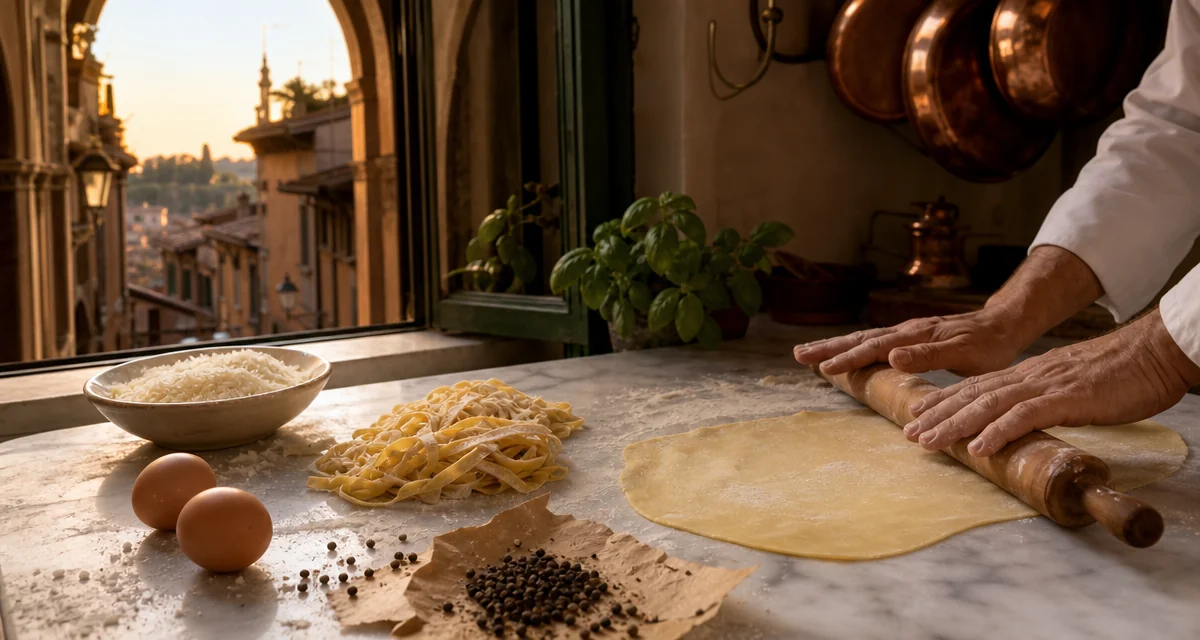
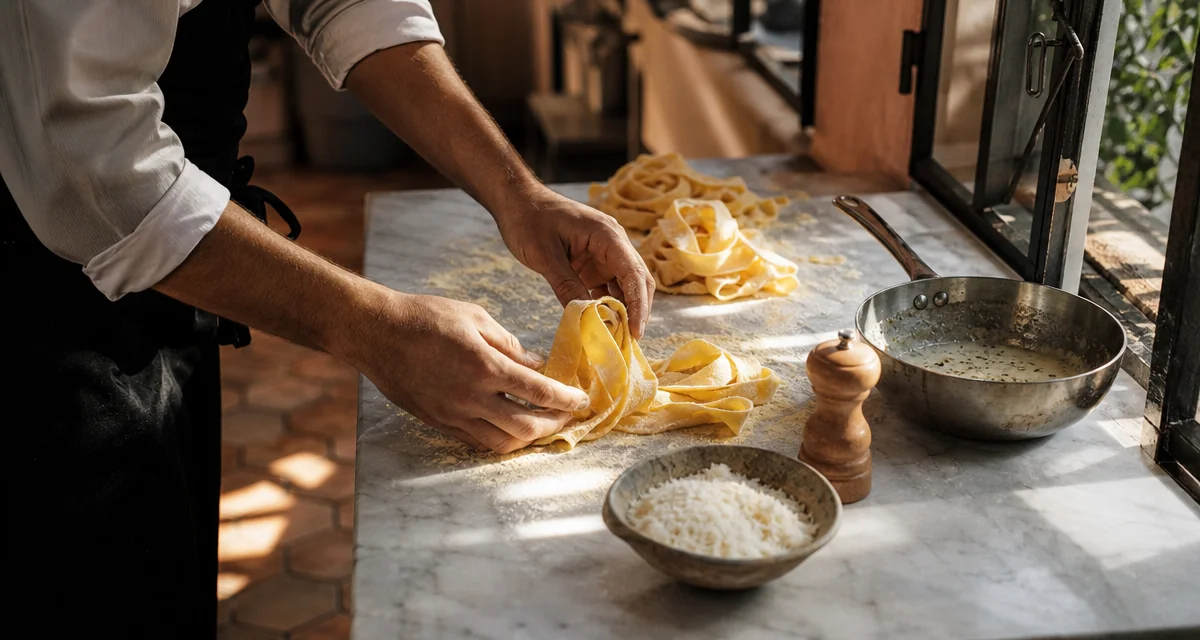
A family cooking class in Rome is a hands-on session where parents and children cook a Roman menu together under a chef's guidance, then sit down and eat it. Most run 2 to 4 hours and centre on fresh pasta, with pizza or focaccia and a dessert. The Chef On Demand version is the Pasta Class plus Dinner Experience, delivered entirely at your villa, apartment or holiday rental. A chef arrives at the property you're staying in with all the ingredients, dough boards, rolling pins and pots, teaches your group two fresh-pasta shapes (one long such as tagliatelle, one short such as the little farfalle children love to pinch), then cooks a full seated dinner of antipasti, both pastas with their sauces, and homemade tiramisu (a layered dessert of coffee-soaked savoiardi biscuits and sweetened mascarpone cream). There is no class venue to reach and no transfer between lesson and dinner: the pasta the children shaped is on the table about thirty minutes later, in the same room. The brand runs a verified network of private chefs across Rome and the wider Lazio region, many trained in Michelin-starred and Gambero Rosso-rated kitchens, so the cooking is genuinely good even when the cooks are nine years old.
What age can children join a cooking class in Rome?
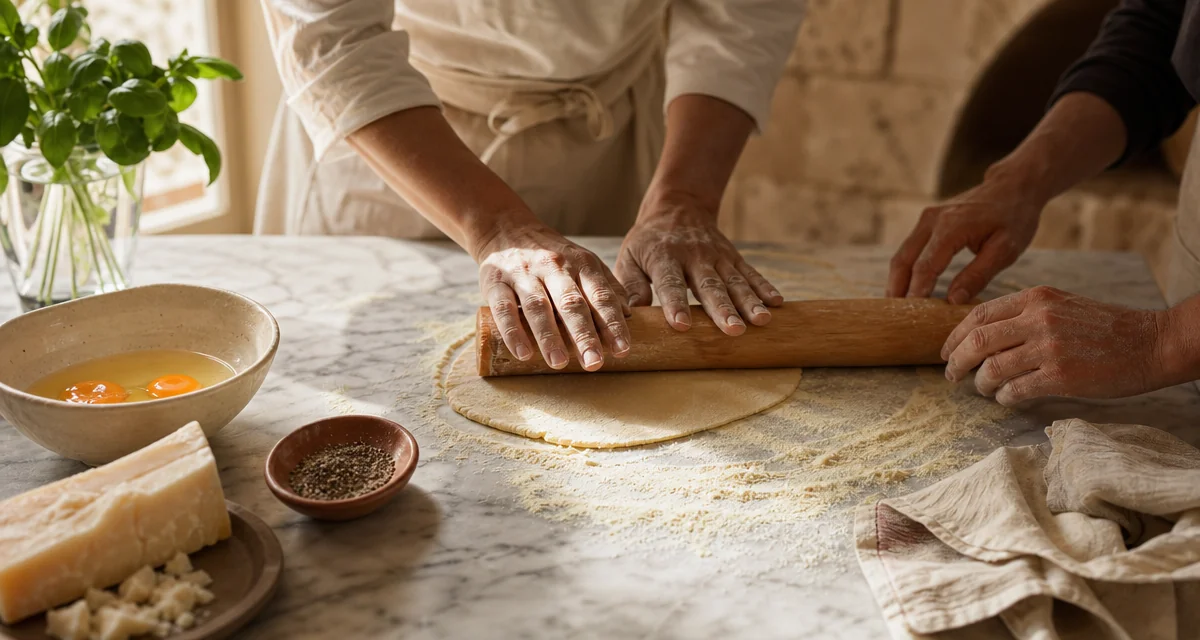
Most Roman family cooking classes welcome children from around age 4, and there is no upper limit. Toddlers under 4 are usually welcome to watch, taste and stamp a bit of dough while an adult supervises, rather than work a full station. Pasta making is the most age-flexible task in Italian cooking: rolling, cutting and shaping demand enthusiasm rather than skill, and a four-year-old who can press cookie cutters can press farfalle. From about age 8, children handle a rolling pin and a blunt pasta cutter confidently, and teenagers often take over an entire dish. The chef calibrates the session to the youngest hands at the table, which is far easier in a private in-home class for one family than in a group cooking school sharing twelve strangers. Roman classics scale beautifully to small cooks: cacio e pepe (a Roman pasta of pecorino romano cheese and cracked black pepper, with no cream and no fuss), pizza or focaccia for dough-pummelling, and tiramisu for the grand finale. Children who refuse vegetables at home have been known to eat their own hand-cut tagliatelle without complaint.
How much does a family cooking class in Rome cost in 2026?
Group cooking-school classes in Rome are publicly advertised from roughly €60 to €90 per adult in 2026, typically with a reduced child rate of around €40 to €55, according to listings on platforms such as GetYourGuide and Viator. A private in-home family class is priced differently: Chef On Demand quotes the Pasta Class plus Dinner Experience as one bundled experience for your whole group, not a per-head ticket, because a private chef travels to your rental, shops at a local market, teaches, cooks a full dinner and cleans up. The total depends on group size, the number of courses and your chosen menu tier (Essential, Taste of Italy or Luxury), so the fairest answer is a custom quote. As a rule of thumb, the more guests in your party, the lower the effective cost per person, since the chef's time is shared across more plates: a group of 4 sits well above a group of 8 per head. Prices rise around Christian holidays and the Christmas-New Year window, when peak surcharges apply across the Italian network. The honest comparison is not class versus class but a private chef in Rome at home versus a family table in a tourist-strip trattoria, where a four-course dinner for a family of five can quietly reach a similar total with none of the cooking, the memory or the choose-your-own-pace calm.
Private in-home class or group cooking school: which suits families better?
For most travelling families, a private in-home class beats a group cooking school, because it adapts to your children rather than the other way round. A group class follows a fixed menu and a fixed clock for a mixed cohort of strangers, while a private class at your rental moves at your family's pace, tailors the menu and dietary needs to your party, and never makes a shy seven-year-old perform in front of twelve adults. The table below sets out the practical trade-offs so you can decide based on your own group, not on marketing copy.
| Factor | Group cooking school | Private in-home family class |
|---|---|---|
| Where it happens | A class venue you travel to in central Rome | Your villa, apartment or holiday rental; the chef comes to you |
| Pace and timing | Fixed start and end for a shared cohort | Starts and ends when your family decides |
| Menu and allergies | Set menu, limited substitutions | Personalised menu, allergies handled per child |
| Best for | Couples and older kids who like meeting people | Toddlers, mixed ages, allergies, larger families |
| After the class | You cook, eat at a counter, then leave | A proper seated dinner on your own table, no transfer |
| Pricing model | Per adult plus reduced child rate | One bundled quote for the whole group |
What do kids cook versus watch in a Roman family pasta class?
Children do the shaping, the parents help with prep, and the chef keeps anything sharp or hot. In a Roman family pasta class, kids reliably handle the parts that are fun and safe: mixing flour and egg, kneading, rolling the dough, cutting long shapes with a blunt cutter, pinching short shapes by hand, and layering the tiramisu at the end. The chef manages the knives, the boiling water and the stove, and steps in for the saucepan work, such as toasting pepper for cacio e pepe or simmering a simple tomato sugo. This division is exactly why pasta making is the gold standard for family classes: the visible, photogenic, memory-making steps are precisely the ones a 4 to 10 year old can own. Many of our chefs come from Michelin-starred kitchens, Gambero Rosso-rated restaurants and Top Chef Italia, yet the moment they hand a four-year-old a ball of dough they become patient teachers first and chefs second. If you want to weigh the city's options more broadly, our wider guide to cooking classes in Rome walks through every format for every kind of traveller.
Where in Rome do families take cooking classes?
Families take cooking classes wherever they are staying, which is the quiet advantage of the in-home format. Rather than dragging tired children across the city to a class venue, the chef comes to your rental, whether that is an apartment in Trastevere (the lively cobbled district across the Tiber, full of trattorie and evening strollers), a flat near the Vatican, or a larger holiday home in the greener neighbourhoods toward the Appian Way. If your group is based outside the city in a Lazio villa, the same network reaches you there. Booking one of our Rome private chefs means your toddler can nap in the next room and your dinner still happens on schedule. For families touring more of Tuscany and beyond, the same bundled format runs through our private chefs across Florence, so a cooking class in Rome can become the first of several, each on the table of the home you've rented.
The children always think the kitchen belongs to them by the end. I just hand over the dough and the farfalle cutter, keep the stove to myself, and forty minutes later a six-year-old is plating tagliatelle for the whole family. That is the dinner the parents photograph, not the Colosseum. Chef Lorenzo, Rome-based ambassador of Chef On Demand Lazio
How do I book a family cooking class in Rome?
Booking a family cooking class in Rome takes a short request and a brief chat about your children. Tell us your dates, where you're staying, how many adults and children, and the ages of the youngest cooks, and we match you with a private chef in Rome who tailors the menu and the pace. Average booking lead time across our network is 7 to 14 days for peak season (June to September), so plan ahead for summer travel. Use this simple checklist to get the most from the experience.
- Confirm your travel dates and the address of your Rome rental before you request a quote.
- Count adults and children separately, and note the age of the youngest child.
- List any allergies or dietary needs so the chef plans safe, kid-friendly dishes.
- Choose your menu mood: classic Roman pasta, or add pizza and focaccia for dough-loving kids.
- Pick a slot that lands after a nap or a quiet morning, not at the end of a museum marathon.
- Ask whether wine pairings are available for the adults while the children cook.
- Submit your details through Chef On Demand and confirm the chef once matched.
Restaurant family dinner or cooking class: which wins the evening?
A restaurant family dinner feeds everyone, but a cooking class feeds everyone and gives the children something to do, which on a long trip is worth more than another plate. A tourist-strip trattoria near a major Roman sight will seat a family of five, deliver four courses, and quietly land at a total that often sits close to what a private in-home class costs, yet the children are asked to sit still for two hours after a day on their feet. The cooking class flips that: the same two hours become the activity, the meal arrives as the reward, and nobody is shushing a restless child. For one special evening of a Roman week, the class is usually the better spend; for the other nights, the restaurants of Trastevere and Testaccio do their job beautifully. The point is not to replace eating out, it is to turn one dinner into the thing the children remember.
Why this matters for your Roman family holiday
A cooking class is the rare Rome activity that asks nothing of your children except enthusiasm and rewards them with a dinner they cooked themselves. With a 4.7 out of 5 Trustpilot rating based on 800+ guests served since 2025, our private chefs turn a couple of hours in your rental into the memory the family carries home, just the muscle memory of rolling pasta under the chef's hands and the taste of the tiramisu the children layered. If Rome is one stop on a longer Italian trip, the same private-chef experiences run nationwide, so explore what's possible through our network of private chefs across Italy and let your children cook their way through the country, one rented kitchen at a time. Years from now, they will remember the afternoon they made pasta in Rome long after they've forgotten which museum came on which day.