What does 'nonna's pasta' actually mean in Tuscany?
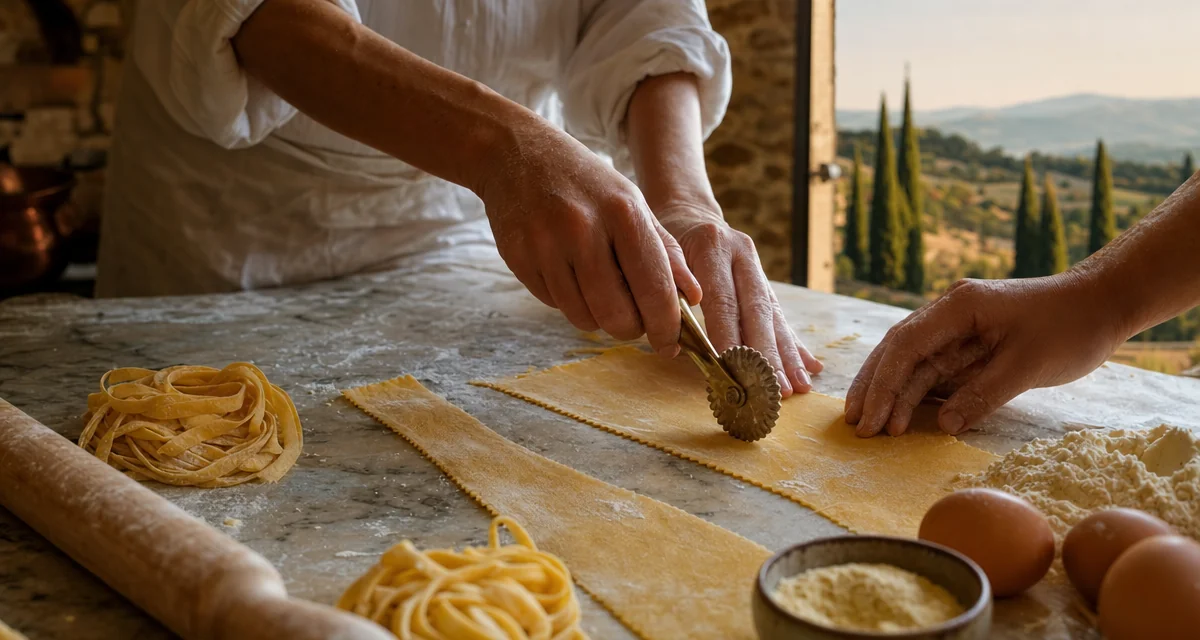
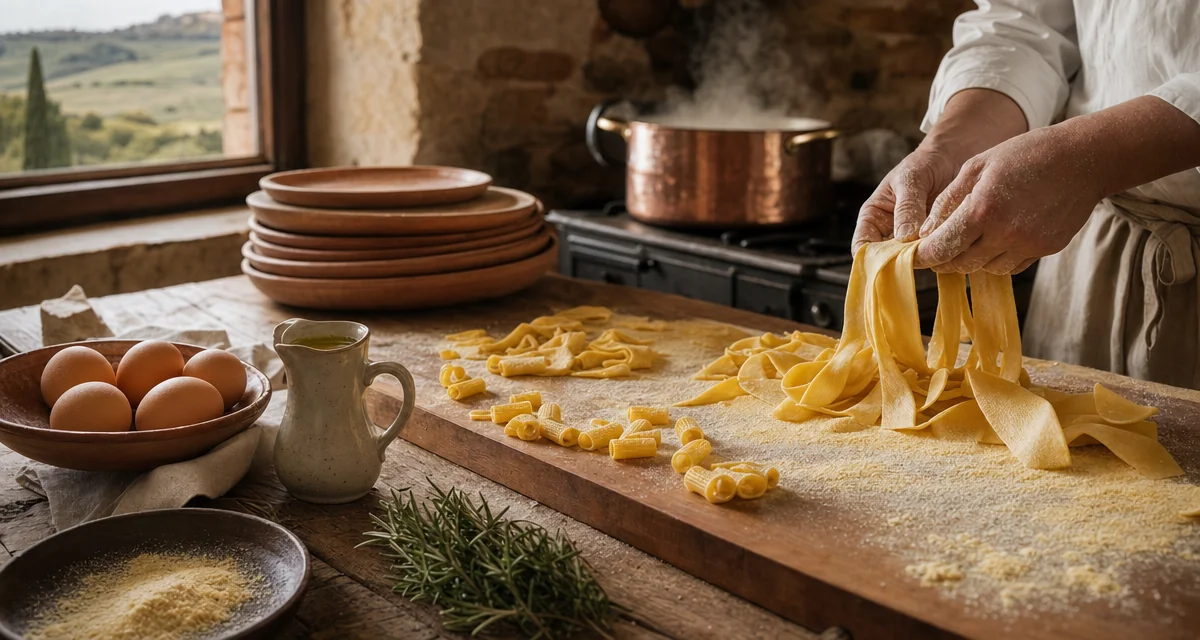
Nonna's pasta is the body of fresh-pasta knowledge that lives in the kitchens of Italian grandmothers — passed down orally, by feel rather than by gram, with no written recipe to consult. In Tuscany the tradition is older and more regional than most travellers expect — each valley defends a specific shape and a specific sauce. Pici — thick, uneven, hand-pulled spaghetti made from just flour and water — belong to the Val d'Orcia (the UNESCO-listed valley around Pienza and Montalcino) and the neighbouring Val di Chiana, where the famed Chianina cattle graze. Pappardelle — wide ribbons of egg pasta a centimetre across — are the Florentine and Chianti answer, designed to scoop up a slow ragù di cinghiale (wild boar ragù) or duck ragù. Tortelli mugellani — large stuffed pillows filled with potato and herbs — are the speciality of the Mugello valley north of Florence and the Casentino. None of this is invented for tourists: it's cucina povera ('poor kitchen' cooking) refined over generations, where the rule is to use what the land gives you and waste nothing. Nonna's pasta isn't a recipe — it's a method, a posture at the board, and a sauce that simmered while she did three other things.
Which pasta shapes define each part of Tuscany?
Tuscany is not one cuisine — it's seven or eight, each tied to a sub-region and the shape a grandmother there has been rolling for sixty years. In the Val d'Orcia (around Pienza, Montalcino, Montepulciano) the queen is pici, paired classically with pici all'aglione (giant Tuscan garlic, tomato and a hint of chilli simmered for 30–40 minutes) or with pici con le briciole (toasted breadcrumbs in olive oil — the original cucina povera dish from when meat was unaffordable). In Chianti and around Florence, pappardelle al ragù di cinghiale rules: wild boar simmers in red wine and tomato for four to six hours until it shreds with a fork. In the Mugello north of Florence, tortelli mugellani filled with potato and parsley are served with butter-and-sage or a meat ragù. In the Maremma (the wilder south-western coast), tortelli maremmani with ricotta and spinach often pair with duck or hare. In the Lunigiana (the far north-west, towards Liguria), testaroli — a sort of pancake-pasta — predate dried pasta by centuries. The closer you stay to your villa's valley, the closer your nonna pasta gets to the real thing.
When my grandmother taught me pici, she never weighed the flour — she'd say 'two handfuls and a thumb of water'. The shape doesn't have to be perfect; the rougher the surface, the better the sauce sticks. That's nonna's secret: imperfection is the design. Chef Elena, Pienza-based ambassador of Chef On Demand Tuscany
Where can you experience authentic nonna pasta in Tuscany?
There are three honest routes to an authentic nonna pasta moment in Tuscany. Route one: visit a family-run villa (a working farm that also rents rooms and serves meals from its own produce — Italian law requires a minimum share of revenue from farming, so eating there feels closer to a farmhouse kitchen than a restaurant). The pasta is rolled the same morning by the family. Route two: book a cooking class with a local nonna — these exist in Florence, Siena and the Val d'Orcia, but you share the kitchen with eight to twelve strangers, the menu is fixed, and you lose half a day to transfers. Route three — the one we coordinate most for international guests — is to invite the chef into your villa kitchen: a chef from our verified network of private chefs across Tuscany arrives with dough boards, rolling pins (the mattarello) and ingredients sourced that morning, teaches your group on your own table, then cooks the dinner you sit down to. No transfer, no strangers, your villa as the stage. If you're staying in Greve in Chianti, Montepulciano or Pienza, route three is by far the highest-fidelity nonna experience available.
- Match the chef to the valley you're staying in — a chef from Pienza for pici, from Florence for pappardelle, from the Mugello for tortelli.
- Ask for two pasta shapes in a single experience: one long (pici or pappardelle) and one short or stuffed (tortelli or maltagliati) — this is how the Pasta Class + Dinner Experience is built.
- Schedule wild boar ragù for a multi-day stay, not a single evening — it needs 4 to 6 hours of simmering to reach the right texture.
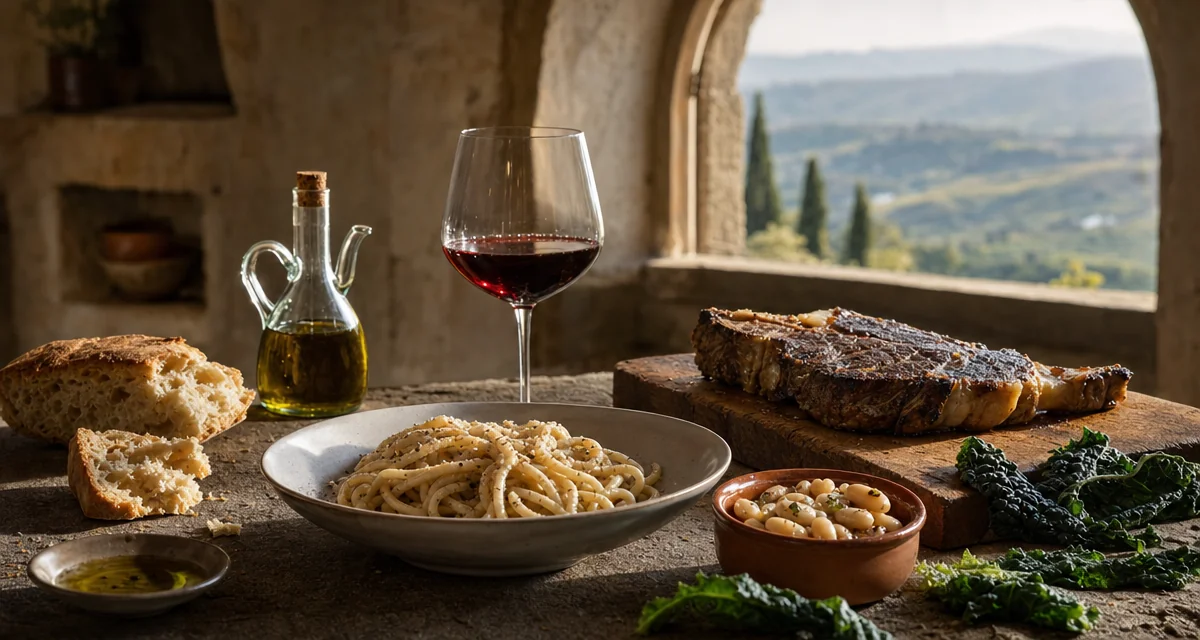
- Pair Chianti Classico DOCG with pappardelle al ragù, Brunello di Montalcino DOCG with wild boar, and Vernaccia di San Gimignano DOCG with pici all'aglione for a textbook nonna table.
- Tell the chef ahead of time if you want children to join the rolling — pici is by far the easiest shape for kids (no rolling pin needed, just hand-pulling).
How much does a private chef nonna pasta experience cost in your villa?
Pricing depends on the menu tier, the group size and whether you book a single evening or a multi-day stay. For a single in-villa dinner in Tuscany in 2026, our network typically quotes €95 per guest for 8 people at the Essential tier (4 courses, classic Tuscan set menu), €110 per guest at the Taste of Italy tier (5 courses, regional showcase), and around €160 per guest at the Luxury tier (6+ courses, white truffle in season, aged Chianina cuts, wild boar ragù, multi-pairing wine flight). For a smaller group of 6 guests, expect roughly €95 Essential, €120 Taste of Italy, €180 Luxury per guest; the per-head price drops with group size. The flagship Pasta Class + Dinner Experience bundles a 2-hour pasta-making class (teaching two shapes — one long, one short, typically pici plus tortelli or maltagliati) with the full seated dinner the chef plates afterwards. The chef brings flour, eggs, dough boards, rolling pins, pots and the sauces; you provide the kitchen and the table. Antipasti, two pasta courses with their sauces, and homemade tiramisù are included as standard, served entirely at your villa.
| Tier | Courses | Per guest (8 people) | Typical nonna menu |
|---|---|---|---|
| Essential | 4 courses (fixed) | ≈ €95 | Crostini misti, hand-rolled pici all'aglione, Tuscan pork stew, cantucci e Vin Santo |
| Taste of Italy | 5 courses (regional showcase) | ≈ €110 | Pecorino di Pienza tasting, pappardelle al ragù di cinghiale, pici con le briciole, secondo di Chianina, tiramisù |
| Luxury | 6+ courses, premium ingredients | ≈ €160 | Truffle crostino, tortelli mugellani al burro e salvia, pappardelle al ragù di cinghiale, Chianina fillet, pecorino flight, dolce |
What about multi-day stays — can a chef cook nonna pasta across a whole holiday?
Multi-day stays are where the nonna tradition really comes to life, because slow ragùs, fresh dough resting times and daily market shopping all need more than one evening. Across our network, three lodging configurations are typical: (1) the chef stays at the property — if your villa has a spare room or chef quarters, the chef sleeps on-site, shops daily at local markets (Pienza, Greve, San Quirico d'Orcia) and is part of the household rhythm; cheapest day rate, because you absorb the lodging. (2) A local chef commutes daily — when the network has a resident chef within 30–45 minutes of your property (very common in Chianti, Val d'Orcia and around Florence), they drive in and out for service, so no accommodation surcharge applies. (3) The chef takes lodging nearby — when no local chef matches and the property has no chef quarters, the chef books a room within a short drive and the surcharge is line-itemed transparently. A typical Tuscany multi-day pattern is 2 dinners + 1 long lunch across a 6-day week (most groups still want a few independent trattoria nights), with the wild boar ragù simmering while the chef teaches your kids to roll pici. Multi-day quotes are always custom — say which configuration applies and ask for a per-day total, not a per-person rate.
How does the Pasta Class + Dinner Experience actually unfold in your villa?
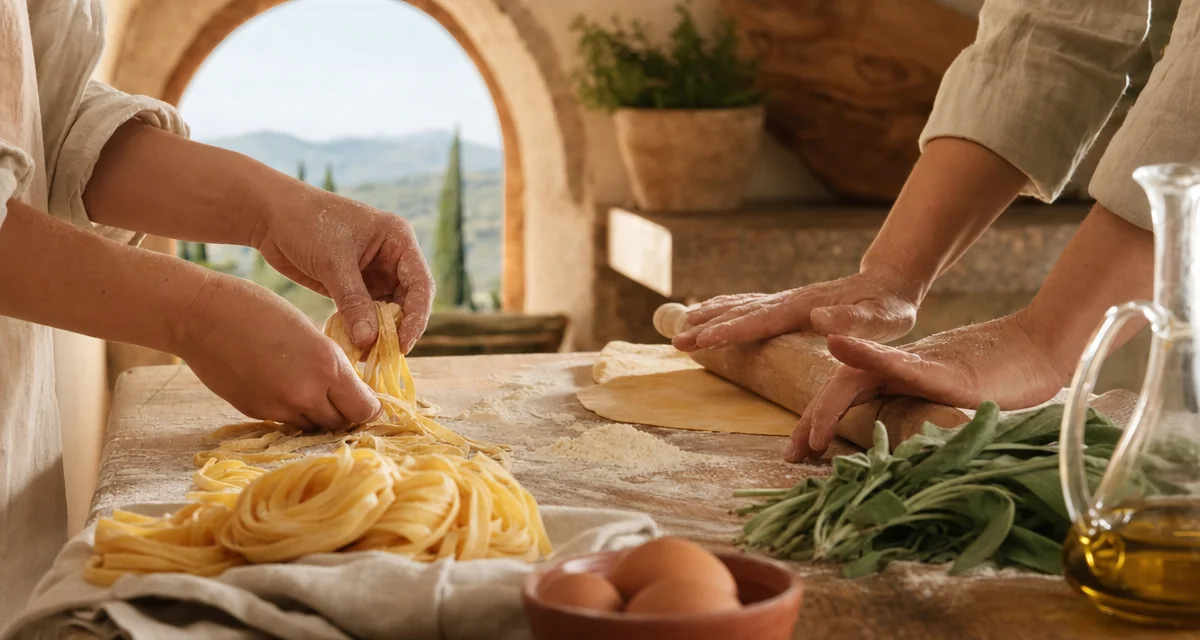
The bundled Pasta Class + Dinner Experience is the format we coordinate most often for international guests on holiday in Tuscany. It runs 4 to 5 hours, entirely at your villa, apartment or holiday rental — guests never visit a cooking school, a restaurant kitchen or any third-party venue. Hour one to two is the hands-on class: the chef arrives with flour, eggs, water, dough boards and rolling pins, and teaches your group two pasta shapes — typically one long (pici or pappardelle, depending on the chef's valley) and one short or stuffed (tortelli mugellani or maltagliati). You knead, you roll, you shape, in your own kitchen. While the pasta rests, the chef prepares two sauces (most commonly a slow ragù di cinghiale and a pici all'aglione), plus two or three antipasti (crostini neri, pecorino di Pienza, finocchiona) and a homemade tiramisù. Hour three onwards is the seated dinner on your own table — terrace, garden, dining room, poolside, whichever your villa offers. The chef plates the pasta you just shaped, serves the full menu, then cleans up. Kids can join the rolling or play in the next room; guests who don't feel like cooking just sit down to dinner. One booking, one chef, one place — yours.
Why this matters for your Tuscan holiday
Nonna's pasta isn't a dish you recreate from a YouTube video, and it isn't something you bring home from a cooking-school classroom in central Florence. It's an inherited posture at a kitchen board, a sense of when the dough has had enough water, a ragù simmering since lunchtime. The closest a traveller can get to that tradition is to invite a chef who learned it from a real grandmother into their own villa kitchen — to hand-roll pici under instruction, then sit down to a table the chef plates from what your group shaped. We've built our Tuscan chef network around this logic: regional fidelity (a Pienza chef for pici, a Florence chef for pappardelle, a Mugello chef for tortelli), at-home delivery, and a single transparent quote covering shopping, cooking, serving and cleanup. After 800+ bookings since 2024, the chefs who do this best aren't the youngest or the most technically credentialed — they're the ones who still ring their nonna on a Sunday to double-check the ratio of olive oil to breadcrumbs in pici con le briciole. For a deeper dive on Tuscan cuisine, see our companion guides on traditional Tuscan dishes, pasta classes in Florence villas and Tuscany food workshops, or browse our private chef hub for other Italian regions.