What does a beginner cooking class in Florence actually cover?
A beginner class in Florence covers four skills in one sitting: kneading fresh pasta dough, shaping two pasta types by hand, building one or two simple Tuscan sauces, and finishing with a classic dessert — almost always tiramisù. You'll spend roughly two hours active at the counter and one to two hours seated at the table eating what you made. Knife skills, when they appear, are minimal: dicing soffritto, slicing tomatoes for the antipasto. No flambé, no sous-vide, no fancy plating — beginner classes are built around three or four irreducible techniques that produce a complete meal.
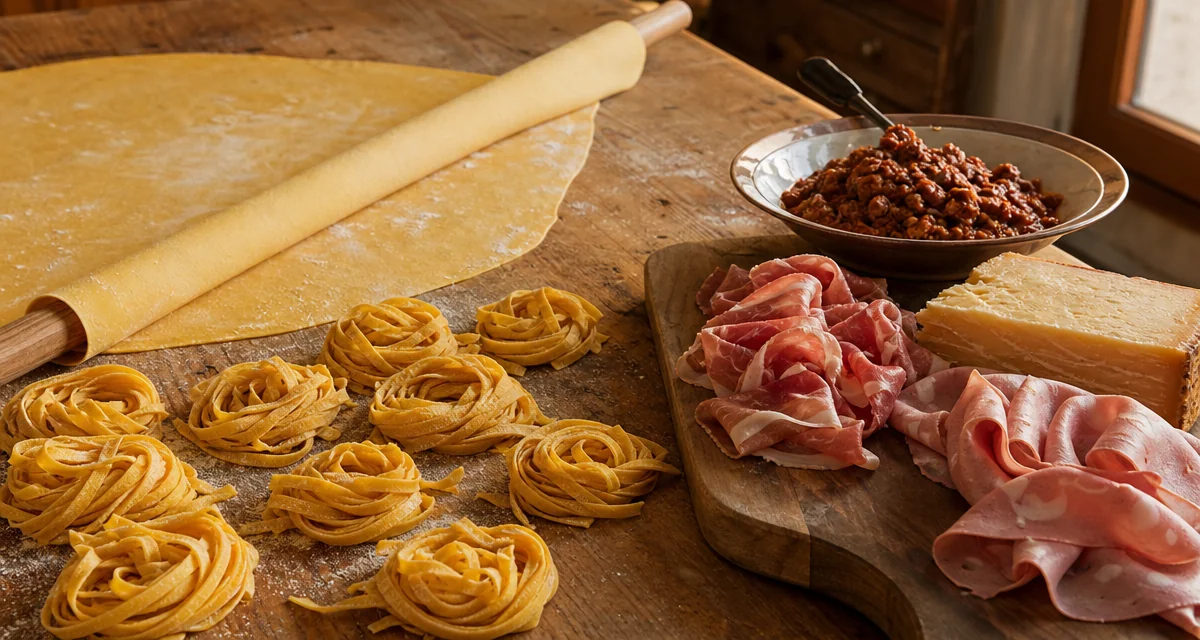
The pasta menu is the heart of the lesson. Most Florence classes teach tagliatelle (a flat, ribbon-shaped fresh egg pasta about 8 mm wide, the traditional partner for a meat ragù in Bologna and central Tuscany) and pici (a hand-rolled, eggless thick spaghetti from southern Tuscany, paired with garlic-tomato sauce or wild boar ragù). The chef demonstrates once, then the group works the dough — flour fountain on a wooden board, eggs in the centre, gradual incorporation, ten minutes of kneading, twenty minutes resting. Resting time is when the antipasto and the tiramisù are explained. The format is gentle, repetitive, and forgiving: getting the dough wrong twice is part of the lesson. By the time the pasta is shaped, the kitchen smells of sugo simmering on the stove, and the group sits down to eat in roughly the same order the meal was built.
How much does a beginner cooking class in Florence cost in 2026?
Group classes in Florence sit between €75 and €110 per person in 2026, while small-private (your party only) classes run €110 to €180 per person depending on group size and venue. The lower band buys you a shared 8 to 12 guest cohort in a downtown teaching kitchen, a 3 hour lesson, basic Chianti included, no market tour. The mid band (€100 to €130) buys a smaller cohort — usually capped at 8 — plus a Mercato Centrale walkthrough and a fuller meal with wine pairings. The upper band (€130 to €180+) is private: only your party, a chef who tailors the menu, often delivered at your own villa or apartment, with no transfers between class and dinner.
For Chef On Demand's at-home Pasta Class + Dinner Experience across our private cooking class experiences in Florence (regional context: Tuscany cooking class hub, private cooking classes in Italy; sibling Tuscan city: Siena cooking class) and the surrounding hills, expect roughly €110 to €135 per person for 6 guests, dropping to around €90 to €110 per head at 10 guests. The format is one booking, one chef, one location — the chef arrives at your villa or apartment with all ingredients, dough boards, pasta cutters and serving plates, teaches the 2-hour class, then cooks dinner on the pasta you shaped, plates and serves antipasti, two pasta courses with their sauces, and homemade tiramisù. No driving, no shared cohort, no rushing between two venues. Group composition matters more than headline price: a 4-guest private class is roughly 30 to 40 percent more per head than a 10-guest one because the chef cost is fixed.
First-timers panic about the dough. Within twenty minutes they're rolling pici by hand and asking when they can do it again. The technique is older than most cookbooks — that's why it works for absolute beginners. Chef Lorenzo, Florence-based ambassador of Chef On Demand Tuscany
Group class, private class or in-villa class: which format is right for beginners?
If you're a solo traveler or a couple on a short stay, a small-group class (4 to 8 guests, mixed cohort) is the most economical and arguably the most fun: you meet other travelers, the chef can still give you individual time, and the format is well-rehearsed. If you're a family with mixed ages, a multi-generational group, or a party of 6 to 12 sharing a Florence apartment or a Tuscan villa, the private at-home class wins on logistics: no transfers, no cohort of strangers, no fixed end time, and kids can drift in and out of the kitchen. We deliver this format across our Florence cooking class network, with the same private-chef-at-home structure regularly available in nearby Tuscan towns — Fiesole on the hillside above the city, Greve in Chianti for villa stays in Chianti Classico (the DOCG wine zone between Florence and Siena, recognised by Italy's Black Rooster consortium), and Lucca a 40-minute drive west. Public teaching kitchens are clustered around the Duomo and Santa Maria Novella — most are a 10 minute walk from the train station.
- Pick a cohort size you can live with: under 8 guests is genuinely hands-on; 12 or more becomes a demo.
- Confirm the chef speaks fluent English (or your group's language) — most Florence instructors do, but a Tuscan grandmother demo without translation is a different experience.
- Verify dietary accommodation in writing 48 hours before: vegetarian, vegan, coeliac (no gluten — the Italian Celiac Association certifies dedicated kitchens), pork avoidance, nut allergies.
- Ask whether wine is included and if the pairings are real DOC/DOCG wines — Chianti Classico DOCG, Vernaccia di San Gimignano DOCG, or simply a house red.
- Check what you take home: a printed recipe card, a digital booklet, an apron. Small thing, but the recipe card is what makes you cook the dough again at home.
- Lock in the date 2 to 6 weeks before peak (May to September); for July and August weekends in central Florence, 6 weeks ahead is safer.
What's the difference between a beginner, intermediate and advanced cooking class?
The honest difference is what you're not taught. A beginner class strips the menu down to four dishes and gives you 90 to 120 minutes hands-on the dough; an intermediate class adds a second technique (gnocchi, ravioli filling, focaccia) and assumes you can follow a recipe; an advanced class is a half-day or full-day immersion, often with a market tour and finishing techniques like pasta drying and sauce reduction. Beginner classes don't teach bistecca alla fiorentina (the iconic Tuscan T-bone steak from Chianina cattle, 1.2 to 1.5 kg, grilled rare over wood embers) — it needs a charcoal grill and a 1 kg cut you won't replicate at home. Save that for a restaurant. Beginner classes also rarely teach ribollita (a thick Tuscan bread-and-bean soup, reheated the next day, hence 'reboiled') because it's a two-day dish.
| Feature | Beginner (3 to 5 hr) | Intermediate (5 hr) | Advanced (full day or multi-day) |
|---|---|---|---|
| Number of dishes taught | 4 (2 pasta + sauce + dessert) | 5 to 6 (adds gnocchi or focaccia) | 6+ courses, market tour included |
| Hands-on dough time | 60 to 90 minutes | 90 to 120 minutes | 2+ hours plus drying |
| Group size | 4 to 12 guests | 4 to 8 guests | 2 to 6 guests (private) |
| Market tour included | Usually no | Sometimes (Mercato Centrale) | Always (Mercato Centrale or Sant'Ambrogio) |
| Wine pairing | House Chianti included | DOC pairing per course | DOCG flight, 3 to 5 wines |
| Price per person 2026 | €75 to €110 group / €110 to €150 private | €110 to €160 | €180 to €350+ |
| Best for | Absolute beginners, families, couples | Confident home cooks | Foodies on a 7+ day stay |
Where in Florence do beginner cooking classes actually happen?
Three settings dominate. The first is a downtown teaching kitchen — usually a converted apartment within a 10 to 15 minute walk of the Duomo or Santa Maria Novella station. Most public-cohort classes happen here. The second is a Tuscan farmhouse 20 to 40 minutes outside the city — Fiesole, Bagno a Ripoli, the lower Chianti slopes. These classes add a transfer and usually a longer format (5+ hours), but the setting is hard to beat. The third is your own villa or apartment: the chef arrives with everything, you cook in your kitchen, you eat at your own table. This is the format Chef On Demand specialises in for groups of 4 to 12 staying in a Florence Airbnb, a Chianti villa, or a Val d'Orcia farmhouse (the UNESCO-listed valley south of Siena famous for pecorino di Pienza DOP and Brunello di Montalcino DOCG).
Are Florence cooking classes worth it for absolute beginners?
Yes — provided you pick a class that's honest about being a beginner format. The trap is paying €120 for an experience labelled 'beginner-friendly' that's really a 14-guest demo in a glass-walled kitchen. A properly run beginner class in Florence does three things at once: it teaches a dough recipe you can repeat at home, it serves as the most relaxed dinner of your trip (you skip the 9pm restaurant scramble), and it gives you a sense of place no Duomo queue can match. For couples on a short stay, it's often the most memorable evening of the week. For families with kids 7+, it's one of the few activities where everyone is genuinely involved. The misalignment to watch is between expectations and format — if you booked a class hoping to learn bistecca alla fiorentina and end up rolling pici dough, you'll feel short-changed. Read the menu before you book, not after.
How do you book a beginner cooking class in Florence?
Two practical paths. For a public-cohort class, third-party platforms (the obvious aggregators) work — but read the group size and inclusions carefully, and avoid anything under €60 unless you're prepared for a 16-guest demo. For a private at-villa experience for your group only, request a quote directly: tell us your accommodation address, dates, group size, dietary requirements, and any preferences (vegetarian, coeliac, no pork). Our concierge returns a tailored Pasta Class + Dinner proposal within 24 hours from our verified network of private chefs delivering cooking classes in Florence. Average lead time in our network is 7 to 14 days for the May to September peak — for July weekends in central Florence, plan 4 to 6 weeks ahead. Chef On Demand's 4.7/5 Trustpilot rating is based on 800+ guests served since 2025, and many of our Tuscan chefs come from Michelin-starred kitchens, Gambero Rosso–rated restaurants, and MasterChef Italia. The same network powers our private chef service across Tuscany if you would rather book the dinner without the lesson.
Why this matters for your Florence trip
The best memory most first-time visitors take home from Florence isn't a museum line or a hilltop view — it's a meal they helped make. A beginner cooking class compresses everything good about Tuscany into one afternoon: the patience of fresh pasta, the simplicity of two ingredients done well, a glass of Chianti in a kitchen that smells like garlic and slow tomato. You don't need cooking skill to deserve the experience. You just need a 3 to 5 hour window and a clear-eyed read of what 'beginner-friendly' actually means in the brochure. Our advice — drawn from coordinating thousands of class and dinner experiences across our Italy and UAE private chef network — is to favour smaller cohorts, fewer dishes done properly, and (if your group is six or more) the in-villa format that brings the chef to where you're already staying. The dinner that follows is the same in either case: pasta you shaped, on a table you sat at, in a city you'll think about for years.