What does 'nonna's pasta' actually mean?
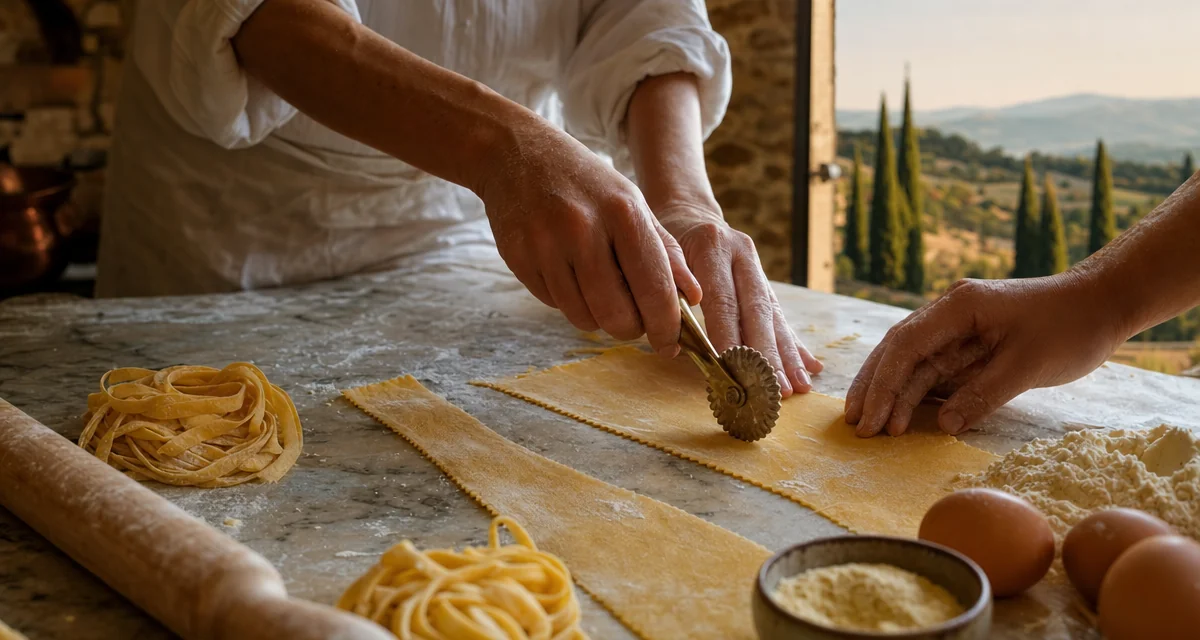
Nonna's pasta is the catch-all phrase Anglo travellers use for the home-kitchen fresh-pasta tradition that lives in the hands of Italian grandmothers — knowledge held by feel rather than by gram, taught at the family table from childhood, and tied to a specific valley or town. There is no written recipe and no precision scale. The phrase covers two distinct doughs. The first is pasta di grano duro (durum-wheat pasta), made only with semola di grano duro rimacinata (twice-milled durum semolina) and water — the southern dough, used for orecchiette in Puglia, cavatelli in Molise and Basilicata, pici in Tuscany (the only northern exception) and trofie in Liguria. The second is pasta all'uovo (egg pasta), made with soft 00 flour and one egg per 100 g — the northern dough, rolled into a thin sheet by the sfogline of Bologna and cut into tagliatelle, folded into tortellini, or stretched wide for pappardelle. Grandmothers learned one tradition or the other — almost never both, which is why a pasta-making class in Italy only feels authentic when the chef genuinely belongs to one of these two traditions.
How are nonna pasta shapes different region by region?
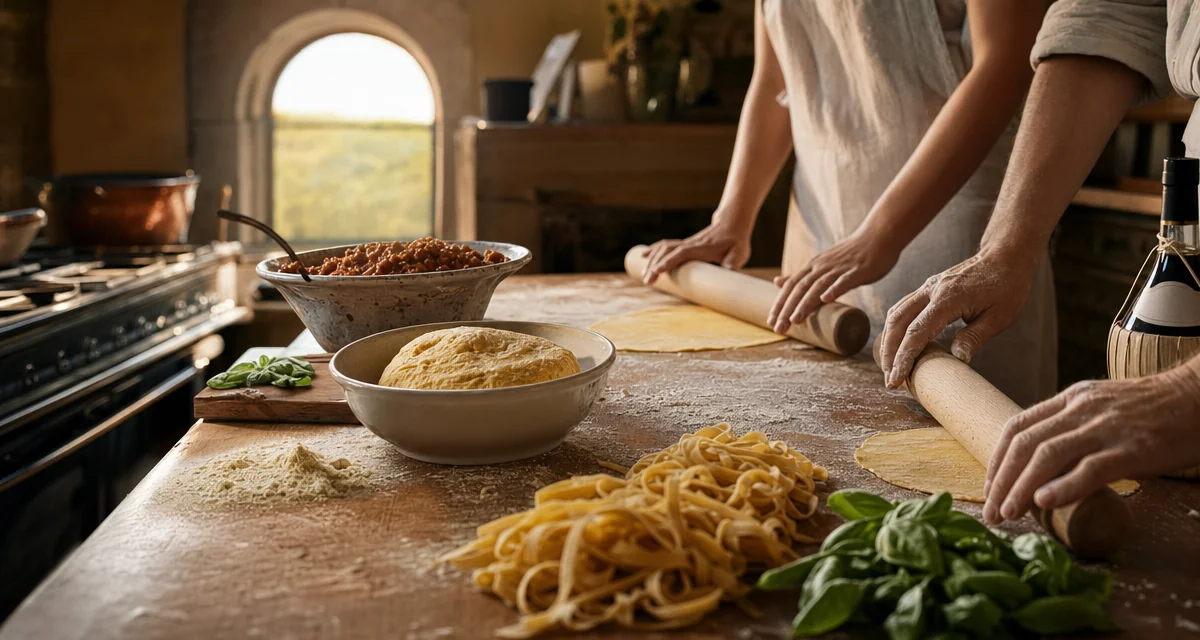
Italy has more than 600 documented pasta shapes and almost every one is a grandmother's signature somewhere. The four hand-rolling tools that grandmothers reach for tell the regional story as well as the shapes themselves. The mattarello (a thin wooden rolling pin up to a metre long) belongs to the sfogline of Emilia-Romagna — the women of Bologna who roll a single sheet of egg pasta so thin you can read a newspaper through it. The chitarra (a wooden frame strung with steel wires) belongs to Abruzzo, where dough is pressed through to produce square-cut spaghetti alla chitarra. The ferretto (a thin iron rod) is used across Puglia and Calabria for fusilli al ferretto. The gnocchi board — a small ridged wooden paddle — is how grandmothers in Sardinia and Puglia ridge their malloreddus and cavatelli. When you book a nonna-trained chef, the tool they bring is a tell. A chef arriving with a metre-long mattarello is signalling northern egg pasta; a chef with a ferretto is signalling southern cucina povera ('poor kitchen' cooking — the resourceful peasant tradition built on what the land freely gave). Both are nonna's pasta — they belong to different grandmothers.
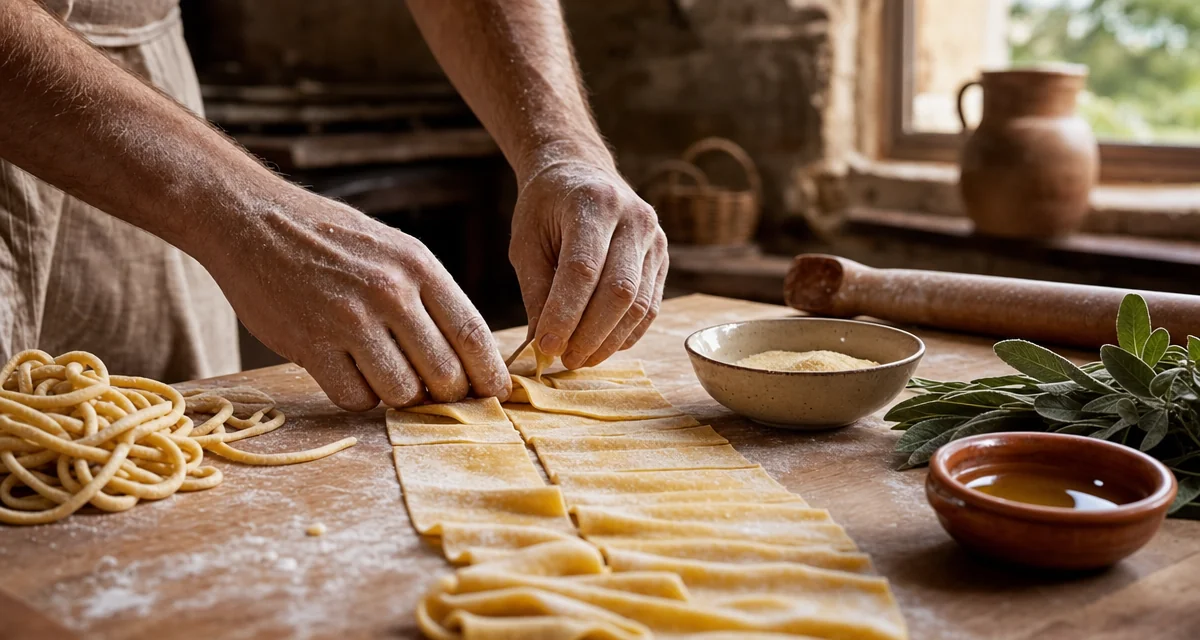
My grandmother in Bari taught me orecchiette with two fingers and a knife — no machines, no scales, the dough tells you when it's right. I now make them in a villa kitchen for guests from London and Sydney, and the moment they shape their first ear correctly, they understand why nonnas don't write recipes. Chef Antonella, Polignano a Mare-based ambassador of Chef On Demand Puglia
How much does a nonna pasta experience cost at your villa?
A nonna pasta experience inside your villa rental is priced per guest, per tier, with a clear group-size effect. At the Essential tier (4 courses including the pasta you shape), expect around €95 per guest for 8 people, dropping to €85 at 9+. At the Taste of Italy tier (5 courses — two pasta shapes plus antipasti, a meat or fish course and dessert), expect around €110 per guest at 8 people, dropping to €100 at 9+. At the Luxury tier (6+ courses with truffle, fresh fish or aged cuts plus a multi-wine pairing), expect around €160 per guest at 8 people, dropping to €150 at 9+. All three tiers are delivered as the Pasta Class + Dinner Experience: a 2-hour hands-on class teaching two shapes (one long, one short — for example pici plus cavatelli), then a seated dinner the chef plates from what you shaped, with antipasti, two sauces and homemade tiramisù. Children under 12 are not counted in the per-guest price. Smaller groups pay more per head (a 4-guest Essential dinner runs around €110 per person). The chef brings ingredients shopped that morning, dough boards, and the regional tools. Holiday surcharges of +35% apply on Easter and Christmas; Christmas Eve and New Year's Eve switch to fixed group pricing.
How do you actually book a nonna-trained chef for your villa?
Booking a nonna-trained chef inside your villa rental is a three-step process. First, choose your region and decide which grandmother tradition matters to your group — Puglia for orecchiette, Tuscany for pici, Emilia for tortellini, Liguria for trofie, Molise or Basilicata for cavatelli. Second, share your villa address, the date, the group size (adults and children separately) and any dietary requirements. Third, our concierge team matches you with a chef who genuinely trained in that tradition, and you receive a personalised proposal within 24 hours. Across our pasta-making-class network in Italy, the average lead time is 7–14 days during peak season (June–September); shoulder season often books inside a week. The chef arrives at your villa 2–3 hours before service with the ingredients already shopped, sets up on your kitchen counters, teaches your group around the dining table, then cooks dinner on the same hobs. There is no transfer to a class venue, no shared cohort, no fixed menu. Most importantly: the entire experience is at your villa or apartment — never at a cooking school or restaurant.
- Pick the region first, the shape second — your villa's valley dictates which grandmother tradition will feel authentic when the chef arrives.
- Ask for the Pasta Class + Dinner Experience by name — the 2-hour class + 2-shape teaching + seated dinner + tiramisù is the format built for this purpose.
- Plan multi-day stays around at least one slow ragù — Bolognese needs 4 hours, wild-boar ragù 4–6 hours; a single evening doesn't give the chef enough time to do it properly.
- Tell the chef ahead of time if you want children to join the shaping — orecchiette and pici are by far the easiest for kids (no rolling pin needed, just hands).
- If your group is curious about the dough difference, ask for one semolina shape plus one egg shape in a multi-day stay — that single contrast is the fastest education in nonna pasta you can get.
| Shape | Region | Nonna technique | Traditional sauce |
|---|---|---|---|
| Orecchiette | Puglia (Bari, Lecce, Polignano) | Semolina + water dough dragged with a serrated knife and turned over the thumb into a 'little ear' shape — no machine | Cime di rapa (turnip greens) with garlic, anchovy and chilli; or a slow tomato sauce with braciole |
| Pici | Tuscany (Val d'Orcia, Val di Chiana) | Semolina + water dough hand-pulled into thick uneven strands — like a fat spaghetti rolled between palms | Aglione (giant sweet Tuscan garlic) with tomato; or pici con le briciole (toasted breadcrumbs in olive oil) |
| Tortellini | Emilia-Romagna (Bologna, Modena) | Thin sheet of egg + 00 flour dough rolled with a metre-long mattarello, cut into squares, filled, folded into a ring around the index finger | In brodo (a clear capon broth) — never with cream |
| Trofie | Liguria (Genoa, Recco, Camogli) | Semolina + water dough rolled into thin spirals between the palm and the wooden board | Pesto alla genovese (Genoese basil, pine nuts, Parmigiano, pecorino, olive oil) with green beans and potatoes |
| Cavatelli | Molise and Basilicata (Campobasso, Matera) | Semolina + water dough rolled into small ridged shells, indented with two or three fingertips | Sugo di salsiccia (sausage and tomato); or a mushroom and pecorino sauce |
Why is doing this at the villa better than a cooking school in town?
A class at a city cooking school typically means a 30–45 minute drive each way, a shared cohort of 10–12 strangers kneading at adjacent stations, a fixed menu, and a hard finish when the next group arrives. A nonna pasta experience at your villa flips every constraint. Privacy — only your group at the kitchen island, only your group at the table. Personalisation — the chef adjusts the menu to your party's allergies, the children's appetites, the wines from yesterday's enoteca. Your villa as the stage — the Pugliese trullo, the Chianti farmhouse, the Amalfi sea-view terrace becomes part of the memory; you don't trade it for a fluorescent classroom in town. Zero transfer logistics — no driving for eight people, no parking, no rushing back for the children's bedtime. Flexible timing — start at 5pm or 7pm, finish when the wine runs out. Continuity — the pasta you shaped is on your plate 30 minutes later, on the same table. Family-friendly — children can roll cavatelli, run to the pool, come back for dessert. One booking, one chef, one location.
When is the best time of year for a nonna pasta experience?
Nonna pasta is a year-round tradition — grandmothers roll dough in February as readily as in August — but the experience peaks twice. The first peak is May through early July, when markets are full of broad beans, courgette flowers, early tomatoes and fresh herbs; in Puglia this is when orecchiette with cime di rapa is at its best, in Liguria when basil hits peak intensity for trofie al pesto. The second peak is September through October, when wild boar season opens in Tuscany for pappardelle al ragù, porcini mushrooms arrive for cavatelli con funghi, and the grape harvest (the vendemmia) makes Chianti Classico DOCG and Brunello di Montalcino DOCG newly available. August is doable but crowded; many local chefs take a break for the Italian Ferragosto holiday around 15 August. November through March is the secret season — quieter villas, lead times often under a week, grandmothers cooking richer cold-weather dishes: tortellini in brodo in Emilia, pici with wild-boar ragù in Tuscany, cavatelli with sausage in Basilicata.
Why this matters for your Italian villa stay
The point of seeking out nonna's pasta in Italy is not really the recipe — every recipe is on YouTube now, and a Pasta Grannies video can teach the orecchiette flick of the wrist in fifteen minutes. The point is the context: the wooden board in a real Italian kitchen, the smell of the ragù simmering since morning, the chef who learned this from a grandmother and is teaching your children. That context only happens when the experience is delivered at your villa, with a chef who genuinely trained in the regional tradition. Across our network of private chefs across Italy, the bookings rated highest by guests since 2025 are not the most expensive — they are the ones where the family asked for one specific grandmother shape and the chef arrived with the right tool and the right story. A trullo in Polignano with orecchiette curled at the kitchen island, a farmhouse in Pienza with pici rolled by hand, a villa in the Mugello with tortellini folded around the children's fingers — these are the memories travellers describe a year later. If you're ready to plan one of these moments, browse our pasta-making chef network across Italy and let us match the chef to your valley. Book the chef, not the class venue — the difference is the entire point.