What makes a menu an Italian dinner party menu?
An Italian dinner party menu is a sequence of small courses that moves from light to rich and back to sweet, drawn from a single regional kitchen and the produce of the month. The traditional Italian meal structure is the template, but a home dinner party trims it to five courses that a host can actually manage. That restraint is what separates it from the Italian-American feast of six dishes on the table at once.
If you search for a traditional Italian dinner menu, you will find lists of seven or eight courses, including cheese and fruit, salad, coffee and a digestivo. Those exist, mostly on Sundays and at weddings. At a weeknight or Saturday dinner party in Italy you are far more likely to see the core five, with coffee and an amaro arriving almost as an afterthought. Each course has a job. The aperitivo (a drink with a few salty bites, taken standing up) opens the appetite. The antipasto (literally 'before the meal') is the first seated plate, usually cold and prepared in advance. The primo is the starch course: pasta, risotto, gnocchi or soup, never a mountain of it. The secondo is the protein, meat or fish, and it arrives with its contorno, a vegetable side that sits next to it rather than counting as a course of its own. The dolce closes the evening. Our piece on how many courses a dinner really needs follows exactly the same order, so the two read together.
The second rule is regional. A Sicilian caponata followed by a Piedmontese braise is not wrong, just confused, a bit like serving sushi before a Sunday roast. Pick one region and one season, and the dishes, the wine and even the table will start to agree with each other.
Menu 1: a Tuscan autumn and winter dinner party
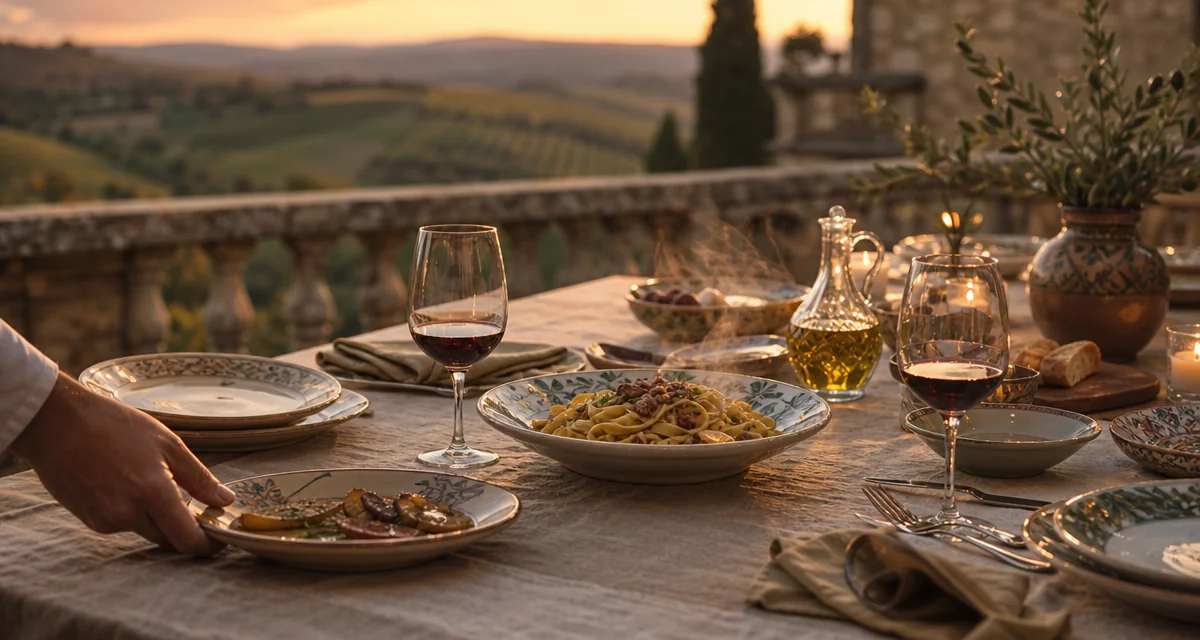
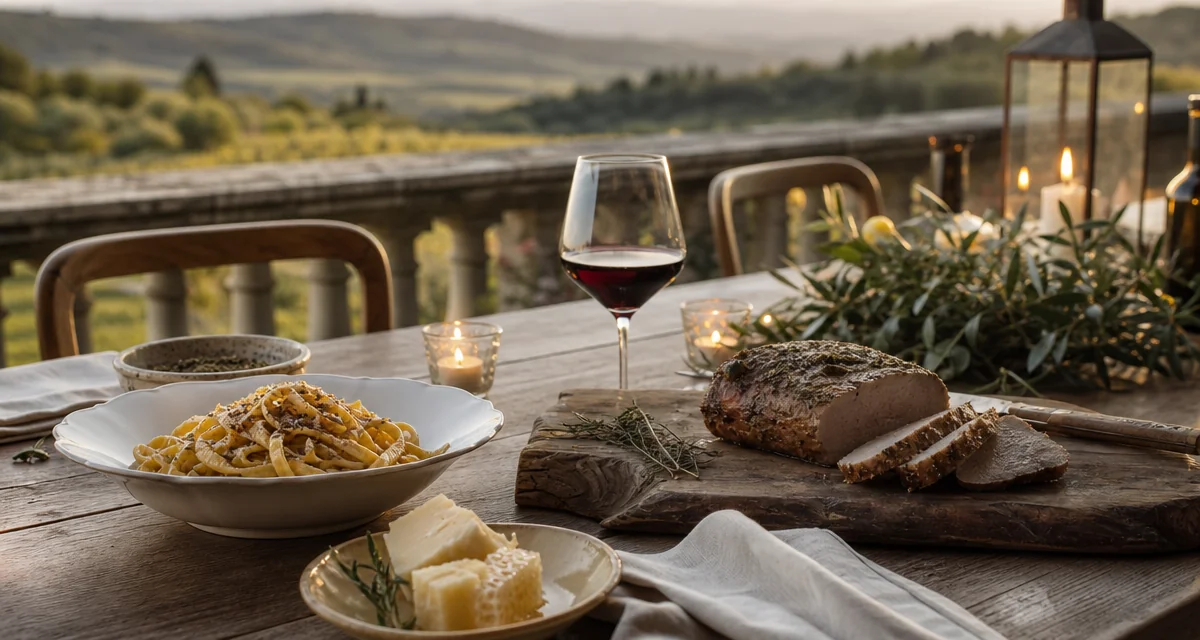
A Tuscan autumn menu for 6–8 guests is built on slow-cooked meat, beans, chestnuts and the new olive oil that is pressed in November, and nearly every element can be made a day or two before. This is the menu our chefs across Tuscany cook most often from October to February, and it is the easiest of the three to host because the secondo reheats perfectly.
Open with a Negroni, the bitter gin, vermouth and Campari aperitivo born in Florence around 1919, alongside fettunta: grilled bread rubbed with garlic and soaked in peppery new-season oil. For the antipasto, set out crostini toscani (toasted bread spread with a warm chicken-liver pâté flavoured with capers and Vin Santo), a few slices of finocchiona (a soft Tuscan salami seasoned with wild fennel seed) and a wedge of aged pecorino. Pour a Vernaccia di San Gimignano DOCG, a crisp white from the towered hill town west of Siena and, in 1966, the first Italian wine ever granted DOC status.
The primo is pappardelle al cinghiale: wide ribbons of egg pasta with a wild boar ragù simmered for 3 hours in red wine and juniper. Serve it with a Chianti Classico DOCG, the Sangiovese red from the hills between Florence and Siena, whose sour-cherry acidity cuts through the fat of the boar. The secondo is peposo dell'Impruneta, beef shin braised for 4–5 hours with a whole bottle of red wine and a startling amount of black pepper, a dish attributed to the kiln workers of Impruneta, just south of Florence. Its contorno is fagioli all'uccelletto, cannellini beans stewed with sage, garlic and tomato, spooned beside the beef. This is the moment for a Brunello di Montalcino DOCG, a 100% Sangiovese aged at least 5 years before release, or the slightly gentler Vino Nobile di Montepulciano DOCG. Finish with cantucci, twice-baked almond biscuits, dipped into Vin Santo, the amber dessert wine made from grapes dried on straw mats for months. If you are hosting in Tuscany and want the same menu cooked for you, our chefs in Florence and Siena cook versions of it every week of the season.
Nobody in Italy remembers how many courses you served. They remember whether the pasta was cooked when they sat down, so make everything ahead except that. Chef On Demand editorial team
Menu 2: a Sicilian summer dinner party
A Sicilian summer menu leans on aubergine, tomato, almonds, capers and swordfish, with sauces that need no cooking at all, so the kitchen stays cool and the host stays out of it. In Italy this menu belongs to June–September; readers in Australia should flip it to December–February, when the same aubergines and tomatoes are at their best in your own markets.
Summer Italian dinner party menu ideas from Sicily
Start with a glass of Grillo, Sicilia DOC, a citrusy white from the west of the island, and a plate of panelle (thin chickpea-flour fritters from Palermo) or small arancine (fried rice balls, here filled with ragù and peas). The antipasto is caponata, a sweet-and-sour stew of fried aubergine, celery, olives, capers and vinegar, which tastes better on day two than on day one and is served at room temperature with bread.
For the primo, cook busiate al pesto trapanese: twisted pasta from Trapani tossed with a raw sauce of ripe tomato, almonds, basil, garlic and olive oil, pounded or blitzed in 5 minutes. If you would rather go east, pasta alla Norma from Catania (fried aubergine, tomato and grated ricotta salata, a firm salted sheep's cheese) is the classic alternative, and our chefs in Catania and Palermo will argue about which is more Sicilian for the whole evening. Pair either with an Etna Bianco DOC, a mineral white grown on the volcano's slopes. The secondo is involtini di pesce spada: thin slices of swordfish rolled around breadcrumbs, pine nuts, raisins and lemon zest, then baked for 12–15 minutes. Serve them with insalata pantesca, the Pantelleria salad of boiled potato, tomato, red onion, capers and olives, as the contorno. Pour Cerasuolo di Vittoria, Sicily's only DOCG, a light Nero d'Avola and Frappato red you can serve slightly chilled with fish. The dolce is an almond semifreddo, frozen the day before and sliced from the tin, with a small glass of Passito di Pantelleria DOC, a sweet wine of dried Zibibbo grapes tasting of apricot and honey.
Menu 3: a Veneto spring dinner party
A spring menu from the Veneto follows the first peas, white asparagus and new lamb of March–May, and it is the only one of the three that asks you to stand at the stove for 20 minutes. Australian hosts can cook it from September to November, when asparagus and peas arrive in your markets.
The aperitivo is a Spritz or, more elegantly, a glass of Prosecco Superiore from Conegliano Valdobbiadene DOCG, the steep hills north of Treviso where the best Prosecco is grown, with a few cicchetti (Venetian bar snacks) such as crostini of baccalà mantecato, salt cod whipped with olive oil. The antipasto is asparagi alla bassanese: fat white asparagus from Bassano del Grappa with a sauce of chopped hard-boiled egg, oil and vinegar. Pour a Soave Classico DOC, from the volcanic hills east of Verona, one of the few whites that does not fight asparagus.
The primo is risi e bisi, rice and fresh peas cooked in a broth made from the pea pods, looser than a risotto and traditionally eaten in Venice for the Feast of San Marco on April 25. It needs 18–20 minutes of stirring just before serving, which is your one live dish, so everything else must already be done. The secondo is roast guinea fowl, faraona, which the Veneto has eaten with peverada, a peppery liver sauce, for centuries; a simple roast with rosemary and garlic is fine too. Its contorno is a tray of new potatoes roasted in the same oven. Pour a Valpolicella Classico Superiore DOC, a medium-bodied red from the hills north of Verona. For the dolce, the obvious and correct choice is tiramisù, which Treviso claims as its own, made the day before so it has 12 hours to set, with a small pour of Recioto di Soave DOCG, a sweet white from dried Garganega grapes. If you are staying near the lagoon, our chefs in Venice cook this menu through the spring.
| Course | Tuscan autumn-winter | Sicilian summer | Veneto spring |
|---|---|---|---|
| Season in Italy / Australia | Oct–Feb / Apr–Aug | Jun–Sep / Dec–Feb | Mar–May / Sep–Nov |
| Aperitivo | Negroni, fettunta with new oil | Grillo, panelle or arancine | Prosecco Superiore DOCG, cicchetti |
| Antipasto | Crostini toscani, finocchiona, pecorino (Vernaccia di San Gimignano DOCG) | Caponata with bread (Grillo, Sicilia DOC) | White asparagus with egg sauce (Soave Classico DOC) |
| Primo | Pappardelle al cinghiale (Chianti Classico DOCG) | Busiate al pesto trapanese (Etna Bianco DOC) | Risi e bisi (Soave Classico DOC) |
| Secondo + contorno | Peposo with cannellini beans (Brunello di Montalcino DOCG) | Swordfish involtini with insalata pantesca (Cerasuolo di Vittoria DOCG) | Roast guinea fowl with new potatoes (Valpolicella Classico Superiore DOC) |
| Dolce | Cantucci with Vin Santo | Almond semifreddo (Passito di Pantelleria DOC) | Tiramisù (Recioto di Soave DOCG) |
| Cooked live | Pasta only, 3–4 minutes | Pasta and swordfish, 15 minutes | Risi e bisi, 18–20 minutes |
How much food do you need per guest?
For an Italian dinner party, plan 3–4 aperitivo bites, 100 g of antipasto, 70–80 g of dry pasta, 150–180 g of boneless meat or fish and 120–150 g of vegetables per guest, because each portion is sized as one course among five rather than as a main meal. Those are the figures our chefs work from when they write shopping lists, and they match the quantities we give for an Italian Christmas dinner, where pasta is likewise one course among several.
The primo is where hosts from the US, the UK and Australia overshoot most. A main-course bowl of pasta is 120–150 g of dry pasta, almost double the Italian dinner party portion, and it leaves nobody hungry for the secondo. Fresh egg pasta such as pappardelle weighs more because it holds water, so allow 100–120 g; for a risotto or risi e bisi, 60–70 g of rice per person is plenty. On the bone, the secondo needs 250–300 g raw per guest, since bone and fat account for a third of the weight. Bread is constant at about 50 g a head.
Scaling an Italian dinner party menu for 8
| Course | Per guest | For 8 guests | Make ahead? |
|---|---|---|---|
| Aperitivo | 3–4 bites, 1 drink | 24–32 bites, 8 drinks | Yes, fry or assemble the morning of |
| Antipasto | About 100 g (or 60–80 g salumi and cheese) | 800 g, or 500–650 g salumi and cheese | Yes, 1–2 days |
| Primo | 70–80 g dry pasta, 100–120 g fresh, 60–70 g rice | 600 g dry, 900 g fresh, 500 g rice | Sauce yes, pasta no |
| Secondo | 150–180 g boneless, 250–300 g on the bone | 1.2–1.4 kg boneless, 2–2.4 kg on the bone | Braises yes, roasts partly |
| Contorno | 120–150 g vegetables | About 1–1.2 kg | Yes, reheat or serve at room temperature |
| Dolce | 1 portion | One 20 x 30 cm dish of tiramisù | Yes, the day before |
| Wine | Half a bottle over 3 hours | 4 bottles, plus 1 spare | Open reds 30–60 minutes before |
What is the make-ahead plan for an Italian dinner party?
The Italian dinner party menu plan works backwards from the one dish you will cook live: braises and ragù two days ahead, desserts and cold antipasti the day before, vegetables and table on the morning, and only pasta or risotto in the last hour. Planned this way, a five-course dinner for 8 guests needs about 20 minutes of active cooking once the doorbell rings.
- Three days before: write the shopping list from the quantities above, buy the wine and order the meat or fish so the butcher or fishmonger can set it aside.
- Two days before: cook the boar ragù and the peposo for the Tuscan menu, or the caponata for the Sicilian one. All three improve overnight in the fridge.
- The day before: make the tiramisù or the semifreddo, bake the cantucci, cook the beans and the pea-pod broth, chill the whites and the Prosecco, and set the table.
- The morning of: make or buy the fresh pasta, pound the pesto trapanese, roll the swordfish involtini, prepare the contorno and slice the salumi under a damp cloth.
- The last hour: reheat the braise gently for 30 minutes, put the pasta water on, open the reds and toast the crostini as the first guests arrive.
- At the table: cook the primo while everyone finishes the antipasto, then bring out the secondo and its contorno together, and leave the dolce until people ask for it.
A simple Italian dinner party menu cuts the same plan down to three courses: antipasto, primo and dolce, with the secondo dropped and a richer pasta in its place. It is how many Italians eat on a weeknight, and nobody will feel short-changed. An Italian dinner party menu with lasagna works the same way, because a tray of lasagne alla bolognese from Emilia-Romagna is assembled the day before and baked for 40 minutes, so it can replace both the primo and the secondo for a big table. Keep the table itself plain: Italian dinner party decor at home is a linen cloth, carafes of water, bread directly on the cloth and candles low enough to talk over.
Would you rather not cook? When a chef in Italy takes it on
If you are on holiday in Italy, the same five-course menu can be cooked for you at your villa or apartment by a private chef who shops at the local market, cooks in your kitchen, serves each course and leaves the kitchen clean. Everything above is written for you to cook yourself, wherever you live; this section is only for the nights in Italy when you would rather sit down from the start.
For a single dinner, a chef works the menu with you in advance, around the season and your guests' allergies, then arrives with every ingredient. Our Tuscan chef network alone has more than 20 chefs based in the region, and Chef On Demand is rated 4.7 out of 5 on Trustpilot. For first-time visitors who want the cooking as well as the eating, the Pasta Class + Dinner happens entirely at your villa or apartment: a 2-hour lesson in two fresh pasta shapes, one long such as pici or tagliatelle and one short such as orecchiette, followed by a seated dinner of antipasti, both pastas with their two sauces and a homemade tiramisù, all in the same kitchen and dining room. What you take home is the technique, the feel of the dough under your hands, rather than any printed material. Longer stays can book a chef for several days, with dinners and a long lunch spread across the week; those quotes are built around whether the chef stays at the property, commutes from nearby or takes lodging close by. If you are curious what a chef would put on the menu, our private chef dinner party menu ideas cover that side of the table.
Why this matters for your Italian table
The point of an Italian dinner party menu is not authenticity for its own sake. It is that the structure was designed, over generations, to let the person who cooked sit down and eat with everyone else. Small courses, a single region, dishes that improve overnight and one pan of pasta at the end are not rules for showing off; they are how a family in Siena or Catania feeds 10 people on a Saturday without anyone being stuck in the kitchen.
Borrow that logic and the menu works anywhere, whether you are cooking the Sicilian summer menu in Sydney in January or the Tuscan winter one in Chicago in February. And if you are lucky enough to be eating it in Italy, in a farmhouse above the vineyards or a flat with a view of the lagoon, you can hand the whole evening to someone else: book a Tuscan villa dinner with one of our chefs, or browse Chef On Demand for every region we cover. Either way, the best sign of a good Italian dinner party is the same: the candles are low, the Vin Santo is going round a second time, and the host is still at the table.