What is a traditional Italian Christmas dinner menu?
A traditional Italian Christmas dinner menu follows the classic Italian course order, antipasto, primo, secondo with its contorno, then dolce, across two separate meals: a fish supper on the evening of 24 December and a long family lunch on 25 December, with the weight shifting between the two as you travel from south to north. The first of those meals is the Vigilia di Natale, the Christmas Eve vigil, a day on which Catholic custom forbade meat and which most families still keep meatless. In Naples, Puglia, Calabria and Sicily the Vigilia is the main event, often sitting down around 8 pm and stretching towards midnight Mass. In Piedmont, Lombardy and Emilia-Romagna the 24th tends to be lighter, and the 25th carries the weight: the table is laid by 1 pm and nobody stands up much before 5.
The antipasto is a spread of small starter plates; the primo is the first course of pasta, broth or risotto; the secondo is the main of fish or meat, served with a contorno (a vegetable side); and the dolce is dessert, followed by fruit, nuts and nougat. Folklore talks of 13 courses, yet most families today serve 4 to 6 per meal, which is also the sensible range for a home kitchen. If you are hunting for traditional Italian Christmas dinner menu ideas, start from that skeleton and fill each slot with one regional dish rather than three. Our guide to how many courses an Italian dinner really needs explains what each course is for.
What goes on an Italian Christmas Eve dinner menu?
An Italian Christmas Eve dinner menu is meatless and usually moves through five moments: a raw or marinated seafood antipasto, a cold vegetable salad, a pasta with clams or anchovies, a fried course of salt cod, squid or eel, and a sweet table of fried dough, dried fruit and nuts. The anchor almost everywhere is baccalà, cod that has been salted and dried until it is stiff as a board, then brought back to life by soaking it for two to three days. Romans and Neapolitans fry it in batter; in Veneto it is whipped with olive oil into a spread.
The pasta is nearly always spaghetti alle vongole, spaghetti with small clams opened in garlic, olive oil, parsley and a splash of white wine, the one course that cannot be cooked ahead. In Naples the fried course belongs to capitone, the large female eel that is cut into thick rounds and either fried or marinated in vinegar and garlic (a scapece); it is the Neapolitan Christmas Eve dish more than any other.
A Feast of the Seven Fishes menu, Italian-American style
The Feast of the Seven Fishes is an Italian-American Christmas Eve celebration of seafood dishes, born in the immigrant neighbourhoods of the American Northeast between the 1880s and the 1930s. The number may stand for the seven sacraments, though nobody agrees, and some families in Calabria have long counted seven or thirteen fish of their own. Most Italian homes do not count at all. For a Feast of the Seven Fishes menu that still feels Italian, use one cooking method per dish so the kitchen never jams:
- Fried smelts or whiting, dusted in flour and served with lemon as guests arrive.
- Marinated anchovies, cured in lemon or vinegar the day before, so they need no cooking on the night.
- Baccalà salad with potatoes, parsley and olives, which can sit in the fridge for 6 hours.
- Linguine or spaghetti with clams, cooked last-minute in two pans if you are more than 8.
- Fried calamari, the course that must go from fryer to table in under 2 minutes.
- Baked stuffed shrimp or lobster tails with breadcrumbs, garlic and parsley, which share the oven with the next dish.
- Whole roast sea bass (branzino) with fennel and lemon, carved at the table.
What goes on an Italian Christmas lunch menu?
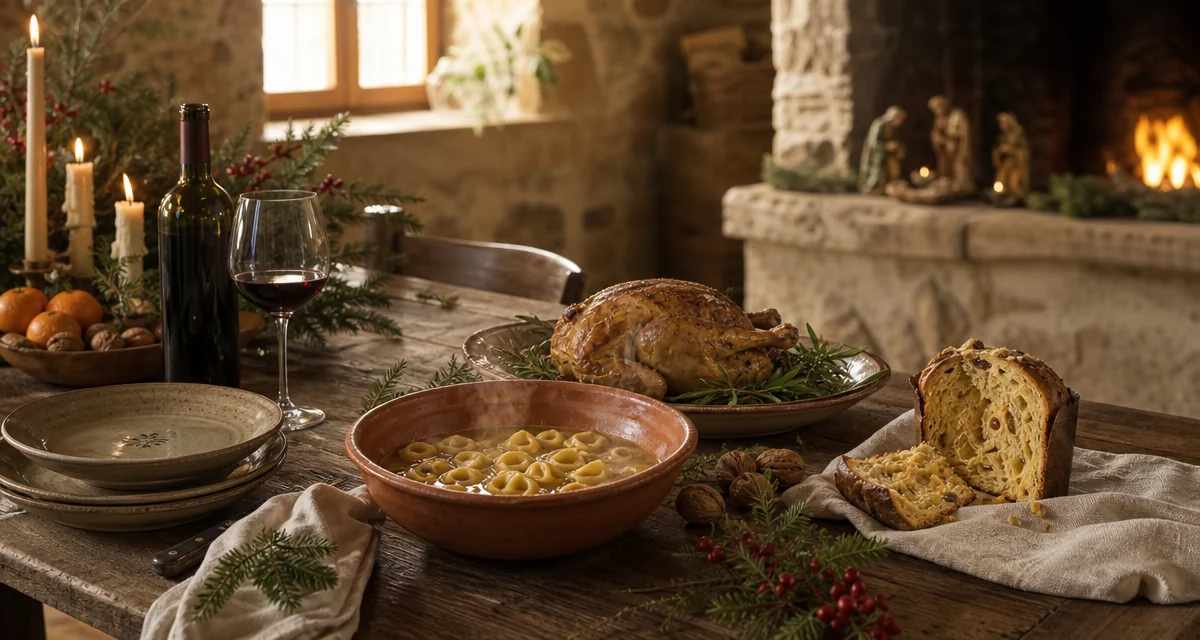
An Italian Christmas lunch menu typically opens with cured meats and crostini, moves on to a pasta in broth or a baked pasta, then serves a slow-cooked or roasted meat with vegetables, and closes with panettone or pandoro, fruit and nougat, usually over 3 to 4 hours starting around 1 pm. The broth course is the heart of the northern table. Tortellini are small ring-shaped pasta parcels from Bologna and Modena, filled with pork loin, prosciutto, mortadella, Parmigiano Reggiano, egg and nutmeg, and served floating in a clear capon broth (tortellini in brodo) (a capon is a castrated rooster of about 3 kg, richer than any chicken).
The main course in much of the north is bollito misto, a 'mixed boil' of tougher beef and veal cuts, tongue, cotechino sausage and sometimes a whole hen, simmered for 3 hours in a vegetable stock and sliced at the table with green sauce and mostarda (fruit candied in a mustard syrup). Further south the 25th belongs to baked pasta and roast lamb or a stuffed capon. The sweets are shop-bought in most homes: panettone is the tall Milanese yeast cake studded with candied orange and raisins, while pandoro is its golden, star-shaped cousin from Verona, plain, buttery and dusted with icing sugar. Add torrone (almond and honey nougat), clementines and walnuts, and the table is complete.
In Naples the Vigilia runs on a clock rather than a fish count. The struffoli go into honey a couple of days ahead, the baccalà gets its last change of water around noon on the 24th, and the eel is fried only once everyone is already at the table.
How do regional Italian Christmas menus differ?
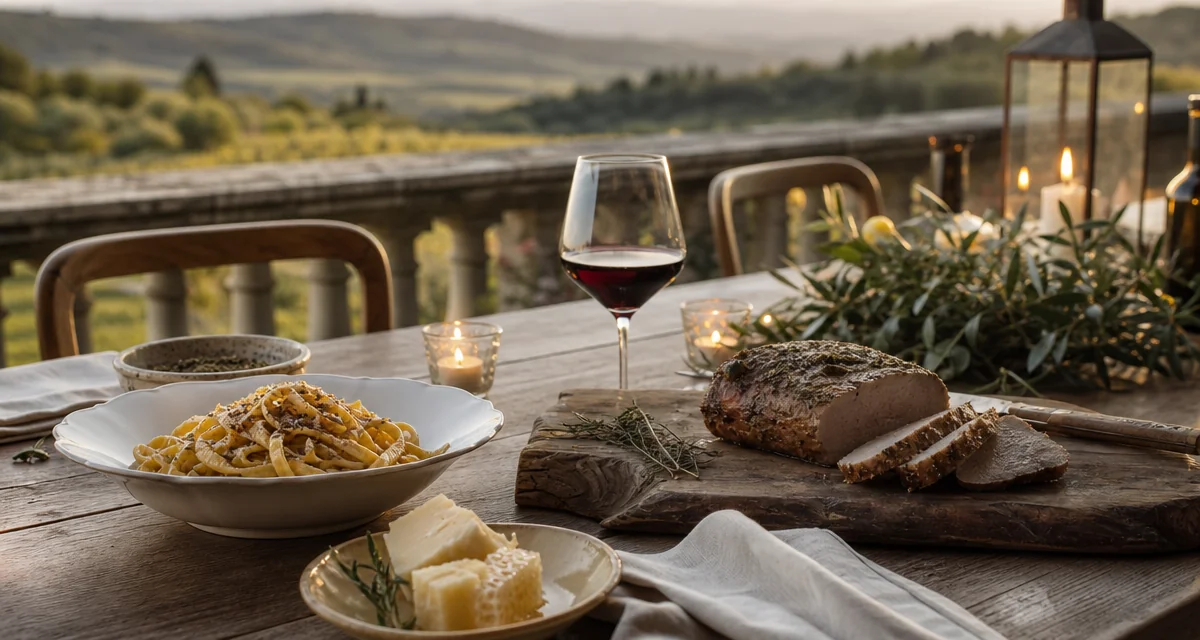
Regional Italian Christmas menus differ mainly in which meal matters: the south invests in the fish supper of 24 December, the north in the broth-and-boiled-meat lunch of the 25th, and central Italy, Tuscany included, splits the difference with chicken-liver crostini, pasta in broth and roast or boiled capon. In Tuscany, where many villa guests spend the holiday, private chefs across Tuscany cook its version with crostini di fegatini (toasted bread with a chicken-liver pâté sharpened with capers and Vin Santo) and Siena's panforte, a dense, peppery cake of candied fruit, almonds and honey.
Naples and the southern Italian Christmas dinner
A southern Italian Christmas dinner reaches its fullest form in Naples, where the Vigilia opens with insalata di rinforzo, the 'reinforcement salad' of boiled cauliflower, black olives, capers, anchovies and pickled red peppers that is topped up every day until New Year. Then come spaghetti with clams, fried baccalà, capitone and fried vegetables, followed by struffoli, marble-sized balls of fried dough glazed in warm honey and scattered with coloured sprinkles and candied peel. The 25th is calmer: minestra maritata, the 'married soup' in which winter greens are wedded to pork and beef, then a baked pasta and a roast. Our private chefs in Naples shop for fish two days ahead, because by the 24th the market queues stretch around the block.
Emilia-Romagna: tortellini, cotechino and Lambrusco
Emilia-Romagna saves itself for the lunch of the 25th, and the lunch begins with tortellini in brodo. In Bologna the filling is guarded by the Dotta Confraternita del Tortellino, which publishes the canonical recipe; in Parma the same slot goes to anolini, small round parcels filled with beef braised for hours and Parmigiano. The main course pairs bollito with Modena's two pork specialities, cotechino (a soft, gelatinous fresh pork sausage simmered for about 3 hours) and zampone (the same mix stuffed into a pig's trotter), served with mashed potatoes and, from 31 December, with lentils for luck. A cook from our Emilia-Romagna chef network will usually roll tortellini by hand the week before, and in Bologna it is a matter of pride.
Piedmont: agnolotti, bollito and the big reds
Piedmont serves the most formal of the northern Christmas lunches. It opens with vitello tonnato (thin slices of cold poached veal under a creamy tuna and caper sauce) and insalata russa, then moves on to agnolotti del plin, tiny meat-filled pasta pinched shut by hand in the Langhe hills, served in broth or with butter and sage. The main course is the gran bui, the Piedmontese bollito, brought to the table with at least three sauces: bagnet verd (parsley, garlic and anchovy), a tomato bagnet ross and saussa d'avie, made with honey, walnuts and mustard. Book through our Piedmont private chefs or a chef based in Turin and you will be steered, rightly, towards a Barolo to drink with it.
| Region | Christmas Eve (24 Dec) | Christmas Day primo | Christmas Day secondo | Sweets | Wine to open |
|---|---|---|---|---|---|
| Naples and Campania | Insalata di rinforzo, spaghetti alle vongole, fried baccalà, capitone | Minestra maritata, then baked pasta | Roast meat or stuffed capon | Struffoli, roccocò, mostaccioli | Falanghina, Greco di Tufo DOCG, Taurasi DOCG |
| Emilia-Romagna | Light supper, often baccalà or vegetable tortelli | Tortellini or anolini in brodo | Bollito with cotechino and zampone | Panettone, spongata | Lambrusco di Sorbara DOC, Pignoletto |
| Piedmont | Light supper; many families skip it | Agnolotti del plin in broth or with butter and sage | Gran bui (bollito) with three sauces | Panettone, torrone | Barolo DOCG, Barbera d'Alba, Moscato d'Asti DOCG |
| Tuscany | Baccalà with chickpeas or stewed in tomato | Cappelletti in capon broth | Boiled or roast capon, crostini di fegatini to start | Panforte, ricciarelli, cantucci | Chianti Classico DOCG, Vin Santo |
How much food do you need for 6 to 12 guests?
For an Italian Christmas dinner for 6 to 12 guests, plan on about 450 g of raw fish and shellfish per person across the whole Vigilia, 80 g of dry pasta per person when pasta is one course among several, and around 350 g of raw meat on the bone per person for a bollito, since boiled meat loses roughly a third of its weight in the pot. They come from the shopping lists our chefs write, and assume 4 to 6 courses. Clams are the exception that catches people out: 250 g in the shell per person sounds generous, yet half of that weight is shell.
For an Italian Christmas dinner for a crowd, the trick is not more of everything but fewer dishes in larger batches. At 12 guests, two pasta pans beat one enormous pot. The table below scales the core ingredients so you can order from the fishmonger and butcher in one go.
| Ingredient | Per guest | 6 guests | 8 guests | 12 guests |
|---|---|---|---|---|
| Fish and shellfish, whole Christmas Eve menu | 450 g | 2.7 kg | 3.6 kg | 5.4 kg |
| Clams in the shell, for spaghetti alle vongole | 250 g | 1.5 kg | 2 kg | 3 kg |
| Dry spaghetti, as one of several courses | 80 g | 500 g | 650 g | 1 kg |
| Baccalà, soaked weight | 100 g | 600 g | 800 g | 1.2 kg |
| Fresh tortellini | 80 g | 500 g | 650 g | 1 kg |
| Capon broth | 400 ml | 2.5 litres | 3.2 litres | 5 litres |
| Bollito meat on the bone | 350 g | 2.1 kg | 2.8 kg | 4.2 kg |
| Panettone or pandoro, 1 kg cake | serves 8 to 10 | 1 | 1 | 2 |
| Still wine, per meal | half a bottle | 3 bottles | 4 bottles | 6 bottles |
What is the make-ahead timeline for Christmas 2026?
The make-ahead timeline for Christmas 2026 starts on Friday 18 December, when you place your fish and capon orders, and builds through four cooking days so that on Thursday 24 and Friday 25 December you are only frying, boiling pasta and carving. Santo Stefano (26 December) is also a public holiday in Italy, so shops that close early on the 24th stay shut until Sunday: have every ingredient in the house by Thursday lunchtime.
- Order fish, eel and a 3 kg capon by Friday 18 December, with collection on Wednesday 23 or the morning of Thursday 24.
- Roll the tortellini or agnolotti on Sunday 20 December and freeze them flat on a floured tray; they cook straight from frozen in 4 to 5 minutes.
- Soak the baccalà from Monday 21 December, skin side up in cold water in the fridge, changing the water every 8 hours for 48 to 72 hours.
- Fry the struffoli on Tuesday 22 December; glazed in honey they keep for a week under a cloth.
- Simmer the capon broth on Wednesday 23 December for 3 hours, chill it overnight and lift off the fat in the morning.
- Purge the clams and dress the cold salads on the morning of Thursday 24 December, then fry the baccalà and calamari only once guests are seated.
- Start the bollito by 9:30 am on Friday 25 December for a 1 pm lunch, and cook the tortellini in the broth while the antipasti go round.
- Turn the leftovers into Saturday's Santo Stefano lunch: boiled meat sliced cold with green sauce, or pressed into meatballs fried in breadcrumbs.
Which wines go with an Italian Christmas dinner?
The wines that go best with an Italian Christmas dinner are crisp whites and dry sparkling wines for the fish of Christmas Eve, then lighter reds such as Lambrusco or Chianti with the broth and boiled meats of Christmas Day, a structured Nebbiolo for bollito, and a sweet, low-alcohol Moscato d'Asti with the panettone. For the Vigilia, open a Prosecco Superiore DOCG from Conegliano-Valdobbiadene or a Franciacorta DOCG with the fried course. With clams and baccalà, reach for Campania's whites: Falanghina, or Greco di Tufo DOCG, a mineral, almondy white grown on volcanic soils near Avellino.
On the 25th in Emilia-Romagna, Lambrusco di Sorbara DOC is the classic match: a pale, dry, frothy red from around Modena whose acidity scrubs the palate after cotechino. With a Piedmontese gran bui, pour a Barolo, the Nebbiolo red that must age at least 36 months before release (18 of them in wood) and smells of roses and tar; a younger Langhe Nebbiolo does nearly the same job for less. Close with Moscato d'Asti DOCG, around 5.5% alcohol and gently sparkling, against panettone, or with Tuscan Vin Santo, an amber dessert wine from dried grapes, alongside panforte and cantucci.
When does a private chef take over the Christmas table?
A private chef takes over the Christmas table when the group grows past about 8 guests, when the kitchen is a rented villa you have never cooked in, or when you want to sit through both the Vigilia and the Christmas lunch instead of watching them from the stove. With Chef On Demand the chef shops, cooks, serves and cleans up at your villa; many of our chefs come from Michelin-starred kitchens, Gambero Rosso-rated restaurants, MasterChef and Top Chef Italia. On 24, 25 and 26 December, 31 December and 1 January the price is a fixed holiday rate per person from our pricing table, so 8 adults choosing the 5-course Taste of Italy menu on Christmas Day pay 8 × €243, or €1,944. In Florence, Rome, the whole of Lombardy, the Amalfi Coast and the other premium zones, add €15 per person; the suggested price counts adults, so tell us the ages of any children and the chef will plan their portions. For a farmhouse lunch you can book a Tuscany private chef experience as easily as a Vigilia in Naples.
| Tier | Courses | 2 to 5 adults | 6 or more adults | Example: 8 adults |
|---|---|---|---|---|
| Essential | 4 courses | €270 | €203 | €1,624 |
| Taste of Italy | 5 courses | €311 | €243 | €1,944 |
| Luxury | 6 or more courses, with seafood or truffle | €351 | €284 | €2,272 |
Christmas Eve, Christmas Day and Santo Stefano with one chef
If you want the same chef for the Vigilia, the Christmas lunch and the lunch of Santo Stefano, book a multi-day stay rather than three separate events. You choose which meals the chef cooks on each day, and the chef shops at the local market every morning. The quote is custom and depends on the lodging arrangement: the chef can stay at the property if your villa has a spare room, which keeps the day rate lowest; commute daily if they live within 30 to 45 minutes; or take a room nearby, in which case the accommodation surcharge appears as its own line. Each meal on a holiday date is priced from the same holiday table above, plus a per-day chef retainer.
Wednesday 23 December, not a holiday date, suits something more playful. Our Pasta Class + Dinner takes place entirely at your villa: a 2-hour hands-on class in which the chef teaches one long shape, such as tagliatelle, and one short shape, such as orecchiette, followed by a seated dinner of antipasti, both pastas with their two sauces and a homemade tiramisù. It costs €150 per adult and €60 per child. Nobody drives anywhere on a December night, children can knead dough or nap in the next room, and you drink whatever is already in the villa's cellar. What you take home is the technique in your hands, not a booklet. Our chefs in Florence run it all winter.
Why this matters for your Christmas table
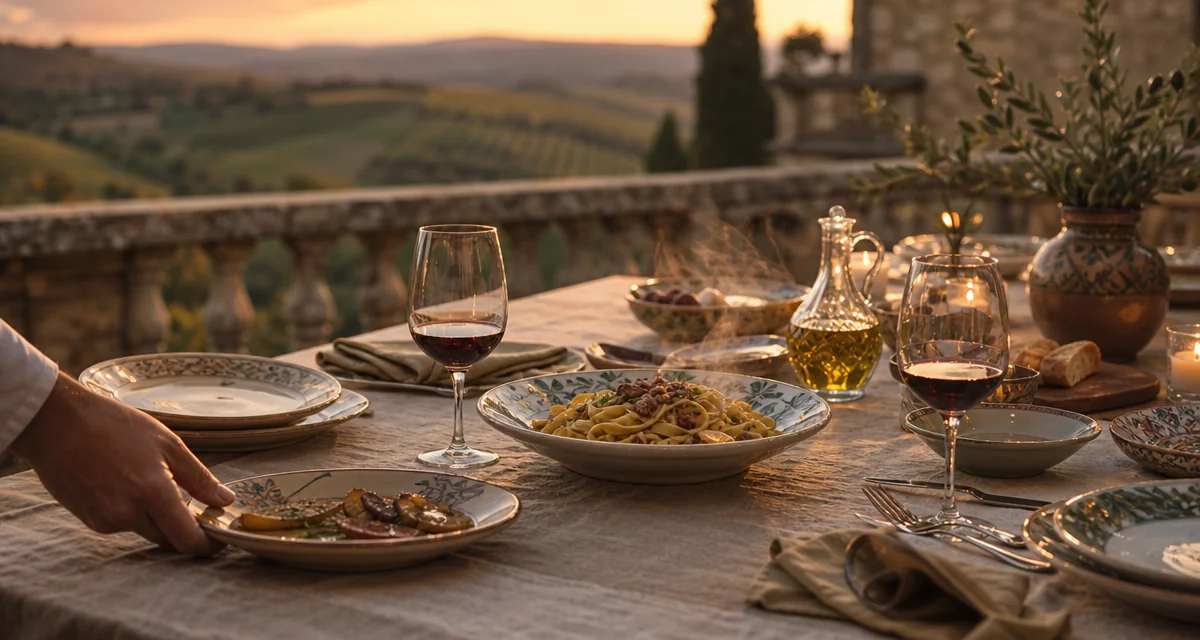
The Italian Christmas menu is about rhythm more than the number of dishes: the baccalà soaking from Monday, the struffoli made on Tuesday, the broth chilling on Wednesday night, so that on Thursday 24 December and Friday 25 December the cook can sit down for most of the meal. Choose one region, keep to 4 to 6 courses and order early. If you would rather spend those two days at the table than at the stove, Chef On Demand pairs you with a chef from our Tuscan chef network, or from our wider network of private chefs across Italy. For the rest of the season, from the markets to what closes on the 25th, read our guide to how Italy spends the weeks from 8 December to Epiphany, and for menus beyond December see our private chef dinner party menu ideas. Then picture the clams opening in the pan, the village lights below the terrace, and nobody watching the clock.