What does 'unlimited wine' actually mean in a Florence pasta class?
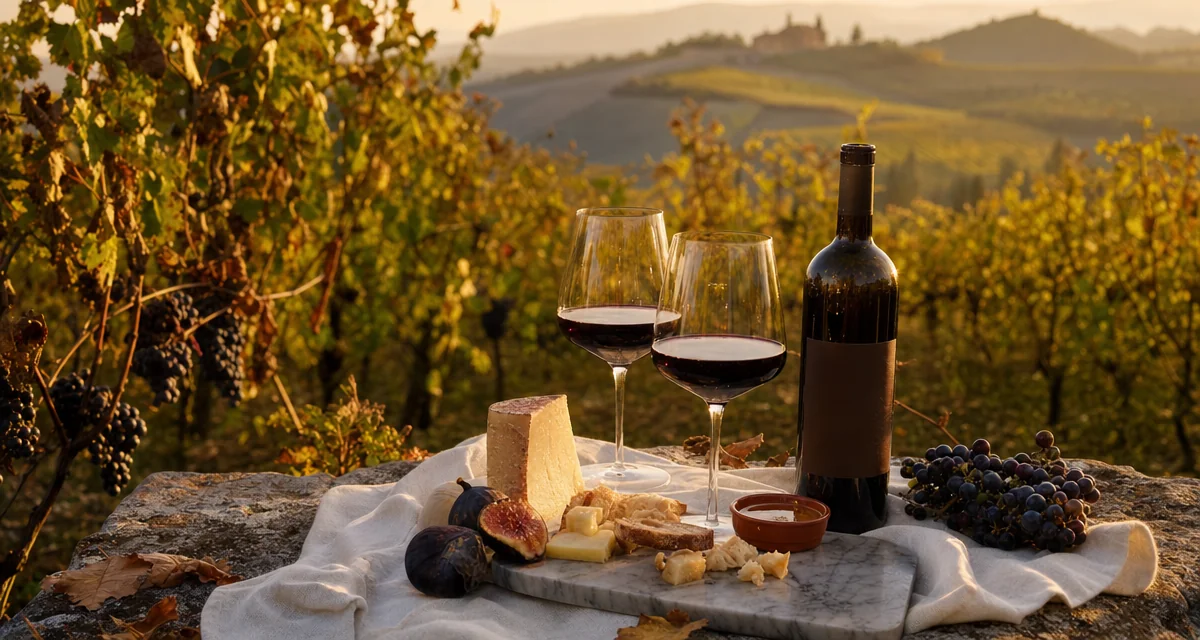
In the Florence market, 'unlimited wine' means the host (the cooking school or the private chef) keeps a Tuscan red and a Tuscan white open on the table for the full duration of the class and the seated meal, and tops your glass up whenever it gets low. It does not mean 14 bottles for two people, and it does not mean a cocktail bar. The standard pour is Chianti DOCG on the red side (an everyday-quality Sangiovese-based wine from the Chianti hills south of Florence, dry, cherry-and-leather forward) and Vernaccia di San Gimignano DOCG on the white side (a crisp, mineral white from the medieval town of San Gimignano about 50 km southwest — Italy's first DOC, awarded in 1966). In group classes the wine quantity is generous but pragmatic — most operators pour from 1.5-litre or 3-litre bottles to keep cost-per-glass low, and they pace the service to the 3-hour class. In a private at-villa format the chef brings selected bottles matched to your menu and decants them course by course — the 'unlimited' part is the same (no rationed glasses), but the wine itself is a tier up.
How much does a Florence pasta class with unlimited wine cost in 2026?
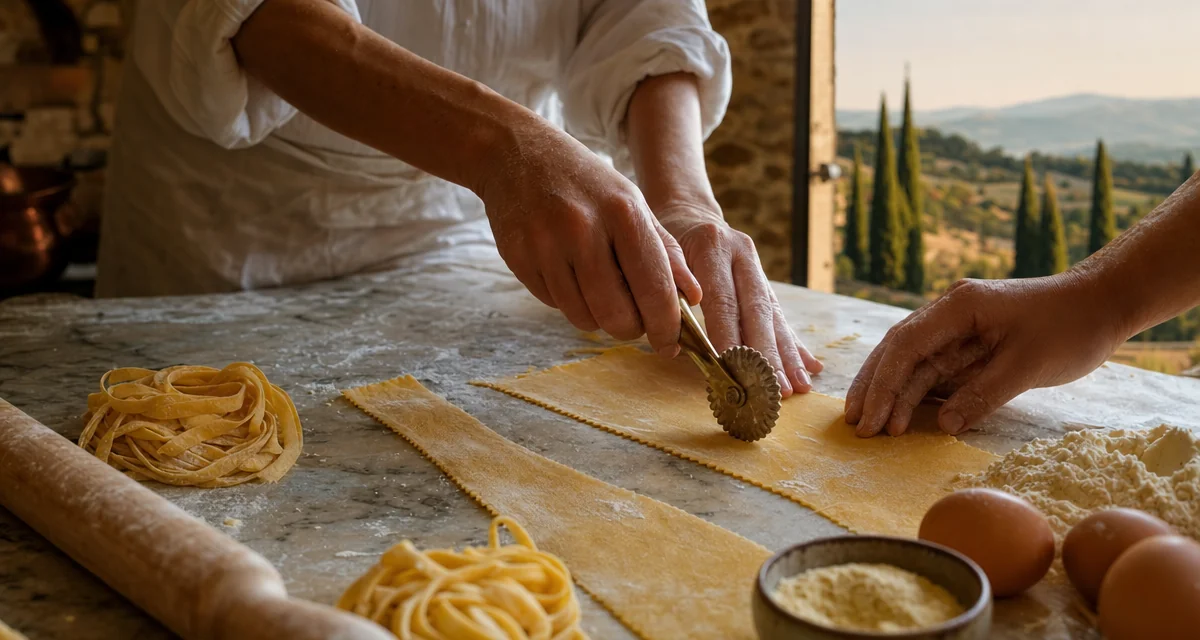
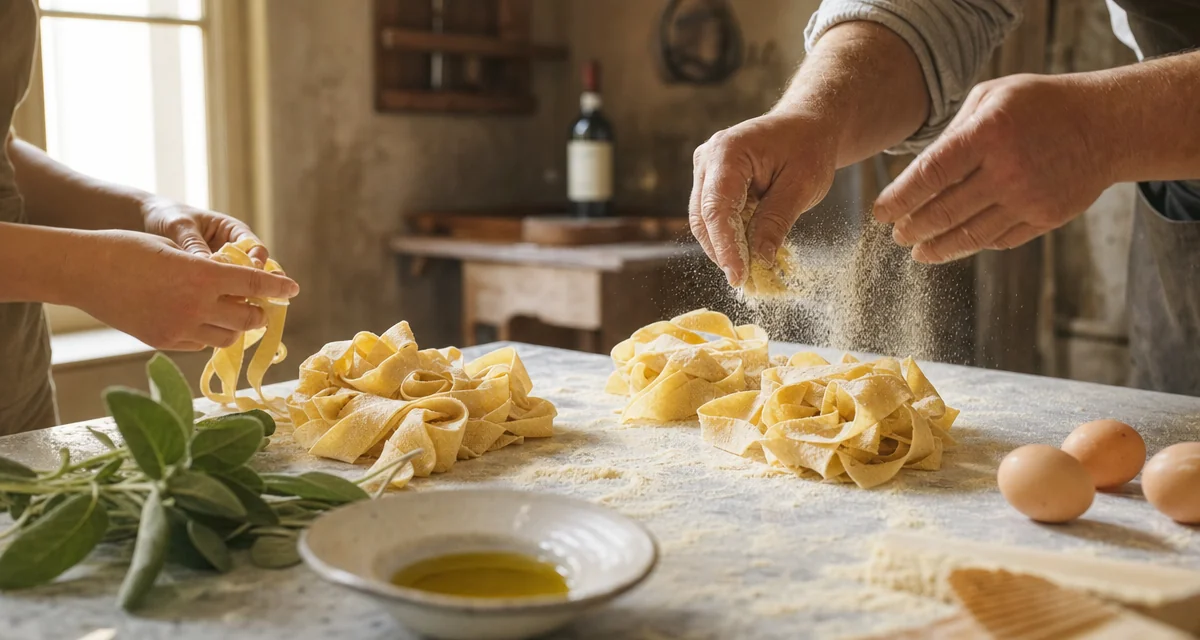
The Florence market in 2026 splits cleanly into three price bands. Walk-in group classes in central Florence — the medieval-tower formats, the cooking schools near the Duomo — run EUR 60-110 per adult for 2.5-3 hours: three pasta shapes (typically pappardelle, ravioli, tortelli), one Chianti and one Vernaccia on the table, a group of 8-20 strangers. Small-group premium classes (max 6-12 guests, sometimes adding tiramisu) sit at EUR 90-150 per adult, occasionally up to EUR 200 for chef's-table editions with truffle ravioli. Private at-villa bookings through a marketplace like Chef On Demand price at EUR 150 per adult and EUR 60 per child as the network standard: a single chef comes to your villa or apartment, teaches two pasta shapes hands-on, cooks the antipasti and tiramisu while the pasta rests, then plates a full seated dinner with 2-3 paired wines on the table for 4-5 hours. The price-per-hour comparison favours private bookings once your party is 4+ adults; below 4 adults the group walk-in is cheaper per head, but you lose the menu personalisation and the at-villa anchor.
Which Tuscan wines should be on the table — and why?
A serious Florence pasta class pours wines that match what you cook. The standard rotation, in order of how often we see it in our Tuscan chef network, is: Vernaccia di San Gimignano DOCG with antipasti and any seafood-or-vegetable pasta sauce (it's Italy's oldest DOC, citrus-mineral-almond profile, cuts through olive oil); Chianti DOCG or Chianti Classico DOCG with a meat ragù on long pasta — pappardelle al cinghiale, tagliatelle al ragù toscano (Sangiovese's cherry-tobacco-tannin profile is the textbook pairing); Rosso di Montalcino DOC with a richer secondo if your bundle includes one (younger, more affordable sibling of Brunello, same 100% Sangiovese Grosso grape); Brunello di Montalcino DOCG only in the Luxury bundle — Brunello is aged a minimum of 5 years before release, retails at EUR 35-80 a bottle wholesale, so it's never the everyday pour. The Super Tuscan category (Sassicaia, Tignanello territory) appears in Luxury-tier private bookings on request; these are Bordeaux-style blends from the Tuscan coast and inland Chianti, priced EUR 80-200+ a bottle, so they're paired one glass per course, not 'unlimited'. Vin Santo (a Tuscan dessert wine made from dried Trebbiano and Malvasia grapes) goes with the tiramisu or the cantucci.
Guests ask me for 'unlimited wine' and I say yes — then I open a Chianti Classico from a producer I know, and a Vernaccia from a 12-hectare estate near San Gimignano. 'Unlimited' is about generosity, not volume. Two good bottles for four guests, decanted, is the whole point. Chef Matteo, Florence-based ambassador of Chef On Demand Tuscany
Pasta class wine pairing: how does the matching actually work?
Wine pairing for fresh pasta runs on three Italian Sommelier Association (AIS) principles: matching weight, balancing tension, and respecting territory. Matching weight means a light pasta (tagliatelle with butter and sage, ravioli with ricotta and lemon zest) needs a light wine — a Vernaccia, a young Vermentino, not a Brunello. Balancing tension means a rich, fatty sauce (Tuscan ragù, pici al cinghiale wild-boar ragù) needs a wine with enough acidity and tannin to cut through fat — Sangiovese (the grape behind Chianti and Brunello) is built for exactly this, which is why it dominates the Tuscan table. Respecting territory is the local shorthand: if the pasta is Tuscan, the wine is Tuscan. Pici (a hand-rolled thick spaghetti from southern Tuscany, made with only flour and water) goes with Chianti Classico, not a Barolo or a Sicilian Nero d'Avola — not because the other pairing is wrong, but because the Tuscan logic of the class is to taste the region as one piece. In a private at-villa format the chef can talk you through each pairing as the bottle opens; in a group class the conversation is usually 'here's the red, here's the white, go'. Both work — the depth is the difference.
- Confirm the pasta shapes taught — a serious class teaches at least one long and one short (e.g. pappardelle plus tortelli, or tagliatelle plus ravioli); single-shape classes are usually beginner cuts.
- Ask which two wines are on the table and which DOC/DOCG zone they come from — a vague 'Tuscan red' is a flag.
- Check group size in writing — if the listing says 'small group' but doesn't cap it, expect 12-20.
- Verify the format — is the seated meal at the same table where you cooked, or do you queue at a buffet? A real class-plus-dinner uses the same room.
- If you booked a villa, ask if a chef can come to you — the at-villa version eliminates the transfer logistics for a group of 6+.
| Feature | Walk-in group class (central Florence) | Private at-villa class + dinner (Chef On Demand) |
|---|---|---|
| Price per adult | EUR 60-110 | EUR 150 (Essential tier) |
| Price per child | EUR 35-50 | EUR 60 |
| Duration | 2.5-3 hours | 4-5 hours (class + seated dinner) |
| Group composition | 8-20 strangers | Your party only (typically 4-12 guests) |
| Pasta shapes taught | 3 (often ravioli, pappardelle, tortelli) | 2 (one long + one short, your choice) |
| Wine — Essential | Chianti DOCG + Vernaccia (tank or 3L) | Chianti DOCG + Vernaccia, decanted bottles |
| Wine — premium / Taste of Italy | Chianti Classico DOCG + Vernaccia DOCG | Chianti Classico + Vernaccia DOCG + Rosso di Montalcino |
| Wine — Luxury tier | Not available | Brunello di Montalcino DOCG, Super Tuscan options |
| Sommelier-led pairings | Rare | Available on request |
| Menu personalisation | Fixed | Tailored to allergies, dietary preferences, kids |
| Location | Cooking school near Duomo or Oltrarno | Your villa, apartment, or holiday rental |
| Transfer logistics | You travel to the venue | Chef comes to you, brings ingredients and wine |
Why a private at-villa pasta class beats the group format for parties of four or more
Group classes work for solo travellers and couples who want a social evening with strangers — that's a real value, and the EUR 60-110 ticket reflects it. For a party of four or more (most family trips, anniversary groups, friends-of-friends villa weeks), the maths and the experience both flip. Privacy: only your group at the table, no twelve strangers kneading dough beside you. True personalisation: menu, pace, dietary requirements (gluten-free, vegetarian, kosher-style, allergies) tailored to your party — impossible in a fixed-cohort classroom. Your villa as the stage: you spend the evening in the rural Chianti farmhouse or the rooftop apartment you're already paying for, not in a basement classroom in town. Zero transfer logistics: no taxi for eight, no parking, no rushing between venues. In rural villa locations south of Florence (Greve in Chianti, San Casciano, Tavarnelle Val di Pesa) the drive to a city-centre class can mean 45-60 minutes each way. Flexible timing: start at 5pm if that's when the kids will hold up, finish at midnight if the wine is good. Wine flexibility: drink the bottles you bought at the local enoteca, the wines from the villa cellar, or the pairings the chef brings — no 'no outside alcohol' rule. Family-friendly: children can join the class, nap, or play in the next room while the adults stay at the table — cooking schools rarely accommodate mixed-age parties.
Florence pasta class price: what drives the EUR 60 to EUR 200 range?
Five variables explain the entire Florence pasta-class price range. Group size sets the floor: a 20-person class amortises the chef's time and the wine across many guests, so per-head cost drops to EUR 60-80. Wine sourcing moves the middle: a class pouring tank Chianti and house Vernaccia stays at EUR 60-90; one pouring Chianti Classico DOCG from a named producer plus Vernaccia di San Gimignano DOCG moves to EUR 100-150. Format depth adds another layer: a 2.5-hour pasta-only class is cheaper than a 4-hour pasta + antipasti + tiramisu class with seated dinner. Truffle and seafood are the obvious uplifts — truffle ravioli with shaved fresh Tuscan tartufo adds EUR 20-50 per head; a seafood pasta with langoustines adds similar. Private vs group is the biggest single lever: bringing a chef to your villa removes the per-head subsidy of a shared class, but lets you control every other variable. For families on extended Tuscan villa stays, the at-villa format also opens the door to multi-day chef bookings where the pasta class becomes one evening of a wider holiday-cook plan.
Why this matters for your Florence trip
The Florence pasta class is one of the city's most-booked experiences — there's a reason it lands on every itinerary alongside the Uffizi and Brunelleschi's Dome. But 'pasta class with unlimited wine' is a category, not a product. Choosing well means knowing the difference between a EUR 65 medieval-tower class with house Chianti — perfectly fun, completely fine, the right answer if you're two travellers wanting a Tuesday night activity — and a EUR 150-per-adult private at-villa pasta-class + dinner where a Florentine chef walks into your kitchen with two pasta shapes, ricotta and spinach for the tortelli, a wild-boar ragù simmering for the pappardelle, a tiramisu kit, and a Chianti Classico plus a Vernaccia di San Gimignano DOCG plus a Rosso di Montalcino selected for your menu. We've coordinated 800+ private chef experiences across Italy since 2024, and the single most-cited reason guests upgrade to the at-villa format is the wine — not because the group classes pour 'bad' wine, but because the private format pours your wine, paired to your menu, in your villa. To browse what's possible in the region, see our Florence cooking class hub or read our companion guides on at-villa pasta-making classes in Florence, the best Florence cooking classes for 2026, and Tuscany food-and-wine day tours with a villa chef. For the technique-led variant of the at-villa class see the Florence pasta making workshop pillar; for regional and country context, the Tuscany cooking class hub and private cooking classes in Italy pages cover terroir and pricing across the wider network. The wine choice is yours; the pasta will be on your plate within thirty minutes of you finishing the dough. That's the part that doesn't change.