What should you expect from a cooking class in Bologna?
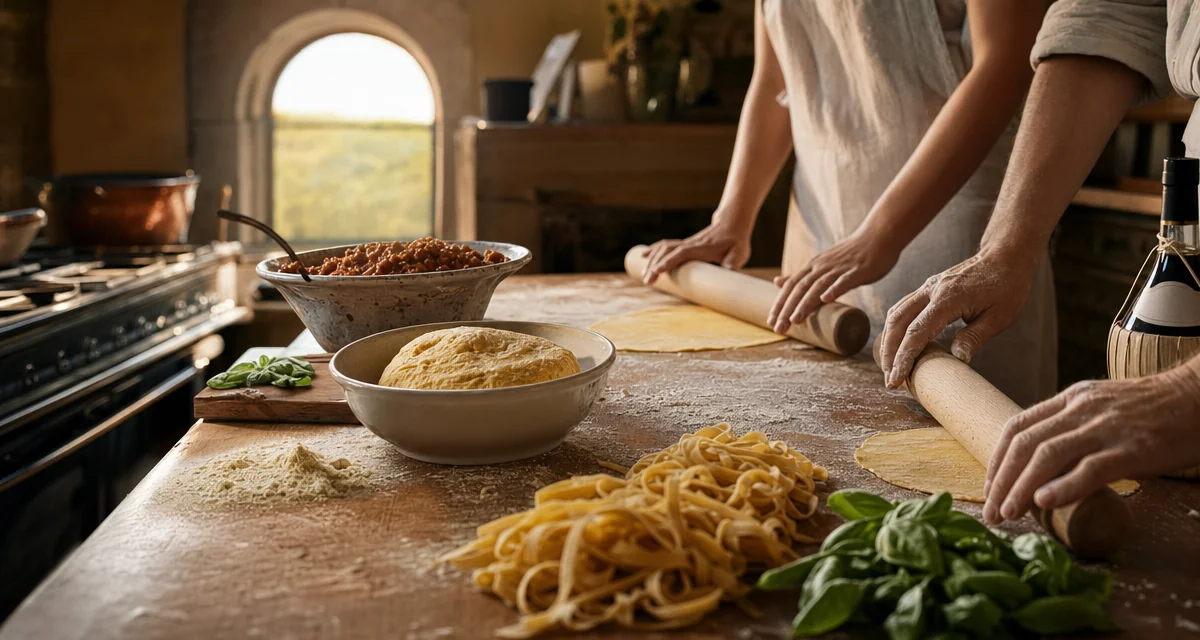
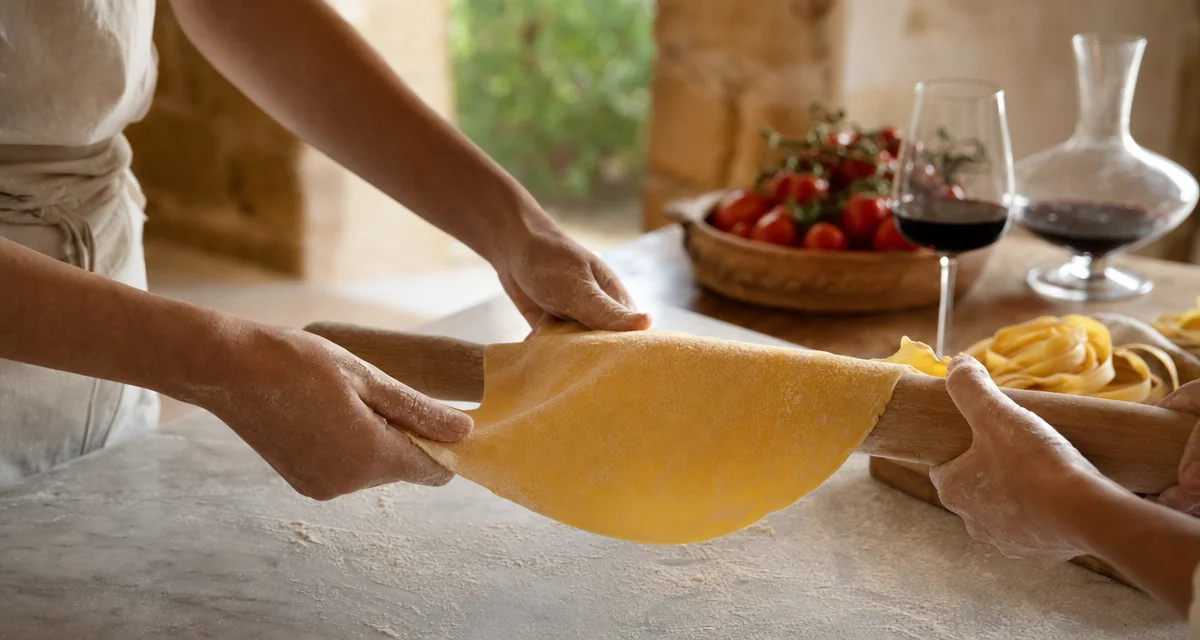
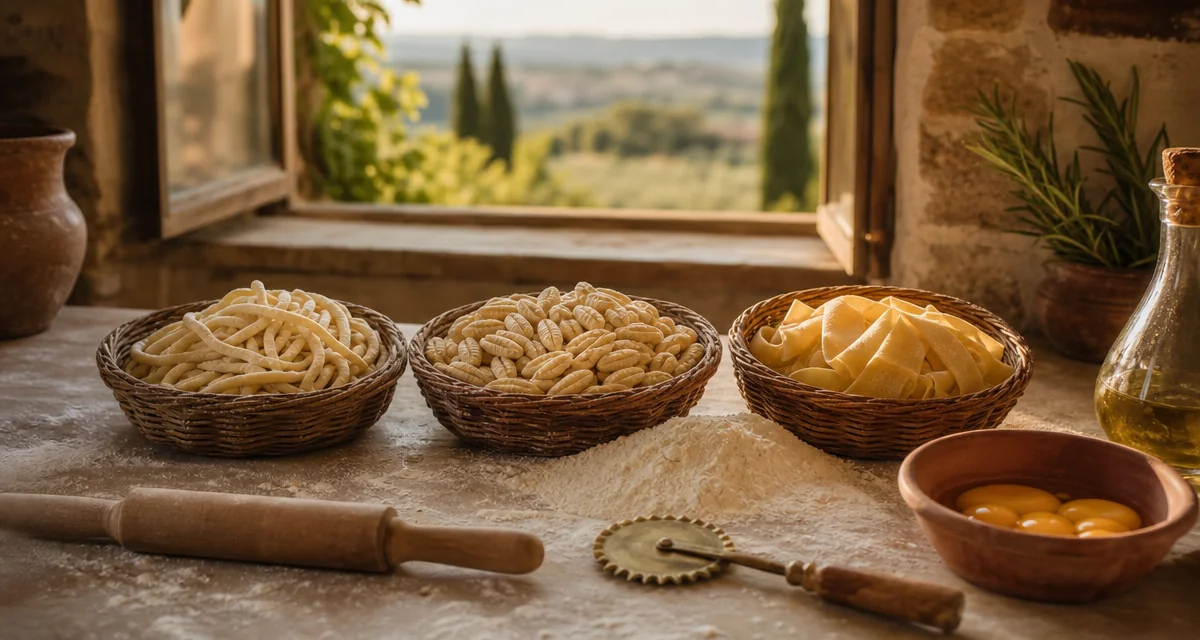
Expect your hands in flour within ten minutes. A Bologna cooking class is built around sfoglia, the hand-rolled egg-pasta sheet that is the city's defining skill, and a good lesson teaches you two shapes: one long, such as tagliatelle, and one short, such as tortellini or garganelli. Most classes run 2 to 4 hours and end with you eating exactly what you made, paired with local wine. The tradition you are stepping into has a guardian: the sfoglina, the woman who rolls pasta for a living, and the rezdora, the matriarch who once ran the Emilian farmhouse kitchen. A typical session covers the 100-gram-flour-to-one-egg ratio, the kneading and resting, the stretching with a mattarello rather than a machine, and the cutting. You will likely finish with homemade tiramisu, the cocoa-dusted dessert of mascarpone and espresso-soaked savoiardi biscuits served at almost every Emilian table. The best teachers slow down at the hard part, the tortellini fold, a pinch-and-twist around a knuckle that takes most people a dozen tries to get right.
How much does a cooking class in Bologna cost in 2026?
A cooking class in Bologna costs roughly EUR 65 to EUR 155 per person for a group studio session in 2026, while a private chef-led pasta class and dinner at your apartment starts at EUR 150 per adult. The spread is wide because two very different products share the same name. At the lower end, EUR 65 to EUR 90 buys a seat in a home-style group class of 8 to 12 people, usually 2 to 2.5 hours, three pasta courses and a glass of wine. The popular Taste Bologna class, for example, runs from EUR 115 per adult for around 3 hours with a maximum of 12 guests, EUR 59 for children aged 4 to 10. Premium group experiences with a market tour reach EUR 150 per person all-in. A Bologna pasta cooking class with dinner therefore costs about what a good restaurant dinner would, but you leave with the skill in your hands. The private route prices differently because you are not buying a seat, you are buying the chef's whole afternoon: a Chef On Demand Pasta Class plus Dinner starts at EUR 150 per adult and EUR 60 per child, held at your rental for your group alone. For four adults that is roughly EUR 600 total, with no taxi and no shared bench. We work with a verified network of 12+ chefs across Emilia-Romagna, and the day rate covers shopping, teaching, cooking, serving and cleanup.
Tourists think the secret is the ragu. It is not. The secret is the sfoglia, the sheet. Get the egg-and-flour sheet right and even a simple butter-and-sage sauce tastes like a holiday you will talk about for years. Chef Francesca, Bologna-based ambassador of Chef On Demand Emilia-Romagna
Group studio or private chef class: which should you choose?
Choose a group studio if you want a social, lower-cost morning out and do not mind sharing a bench with strangers; choose a private chef class if you want privacy, a tailored menu and your own apartment as the setting. The two formats answer different holidays. A group class in central Bologna puts you elbow-to-elbow with 8 to 12 other travellers, a fixed menu and a fixed clock, often a 40-minute walk or taxi from the apartment you rented near the Quadrilatero, the medieval market quarter of narrow lanes and food stalls behind Piazza Maggiore. It is fun, it is affordable, and it suits solo travellers or couples happy to meet people. A private Pasta Class plus Dinner flips every variable: the chef comes to you, brings every ingredient and tool, and teaches only your group. You set the start time, drink the Lambrusco you bought at the local enoteca (the slightly fizzy, dry-to-sweet red of Emilia, best chilled with mortadella), and the children can wander off when they tire of folding. There is no transfer and no rush to clear the bench for the next class. For a group of six in a rented apartment, the privacy and the menu control are usually worth the premium. If your search is really 'I want a private chef in Bologna' rather than a lesson, our private chefs across Bologna also cook full dinners without the teaching component, and you can browse the Bologna chef network to see who is available for your dates.
- Confirm the format: a true Pasta Class plus Dinner is one booking, one chef, one location, with a 2-hour hands-on lesson followed by a seated dinner of what you made.
- Lock the two shapes: ask for one long and one short, in Bologna that means tagliatelle plus tortellini or garganelli, so you learn two techniques, not one.
- State allergies and diets in writing as a bullet list, not buried in a paragraph, so the chef can plan around them.
- Set the headcount and split adults from children early, because pricing and station setup depend on it.
- Choose your wine plan: bring your own bottles from a local shop, use the villa cellar, or ask the chef to source pairings.
- Agree the timing window, most private classes run 4 to 5 hours end to end, so plan the rest of your day around it.
| Feature | Group studio class | Private Pasta Class plus Dinner |
|---|---|---|
| Price (2026) | EUR 65 to EUR 155 per person | From EUR 150 per adult, EUR 60 per child |
| Who is in the room | 8 to 12 strangers, fixed cohort | Your group only |
| Location | Studio or host's kitchen in the city | Your apartment, villa or rental |
| Menu | Fixed for everyone | Tailored to your group and diets |
| Start time | Fixed slots | You decide |
| Transfer | Travel to the venue | Chef comes to you, zero transfer |
| Wine | Usually one included glass | Your bottles, the villa cellar, or chef pairings |
| Best for | Solo travellers, couples, budget | Families and groups of 4 to 12 |
What is a private Pasta Class plus Dinner, exactly?
A private Pasta Class plus Dinner is a single booking that bundles a 2-hour hands-on pasta lesson with a full seated dinner of what you cooked, held entirely at your apartment or villa for your group only. Here is how the afternoon runs. The chef arrives at the property you have rented with all the ingredients and tools, dough boards, rolling pins, cutters, pots and plates, and you cook in your own kitchen. The lesson teaches two fresh-pasta shapes, one long and one short, which in Bologna maps naturally to tagliatelle (the ribbon that carries ragu alla bolognese, the slow-simmered meat sauce that is the city's most famous export) and tortellini (the small navel-shaped parcels of the Emilian table). While the pasta rests on the counter, the chef prepares two sauces, one per shape, plus a few regional antipasti, often mortadella (the silky, pistachio-studded pork sausage that Bologna gave the world, the ancestor of American baloney) and a wedge of Parmigiano Reggiano DOP, the hard aged cow's-milk cheese from this exact province, matured at least 12 months. Then everyone sits at your own table, terrace or garden while the chef cooks the pasta you shaped, plates it, serves the full menu, ends with homemade tiramisu and cleans up entirely. One chef, one location, your group. Crucially, there is no recipe handout: the takeaway is technique and muscle memory, the knuckle-fold of the tortellini and the feel of correctly hydrated dough, coached under the chef's hands, plus any photos you take yourselves.
Which dishes and ingredients define a Bologna class?
The two dishes that define any honest Bologna class are tagliatelle al ragu and tortellini, both with recipes officially deposited at the city's Chamber of Commerce. Tagliatelle al ragu is the truth behind 'spaghetti bolognese', a dish that does not actually exist in Bologna: the slow meat-and-soffritto sauce clings to flat ribbons, never to spaghetti. Tortellini, the tiny ring said to be modelled on the goddess Venus's navel, are traditionally served not with sauce but in brodo, a clear capon broth, especially at Christmas. Around these you will meet the Emilian larder: Parmigiano Reggiano DOP, grated over almost everything, and aceto balsamico tradizionale di Modena DOP, the syrupy aged balsamic from neighbouring Modena, casked for a minimum of 12 years. To taste the source of these ingredients, walk the Quadrilatero behind Piazza Maggiore before your class, or take a day trip to nearby Modena for balsamic and to Parma for the ham and the cheese, the two towns that complete the Emilian food triangle with Bologna.
Why this matters for your Emilia-Romagna holiday
Of all the cities in Italy, Bologna rewards the cook more than the sightseer. There is no single must-see monument the way Florence has its Duomo or Rome its Colosseum; what Bologna has is a table, and the only way to truly sit at it is to make the food yourself. A class is not a souvenir, it is a skill that travels home, so the tagliatelle you serve in London or Boston six months from now carries the memory of a Bologna afternoon in every ribbon. The choice between a crowded studio and a private chef in your own kitchen is really a choice about what you want the memory to be: a fun morning with strangers, or a slow afternoon with your own people in the apartment you came all this way to enjoy. If you decide you want the private path, with a chef who shops the morning markets, teaches in your kitchen and stays to cook the dinner, start with a Bologna private chef experience, then explore our wider network of private chefs across Italy and read our companion guides to the best cooking classes in Italy and cooking classes in Italy for tourists. However you choose, do not leave Emilia-Romagna without flour on your hands at least once. The city, quietly, is asking you to.