What do you actually learn in a Sicilian cooking class?
In a Sicilian cooking class you learn to make 3 to 5 dishes by hand over 2 to 4 hours, usually a fresh pasta, one or two island classics, and a dessert, while the cook explains the technique and the story behind each one. The teaching is practical, not academic: you knead, shape, fry and taste rather than watch.
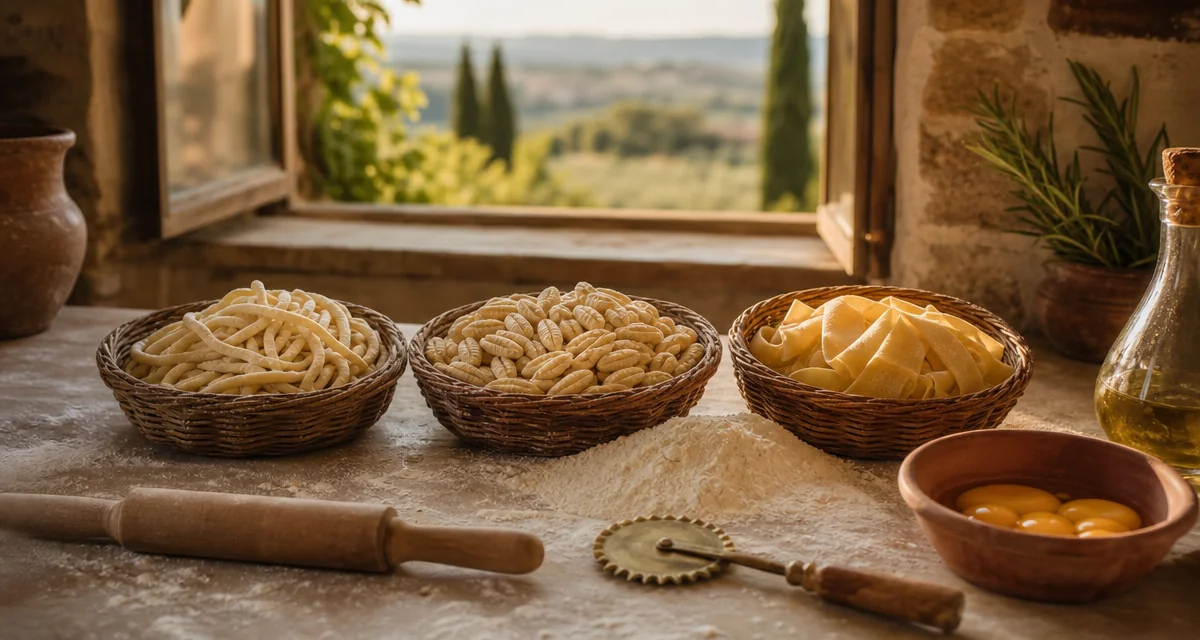
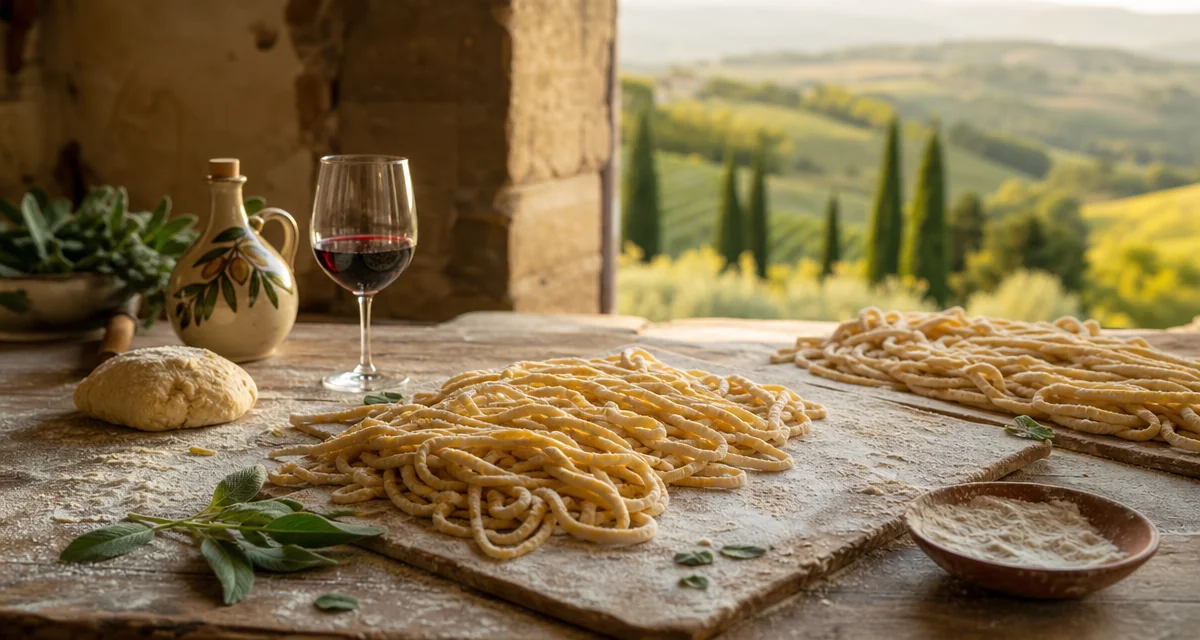
Most classes anchor on busiate, the corkscrew-shaped fresh pasta of western Sicily that is rolled around a thin reed or skewer and traditionally served with pesto alla trapanese, a Trapani-style raw sauce of almonds, tomato, basil and garlic. From there the menu wanders into the island's greatest hits. Caponata is a sweet-and-sour aubergine relish, fried and then simmered with celery, capers, olives and a splash of vinegar and sugar, eaten cold or at room temperature. Pasta alla Norma, born in Catania and named after Bellini's opera, tops short pasta with tomato, fried aubergine, basil and a snowfall of salted ricotta, known as ricotta salata. Many classes end with arancini, the deep-fried stuffed rice balls that are conical in the east and round in the west, and cannoli, the crisp fried pastry tubes piped to order with sweet sheep's-milk ricotta so the shell never goes soft. If you'd rather compare regions before you commit, our guide to where to take cooking classes across Italy sets Sicily against Tuscany, Rome and the north.
How much does a cooking class in Sicily cost in 2026?
A cooking class in Sicily costs roughly EUR 55 to EUR 145 per person in 2026. Standard group classes of 2 to 3 hours sit around EUR 55 to EUR 85, small-group and market-tour formats run EUR 90 to EUR 130, and private or in-villa experiences are quoted per group or per head with a clear group-size assumption.
The single biggest factor is whether you share the kitchen. A studio class in Palermo or Ortigia with 8 to 12 strangers spreads the cook's fee across many heads, so it stays cheap. A private class, where the cook works only with your party, costs more per person but buys you the menu, the pace and the conversation. The second factor is the market tour: classes that begin at Ballaro, Vucciria or the Catania fish market before cooking add an hour or two and typically EUR 20 to EUR 40 per person for the guided shopping. For the in-villa Pasta Class plus Dinner from Chef On Demand, a useful anchor is EUR 120 per head for 6 guests on the 4-course Essential tier and EUR 145 per head for the 5-course Taste of Italy tier; at 9 or more guests those settle to around EUR 90 and EUR 115 per head respectively, because the chef's time is shared across a larger table. Children are counted at half in the chef's fee only, which keeps a family booking sensible.
| Tier | Courses | 6 guests | 9+ guests | Best for |
|---|---|---|---|---|
| Essential | 4 courses | ~EUR 120 | ~EUR 90 | First-timers who want the hands-on class and a generous dinner without extras |
| Taste of Italy | 5 courses (signature) | ~EUR 145 | ~EUR 115 | The classic choice: two pasta shapes, antipasti, a Sicilian dessert, fuller menu |
| Luxury | 6+ courses | ~EUR 185 | ~EUR 150 | Special occasions with premium seafood, more courses and a wine flight |
Where are the best places in Sicily for a cooking class?
The best place for a cooking class in Sicily depends on where you are based, because the island's regions cook differently. Palermo and the west lean toward Arab-influenced sweet-savoury flavours and busiate; the east around Catania and Taormina is the home of pasta alla Norma and Etna wine; the southeast around Siracusa and the Val di Noto adds Baroque towns and Modica chocolate. Whichever you choose, you can lean on our network of private chefs across Sicily to bring the class to your door.
Cooking class in Taormina and the east
Taormina, the cliff-top resort town below Mount Etna, is the most popular base for visitors and the easiest place to book a class with a sea view. The cooking here is eastern Sicilian: pasta alla Norma, fresh seafood from the Ionian coast, and pistachios from nearby Bronte, a town on Etna's slopes whose bright-green DOP pistachio flavours everything from pesto to gelato. Catania, half an hour south, is grittier and more authentic, with the famous Pescheria fish market thrashing with tuna and sea urchins each morning. Wine lovers should note the Etna DOC appellation, whose nerello mascalese reds grown on volcanic soil have become some of Italy's most talked-about bottles. If you are staying in a villa near Taormina or down in Catania, a resident chef can come to you.
Cooking class in Palermo and the west
Palermo is the street-food capital of Sicily and the obvious choice if you want a market tour. Classes here usually begin at Ballaro or Vucciria, two chaotic historic markets where you'll smell panelle, the chickpea-flour fritters, and sfincione, a thick Palermitan focaccia-pizza, before you cook. Western Sicilian food is the most Arab-influenced on the island: think busiate with pesto alla trapanese, couscous in Trapani, and sarde a beccafico, sardines rolled around breadcrumbs, pine nuts and raisins, then baked. The wine to know is Marsala DOC, the fortified wine from the town of the same name that ranges from dry aperitif styles to sweet dessert pours. For a class on your own terms, you can book a private chef in Palermo who brings the kitchen to your apartment.
Cooking class in Siracusa and the Val di Noto
The southeast is Sicily at its most beautiful and least crowded for cooking. The morning market on Ortigia, the island heart of Siracusa, is small but superb, and the surrounding Val di Noto, a UNESCO-listed cluster of honey-coloured Baroque towns rebuilt after the 1693 earthquake, is dotted with Slow Food producers. This is the land of Modica chocolate, ground cold in the Aztec style so it stays grainy, of Pachino cherry tomatoes, and of almonds from Avola. Classes here are more agricultural and seasonal, often run on or near a farm, and tend to skew toward vegetable-forward Sicilian home cooking.
In-villa class or studio class: which format suits your group?
Choose a studio or market-tour class if you are travelling solo or as a couple and want to meet people for the lowest price; choose an in-villa private class if you have rented a property and want the cooking, the dinner and the setting to revolve around your own group. The two formats deliver very different evenings.
A studio class is fixed: a set menu, a set time, a mixed cohort of 8 to 12 strangers, and a cook-then-eat-at-the-counter rhythm before everyone leaves. It is sociable and cheap, and the market-tour version is genuinely educational. The trade-off is logistics. If your villa is up in the hills of the Val di Noto or out toward Etna, reaching a class venue in town can mean a 40-minute drive each way for the whole party, then the same back after wine. The in-villa Pasta Class plus Dinner solves that entirely, and it is the format we lead with for families and groups.
How does the in-villa Pasta Class plus Dinner work?
The in-villa Pasta Class plus Dinner is a single booking, one chef, one location: the chef comes to the villa, apartment or holiday rental you are already staying in, teaches a roughly 2-hour hands-on pasta class, then cooks and serves a full seated dinner from what you made. Nobody goes to a cooking school or a restaurant kitchen; the whole experience happens at your property.
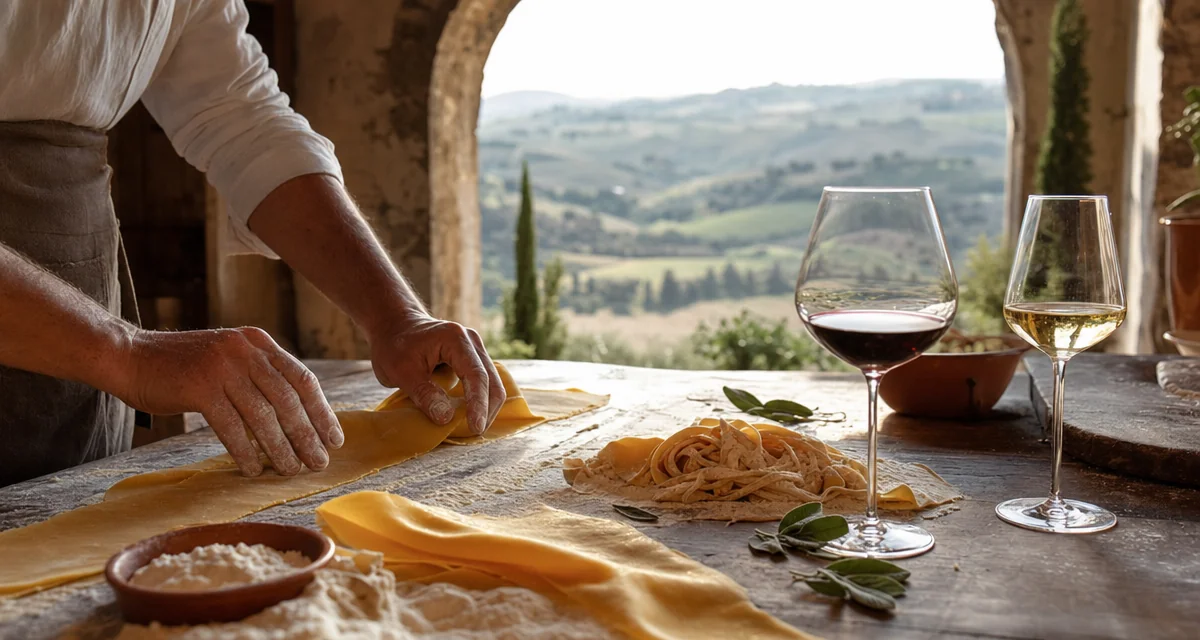
Here is the shape of it. The chef arrives at your villa with every ingredient, every dough board, rolling pin and pasta cutter, and sets up in your kitchen. For about two hours you are taught two fresh-pasta shapes, one long, such as tagliatelle or pappardelle, and one short, and in a Sicilian setting many chefs will teach busiate as the short shape so you take home the island's signature twist. While the pasta rests on your countertop, the chef prepares two sauces, often a meat ragu for the long pasta and a vegetable or seafood sauce for the short, a selection of antipasti, and a homemade dessert such as cannoli or a Sicilian almond and citrus sweet. Then you sit down, at your own table, on your own terrace or by the pool, and the chef plates and serves antipasti, both pasta courses with their sauces, and dessert. Wine is whatever you choose: bottles from the villa cellar, a Nero d'Avola you bought at a local enoteca, the wine shop on the corner, or pairings the chef brings.
Why at your villa rather than a studio? Privacy, for one: only your group at the table, no strangers kneading dough beside you. Real personalisation, for another: the menu, the pace, dietary needs and allergies are built around your party, which a fixed studio menu for twelve cannot do. Your setting becomes part of the memory, so you experience the sea-view terrace or the farmhouse garden you are paying for rather than a classroom in town. There is zero transfer logistics, no driving and no parking for eight people. The timing is flexible, with no next class waiting and no early-departure pressure when the group wants to linger over wine. And children can join the class, nap or play next door while older relatives who would rather not cook still sit down to the same dinner. The same in-villa format works beautifully elsewhere too, as our Florence pasta class with unlimited wine shows.
People come to my class expecting to learn cannoli. They leave talking about the busiate. When you twist that dough around the reed with your own hands, on the terrace of the house you've rented, it stops being a holiday activity and becomes the dinner the whole group remembers. Chef Salvo, Catania-based ambassador of Chef On Demand Sicily
- Confirm the group format: is the kitchen private to your party, or shared with other guests?
- Check exactly which dishes you'll make, and whether busiate or another fresh pasta is taught by hand.
- Ask whether a market tour is included and how long the total experience runs.
- State dietary needs and allergies up front, and ask whether the menu can flex for them.
- Clarify the per-person price and the group size it assumes, so you can compare like with like.
- For an in-villa class, confirm the chef brings all ingredients and equipment and handles the full clean-up.
- Book 7 to 14 days ahead in peak season to secure your preferred date and town.
Cooking class or restaurant dinner: which is the better night out in Sicily?
A restaurant gives you a polished meal you don't have to work for; a cooking class gives you a skill, a story and a meal you helped make. For a once-in-a-holiday Sicilian food experience with a group, an in-villa class that ends in dinner often wins, because it bundles the activity and the meal into one evening at your own property.
Think about what each delivers. A good trattoria in Ortigia or Taormina will feed you beautifully for perhaps EUR 45 to EUR 70 a head with wine, and you'll remember the swordfish. A cooking class costs more but you leave able to roll busiate, and the dinner is the second half of the experience rather than the whole of it. For families with children, for milestone trips, or for groups who want one anchor night that everyone talks about for years, the class wins on memory per euro. For a quiet romantic dinner with no effort, the restaurant wins. There is no wrong answer; there is only what your trip needs, and if you decide the class is yours, you can browse our Sicilian chef network to find a cook near your villa.
Why this matters for your Sicilian holiday
Sicily rewards travellers who get their hands into the food. The island has been ruled by Greeks, Arabs, Normans and Spaniards, and every one of them left something on the plate, from the saffron and raisins of the west to the volcanic wines of the east, a heritage chronicled in depth in the record of Sicilian cuisine. A cooking class is the shortest path from tourist to insider. Chef On Demand operates a verified network of private chefs across Sicily, with a 4.7/5 Trustpilot rating based on 800+ guests served since 2025, and our typical booking is 4 to 12 guests in a private villa over a 2 to 4 hour window. Whether you choose a market-tour class in Palermo or an in-villa Pasta Class plus Dinner near Taormina, the goal is the same: to send you home with the technique in your hands. You can also explore private chefs across Italy if your trip takes in more than one region, and our Sicily chef network is the place to start once you've picked your town. Picture it now: the busiate you twisted with your own fingers, on a plate on your terrace, the lights of the bay below and a glass of Nero d'Avola in hand.