What actually happens during a private chef dinner, hour by hour?
A private chef dinner runs in three phases. The chef shops in the morning, arrives 2 to 3 hours before the agreed service time to unpack and prep, then serves the meal across 2 to 3 hours at your table, and finally spends 45 to 60 minutes restoring the kitchen. Total presence on site is normally 4 to 6 hours. What stretches or compresses that window is group size, course count and how far the property sits from a decent market. A four-course dinner for 6 guests in a Florence apartment works on a 2-hour lead time, while a six-course menu for 14 in the Val d'Orcia (the UNESCO-listed valley in southern Tuscany, the cypress-lined landscape on every postcard, where the nearest full market may be 30 minutes away) needs 3 hours and often a second pair of hands. What surprises most first-time hosts is how quiet the setup is: professional kitchens run on mise en place, the discipline of arranging every component before a pan goes on the heat, so by the time your guests walk in most of the noisy work is behind the chef.
| Time | What the chef is doing | What you and your guests are doing |
|---|---|---|
| 8.30am to 10am | Market run: vegetables, bread, fish or meat, cheese from a local alimentari | Nothing. You are still on your first coffee |
| 5pm | Arrival, unloading crates, agreeing the service point and confirming allergies | A five-minute walkthrough of the kitchen with the chef |
| 5.15pm to 7.45pm | Mise en place: stocks, pasta dough, sauces, dessert set, plates warmed | Aperitivo by the pool, showers, laying the table |
| 8pm | Antipasti sent out, wine opened if requested | Sitting down. First course lands |
| 8.40pm to 10.15pm | Primo, then secondo with contorno, plated to order | Eating slowly. Roughly 25 to 35 minutes between courses |
| 10.30pm | Dolce, then coffee and digestivi if booked | Still at the table, usually the best hour of the night |
| 11pm to 11.45pm | Full clean-up: pans, hobs, worktops, your table dishes, rubbish out | Nothing. The kitchen is handed back cleaner than it was found |
Why does the chef shop at the market on the day?
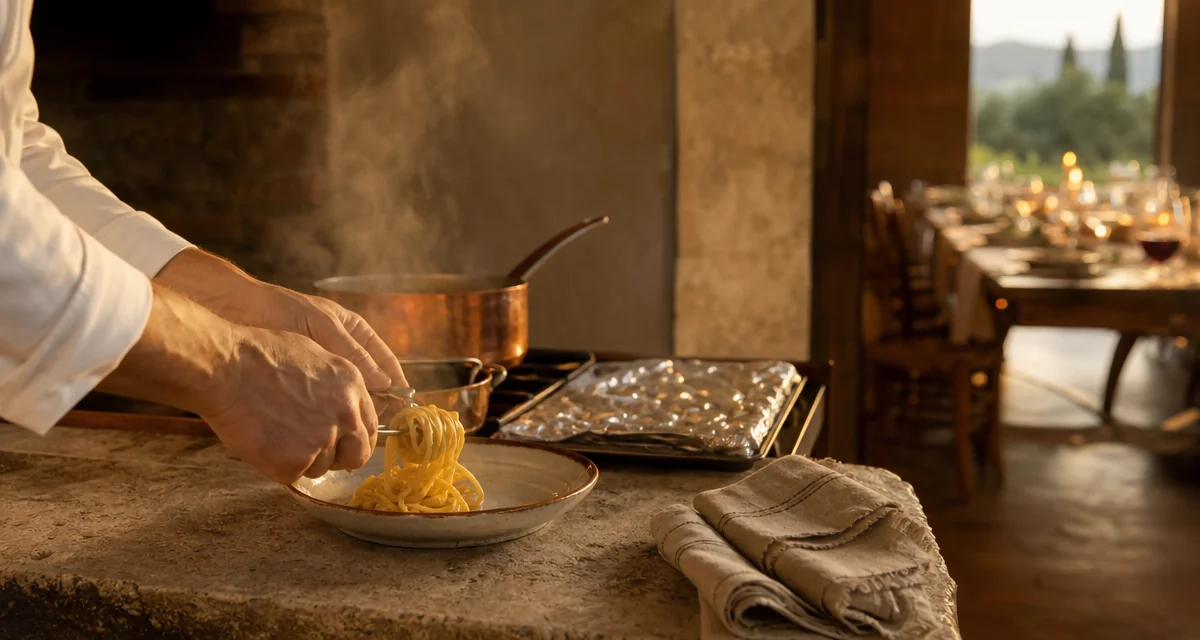
Chefs shop the morning of service because Italian menus are written around what a specific market has that specific week, not around a fixed catalogue. A confirmed menu is a framework, and the last 10 to 15 percent gets decided at the stall. That is the honest reason a chef will not commit to an exact fish 10 days out. In Florence a chef might start at the Mercato Centrale in San Lorenzo, then walk to Sant'Ambrogio for vegetables. In Siena or Greve in Chianti the run is smaller and more personal, often two or three suppliers the chef has used for years. Expect 60 to 90 minutes and four or five stops. This is where a menu picks up the details that make it feel like the place you are staying in: pici, the thick Tuscan pasta of flour and water alone, rolled by palm so every strand is uneven and holds sauce beautifully. Or pecorino di Pienza DOP, a sheep's-milk cheese from the Val d'Orcia aged from 30 days to a year, grassy when young and nutty when old. Ingredients like these are why Slow Food, founded in Bra in 1986, keeps a register of protected Presidia products.
What happens when the chef arrives at your villa?
The chef arrives 2 to 3 hours before service, does a five-minute walkthrough with you, then takes over the kitchen. That walkthrough is short but it decides the evening: where the food goes out, which surfaces the chef can claim, where the bin is, and whether anyone at the table has changed since the booking. After that the kitchen is theirs and yours is the terrace. In our network the typical booking is 4 to 12 guests with a 2 to 4 hour service window, so setup is designed to be invisible rather than theatrical. Equipment travels with the chef: knives, pans, a plating set, sometimes a portable induction ring and extra plates if the property has a mismatched set. What does not travel with the chef is your table. Linen, glassware, candles and seating are the host's territory, and that division is worth understanding beforehand, which is what our guide to private chef etiquette for guests sets out.
What a holiday-rental kitchen actually needs to have
This is the part almost nobody writes about, and the one that goes wrong. Rental kitchens in Italy are often beautiful and badly equipped: a single small oven, four hobs of which two work properly, one sink, and no dishwasher in older stone farmhouses. None of that stops a dinner, but the chef needs to know in advance, so send a photo of the kitchen when you book with a note on the oven type, the hob type and whether a dishwasher exists. Three things genuinely matter. First, a metre of clear worktop, which means moving the fruit bowl, the coffee machine and the holiday shopping before 5pm. Second, hot water and a working sink, because clean-up is included and nobody hands back a spotless kitchen without it. Third, fridge space: a five-course menu for 10 needs about half a standard fridge. Properties in Montalcino and the deeper Chianti hills often have an outdoor grill too, which a chef will happily use for a bistecca alla fiorentina, the thick T-bone of Chianina beef, 1.2 to 1.5 kg and 4 to 5 cm tall, grilled over embers and served rare on the bone. Mention it. It changes what gets proposed.
Guests always apologise for their rental kitchen. I have cooked a five-course dinner on two working hobs in a farmhouse near Panzano and nobody at the table ever knew. What I actually need is a clear metre of worktop and twenty minutes of quiet when I arrive. Chef Lorenzo, Florence-based ambassador of Chef On Demand Tuscany
How is an Italian private chef dinner paced across the courses?
Italian service follows a fixed architecture and pacing is built on it: antipasto, primo, secondo with a contorno alongside, then dolce. Courses land roughly 25 to 35 minutes apart, so five courses occupy 2 to 2.5 hours at the table and a six-course Luxury menu closer to 3. That structure, described in most surveys of Italian cuisine, is not decoration. It is a rhythm designed so the pasta arrives before anyone is full and the meat arrives after the wine has opened up. A private chef reads the table rather than a stopwatch: if your group is deep in conversation the next plate waits five minutes, and if a toddler is fading the dolce jumps the queue. That flexibility is the practical difference from a restaurant, where a coperto (the small per-person cover charge Italian restaurants add for bread and table service, usually €2 to €4) buys you a fixed slot rather than a night that runs at your speed. Wine follows the same logic. A Chianti Classico DOCG, the Sangiovese red from the hills between Florence and Siena marked with the black rooster seal, sits happily beside both the primo and the secondo, while a Brunello di Montalcino DOCG, 100 percent Sangiovese aged at least five years before release, is worth saving for the meat.
What a private chef dinner experience feels like for two
A private chef dinner for 2 is a different animal from a group booking. With two guests the chef is on site closer to 3.5 hours than 6, the course count usually holds at four or five, and the pacing tightens to 20 to 25 minutes between plates because there is no table-wide conversation to wait out. Per person it is the most expensive configuration, since shopping, travel and clean-up cost the same whether the chef cooks for 2 or 12. What you gain is proximity: at two covers the kitchen conversation becomes part of the evening, and most couples end up leaning on the worktop with a glass of Vin Santo (the amber Tuscan dessert wine made from dried grapes, traditionally dipped with hard almond cantucci) while the dolce is plated. It is the format we see most often for anniversaries and proposals across private chefs in Tuscany.
Who cleans up, and what is the host actually responsible for?
The chef cleans up. That covers their own pans and equipment, the hobs and oven, the worktops, the bin, and the plates, cutlery and glasses from your table. Budget 45 to 60 minutes after the last course. The host is responsible for the room, not the food: table setting, seating, wine choices, and keeping the guest count honest. Think of the booking as a split down the middle. The chef owns the menu, the shopping, the cooking, the service and the kitchen. You own the table, the arrival times and the mood, plus the question of whether to leave something extra at the end, which our piece on tipping a private chef in Italy answers properly. Get the guest count right in particular, because a menu shopped for 8 does not stretch to 11 at 7pm. Confirm your final number 72 hours ahead. If plans move, our team can usually re-cost a booking within 24 hours, and the average lead time when you book a Tuscany private chef experience is 7 to 14 days across the June to September peak.
Do private chefs clean up after themselves, or do you wash the dishes?
Yes, private chefs clean up after themselves, and in our network the kitchen is handed back at least as clean as it was found. The question comes up constantly because the answer varies by market and by contract. Some caterers abroad clean only their own station and leave your table service in the sink. That is not how a Chef On Demand booking works in Italy: dishes from the table, glassware, the hob, the oven interior if it was used, the worktops and the floor around the cooking area are all part of the service. Do private chefs clean the kitchen at 1am if the table is still going? They clean their area, stage the rest, and leave when the work is done rather than when the party is. If you want the chef to stay on for coffee service after midnight, say so at booking, because it changes the quoted hours.
- Send a photo of the kitchen and the dining area when you book, noting the oven type, hob type and whether a dishwasher exists.
- Confirm the final guest count and all allergies in writing 72 hours before service, one line per person.
- Clear a metre of worktop and half a fridge shelf before the chef arrives at 5pm.
- Set the table yourself 30 minutes before service, or ask at booking whether table setting can be added to the quote.
- Decide your wine plan in advance: bring bottles from a local enoteca (a wine shop and bar in one), use the villa cellar, or ask the chef to source pairings.
- Agree the finish time up front, including whether the chef stays through coffee and digestivi.
- Keep children, dogs and curious guests out of the working area during the final 30 minutes before service.
How much does a private chef dinner at home cost in Italy?
In Italy a private chef dinner is priced per person and per menu tier, and the per-head figure falls sharply as the group grows because the shopping, travel and clean-up are fixed costs spread across more covers. A Taste of Italy menu of 5 courses costs around €120 per person for 6 guests and about €100 per head at 10 guests. The four-course Essential runs roughly €95 per person at 6 guests and €85 at 10. A Luxury menu of six or more courses, the one carrying truffle, seafood and aged cuts, sits near €180 per person at 6 and €150 at 10. Premium city zones such as central Milan and Rome add around €15 per person, and Christian holidays such as Easter carry a surcharge of roughly 35 percent. Those figures cover the shopping, the cooking, the service and the clean-up, which is the comparison that matters against a restaurant bill where the coperto, the wine markup and two taxis for 8 quietly add 30 percent. Our guide to booking a private chef for a dinner party in Italy goes deeper on formats and inclusions.
| Tier | Courses | 6 guests, per person | 10 guests, per person |
|---|---|---|---|
| Essential | 4 courses | around €95 | around €85 |
| Taste of Italy | 5 courses | around €120 | around €100 |
| Luxury | 6 or more courses | around €180 | around €150 |
How does the timeline change for a multi-day stay or a pasta class?
The single-dinner clock is the baseline, and two other formats reshape it. A multi-day booking puts the chef with your group for the whole holiday, typically 3 to 7 days, and you choose meal by meal which ones the chef cooks: breakfast, lunch, dinner or any combination. The pattern we see most is 2 or 3 dinners plus one long lunch across a week, because most groups still want a few restaurant nights of their own. Daily market shopping is part of it, so the rhythm becomes a morning shop, an afternoon prep and an evening that starts when you decide. The second format is the Pasta Class + Dinner experience, a single 4 to 5 hour booking that happens entirely at the villa or apartment you have rented. The chef arrives with every ingredient, board, rolling pin and pot, teaches a 2-hour class covering two fresh pasta shapes (one long such as tagliatelle or pici, one short such as orecchiette or maltagliati) in your own kitchen, then prepares two sauces, regional antipasti and a homemade tiramisù while the dough rests. You sit down at your own table to the pasta you shaped. No transfer, no cooking school, no cohort of strangers. Children can join, nap or play next door. What you take home is technique and muscle memory, not a printed or digital handout.
Does a private chef live with you on a multi-day booking?
Not necessarily, and the answer changes what you pay. There are three lodging configurations and every multi-day quote is built on one of them. In the first, the chef stays at the property, using a spare room or dedicated chef quarters, which carries the lowest daily rate because you absorb the accommodation. In the second, a local chef commutes daily from home, which works well in dense areas such as Chianti, the Amalfi Coast and Lake Como where our network has resident chefs within 30 to 45 minutes, and there is no lodging cost at all. In the third, the chef books a room nearby and the accommodation appears as a transparent line item. There is no single multi-day per-person rate, because the price is assembled from the per-meal cost plus a daily retainer that depends on which of those three applies. Ask which configuration a quote assumes before comparing two proposals, otherwise you are comparing different products. Multi-day is available across Italy and in the UAE.
Why this matters for your Italian holiday
The question behind 'what to expect from a private chef dinner' is almost never really about food. It is about control. You have rented a house you love, you have a group you rarely get together, and you would rather not spend the best evening of the week negotiating a table for 9 at a restaurant 40 minutes away. A private chef inverts that. The room is yours, the clock is yours, the children can go to bed upstairs when they are done, and the conversation ends when it ends. Is a private chef worth it? At 6 guests and up, once you add the coperto, the wine markup and two taxis to a restaurant total, the arithmetic usually says yes, and the evening is not remotely the same product. Our network holds a 4.7 out of 5 Trustpilot rating across 800+ guests served since 2025, and the reviews that stay with us are rarely about the truffle. They are about the fact that nobody had to leave the table. Our private chef hub maps the network across the country, and regional pages such as our Tuscan chef network show who cooks where. Somewhere around 11pm, when the plates have gone and the kitchen light clicks off behind you, the only sound left is your own group still talking on a terrace in the dark. That is what you actually booked.