Private chef vs catering: what actually changes?
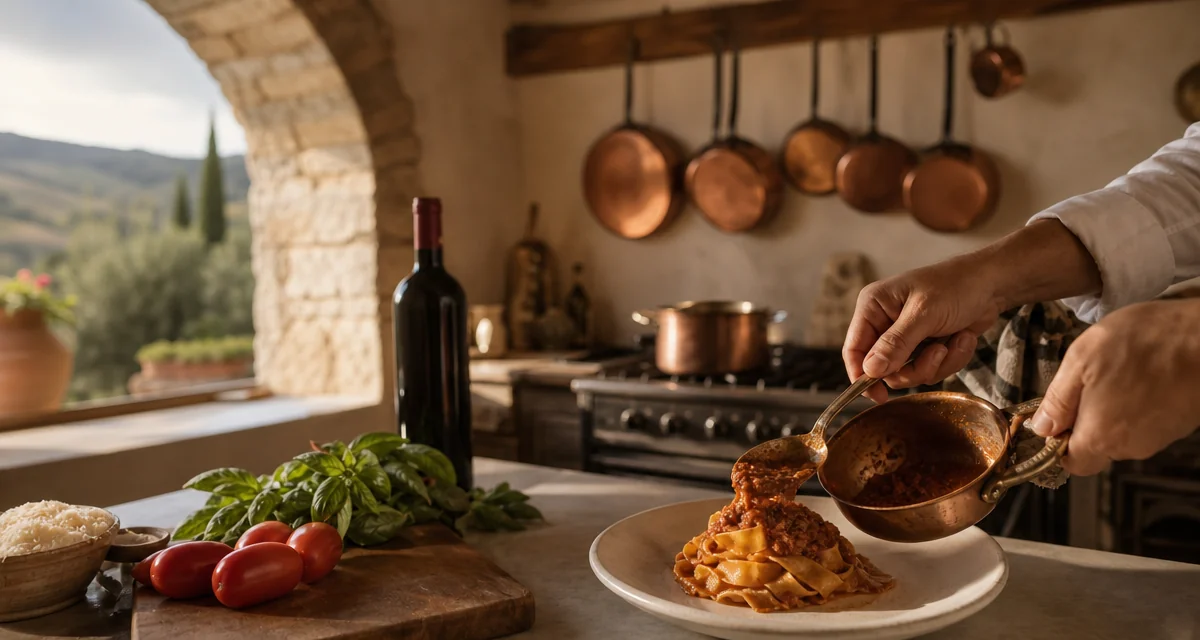
The difference is production location, and almost everything follows from it. A private chef shops that morning, cooks in your kitchen, and plates each course seconds before it reaches the table. A catering company cooks in a licensed production kitchen hours earlier, then transports the food, holds it hot and finishes it on site.
That single distinction cascades through the whole evening. Because the chef is standing at your hob with 4 burners and an oven, the menu can still change at 6pm when a guest mentions a shellfish allergy. Because the caterer left the production kitchen at 4pm with trays for three separate events, it cannot. And because the chef is cooking for one table, the menu can be built around dishes that are ruined by waiting: risotto, fresh pasta, a fillet of fish seared 90 seconds before it is eaten. A caterer, cooking for volume, engineers the menu around what survives a 40-minute drive and 45 minutes over a flame.
Neither model is better in the abstract, because they were built for different jobs. Catering solves the problem of feeding 120 people at once, and solves it beautifully. A private chef exists because a table of ten deserves food that was never held. Most people comparing personal chef services vs catering find their event sits clearly on one side of that line.
What is a private chef, and how is a caterer different?
A private chef is a professional cook who works for one household at a time, planning the menu, buying the ingredients, cooking on the client's premises and serving the meal. A caterer is a business that produces food for an event, usually off-site and at scale, then delivers it with the staff and equipment needed to serve it.
In practice the difference you feel as a host is control. The chef is one person answering only to your evening, with a service window of 2 to 4 hours from arrival to a clean kitchen. The caterer is a supply chain: a kitchen manager, a driver, a captain, servers, and a schedule that slots your event between two others. That structure makes catering possible at 150 guests, and clumsy at 10.
Private chef vs personal chef: which one are you actually booking?
The two terms get used interchangeably, and for a one-off dinner party the distinction rarely matters. Strictly, a private chef is employed by a single household on an ongoing basis, while a personal chef serves several clients on booked dates. The second is what almost everyone actually hires for a dinner party or a villa week.
What you book through Chef On Demand is that second model: a professional chef engaged for a specific date and a specific table, who arrives with the shopping done and leaves the kitchen as they found it. Our guide on how to hire a personal chef in Italy covers vetting, contracts and lead times.
Where does the food get cooked, and does that change how it tastes?
Yes, measurably. Catered food is cooked in a production kitchen, chilled or held, transported, then kept above 60°C until service, because food safety rules treat 5°C to 60°C as the danger zone where bacteria multiply. Everything a caterer serves has to survive that window. A private chef never enters it.
The equipment tells the story. A caterer arrives with insulated boxes and chafing dishes, shallow water-bath trays heated by fuel canisters underneath, which keep food safe and warm but keep gently cooking it. Forty-five minutes in a chafing dish is fine for a beef cheek braised for 4 hours anyway. It is fatal to fresh tagliolini, which goes from perfect to pasty in about 6 minutes, and it is why buffet pasta tastes the way buffet pasta tastes.
This is not a criticism of caterers, who work around the constraint with real skill and build menus that are genuinely better after 30 minutes of resting. But it does mean the two models cannot serve the same food. If your evening is built around hand-rolled pici (a thick, chewy spaghetti from the province of Siena, made from flour and water and rolled between the palms) and bistecca alla fiorentina (a 1.2 to 1.5 kg T-bone from Chianina cattle, grilled 4 to 5 minutes a side over embers and served rare on the bone), only one model can put it in front of you at the right moment.
People think they're choosing between two prices. They're choosing between food that was finished in front of them and food that was finished somewhere else and asked to wait. Chef Lorenzo, Florence-based ambassador of Chef On Demand in Tuscany
At what guest count does catering start winning?
The crossover sits at about 20 guests, and it moves either way depending on your kitchen. Below 20, one chef can shop, cook and plate a full menu without help and the per-head cost stays competitive. Between 20 and 40 both models work, but the chef needs a second pair of hands. Above 40, catering wins on almost every axis.
What moves the line is kitchen footprint, the one variable nobody quotes on. A private chef cooking for 12 needs 4 working burners, an oven that holds temperature, about 1.5 metres of clear worktop, a reachable sink and roughly one full fridge shelf. Most Italian holiday villas and city apartments clear that bar comfortably. Plenty of modern open-plan kitchens with 2 induction zones and a decorative island do not, and a good chef will say so at the quoting stage rather than discover it at 7pm.
A caterer needs almost the opposite: no cooking capability at all, but a staging area of 3 to 4 square metres out of sight, a socket, and a route from the van that avoids your dining room. If your kitchen is small but your garage is generous, catering becomes practical at 15 guests rather than 40. In our own network the busiest bookings sit at 6 to 14 guests, exactly the band where a domestic kitchen and a single chef are matched.
- Count the burners. Four gas rings or four induction zones is the working minimum for a plated menu at 10 or more guests.
- Measure the clear worktop. You want 1.5 metres of usable surface with nothing on it, which usually means moving the kettle and the coffee machine that morning.
- Open the oven and check it holds a set temperature. Villa ovens that run 30°C cold are common and worth flagging in advance.
- Empty one full fridge shelf. A chef cooking for 12 arrives with 3 or 4 shopping bags that all need cold storage on arrival.
- Check the parking and the last 200 metres. A chef with market shopping can walk it; a caterer with stacked trays usually cannot.
- Decide where the dirty plates go. Plated service for 12 generates around 40 items to wash, and that landing zone is not your dining table.
How much does each one really cost per head?
For a dinner party in Italy, a private chef costs €85 to €160 per person depending on the menu tier and the group size, with shopping, cooking, service and clean-up inside that number. Published 2026 catering price guides put buffet service at roughly $25 to $55 per guest and plated service at $50 to $120, before the service charge.
Here are our own verified figures, because a range without a group size is useless. A Chef On Demand Essential menu (4 courses) is €85 per person for 8 guests and stays at €85 from 9 upward. A Taste of Italy menu (5 courses, the signature regional showcase) is €110 per person at 8 guests and about €100 per head from 9 upward. A Luxury menu (6 or more courses, with truffle, seafood or aged cuts) is €160 at 8 and around €150 from 9. Premium zones such as Milan and Rome add roughly €15 per person, Easter and other Christian holidays carry a 35% uplift, and Christmas and New Year's Eve are quoted as fixed group prices.
Notice what the curve does. Per-head cost falls as the table grows and then flattens, because one chef cooking for 12 is not much more work than one cooking for 8. Catering behaves the opposite way at small numbers: the per-head figure looks low, but the minimum order and the 18-22% service charge pull the real number up. People searching for the average cost of personal chef vs catering usually find two headline ranges that ignore this entirely. For a breakdown by city and season, see our guide on how much a personal chef costs in Tuscany.
| Factor | Private chef | Catering company |
|---|---|---|
| Where the food is cooked | In your kitchen, from ingredients bought that morning | Off-site production kitchen, 3 to 8 hours ahead |
| Temperature at service | Plated straight from the pan, no holding | Held above 60°C in chafing dishes |
| Menu | Written for your table, adjustable up to 48 hours before | Set packages, locked 7 to 14 days ahead |
| Best guest count | 2 to 20, ideal at 6 to 14 | 25 and above, ideal at 50+ |
| Cost per head (Italy, 8 guests) | €85 Essential, €110 Taste of Italy, €160 Luxury | Market range plus 18-22% service charge and delivery |
| Minimum order | None; priced on actual headcount | Commonly 20 to 25 guests or a flat event fee |
| Staffing | One chef to about 10 guests, plus a server from 10 to 20 | Captain plus one server per 12 to 15 covers, plated |
| Clean-up | Included: kitchen, pans and plates left as found | Own equipment only; your dishes may stay yours |
| Typical booking lead time | 7 to 14 days in peak season (June to September) | 3 to 8 weeks, longer for Saturdays |
Who plans the menu, and how far can you push it?
With a private chef the menu is written for your table and can be rewritten until roughly 48 hours before service, when the shopping list is locked. With a caterer you choose from packages built for volume, and changes usually close 7 to 14 days out, because the production kitchen orders in bulk for several events at once.
That flexibility is worth more than it sounds in Italy, where the good version of a menu is aggressively seasonal. A chef working in Greve in Chianti in November builds a table around ribollita (a thick Tuscan bread and bean soup, cooked, rested overnight and reboiled the next day, which is what the name means) and porcini, then pours Chianti Classico DOCG, the Sangiovese-based red from the hills between Florence and Siena marked by a black rooster on the bottle neck. The same chef in July builds something else around tomatoes and grilled fish. Our private chefs across Tuscany work this way as a matter of course, so the menu in your quote is a starting point, not a catalogue page.
Allergies are the other place the two models separate sharply. A chef cooking one menu in one kitchen can genuinely isolate an allergen, keeping separate boards, pans and oil, while a production kitchen turning out 300 covers can promise care but not separation. If your table includes a coeliac guest, a vegan and someone who does not eat pork, the chef route handles it with a conversation and the catering route handles it with three boxed alternatives that look different from everyone else's plate.
Who serves the table, and who cleans your kitchen?
A private chef handles service alone up to about 10 guests and adds one server between 10 and 20, then leaves your kitchen clean. A catering team scales differently: plated service needs one server per 12 to 15 covers plus a captain, and their clean-up usually covers their own equipment rather than your washing up.
That last point catches more hosts out than any other. Read the contract line by line, because 'removal of catering equipment and waste' is not the same as your roasting tin, your glasses and the 40 or so items plated service for 12 generates. With a private chef, clean-up is the last 30 to 40 minutes of the booking, and a host walking into the kitchen at midnight finds nothing waiting.
Money changes hands differently too. A caterer's quote carries a service charge, commonly 18 to 22% of the food total, which is a business fee rather than a gratuity, so staff tips are a separate question worth asking about. A private chef's quote is the full cost of the evening, and in Italy tipping is optional and modest, typically €20 to €50 on a table of eight. People also ask how many hours a private chef works for a dinner party: budget 5 to 7 hours, of which 2 to 4 are on site.
Villa stays: when catering isn't really an option
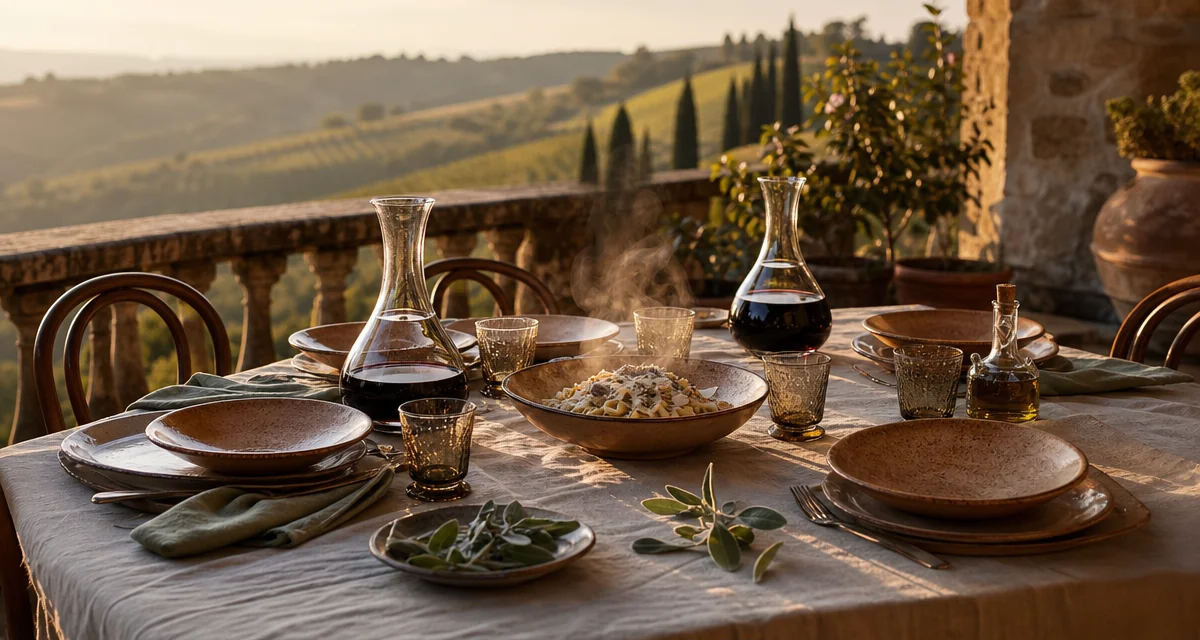
If you have rented a farmhouse in the Val d'Orcia (the UNESCO-listed valley of cypress-lined ridges in southern Tuscany that produces pecorino di Pienza DOP and, a few kilometres away, Brunello di Montalcino DOCG, a 100% Sangiovese red aged at least 5 years before release), the comparison collapses. Very few caterers will drive 25 minutes down a strada bianca, the white gravel roads serving most rural Tuscan properties, to feed 10 people, and those who will price it as a full event. Meanwhile the villa's kitchen, generous because it was built for farm work, sits unused. That is why so many guests book a Tuscany private chef experience as the first thing they arrange after the property itself.
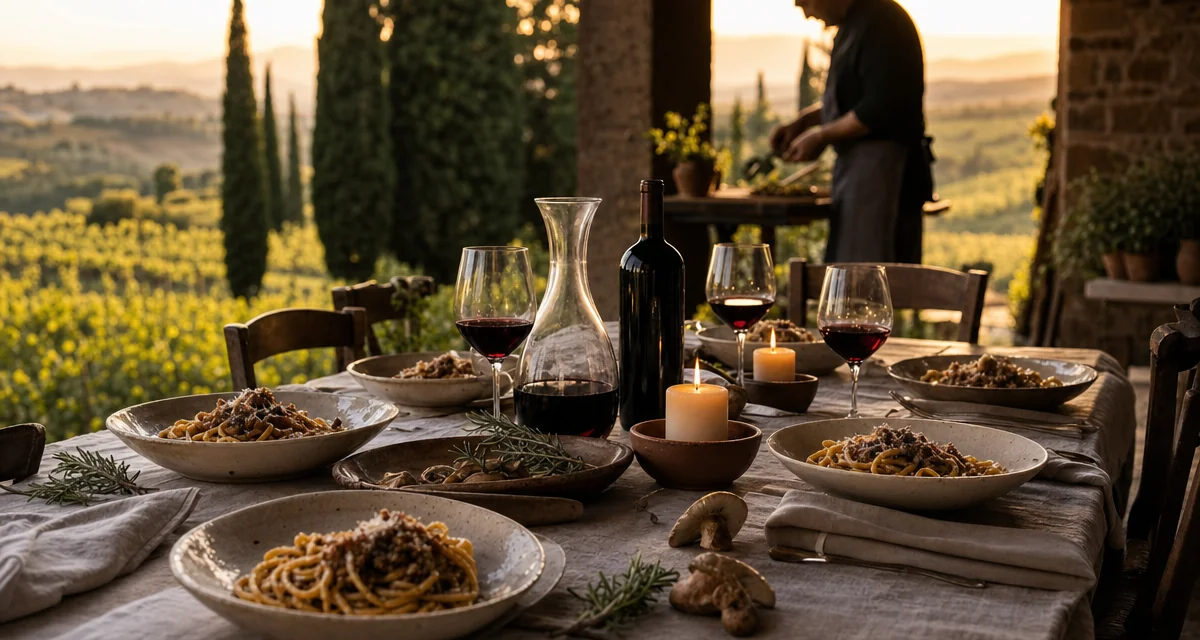
The chef drives out with market shopping from Siena or Montalcino, cooks in the kitchen you are already paying for, and turns your rented terrace into the dining room. It also unlocks formats catering structurally cannot deliver. Our Pasta Class and Dinner experience runs 4 to 5 hours entirely at your property: a 2-hour hands-on class teaching one long pasta shape and one short one, then a seated dinner of antipasti, both pastas with their sauces, and homemade tiramisù, served in the same kitchen you learned in. No caterer can bring that, because there is nothing to transport. Our multi-day service works the same way across a week, with the chef shopping daily and the day rate depending on whether the chef stays at the property, commutes locally, or books lodging nearby.
Why this matters for your dinner party in Italy
Most of the hosts who write to us are not weighing two invoices. They are trying to work out how to be at their own dinner party, and that is the honest measure of this decision. At 12 people around one table the private chef model gives you an evening you actually get to attend; at 80 it gives you a lovely dinner nobody can physically produce.
What surprises first-time bookers in Italy is how ordinary it feels. The chef arrives in the afternoon with bags from the market, works quietly while you finish getting ready, and the first plate lands while everyone is still standing with a glass in hand. The food is regional rather than generic: an agriturismo-style menu of things grown within a few kilometres, the kind of eating that Italy's own tourism board and the Slow Food Presidia have spent decades protecting. An agriturismo is a working farm that also rents rooms and cooks from its own produce, and Italian law requires a minimum share of its revenue to come from farming, which is why eating at one feels closer to a farmhouse kitchen than a restaurant.
Chef On Demand holds a 4.7/5 Trustpilot rating based on 800+ guests served since 2025, and the pattern in that feedback is consistent: people remember the evening, not the invoice. If you have settled on the chef route, our guide to a private chef dinner party in Italy covers timings and table logistics, and how private chef service works in Italy gives the wider picture. You can also browse private chefs across Italy, start from our Tuscan chef network, or look at Florence. Whichever you choose, picture the moment that decides it: the terrace, ten people, and a plate that was in a pan seconds ago.