What does a private chef need in your kitchen?
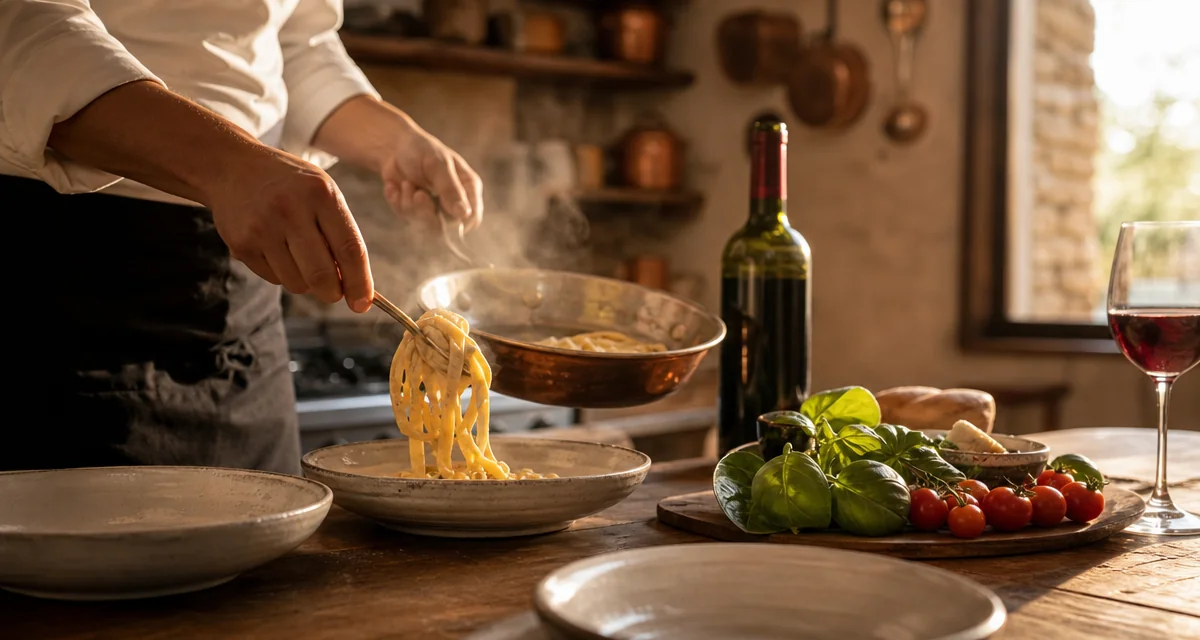
A private chef needs one metre of clear worktop, two working hob burners, an oven that reaches and holds 200°C, one fridge shelf for every 6 guests, hot running water, a lined bin and enough tableware for the courses on the menu. Pans, knives, ingredients and cloths travel with the chef. That list is deliberately short, because the question people actually type into a search box, what does a private chef provide and what do I have to find myself, has a reassuring answer. In our network the chef shops at a local market on the morning of service, arrives 2 to 3 hours before the first course, cooks, plates, serves, and leaves the kitchen in the state they found it. You provide the room and the table. Holiday rentals complicate that in fairly predictable ways. An agriturismo (a working farm that also rents rooms and serves meals from its own produce, a format Italian law ties to a minimum share of revenue coming from farming) usually has a generous kitchen but a modest domestic oven. An apartment in the centre of Florence may offer a beautiful marble counter of only 70 cm. A villa on the Amalfi Coast might have three terraces and a kitchen the size of a galley. None of that stops dinner happening, so two minutes describing your kitchen at booking is worth more than any last-minute shopping for equipment.
How much worktop, hob and oven space do you actually need?
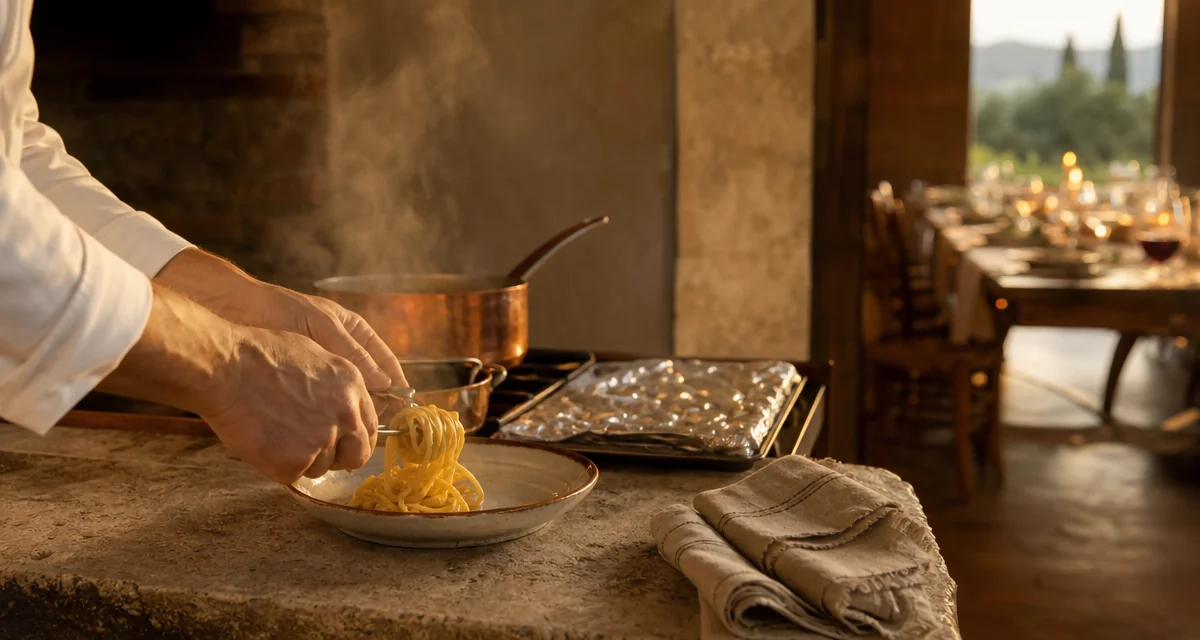
A chef needs roughly one metre (about 3–4 ft) of continuous, clear worktop within arm's reach of the hob, two burners for a 4-course dinner for 6 guests, three or four for a 6-course menu at 10 guests, and one empty oven rack that reliably holds 200°C. Continuous is the word doing the work there. Two half-metre stretches on opposite sides of a sink are not the same thing as one metre in a line, because plating a course for 8 guests means laying out 8 plates at once and dressing them in sequence. That discipline of arranging every component within reach before service begins is what cooks call mise en place, and it is the difference between a relaxed 2-hour dinner and a chef working with their elbows tucked in. The oven matters less than most people fear. Italian domestic ovens generally run 55 to 60 cm wide and take one full roasting tray, which covers the vast majority of menus our chefs cook across Tuscany. The notable exception is bistecca alla fiorentina, a thick T-bone of 1.2 to 1.5 kg cut from Chianina cattle and seared over hardwood embers, served rare on the bone with olive oil and salt. It wants a proper grill or a very hot oven with room around it, so if your rental has neither, say so and the chef will build the main course differently.
Induction or gas: does the hob type change what you eat?
Both work, but they fail differently, and the chef would rather know which one you have before packing the car. Induction cooking, which heats the pan directly through a magnetic field instead of warming the air around it, boils water noticeably faster than gas and gives very precise low-temperature control, which suits sauces and slow reductions. The catch is that it only works with ferrous pans, so a chef travelling with a favourite aluminium sauté pan will need to borrow yours. Gas gives instant visual feedback, which is why many chefs still prefer it for searing and for a risotto that needs 18 minutes of attentive stirring. Ceramic and halogen electric hobs are the slowest of the three, because they hold heat after you turn them down, which makes fast-finishing pasta sauces harder to control. None of this is a dealbreaker. It shifts the timings, and a chef who knows in advance will plan a 3-hour service instead of a 2-hour one.
People apologise for their kitchens before I have even taken my jacket off. In fifteen years I have cooked in a Chianti farmhouse with one reliable burner and in a Milan penthouse with a professional range, and the dinner guests still talk about was the farmhouse. Chef Lorenzo, Florence-based ambassador for Chef On Demand Tuscany
How much fridge and freezer space should you clear?
Clear one full fridge shelf for every 6 guests, plus one freezer drawer, before the chef arrives. For a dinner for 8 guests that means roughly 40 litres of cold storage: enough for antipasti trays, a chilled dessert, dairy, and anything that has to rest before service. The volume people underestimate is drinks. A case of 12 bottles of white wine laid flat will occupy an entire shelf on its own, and once beer and soft drinks join it, the chef's produce ends up stacked on the floor of the fridge next to the salad drawer. If you plan to chill a lot of wine, use a cool box or the second fridge that many villas keep in a utility room. Dessert drives the rest of the requirement. A tiramisù for 10 guests needs 3 to 4 hours undisturbed on a flat shelf, at exactly the point in the evening when the fridge is busiest, and gelato-style desserts need a freezer nobody opens every ten minutes for ice. Do the shelf-clearing the day before. Our chefs working around Greve in Chianti report that the single most common delay at the start of service is waiting for somebody to make room for the produce.
Do private chefs bring their own pots and pans?
Mostly yes, and always their knives. The tools a private chef treats as personal typically amount to a roll of 4 to 6 knives, a peeler and a mandolin, a digital probe thermometer, plating spoons and tweezers, squeeze bottles, a fine sieve, and one or two pans they refuse to work without. What chefs generally do not carry is bulk. A 10-litre stockpot, a large colander, a full-size roasting tray and a set of mixing bowls are heavy, awkward and already present in most kitchens. That is the honest answer to what people search as a private chef equipment list: the kit is personal and precise, the volume equipment is yours. If your rental is genuinely missing something structural, a colander, a sieve, a baking tray, mention it at booking rather than on the night, because a detour to a hardware shop in an Italian village at 17:00 is not always possible. Many still close in the early afternoon and reopen around 16:30.
- Clear one metre of worktop beside the hob and wipe it down, relocating the kettle, the fruit bowl and the coffee machine for the evening.
- Empty the dishwasher completely, cutlery basket included, so the first wave of prep bowls has somewhere to go.
- Empty one fridge shelf per 6 guests and one freezer drawer, moving drinks to a cool box wherever you can.
- Check the oven is empty, that the racks are in place, and run it up to 200°C once to confirm it actually gets there.
- Line the bin with a fresh bag and set out a second one for glass and recycling, which fills faster than anyone expects.
- Lay plates, cutlery and glassware out on a side table so the chef can count them without opening every cupboard.
- Run the hot tap for 30 seconds and note whether the boiler is a small 80-litre unit that will need recovery time.
- Locate a power socket within reach of the worktop for a blender or a portable induction plate, and point it out on arrival.
| Group size | Clear worktop | Hob and oven | Fridge and freezer | Tableware |
|---|---|---|---|---|
| 2–4 guests | 0.8 m continuous | 2 burners, 1 oven rack | 1 shelf | 4 plates and 2 glasses per guest |
| 5–8 guests | 1.0–1.2 m continuous | 3 burners, 1 oven rack | 1–2 shelves plus a freezer drawer | 8 plates and 2–3 glasses per guest |
| 9–12 guests | 1.5 m plus a side table for plating | 4 burners, full 60 cm oven | 2 shelves plus a freezer drawer | 12 plates and 3 glasses per guest |
| 13+ guests | 2 m, or worktop plus a dedicated prep table | 4 burners plus a portable induction plate | 2 shelves plus a second fridge or cool box | Hired in, or one wash cycle timed mid-service |
How many plates, glasses and how much cutlery does a chef need?
Count tableware by course, not by guest. A 5-course Taste of Italy menu for 8 guests ideally wants 40 plates and a full setting of cutlery per course, but 16 plates plus one dishwasher cycle timed between the pasta and the main course works perfectly well in a normal holiday rental. Most villas sit somewhere in between, and the chef plans around what exists rather than around what would be ideal. Variety of shape helps more than raw quantity: two flat plates and one shallow bowl per guest cover almost any Italian menu, because the pasta course wants a rim while antipasti want a flat surface. Glassware is where rentals are thinnest. Budget two glasses per guest as a minimum, water and wine, and three if the menu closes with Vin Santo, the amber Tuscan dessert wine pressed from grapes dried on racks for months, traditionally poured in small glasses alongside cantucci (twice-baked almond biscuits) for dipping. If you are drinking Chianti Classico DOCG, the Sangiovese-based red from the hills between Florence and Siena marked by its black rooster seal, a larger bowl flatters it more than the tumblers most kitchens stock. Nobody minds a tumbler. But if there are 6 wine glasses for 10 guests, say so, because a Tuscany private chef experience can include glassware or a pairing built around one wine served throughout.
What happens to the washing-up, the bins and the hot water?
Guests often ask whether private chefs clean the kitchen afterwards. They do, and cleanup is included in every dinner, lunch and breakfast we arrange. Budget 30 to 45 minutes after the last course for a group of 8 guests, during which the chef returns the room to the state they found it. What people rarely anticipate is capacity. A dinner for 10 guests generates far more waste than a family meal: vegetable trimmings, fish bones, market packaging, and a surprising volume of glass. A single 30-litre bin will overflow before the main course arrives, so put out a second bag, and if your rental has separate collection (most Italian comuni now enforce sorted waste on fixed collection days) show the chef where each stream goes. Hot water is the other quiet constraint. Plenty of restored farmhouses and older apartments run on an 80-litre electric boiler that takes 60 to 90 minutes to recover once drained, so if four people have showered before dinner the chef may meet cold water halfway through the washing-up. Villas on Lake Como vary enormously here. This is the practical layer beneath the behavioural one, and our guide to private chef etiquette for guests covers who belongs in the kitchen and when.
What changes for a multi-day stay or a pasta class at your villa?
A multi-day booking, where the chef cooks for your group across 3 to 7 days, roughly doubles the cold storage you need and folds daily market shopping into the rhythm of the house. Most groups choose 2 to 3 dinners plus one long lunch across a week rather than three meals a day, because everybody still wants a few independent restaurant nights. Since the chef shops daily, the fridge needs working room rather than one tightly packed shelf, and airtight containers for stocks, sauces and doughs earn their keep. Cost depends on where the chef sleeps, and there are three configurations. Where the property has chef quarters and the chef stays on site, the daily rate is lowest, because you absorb the lodging. Where the chef lives within 30 to 45 minutes and commutes daily, common in dense areas like Chianti, the Amalfi Coast and the lakes, there is no accommodation to factor in at all. Where neither applies, the chef books a room nearby and the quote line-items that surcharge openly. Multi-day quotes are always built bottom-up from the per-meal cost plus a daily retainer, so there is no single per-person rate to look up. Guests sometimes ask whether a private chef lives with you: only in the first configuration, and only if you have the room to spare.
What a pasta-making class at your villa needs that a plated dinner doesn't
The Pasta Class + Dinner Experience is the format international guests book most often in Italy, and it happens entirely at your villa, apartment or holiday rental. The chef arrives with all the ingredients and every piece of equipment, dough boards, rolling pins and pasta cutters included, and works in the kitchen you have rented. There is no cooking school, no transfer between venues, no cohort of strangers. The kitchen requirement differs from a plated dinner because guests need somewhere to stand and roll: ideally 1.5 m of flat surface at roughly 90 cm height, which a kitchen island or a scrubbed dining table both provide, with standing room for 4 to 6 people around it. The structure runs 4 to 5 hours. A 2-hour hands-on class teaches two shapes, one long such as tagliatelle, pappardelle or pici (the fat, hand-rolled Tuscan spaghetti from the hills around Montalcino and Siena, made from nothing but flour and water), and one short such as orecchiette or maltagliati. While the dough rests the chef prepares two sauces, one per shape, 2 to 3 antipasti and a homemade tiramisù, then everyone sits at the same table for dinner. Cooking at your own property means only your group at the table, a menu shaped around your allergies and your pace rather than a fixed syllabus, no 40-minute drive each way from a rural villa, and children who can join in or play next door. In Italy the bundled experience is quoted at around €150 per adult and €60 per child, covering class, ingredients, equipment, dinner and cleanup. What you take away is technique, the feel of the dough and the timing of the sauces: we do not provide printed or digital recipes, recipe cards or follow-up emails. Browse our Tuscan chef network to see who teaches it.
Why this matters for your Italian holiday
The anxiety about kitchens is really an anxiety about being a good host in a house that is not yours. You booked the farmhouse for the view and the walk down to the village, and now you are wondering whether a stranger with knives will judge your two-ring hob. In practice our chefs, many of them from Michelin-starred kitchens and Gambero Rosso-rated restaurants, have cooked in far stranger rooms than yours, and they judge a booking on the table and the company rather than the appliances. Chef On Demand holds a 4.7 out of 5 Trustpilot rating from 800+ guests served since 2025, and the reviews almost never mention equipment. They mention the evening. Even so, twenty minutes of preparation changes the shape of the night: an empty dishwasher, a clear metre of worktop and a fridge shelf turn a slightly frantic service into one where the chef has time to talk to your children about pasta shapes. For the hour-by-hour picture, read what to expect from a private chef dinner, and if you are still choosing a property, our Airbnb and villa guide covers what to check before you book. Then browse private chefs across Italy and stop worrying about the oven. The bread will come out of it either way, and by 22:00 everyone will be outside with the last of the wine, talking too loudly under the fig tree.