What happens in a pizza making class in Naples?
A Naples pizza class moves through four stages in two to three hours: you mix and knead flour, water, salt and yeast, learn how the dough is divided into balls, stretch one by hand, then top it and bake it in an oven hot enough to finish in about 90 seconds.
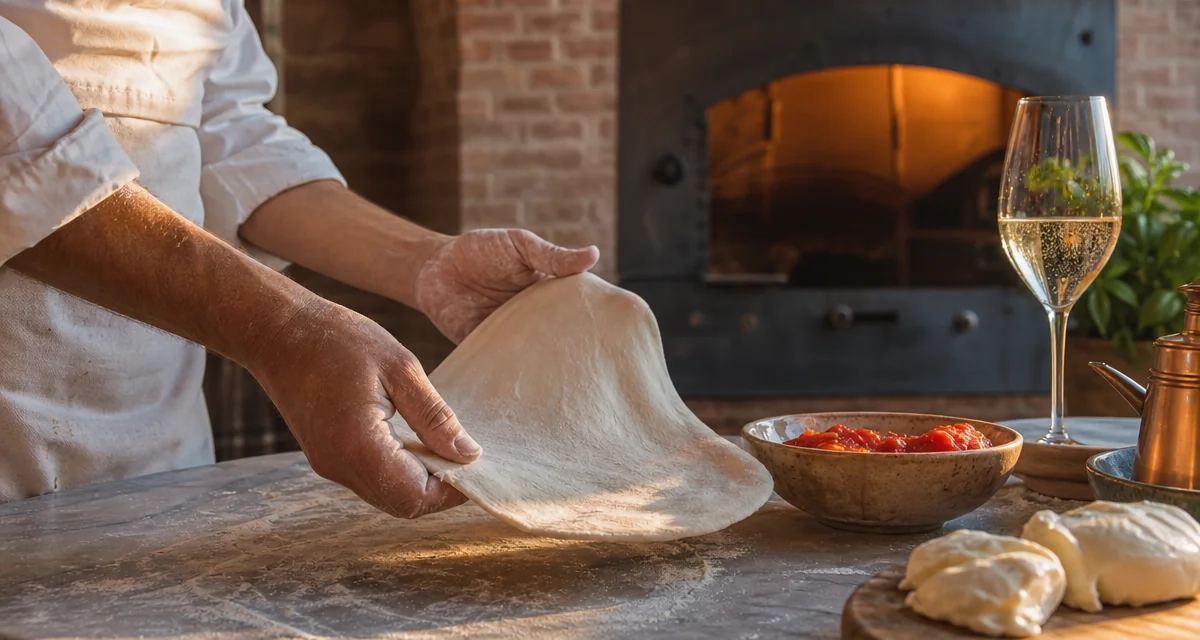
The first stage, the impasto (the dough itself), is hands in a bowl. The second is the staglio, the cutting of the mass into balls, done with the same pinch cheesemakers use to close a mozzarella. Then comes the part people photograph: the pizzaiolo presses from the centre outwards so that the gas moves to the edge and becomes the cornicione, the puffed rim that should stand 1–2 cm tall. Toppings are sparse by design, and the European specification asks for 60–80 g of crushed tomato and 80–100 g of mozzarella on a Margherita. Expect San Marzano, a long plum tomato with thick flesh and few seeds, first grown in volcanic soil near Vesuvius and protected as a DOP (designation of origin), and either buffalo mozzarella from the Campanian plains or fior di latte, its milder cow’s-milk sister, which weeps less water onto the dough.
The art of the Neapolitan ‘Pizzaiuolo’ is a culinary practice comprising four different phases relating to the preparation of the dough and its baking in a wood-fired oven, involving a rotatory movement by the baker. UNESCO, Representative List of the Intangible Cultural Heritage of Humanity, inscribed 2017
Why is the dough you knead rarely the pizza you eat?
Neapolitan dough needs far longer to rise than a class lasts. The European specification sets two hours for the mass plus four to six for the balls, and the 2024 rules of the AVPN, the Naples association that certifies true Neapolitan pizzerias, ask for 12 to 24 hours overall.
So in a two-hour session the sums cannot work, and honest schools simply say so: you knead one dough to learn the feel, then bake another that was balled the day before or early that morning. There is nothing shabby about it, since pizzerias work hours or a full day ahead of their customers too, and it only disappoints people who took “from scratch” literally. If fermentation is what interests you, ask to handle a fresh ball and a rested one side by side: five minutes of that stays in the fingers longer than any lecture. You are in the right place for it, because UNESCO counts about 3,000 pizzaiuoli in Naples and lists the craft, rather than the dish, as heritage.
Which rulebook makes a pizza Neapolitan?
Two texts do. The European one registers Pizza Napoletana as a Specialità Tradizionale Garantita (STG, a guaranteed traditional speciality, which protects a method rather than a place). The other belongs to the AVPN, founded in 1984, and the two disagree on oven temperatures, rising time and fuel.
That explains why two teachers in the same city will contradict each other with total confidence. The EU specification insists on wood and gives the oven floor as the hotter surface. The AVPN’s 2024 regulations put the heat in the dome and now admit approved gas and electric ovens, while the shorter summary on the association’s website quotes 430–480 °C for a forno a legna (a domed, wood-fired brick oven). What they share matters more: hand-stretched, no more than 35 cm across, 60 to 90 seconds. If it is the crisp Roman disc that you want to set against this one, our piece on how Rome and Naples part ways over dough handles the comparison.
| Rule | EU specification (Reg. 97/2010) | AVPN regulations (2024) |
|---|---|---|
| Rising time | 2 h, then 4–6 h in balls; use within 6 h | 12–24 h overall |
| Dough ball | 180–250 g | 200–280 g |
| Oven floor / dome | About 485 °C / about 430 °C | About 380–430 °C / about 485 °C |
| Baking time | 60–90 seconds | 60–90 seconds |
| Fuel | Wood only | Wood by tradition; approved gas or electric allowed |
| Rolling pin | Not permitted | Not permitted |
Where do classes take place, and what does each setting give you?
Naples teaches pizza in three kinds of room: the AVPN’s own school at Capodimonte, working pizzerias that lend you the oven before service, and purpose-built cooking labs in the historic centre. The school gives you the rules, the pizzeria the atmosphere, the lab a second dish.
At the AVPN’s ‘pizza maker for one day’ workshop, up to 15 people spend three hours at Via Capodimonte 19a, on the hill of the royal palace and its park. It runs daily by reservation, 10:00–13:00 and 15:00–18:00. Food Tours of Naples takes a maximum of 10 into a pizzeria near the Maschio Angioino, the five-towered castle facing the port, at 10:30 and 18:00, while Secret Food Tours works in the old town for 1.5 to 2 hours. A lab such as NaplesBay at Via delle Zite 30 adds tiramisù or gelato to fill three hours. The Quartieri Spagnoli, the steep grid of lanes built in the 16th century for Spanish troops and now thick with fried-pizza counters, are the place to keep eating afterwards.
A workshop for visitors or a full pizza making course?
If one afternoon is not enough, the AVPN also trains professionals, and its gluten-free course shows the jump: 16 hours over two days for 4 to 10 people at €350 plus VAT, with the next date listed as 25 January 2027.
| Setting and example | Length and group | Adult price | Check or not included |
|---|---|---|---|
| Association school: AVPN, Capodimonte | 3 h, max 15 | €97 (€57 ages 5–14) | Soft drinks only; transport up the hill |
| Working pizzeria: Food Tours of Naples | 2 h, max 10 | From €49 | Pickup, tips; one drink included |
| Old-town pizzeria: Secret Food Tours | 1.5–2 h, max 14 | €54.99 | Extra drinks; confirm the meeting point |
| Cooking lab: NaplesBay, pizza + tiramisù | 3 h, shared | From €65 | Transport; not wheelchair accessible |
| Private school: Family Twist | 3 h, your family only | On request | Transport, extra alcohol |
How much does a pizza making class in Naples cost?
Booked with the operator, a shared pizza class in Naples costs roughly €49 to €97 per adult in November 2026. Two hours in a pizzeria sits near €49 to €55, three hours in a lab with a second dish starts around €65, and the AVPN school charges €97 for adults and €57 for children aged 5 to 14.
Your pizza is always in the price and one drink usually is, but hotel pickup, tips and second glasses usually are not. For two adults and two children under 14, the AVPN session comes to €308, against €196 at a flat €49. The Tour Guy sells a two-hour class from US$44.46 that meets at the same Via delle Zite lab, which brings us to the trap. (Search ‘pizza making class naples’ without adding Italy and you will meet Florida prices in dollars as well.)
Which other cooking classes does Naples offer?
Beyond pizza, Naples offers fresh-pasta classes of about 3 hours from €65, four-hour market-and-cook mornings around US$149, and specialist pastry workshops on sfogliatella at about €180 per person.
Pizza and pasta in one class, or pasta on its own
A pizza and pasta making class in Naples does exist, but in three hours something gets rushed. For a pasta making class in Naples on its own, NaplesBay’s 3-hour version covers fettuccine Alfredo, ricotta ravioli and tiramisù, and another 3-hour session for up to 12 makes tagliatelle and ravioli from US$54.72. Good fun, though Alfredo is a Roman dish (butter and Parmesan) that went on to fame in America. The home sauces are ragù napoletano, beef and pork braised for hours in tomato, with the sauce served on pasta first and the meat after, and genovese, which has nothing to do with pesto: onions cooked down with beef until they turn sweet and brown.
Market mornings and pastry
The market class listed on Cookly starts at 9:30 at La Pignasecca, one of the oldest street markets in the city, and moves to a private home for crocchè (fried potato croquettes with a mozzarella heart), gnocchi, braciola (here a stuffed pork roll simmered in tomato) and torta caprese, an almond and chocolate cake. It lasts 4 hours and costs US$149 per person. Sfogliatella, the shell-shaped pastry of crackling layers around a sweet filling, sold in Naples since 1818, has its own workshop in San Gregorio Armeno, the lane of nativity-figure makers: 2.5 hours, at most 8 guests aged 8 and over, listed at €180 each.
A private cooking class in Naples, Italy
Private can mean three things: a school closed for your family, as with Family Twist’s 3-hour lesson (which adds montanara, a small fried pizza, and babà, a syrup-soaked yeast cake), a host’s home, or a chef who comes to you. If you are still choosing a base, our guide to picking the right Italian city for a class weighs Naples against the north, and on the far side of the bay the subject changes to lemon groves and gnocchi around Sorrento.
How do you fit a class around a cruise stop or a train day?
Count backwards from your last safe departure. A two-hour class in the centre needs about four hours door to door, a three-hour class at Capodimonte needs five or six, and both work best in the morning slot, when a late start can still be absorbed.
Line 1 of the Naples Metro serves Garibaldi (next to the central railway station), Duomo (about five minutes on foot from the Via delle Zite lab) and Municipio, the stop for the port. From a cruise ship, the 10:30 class near the Maschio Angioino is the simplest choice, over at 12:30 with lunch already eaten. From Rome, high-speed trains take about 70 minutes, so an 11:00 lesson is comfortable and a 10:00 start at the AVPN is brave. Allow for a taxi to Capodimonte, which is uphill.
- Fix your last safe departure (all-aboard time minus 90 minutes, or your train minus 45) before looking at any class.
- Pick the setting nearest your arrival point, and keep Capodimonte for a half-day.
- Ask when the dough was balled, who handles the peel, and how many people will share the table.
- Declare allergies in writing at booking: at least one Naples operator says it cannot serve vegan, gluten-avoiding or dairy-avoiding guests.
- Wear closed shoes and leave rings at the hotel, because the oven is close and wet dough sticks to everything.
- Keep the evening light, since a whole pizza plus starters at 18:00 is dinner.
Can a private chef teach pizza at your Naples apartment?
Rarely, and we would rather say so. A Neapolitan pizza wants an oven well above 400 °C for 60 to 90 seconds, while a domestic oven stops near 250 °C. For pizza, a pizzeria or school with a real oven is the right choice, and for your apartment there is something better suited.
That is our Pasta Class + Dinner Experience, always at the apartment or villa where you are staying. Over 4–5 hours a chef from our Naples network gives a two-hour lesson on two fresh shapes, one long (such as tagliatelle) and one short (such as orecchiette, the little ‘ears’ of the south). While the dough rests, the chef prepares a sauce for each, regional antipasti and tiramisù, then serves a seated dinner at your table and cleans the kitchen. It costs €150 per adult and €60 per child, so four adults and two children pay €720. Only your group is in the room, the menu follows your allergies, nobody crosses the city afterwards, grandparents can skip the kneading and still sit down to dinner, and you pour the wine you bought that morning. If your rental has a wood-fired oven on the terrace, mention it in the enquiry: a chef who bakes may be available, though we cannot promise one. More on the format: pasta making at home in Italy.
Prefer to be cooked for? A private dinner in Naples, with six adults, runs about €95 per person for Essential (4 courses), €120 for Taste of Italy (5 courses) and €180 for Luxury (6 or more), and drops to roughly €85, €100 and €150 at ten. Naples carries no premium-zone surcharge in our pricing, unlike Sorrento and Capri. Wine is separate, and you receive a full refund for cancellations more than 30 days before the event. Menus are covered in our piece on a Neapolitan dinner beyond pizza.
Why this matters for your days in Naples
Naples is generous with its knowledge, but it has an order to things. Pizza belongs to the street, to ovens that never quite cool and to people who started their dough while you were still at dinner in another city, so learn it there. Pasta, ragù and the long talk afterwards belong to the house. Put the two on different days: one loud morning among strangers with flour to the elbows, one slow evening at your own table with a window open on the bay. Chef On Demand (4.7/5 on Trustpilot) looks after the second, with chefs across Campania and a usual lead time of 7–14 days in high season. See the chefs who cook in the city, send your dates and street address, and a Neapolitan evening at home can follow the class by a day. By then you will know how the dough should spring back.