What does it actually take to hire a private chef in Italy?
Hiring a private chef in Italy takes five inputs and about five minutes: the address you're staying at, the exact date, how many adults and children, the kind of menu you want, and any allergies. Everything after that is the chef's problem, not yours. Proposals come back within 24 hours, and you choose. The reason the input list is so short is that the chef absorbs the rest. They shop the local market on the morning of service, drive to your property with the groceries and the equipment, cook in your kitchen, plate and serve at your table, then clean up and leave. You are not hiring a caterer who arrives with trays, and you are not hiring a restaurant that expects you to come to it. Chef On Demand operates a verified network of 12+ private chefs in most of the regions we cover, and across that network three formats account for almost everything booked. A single event is one dinner, one lunch or one breakfast, priced per person in a 2-4 hour service window. A multi-day stay puts a chef alongside your group for the whole holiday. The Pasta Class + Dinner Experience folds a hands-on lesson into the evening itself. Which one you pick changes the quote more than any menu decision you'll make later.
A villa with a private chef in Italy: what the property actually needs
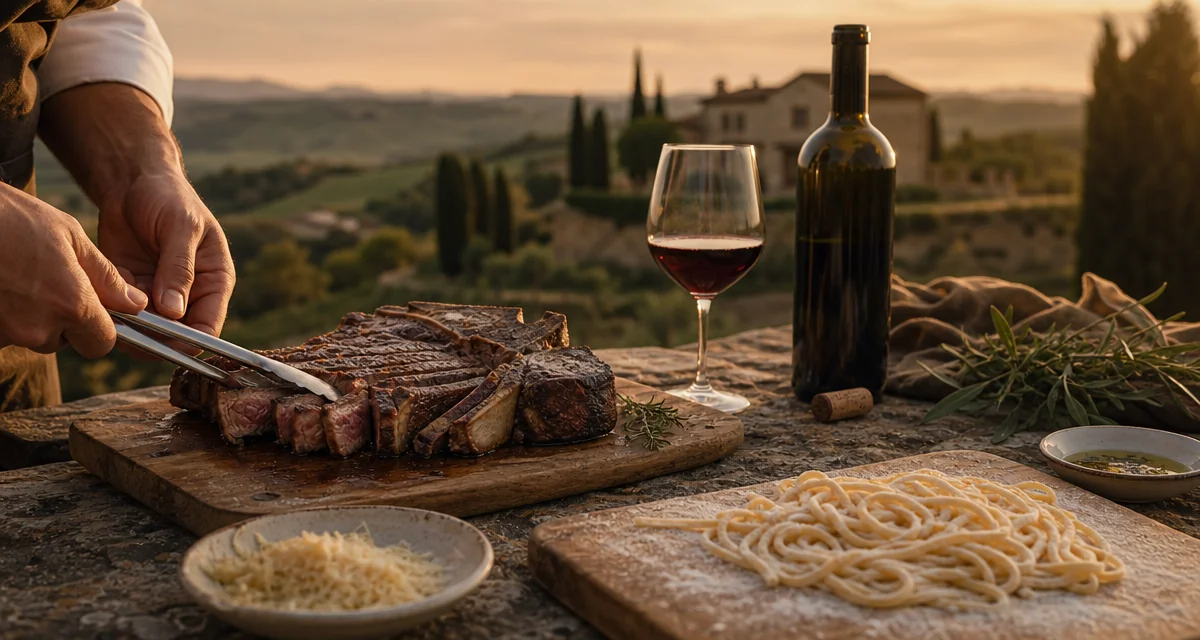
This is the question nobody asks until it's too late, and it is worth ninety seconds of your time. A chef cooking for eight needs four burners, an oven that holds a steady temperature, roughly two metres of usable worktop, a fridge with a spare shelf, and hot running water. That is it. Most Italian villas clear that bar comfortably, and many of the luxury villas with a private chef included in the rental have a second prep kitchen built for exactly this. Apartments are where it gets interesting: a Florence flat with a two-ring hob and a bar fridge can still host a beautiful dinner, but the chef will build the menu around cold openers and one hot course rather than fighting the kitchen. Send a photo of the hob and the oven with your request. It takes you ten seconds and it saves a conversation on the day. Outdoor space matters too: a wood-fired oven or a working grill on the terrace opens up the whole live-fire side of the repertoire, from bistecca alla fiorentina (a thick T-bone of 1.2-1.5 kg cut from Chianina cattle, the enormous white breed raised in the Val di Chiana, grilled over hardwood embers and served rare on the bone with nothing but salt, pepper and Tuscan olive oil) to whole sea bass baked under a crust of salt.
How fast does the quote arrive, and what should be in it?
A proposal should reach you within 24 hours of your request, and it should be itemised rather than a single number. Anything that arrives as a bare '€1,400 for the evening' with no breakdown is asking you to trust a black box, and you have no way to compare it to the next one. A quote worth reading separates four things. The chef fee is the professional's time and skill. The shopping budget is the raw ingredients, which move with what you ordered: a vegetable-forward Tuscan menu and a menu built on turbot and langoustine are not the same grocery run. Travel covers the drive, and it is real money when your farmhouse sits 40 minutes up a gravel road. Finally, surcharges, which are the ones people miss. In Italy a Christian holiday date such as Easter or Ferragosto carries a +35% uplift on the client price, and the premium zones around Milan and Rome add roughly €15 per person. For orientation, a Taste of Italy menu of five courses runs about €120 per person for 6 guests and drops to roughly €100 per head at 10 guests, while Essential sits near €95 per person at 6 guests and Luxury near €180. The full breakdown, with every variable, lives in our guide to booking and pricing a private chef dinner in Italy.
| Stage | When it happens | What you pay |
|---|---|---|
| You send the request | Day 0, about 5 minutes of form | Nothing at this stage |
| Proposals land in your inbox | Within 24 hours | Nothing at this stage |
| You pick a chef and lock the date | Day 1-3, once you've compared | Deposit, typically 30-50% of the quote |
| Menu signed off in writing | 7-10 days before service | Nothing extra unless you upgrade the tier |
| The chef shops, cooks and serves | Service day, 2-4 hour window | Balance, plus any tip you decide to leave |
How do you customise the menu without hijacking the chef?
Menu customisation in Italy is a negotiation with two constraints, and both are worth understanding before you start asking for things. The first is the market: a chef in Cefalù, the fishing town on Sicily's northern coast beneath a vast limestone crag, can put astonishing raw red prawns on your table in June and cannot conjure them in a February storm. The second is the chef's own repertoire, which is the whole reason you hired a person instead of a menu. The move that works is to hand over direction rather than a recipe. 'We'd love something with the local cheese, the kids are eight and eleven, and one of us doesn't eat red meat' gives a chef in Puglia, the sun-flattened heel of the Italian boot, everything they need to build you something with burrata (the fresh cow's-milk cheese from around Andria, a mozzarella shell holding a soft centre of curd and cream, made to be eaten within 24 hours) and orecchiette (the small ear-shaped pasta Puglian women still shape by thumb on wooden boards). The move that fails is arriving with a printed menu from a restaurant in Brooklyn. In practice the exchange runs two or three emails over about a week and closes 7-10 days before service. That deadline is not bureaucracy: it is when the chef commits to fishmongers and small producers who need notice, including the tiny regional operations safeguarded as Slow Food Presidia, a programme that protects heritage cheeses, breeds and grains that would otherwise disappear. If you want a sense of what each region actually grows, catches and ages before you write your brief, the Italian tourist board's regional food and wine overview is a better starting point than any restaurant menu.
Personal chef vs private chef: which one are you actually hiring?
The words get used interchangeably online and the distinction matters when you read a contract. A private chef is traditionally employed by one household, cooking for that family more or less exclusively. A personal chef historically serves several clients, cooking on a per-engagement basis. On the traveller side of the market the labels have collapsed into each other: what you are booking for your villa week is a professional who works with multiple clients across a season, whatever the platform calls them. What you should actually check is not the noun but the scope: how many hours, which meals, whether shopping is included, who provides wine. If you want the distinction unpacked properly, our guide to hiring a personal chef in Italy covers how it works and what it costs at national level.
The guests who get the best dinner out of me are never the ones with the longest list of requests. They are the ones who tell me who is at the table and then get out of my way. Chef Salvatore, Naples-based ambassador of Chef On Demand Campania
What deposit will you pay, and what happens if you cancel?
A deposit of 30-50% of the quote is the norm across our network, paid by card or bank transfer, and it is what converts a proposal into a booked date. The chef is now holding an evening they cannot sell to anyone else, and in August on the Amalfi Coast that evening is genuinely scarce. The balance is settled on the night of service in most cases. If you are paying by wire from abroad, note that Italian IBANs start with IT followed by 25 characters, and that a transfer from a US bank can take 2-3 working days to land, so do not leave it to the morning of. Cancellation follows a sliding scale that is worth reading rather than skimming: a full refund is standard 30+ days out, roughly 50% is retained inside 14 days, and the deposit is forfeit inside 72 hours unless the chef can rebook the date. That last clause is the one that rewards honesty. If your flight is cancelled and you tell the chef at 9am rather than 6pm, they have a real chance of filling the slot and you have a real chance of your money back. Weather is the other live question. A terrace dinner in October is a terrace dinner with a plan B, and you should ask what the plan B is before you pay, not while it is raining.
- Confirm the exact service window in writing, not just the date. 'Dinner on the 14th' and '7.30pm to 11pm on the 14th' are different agreements.
- Ask what the deposit percentage is and what triggers forfeit, and get the cancellation scale as text you can re-read, not as a verbal reassurance.
- State who supplies wine. Some chefs bring pairings, some expect the villa cellar, and the assumption is worth €20-€50 per head either way.
- Photograph your hob, oven and worktop and send them with the request, especially for an apartment rather than a villa.
- List allergies separately from preferences, with the guest's name against each line.
- Check whether the property sits inside a ZTL or needs a boat, and say so upfront, because access changes the travel line on the quote.
- Agree the wet-weather plan for any outdoor table before you pay the deposit.
- Keep the whole thread in one place so the menu you signed off is the menu everyone can point at on the day.
Do you tip a private chef in Italy, and how much?
Tipping is appreciated but never expected in Italy, and this is the single point where American and British guests most reliably misjudge the room. Italy has no tipping wage. A chef's fee is their fee, and unlike a US restaurant where 18-22% is effectively part of the price, nothing here is quietly missing from the number you agreed. If you want a benchmark, 5-10% of the quote for an evening that genuinely exceeded what you paid for is generous, and a round €50 pressed into a hand at the door for a €900 dinner is a normal, warm, entirely sufficient gesture. Nobody will count it. It helps to understand the local baseline: in Italian restaurants you'll often see a coperto on the bill, a small per-person cover charge of roughly €1.50-€3.50 for bread and table service, which exists precisely because tipping culture never developed the way it did in the US. The documented custom across continental Europe is rounding up rather than percentage arithmetic. Cash is kinder than adding it to a card payment, and if the chef brought an assistant for a larger group, say the tip is for both. What lands even better than money, incidentally, is a review with the chef's name in it.
When should you book, and what makes a date hard to fill?
Average booking lead time across our network is 7-14 days for peak season, meaning June through September, and 3-4 weeks for the high holidays. Ferragosto on August 15, the Italian midsummer holiday that empties the cities and fills the coast, is the single hardest date in the calendar, and Christmas week and Easter are close behind. In the shoulder months of April, May and October you can often be served on a week's notice. What makes a date hard is rarely the date alone. It is the combination of a scarce evening, a remote address and a large group: a Saturday in August, a farmhouse 45 minutes from the nearest town, and 14 guests is three constraints stacked on one chef's diary. Multi-day stays need more runway still, because they are custom-built. The chef either sleeps at your property, commutes daily from home if they live within 30-45 minutes, or takes lodging nearby that gets line-itemed into the quote, and which of the three applies depends entirely on where you're staying and who is resident nearby. In a dense region it is usually the second: our Tuscan chef network is the deepest in the country, so a farmhouse in Chianti will almost always find a resident chef who drives home at midnight, and your quote carries no accommodation line at all.
Private chef on the Amalfi Coast and Lake Como: why access shapes the quote
Geography is a line item, and two regions make the point better than anywhere else. On the Amalfi Coast the SS163 corniche is a single lane of switchbacks above the sea, and in August a 12 km drive from Amalfi to Positano can take an hour. Some villas are reachable only by 200 steps or by boat, which means a chef carrying groceries for ten is making two trips. On Lake Como the constraint is water rather than gradient: properties on the western shore between Cernobbio and Bellagio can be quicker to reach by ferry than by the SS340. Then there is the ZTL, the zona a traffico limitato, the camera-enforced restricted zone that covers the historic centre of nearly every Italian city, Florence and Venice included, where an unauthorised vehicle collects an automatic fine. Venice adds its own twist, since a chef there moves groceries by boat and handcart over bridges. None of this is your problem to solve. It is simply why the travel line on a Positano quote is not the travel line on a quote in the Tuscan hills, where a chef can usually park at the door, and why telling us the exact address at the request stage produces a more honest number than telling us the town.
Why this matters for your Italian holiday
You have, at most, seven or eight dinners in Italy. That is the real budget, and it is not measured in euros. Spend two of them driving somewhere with a booking, parking badly, eating adequately and driving back, and you have spent a quarter of your holiday's evenings on logistics. The reason the mechanics in this article are worth twenty minutes of your attention is that they buy the opposite: an evening where the only decision left by 7pm is whether to open the second bottle. Get the request right and the quote is honest. Get the deposit and the cancellation terms in writing and nothing can sour later. Get the menu conversation right and a stranger arrives already knowing that your father-in-law doesn't do garlic. Our network holds a 4.7/5 Trustpilot rating across 800+ guests served since 2025, and the pattern behind that number is unglamorous: the dinners people remember are the ones where the admin was done a fortnight earlier. Browse private chefs across Italy to see who works where, or go deeper on a single region: our private chefs across Tuscany are the most-booked in the country, and the Tuscany hiring walkthrough follows one booking from first quote to last course. Somewhere in the next fortnight there is a terrace, a bottle of something local, and eight people who have nowhere to be. The forms are just how you get there.