Do private chefs in Italy actually speak English?
Not automatically, and the honest answer matters more than a reassuring one. Italy scored 513 points and placed 59th globally in the 2025 EF English Proficiency Index, so fluency varies enormously from one kitchen to the next. Some private chefs are genuinely fluent, others manage a warm approximation, and a few operators solve the gap by adding a second person to the room. That last arrangement is more common than travellers realise. Read the fine print on Tuscan villa-cook services and you'll find cooks openly described as having limited English, with an English-speaking assistant sent along for parties of 5 or more. It works, and plenty of guests have lovely evenings that way, but you should know it's what you booked. The difference shows up in the small moments rather than the big ones. A translated menu still reads beautifully. What gets lost is the aside, the follow-up question, the moment your teenager asks what's actually in the sauce and the chef wants to explain that ribollita (a thick Tuscan bread and black-cabbage soup, cooked once, rested overnight, then reboiled the next day, which is what the name means) is peasant food elevated by patience rather than by butter. That exchange is half the reason you booked a chef instead of a restaurant table, so it's worth protecting.
How much does an English-speaking private chef in Italy cost in 2026?
Expect €95 to €180 per guest for a dinner in the Tuscan countryside in 2026, before wine and before holiday surcharges, assuming a group of 6 to 10. The spread is not about language. It's about course count and group size, and English-speaking service is not a line item you pay extra for on our network. Group size does most of the work. A Taste of Italy menu of 5 courses costs around €120 per person for 6 guests in Tuscany, and drops to roughly €100 per head at 10 guests, because a chef's evening has fixed costs that spread across however many people sit down. The four-course Essential tier runs €95 per person at 6 guests and €85 at 10. Luxury, at 6 courses or more with truffle, seafood or aged cuts and a multi-pairing wine flight, sits at €180 per person for 6 and €150 for 10. City addresses carry a premium of €15 per person, so the same Taste of Italy menu that costs €120 per head in a Chianti farmhouse comes to €135 in a Rome or Florence apartment at 6 guests. Those figures include the chef shopping that morning, cooking in your kitchen, serving, and cleaning up before leaving.
| Tier | Courses | 6 guests | 10 guests |
|---|---|---|---|
| Essential | 4 (fixed) | €95 per person | €85 per person |
| Taste of Italy | 5 (fixed) | €120 per person | €100 per person |
| Luxury | 6 or more | €180 per person | €150 per person |
What does 'English-speaking' actually cover, from menu to allergy brief?
Properly done, it covers five touchpoints: the enquiry, the menu you approve, the pre-arrival dietary brief, the conversation at the table, and the moment something changes on the day. Most services translate the middle one and leave the rest to chance, which is exactly backwards. The menu is the easiest thing to translate and the least likely to cause a problem. The dietary brief is the hardest and the most consequential. When a guest writes 'no nuts' in an email and the chef reads it through a translation layer, the word that survives is usually the ingredient, not the severity. A preference and a hospitalisation risk look identical in a badly relayed sentence. So the practical test of an English-speaking chef is not whether they can recite the courses. It's whether you can interrupt them. If your group changes its mind at 6pm and wants to eat at 9 instead of 8, or an aunt arrives who doesn't eat pork, you need to say so once, to the person holding the pan, and be understood. That is also where the pleasure lives, because a chef who can explain why pici (a thick, hand-rolled Sienese pasta, made with just flour and water and never eggs, rolled between the palms until it looks like fat, uneven spaghetti) takes eleven minutes rather than eight is giving you something no restaurant service ever will.
- Write your allergies and intolerances as a bullet list in English, one line per person, and mark severity plainly ('anaphylactic, no cross-contamination' reads very differently from 'dislikes').
- Send that list 48 hours before service, so the chef shops around it rather than working around it in your kitchen.
- Confirm who speaks English on the night: the chef, or an assistant standing alongside them.
- Ask for the menu in English with the Italian dish names kept, so you can look them up and so the chef can talk about them naturally.
- State your service window in numbers, not adjectives ('seated at 8pm, dessert by 10pm' beats 'a relaxed evening').
- Flag the kitchen honestly, including a two-ring hob or a missing oven, because a chef who knows in advance simply redesigns the menu.
- Name one decision-maker in your group, so the chef isn't fielding six versions of the same request in three accents.
Guests apologise to me for their Italian. I tell them the same thing every time: you didn't hire me to be understood, I was hired to understand you. If I need someone to translate your daughter's allergy, I shouldn't be cooking for your daughter. Chef Lorenzo, Florence-based ambassador of Chef On Demand Tuscany
| Arrangement | What happens in your kitchen | What it means for you |
|---|---|---|
| Chef briefs and serves in English directly | One professional, who cooks and talks you through every course | Allergy brief travels one link. Questions get answered mid-course. Chef On Demand's model |
| Chef with limited English plus an English-speaking assistant | Two people, commonly triggered for parties of 5 or more with villa-cook operators | Works well, but every request passes through a second person, and your kitchen is busier |
| Villa staff, host or your own group translating | A cook and a well-meaning volunteer | Fine for timings, risky for allergies, and the food talk quietly disappears |
Where in Italy can you book an English-speaking private chef?
Anywhere our network reaches, which in practice means the regions where international guests rent houses: Tuscany first, then Rome, Lake Como, the Amalfi Coast and the Sicilian coast. Tuscany carries the deepest bench simply because it has the most villas with kitchens worth cooking in, and you can browse our Tuscan chef network by town. If you're weighing regions before you book, our guide to hiring a private chef in Italy maps the practicalities country by country, and travellers renting through a platform will find the property-specific details in our Airbnb and villa dining guide. Wherever you land, the same rule holds: the further you are from a city, the more the chef's local knowledge matters and the more you'll want to understand what they're telling you about it.
An English-speaking chef in a Tuscany villa
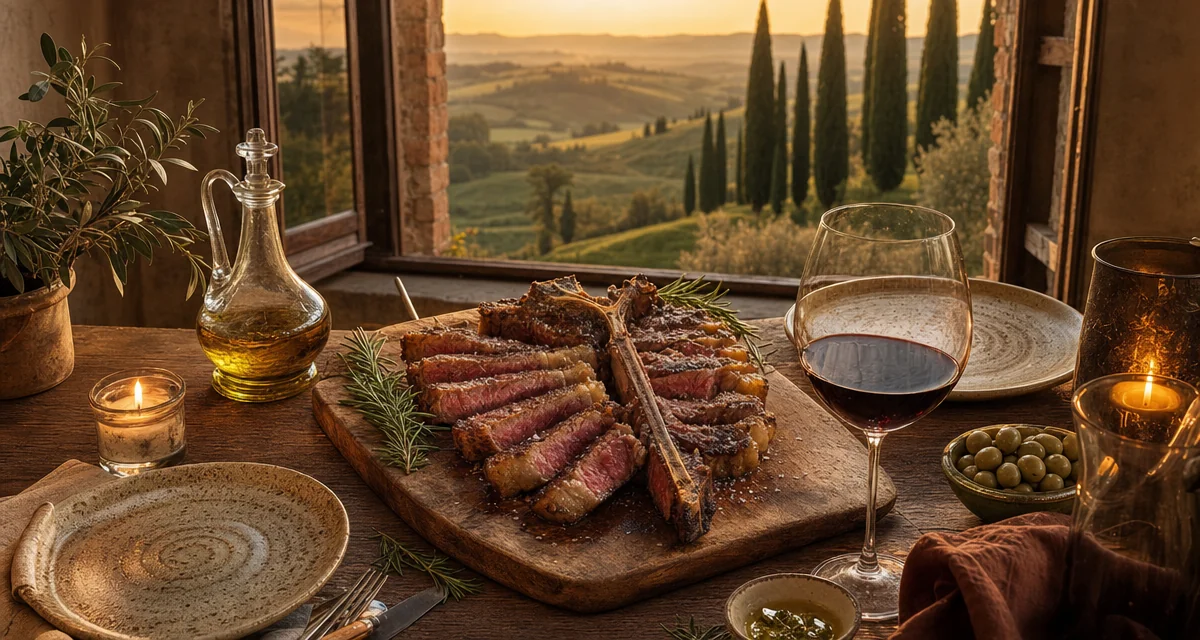
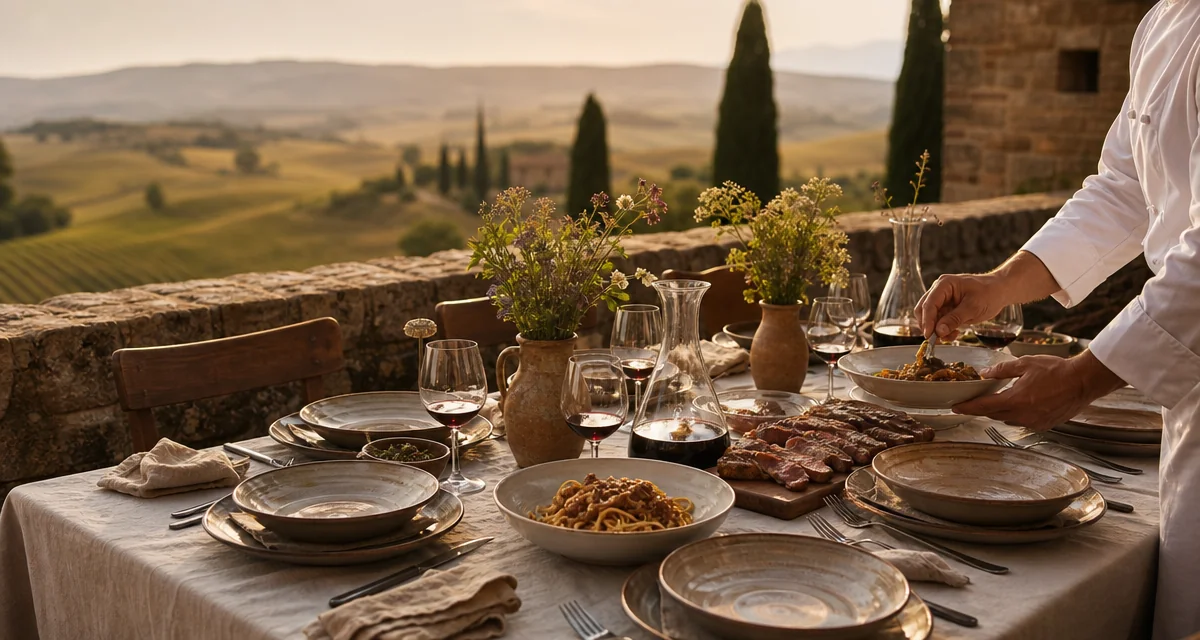
This is the classic case, and the one people picture: a farmhouse with a long table, hills going gold at eight in the evening, nobody driving anywhere. Our private chefs across Tuscany cover the villa belt from the Chianti hills down through the Val d'Orcia, the UNESCO-listed valley in the south of the region whose cypress-stippled ridges appear on every Tuscan postcard, and which produces pecorino di Pienza, Brunello di Montalcino DOCG (a pure Sangiovese red aged at least five years before release, all black cherry, leather and tobacco, and a natural partner for grilled red meat) and Vino Nobile di Montepulciano within a 30 km radius. The English matters here more than in a city, because the chef is your interpreter for the whole landscape. When they come back from the market at Greve in Chianti and want to tell you why this week's bistecca alla fiorentina (a thick T-bone of 1.2 to 1.5 kg, cut 4 to 5 cm tall from Chianina cattle, grilled over hardwood embers and served rare with salt and Tuscan olive oil) is better than last week's, you want to actually hear it. Same for the Chianti Classico DOCG they've brought, or the reason a Slow Food Presidium product costs what it costs. Our Tuscany private chef guide goes deeper on menus by season.
English-speaking private chefs in Rome and Florence apartments
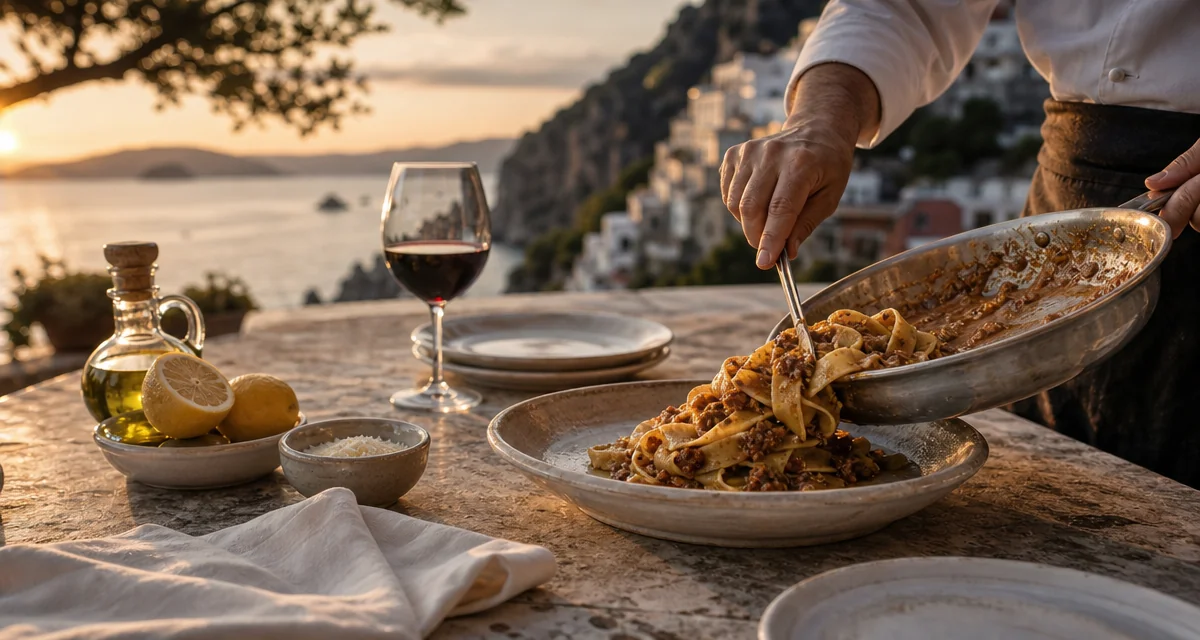
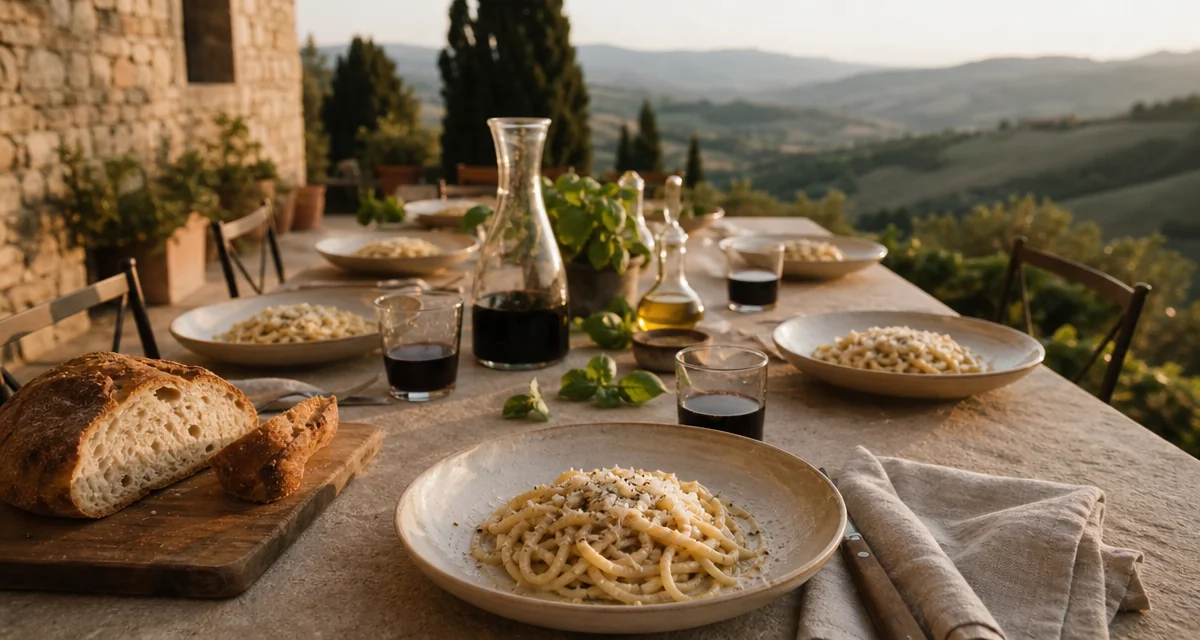
City bookings behave differently. Kitchens are smaller, groups are usually 4 to 8, and the chef is competing against 3,000 restaurants rather than against a 40-minute drive. An English-speaking private chef in Rome is most often booked for the first or last night of a trip, when nobody wants to negotiate a Trastevere queue at 9pm with tired children. Expect €135 per person for a five-course Taste of Italy menu at 6 guests in a Rome or Florence apartment, reflecting the €15 city premium. What you get for it is the version of cacio e pepe (Rome's three-ingredient pasta of pecorino romano, black pepper and pasta water, emulsified into a sauce that defeats most home cooks) made in front of you, with the technique explained as it happens. In Florence the same booking tends to skew towards a bistecca and a slower table. Both cities are where an English-speaking chef earns their keep on logistics too, since apartment buildings, intercoms and unloading a car full of groceries all go faster when instructions flow both ways.
Can an English-speaking chef teach a pasta class at your villa?
Yes, and this is the format where language stops being a comfort and becomes the entire product. Our Pasta Class + Dinner Experience is a single booking of roughly 4 to 5 hours, and it happens exclusively at the property you're staying in. The chef arrives at your villa or apartment with every ingredient, dough board, rolling pin and pot required. There is no cooking school, no transfer, no cohort of strangers. It runs in three movements. First, a 2-hour class, typically 2pm to 4pm, in which the chef teaches your group two fresh-pasta shapes, one long (tagliatelle, pappardelle or pici) and one short (orecchiette, farfalle or maltagliati), and you knead, roll and shape under their hands. Then, while the pasta rests on your countertop, the chef prepares two sauces, one for each shape, usually a meat ragù for the long pasta and a vegetable or seafood sauce for the short, plus 2 to 3 regional antipasti and a homemade tiramisù. Finally you sit down at your own table, on the terrace or by the pool, and the chef cooks the pasta you shaped, plates it and serves the full menu. Pricing is €150 per adult and €60 per child, as one bundled experience rather than a class fee plus a dinner. There are no printed or digital recipes, no PDFs, no follow-up emails. The class itself is the takeaway.
How does a week with an English-speaking chef work?
Multi-day bookings are where daily English stops being a nicety, because you're now having a conversation every morning about what the market had. The chef joins your party for the stay, typically 3 to 7 days, and you choose meal by meal which ones they cook: breakfast, lunch, dinner or any combination. A realistic week is 2 to 3 dinners plus one long lunch, not three meals a day, because most groups still want a few independent restaurant nights. Every day includes the chef shopping the local markets, cooking on-site, personalising each menu so nothing repeats unless you ask, serving and cleaning up. Cost turns on lodging, and there are three configurations. The chef may stay at the property when there's a spare room, which carries the lowest day rate because you're absorbing the accommodation. A local chef may commute daily from home, common in dense areas like the Chianti hills or the Amalfi Coast, with no lodging to factor in. Or the chef books a room nearby, line-itemed transparently in your quote. Multi-day quotes are built bottom-up from the per-meal cost plus a day retainer, so they're custom rather than a single per-person rate. Our multi-day chef guide works through each configuration.
Why this matters for your Italian holiday
You booked the house months ago. You've thought about the terrace, the light at eight in the evening, the long table with everyone around it. What you probably haven't thought about is that the single evening most likely to go sideways is the one where a professional stranger walks into your kitchen and cannot quite tell you what's in the sauce. It's a small failure, and it's the one guests remember. So the case for an English-speaking private chef in Italy isn't really about convenience. It's about getting the thing you actually paid for, which is not dinner. Dinner you can buy anywhere. What you paid for is the chef leaning on the counter at half past nine, glass in hand, explaining why the Slow Food Presidium lardo on your antipasto board comes from one valley and nowhere else, and why the family who cure it have done so for six generations. That conversation is the souvenir. It doesn't survive translation, and it doesn't happen at a restaurant table. Across our network, briefed in English chef by chef and rated 4.7/5 on Trustpilot by 800+ guests served since 2025, that's the standard we hold: you should be able to interrupt your chef. Browse Chef On Demand's private chefs across Italy, or start with the region that does this best and book a Tuscany private chef experience. Then put your phone down. The hills go gold at eight, and someone else is doing the washing up.