What does a cooking class in Verona actually involve?
A cooking class in Verona is a hands-on session, usually three hours long, in which a chef or home cook teaches a small group to make fresh pasta, a dessert and sometimes a risotto, then sits everyone down to eat the result with local wine. Almost every class in the city follows that shape. The differences lie in who teaches, where and for whom.
Look at the listings and the menus repeat themselves: fresh egg pasta such as tagliatelle or fettuccine, a filled pasta like ravioli, and tiramisù, the coffee-and-mascarpone dessert the Veneto proudly claims as its own. Fewer classes go properly Veronese. The ones that do reach for bigoli, gnocchi or a risotto made with the region's rice, and that is where a class stops being a generic Italian cooking class in Verona and becomes a lesson about the place. Venetian cuisine is built on rice, polenta, freshwater fish and long-simmered meat, and Verona adds the wine-country layer of the Valpolicella hills on its doorstep. Groups are small, typically 2–12 people, and most classes include the meal, so a 3-hour class is effectively lunch or dinner as well. If you search for a cooking school in Verona, you will mostly find restaurant kitchens, family apartments and wineries rather than a large academy, which suits a city where cooking still happens at home.
Which cooking class formats can you book in and around Verona?
Four formats cover nearly everything on offer around Verona in 2026: a small-group class in the old town, a private lesson in a local host's home, a market tour followed by a class, and a private class delivered at the villa or apartment you are renting. Each one trades price against privacy, setting and how much of the evening it fills.
A pasta cooking class in Verona's old town
The most booked option is the small-group pasta and tiramisù class. The Tour Guy lists one at a professional kitchen in Verona from $79 per person: 3 hours, fettuccine and ravioli, tiramisù, lunch or dinner and two glasses of wine, with groups capped at 12. Cooking con Amore runs a similar three-hour class at Ristorante Rubiani, a few steps from the Arena, booking up to 10 guests online and up to 50 on request. These are lively, sociable and good value for couples and solo travellers. The Verona pasta and tiramisù cooking class is, in effect, the city's default experience, and you will share the bench with strangers.
A private lesson in a local home, with or without the market
Several Veronese cooks teach in their own kitchens. Cooking Class Verona lists a Pasta and Ravioli class at €98, Bigoli in Salsa at €90, Lasagne and Tiramisù at €130 and a pizza cooking class at €110, for groups of 2–8 in Italian, English or German. Add a morning at the market and the price climbs: a host on Traveling Spoon charges $125 per person for the class and meal and $145 with the market tour, with menus that include zaletti, small Veronese cornmeal biscuits studded with raisins. Expect a payment processing fee on top with most booking platforms.
A cooking class in the Valpolicella or on Lake Garda
Many visitors stay outside the city. The Valpolicella is the hilly wine district a 20-minute drive north-west of Verona, home of Amarone, Ripasso and Valpolicella Classico, and some of its wineries and home cooks run half-day classes built around Amarone risotto. Lake Garda, Italy's largest lake, sits about 30 km to the west, and a cooking class on Lake Garda usually means a family kitchen near Bardolino or Lazise. If you are searching for a cooking class in Sirmione on Lake Garda, the honest answer is that the peninsula's old town has little space for teaching kitchens, so the class tends to come to your rental instead. Chefs also cover Sirmione and Peschiera del Garda for exactly this reason.
A private class in your villa or apartment
The fourth format is the one Chef On Demand offers: a chef arrives at your villa, farmhouse or apartment with every ingredient and tool, teaches your group alone, then cooks and serves a full seated dinner in the same house. It is the only format where the setting is the place you already chose for your holiday, and it is covered in detail below. Our chefs who cook for guests across Verona also travel to the Valpolicella, the Soave hills and the Garda shore.
How much does a cooking class in Verona cost?
A cooking class in Verona costs from about $79 per person for a 3-hour small-group class, €90–€130 per person for a private lesson in a local home, $125–$145 per person with a market tour, and €150 per adult for a private Pasta Class + Dinner at your own villa. The group-size assumption matters as much as the format.
Town and home classes are priced per head, so a couple pays twice the listed rate and a group of eight pays eight times. The Chef On Demand price is also per head and does not fall as the group grows: four adults pay €600 in total, six adults pay €900 and eight adults pay €1,200, while children count at €60 each. What changes is what the money buys. The town class includes a meal of the two or three dishes you made; the at-home format ends in a full seated dinner with antipasti, two pasta courses and tiramisù, with no taxi on either side of it. Wine is not included in the Chef On Demand figure, so you can open bottles from a Valpolicella cantina or ask the chef to arrange a pairing at extra cost. Prices below were checked on the operators' own pages in November 2026 and can change by date and season.
| Format | Typical price | Duration | Group | Where it happens | What you cook |
|---|---|---|---|---|---|
| Small-group class in the old town | From $79 per person (The Tour Guy) | 3 hours | Up to 12, shared with strangers | Professional kitchen in central Verona | Fettuccine, ravioli, tiramisù, meal with 2 glasses of wine |
| Restaurant class by the Arena | Paid on the day (Cooking con Amore) | 3 hours | Up to 10 online, 50 on request | Ristorante Rubiani, Verona | Fettuccine, ravioli, tiramisù |
| Private lesson in a local home | €90–€130 per person (Cooking Class Verona) | Half a day | 2–8 | Host's home in Verona | Bigoli in salsa, ravioli, lasagne or pizza |
| Market tour plus class | $125–$145 per person (Traveling Spoon host) | Morning to lunch | 2 or more, private | Market, then host's apartment | Tagliatelle, ravioli, gnocchi, zaletti |
| Pasta Class + Dinner at your villa (Chef On Demand) | €150 per adult, €60 per child | 4–5 hours, class 2 hours | Your group only | Your villa, farmhouse or apartment | Two pasta shapes, two sauces, antipasti, tiramisù, seated dinner |
What Veronese dishes will you actually learn?
Most classes in Verona teach fresh egg pasta, ravioli and tiramisù, with Veronese specialities such as bigoli, gnocchi and risotto all'Amarone appearing on a minority of menus. The dishes below are the ones worth asking for, because they belong to this city and its hills rather than to Italy in general.
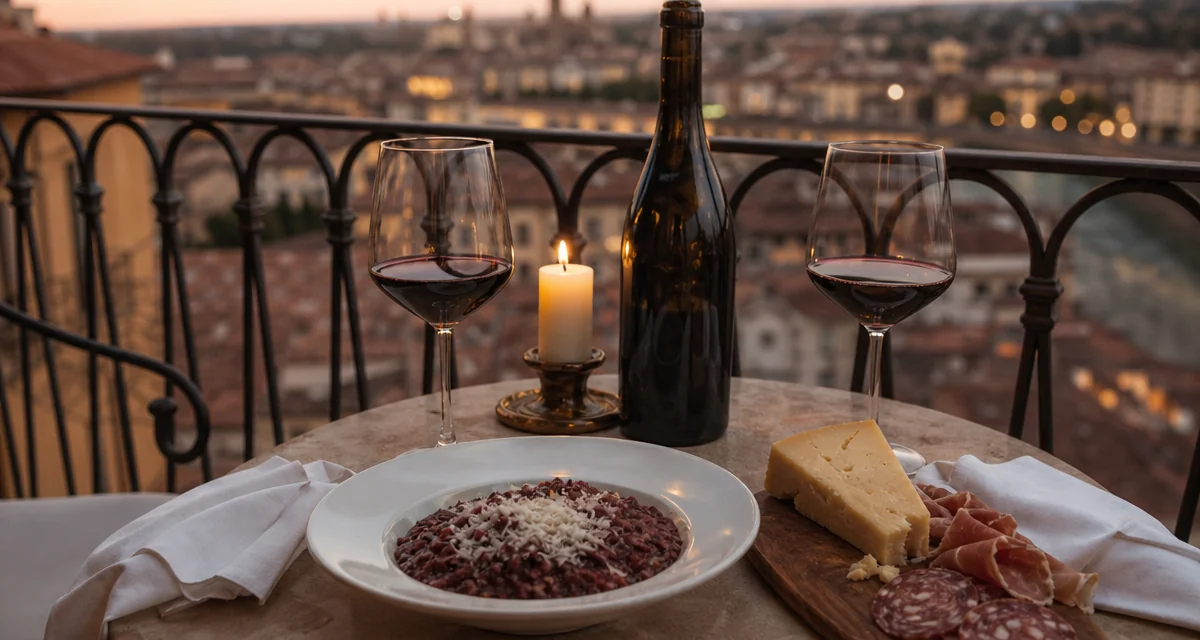
Bigoli are thick, rough-surfaced long noodles, originally made with wholewheat flour and pushed through a heavy hand press called a torchio. In Verona they come con l'arna, with a duck ragù, while around Custoza, toward the lake, Italia.it notes they are served with sardines. Risotto all'Amarone is the city's signature first course: Vialone Nano, a creamy, medium-grain rice grown in the lowlands south of Verona, cooked with Amarone and often finished with Monte Veronese, a DOP cow's-milk cheese from the Lessinia plateau north of the city. Amarone della Valpolicella itself is a dry red made mostly from Corvina grapes that are dried for months before pressing, which concentrates them into notes of cherry, spice and leather; it has been a DOCG since 2010 and pairs naturally with braised meat and aged cheese.
Pastissada de caval is a horse-meat stew marinated for hours, sometimes a whole day, in red wine with onions and spices, then simmered slowly and served with polenta or gnocchi. Local legend ties it to a battle in 489 AD, and you will rarely meet it in a tourist class, though it is worth ordering in a trattoria. Gnocchi have their own festival: the Bacanal del Gnoco, Verona's carnival, which tradition dates to a famine in 1531 and which peaks on the Venerdì Gnocolar, the last Friday before Lent. For dessert, Verona gave Italy pandoro, the tall, star-shaped, buttery Christmas cake patented by Domenico Melegatti in 1894. Twenty-five kilometres south-west, Valeggio sul Mincio makes its tortellini so thin they are nicknamed the nodo d'amore, the love knot. White wine comes from Soave, the walled town about 25 km east, where Garganega grapes give a crisp, almond-edged white that suits lake fish.
'Visitors expect Verona to be a risotto town, and it is, but the dough is where the character shows. Bigoli are coarse and thick because they were made to hold a duck ragù through a long Sunday lunch.' A Chef On Demand chef who cooks between Verona and the Valpolicella
How does a Pasta Class + Dinner at your villa work?
A Pasta Class + Dinner with Chef On Demand is a 4–5 hour private experience held entirely at your villa, farmhouse or apartment: a 2-hour hands-on class teaching one long and one short fresh pasta shape, followed by a seated dinner of antipasti, both pastas with their own sauces and homemade tiramisù. The chef travels to you; nobody goes to a school.
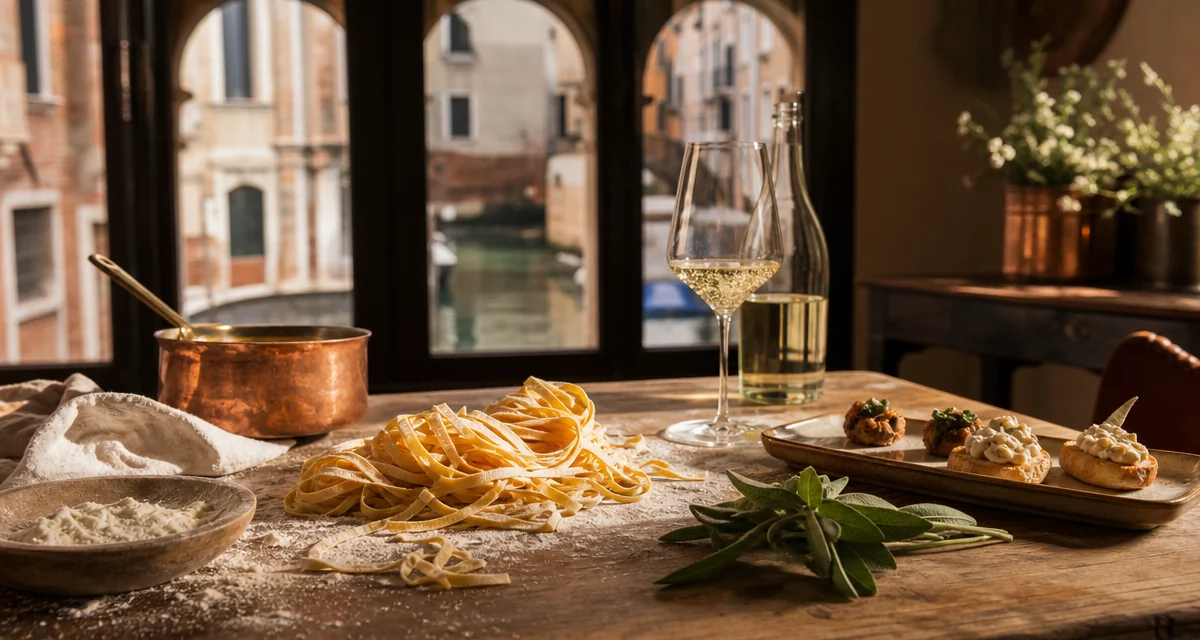
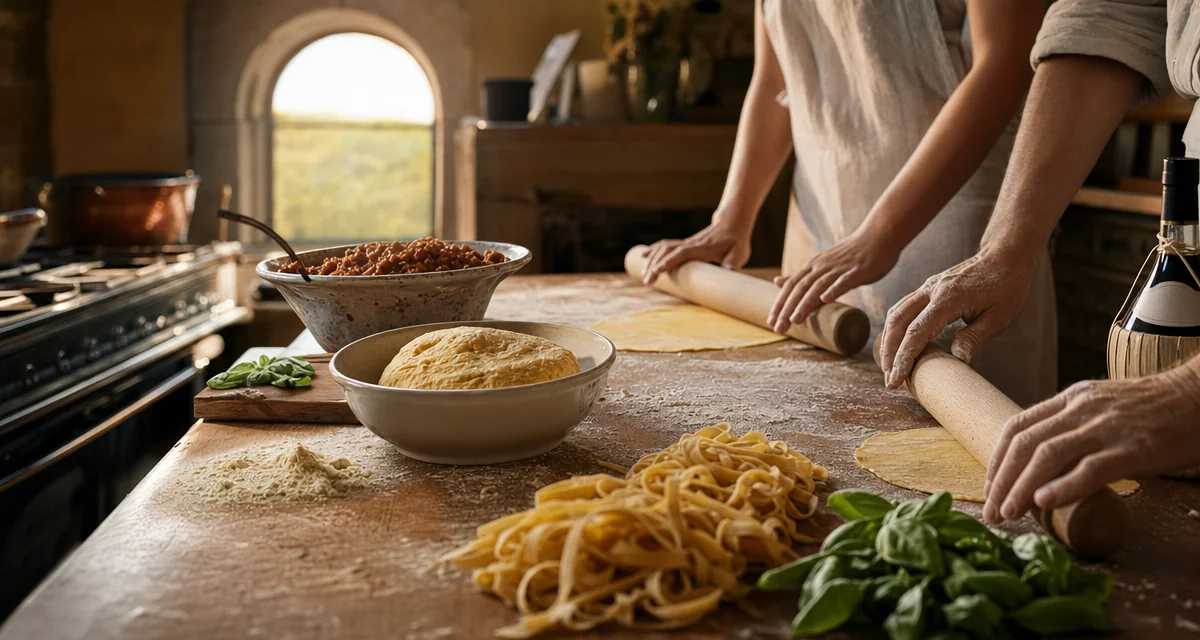
A typical afternoon starts at 2pm. The chef arrives with all the ingredients, dough boards, rolling pins, pasta cutters, pots and plates, and sets up in your kitchen. For two hours your group kneads, rolls and shapes a long pasta, often tagliatelle or pappardelle (bigoli need a heavy press, so ask when you book if you want them), and a short one such as maltagliati or farfalle. While the pasta rests on your counter, the chef makes two sauces, typically a meat or duck ragù for the long shape and a seasonal vegetable sauce for the short one, radicchio in winter or courgette and herbs in summer, plus two or three small antipasti such as Monte Veronese with polenta crostini, and a tiramisù. Then you sit down at your own table, on the terrace if the evening allows, and eat what you made about 30 minutes after making it. Full clean-up is included. We do not provide printed or digital recipes: the class itself is the takeaway, technique coached under the chef's hands and the muscle memory of two shapes you can repeat at home.
- Privacy: only your group at the table, with no strangers sharing your dough board.
- Your villa as the stage: the farmhouse kitchen or the lake terrace you are already paying for becomes part of the memory.
- Zero transfers: no taxis for eight people and no parking near Verona's limited-traffic zone after dinner.
- Flexible timing: start and finish when your group decides, with no next class waiting at 6pm.
- Family-friendly: children can shape farfalle, nap or play next door, and relatives who prefer not to cook still sit down to the same dinner.
- Wine on your terms: pour the bottles you bought in the Valpolicella, with no rule against glasses on the cooking floor.
Chef On Demand holds a 4.7/5 rating on Trustpilot based on 800+ guests served since 2025 across Italy, and the same format runs in other cities: our guide to cooking classes in Venice explains how it changes on the lagoon, and our region-by-region selector of Italian cooking classes compares Verona with Florence, Bologna and the south. To check dates, you can book a chef for your Verona stay directly.
- Send your dates, the address of your villa or apartment and the number of adults and children.
- List every allergy and dietary need in writing, one guest per line, when you request a quote.
- Choose the long and the short shape you would like to learn, or let the chef pick what is in season.
- Clear about 1.5 metres of counter or table space and check the oven and hob work before the day.
- Decide on the wine: your own bottles from a local cantina, or a pairing arranged by the chef.
- Sit down at your own table once the pasta is cooked and let the chef serve and clean up.
How long does a class last, and how do you choose by group size?
Most cooking classes in Verona last 3 hours including the meal, market-tour classes take a morning, and a private Pasta Class + Dinner at your villa takes 4–5 hours from the chef's arrival to the last plate. Group size is the cleanest way to choose: small parties suit a shared town class, larger parties outside the city suit an at-home class.
For one to three people staying in the centro storico, a small-group class is hard to beat on price and atmosphere: $79 each, a short walk from your hotel, and new friends at the table. For four or five, a private home lesson at €90–€130 per head gives you the cook to yourselves. From six guests up, especially families renting a villa in the Valpolicella or a house on the Garda shore, the maths and the logistics tilt the other way. Six people in a town class pay around $474 plus two taxis each way across 20–30 km, and dinner is a set meal of what you made. The same six at home pay €900 for a private class and a full seated dinner, served where the children can go to bed upstairs. Chefs across the wider Veneto work the same way, so the format follows you if you move on to Vicenza or Venice.
When is the best time to take a cooking class in Verona?
You can take a cooking class in Verona all year, but the menu changes with the season: spring and summer bring lighter vegetable sauces and lake fish, autumn brings the grape harvest and game, and winter brings radicchio, pandoro and the gnocchi carnival. Book 7–14 days ahead in peak months and around the opera festival.
From June to early September the Arena di Verona opera festival fills the city, and classes on opera nights book up early, so a lunchtime class or an at-home class on a non-opera evening is the easier option. Average booking lead time across the Chef On Demand network is 7–14 days for that June–September peak. September and October are harvest months in the Valpolicella, when grapes for Amarone are laid out to dry for the winter, and the region's kitchens move to mushrooms, chestnuts and heavier ragù. If you are reading this in late 2026, the next weeks belong to radicchio and pandoro, and the next Venerdì Gnocolar falls in early February 2027, the obvious moment to ask for a gnocchi class. Spring brings asparagus from the Veneto's flatlands and lighter, herb-led sauces that suit a terrace dinner.
Why this matters for your stay in Verona
Verona is often a stop of a night or two between Venice and the lakes, and it is easy to leave having eaten well without ever learning why the food tastes of this place. A cooking class fixes that. Whether you choose a busy bench in the old town or your own kitchen above the vineyards, you go home knowing why bigoli are rough, why the risotto is purple and why the Veneto fights for tiramisù. If you are staying a few days, the at-home format adds the part a class venue cannot: your own table, your own wine and nobody checking the time. It also sits well alongside other evenings with a chef, from a quiet Verona anniversary dinner with Amarone in the risotto to a family lunch on the lake. You can explore Chef On Demand and its chefs across Italy, or see our Verona private dining page for the dishes and zones the chefs cover. Picture it: the light going amber over the Valpolicella, a board dusted with flour on the terrace table and eight people who made dinner together, finally sitting down to eat it.