What does a Sicily cooking class in a villa actually include?
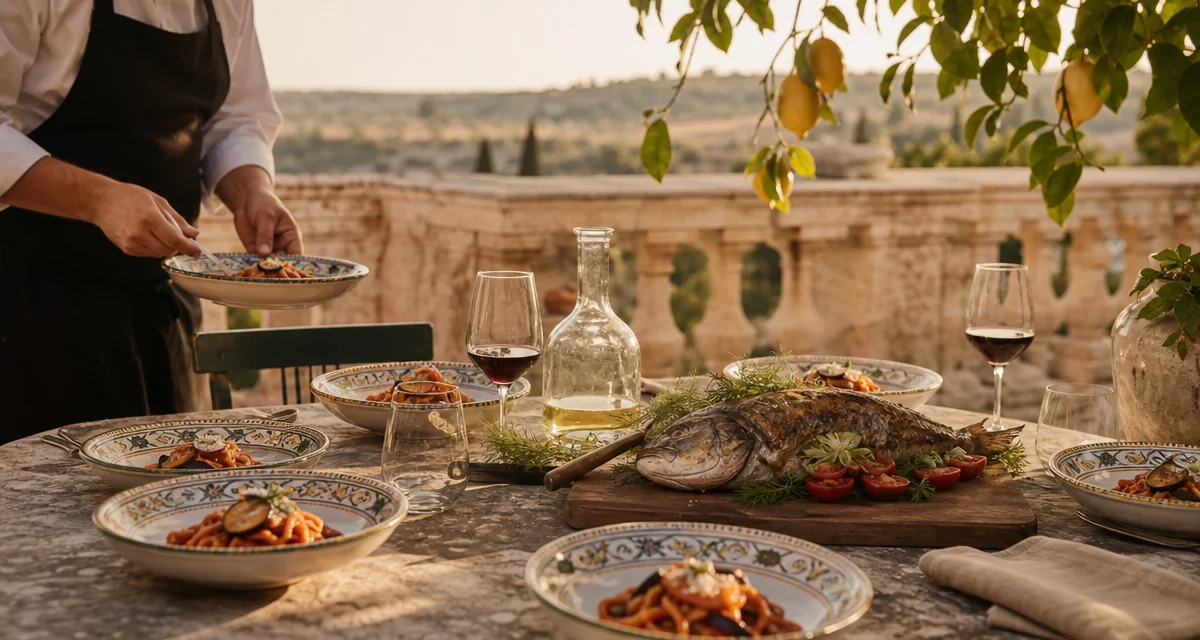
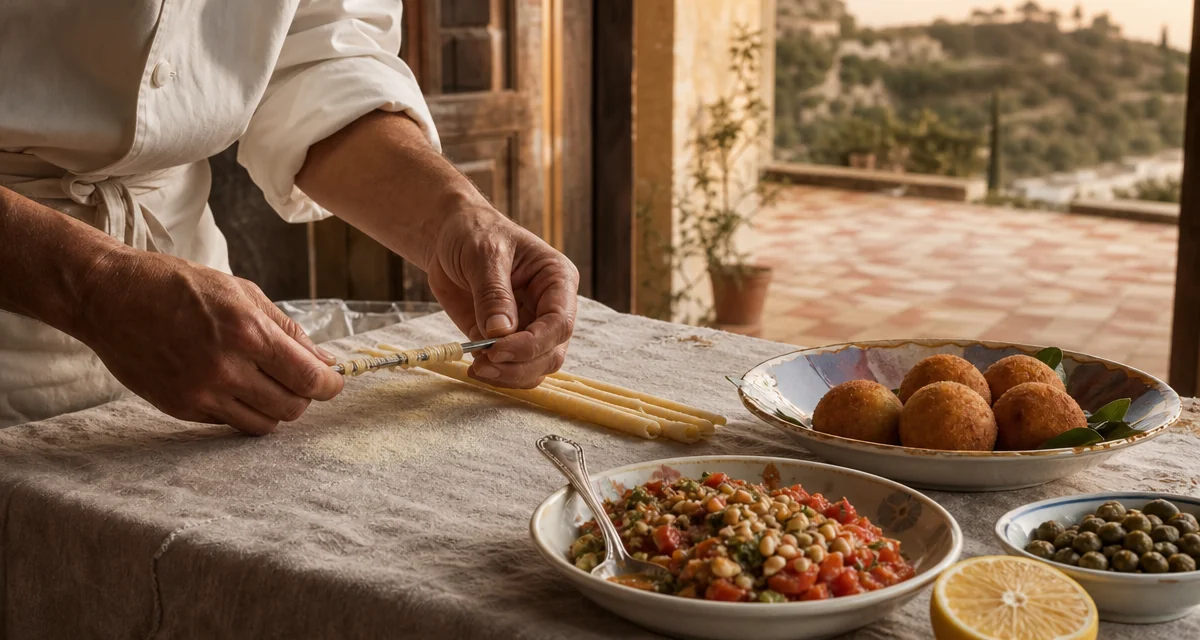
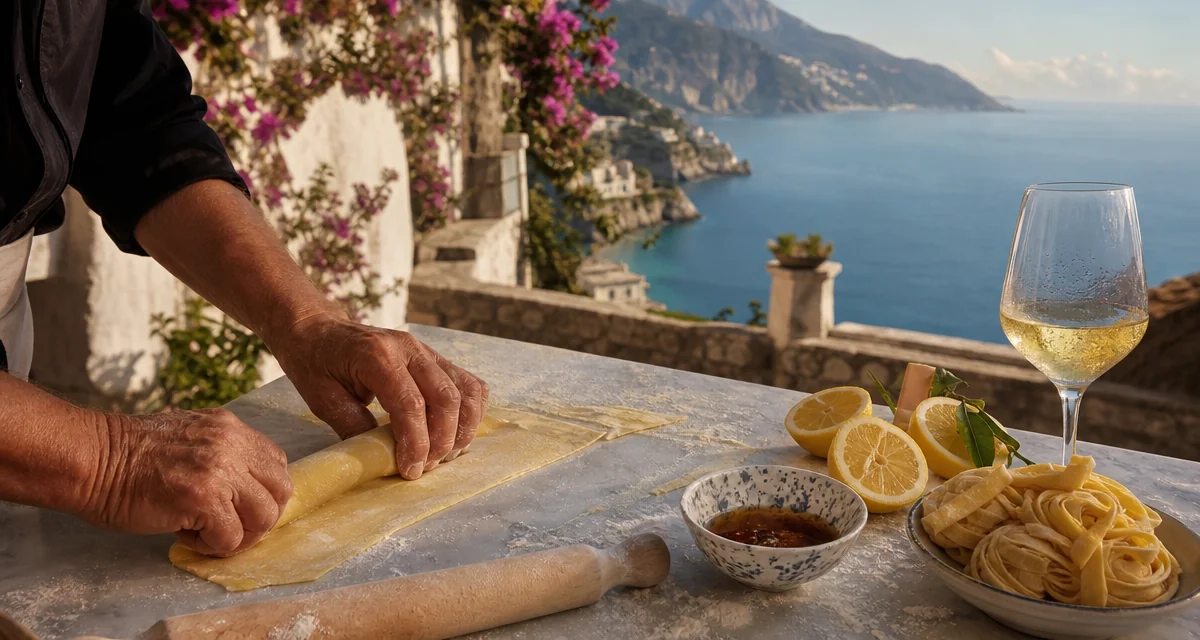
A Sicily cooking class in a villa is a bundled experience: a chef arrives at the property you have rented with all the ingredients and equipment, teaches your group two fresh pasta shapes by hand, then cooks the full dinner and serves it at your table. The flagship format we run for international guests is the Pasta Class plus Dinner. Across a 4 to 5 hour window, the first two hours are the class itself, where you knead, roll and shape one long pasta and one short pasta under the chef's hands. In Sicily the long shape is very often busiate, a corkscrew pasta from the Trapani area traditionally wound around a thin reed or knitting needle, paired in the classic way with pesto alla trapanese, a raw sauce of almonds, tomato, garlic and basil. While the dough rests on your countertop, the chef builds the two sauces, a few Sicilian antipasti and a dessert. Antipasti almost always include caponata, the island's sweet-and-sour stew of fried aubergine, celery, capers and olives sharpened with vinegar and a little sugar, and often arancini, the stuffed and fried rice balls that are Sicily's most famous street food. Then everyone sits down: antipasti, both pastas with their sauces, dessert, wine if you want it, and a full clean-up at the end. It is private, for your group only, and the menu bends to your party rather than the other way round.
How much does a private cooking class in Sicily cost?
A private Pasta Class plus Dinner in Sicily costs around 150 euros per adult, with children counted at roughly 60 euros each. Because it is sold as one combined experience rather than a class-only fee, the price covers the lesson, all ingredients, the chef's travel to your villa, the cooking, the seated dinner and the clean-up. The per-adult figure stays flat whether you are four people or ten, so a group of six pays roughly 900 euros total and a group of eight around 1,200 euros, which on a per-head basis often works out cheaper than the area's off-site options once you remember there is no separate restaurant dinner to buy afterwards. For comparison, the off-site classes Sicily is known for span a wide range: small-group lessons on the big booking platforms start near 35 to 90 euros per person, market-to-table half-days run 80 to 150 euros, and celebrity-chef or luxury villa schools quote 200 to 350 euros and up. A straight private dinner is a useful yardstick too: a five-course Taste of Italy menu runs about 120 euros per head for six guests and 110 euros for eight, so the class adds a modest premium for the experience of making the food yourself. You can weigh both formats with our Sicily private chefs before you commit.
People arrive in Sicily wanting a famous table. By the second night they want their own terrace, their own busiate, and a chef who lets the children flour the board. That is the dinner they photograph and the one they talk about back home. Chef Salvo, Catania-based ambassador of Chef On Demand
In-villa class vs a cooking school in town: which should you book?
The honest trade-off comes down to privacy and logistics versus price. A cooking school in town is usually cheaper per head and can be a lovely half-day out, but you share a kitchen with a cohort of strangers, follow a fixed menu, and in Sicily you often face a real drive: villas here sit deep in the countryside near Noto, the baroque town in the south-east, or up in the hills behind Cefalu, so reaching a school in Taormina or Catania can mean 40 minutes each way, parking, and a hard finish time when the next class is waiting. An in-villa class flips all of that. Only your group is at the table, the menu and pace bend to your party, children can join in or play in the next room, and the villa you are already paying for becomes the stage rather than something you leave behind for a classroom in town. There is no transfer between class and dinner because both happen in the same kitchen, and you drink the wine you bought at the local enoteca, the wine bar where Sicilians buy by the bottle, instead of being told there is no alcohol on the cooking floor. If you are staying near a villa around Taormina or over in the Ortigia side of Syracuse, the simple maths of getting a group to and from an off-site venue often makes the in-villa option the easier choice. For the broader picture of where classes happen across the island, our wider guide to cooking classes in Sicily maps the in-town schools too.
- Confirm the experience happens entirely at your villa, with no transfer to a separate venue for either the class or the dinner.
- Ask which two pasta shapes the chef plans to teach (busiate is the classic long shape) and which two sauces will pair with them, so you know the menu before the day.
- Send a photo of your kitchen and your best outdoor table when you book, so the chef can plan the mise en place around your space.
- Flag any allergies or dietary needs in a short bullet list rather than a paragraph, which cuts misreadings to near zero.
- Decide whether you want wine pairings from the chef or prefer to supply your own bottles, perhaps a Nero d'Avola or an Etna DOC from a nearby cantina, the cellar or wine shop.
- Agree the start time so dinner lands at golden hour, usually a 2pm class start in summer.
| Feature | In-villa Pasta Class plus Dinner | Cooking school in town | Standard private-chef dinner |
|---|---|---|---|
| Typical price per adult | Around 150 euros | 35 to 150 euros (luxury schools 200+) | 110 to 120 euros (Taste of Italy, 5 courses) |
| Where it happens | At your rented villa | At a school or restaurant kitchen | At your rented villa |
| Hands-on cooking | Yes, two pasta shapes taught | Yes, usually a fixed menu | No, the chef cooks for you |
| Group privacy | Your party only | Shared with strangers | Your party only |
| Transfer needed | None | 30 to 45 min each way is common | None |
| Ends with a seated dinner | Yes, antipasti, two pastas, dessert | Sometimes, often a counter tasting | Yes, the full menu |
| Total duration | 4 to 5 hours | 2 to 3 hours | 2 to 4 hours |
What Sicilian dishes and techniques will you actually learn?
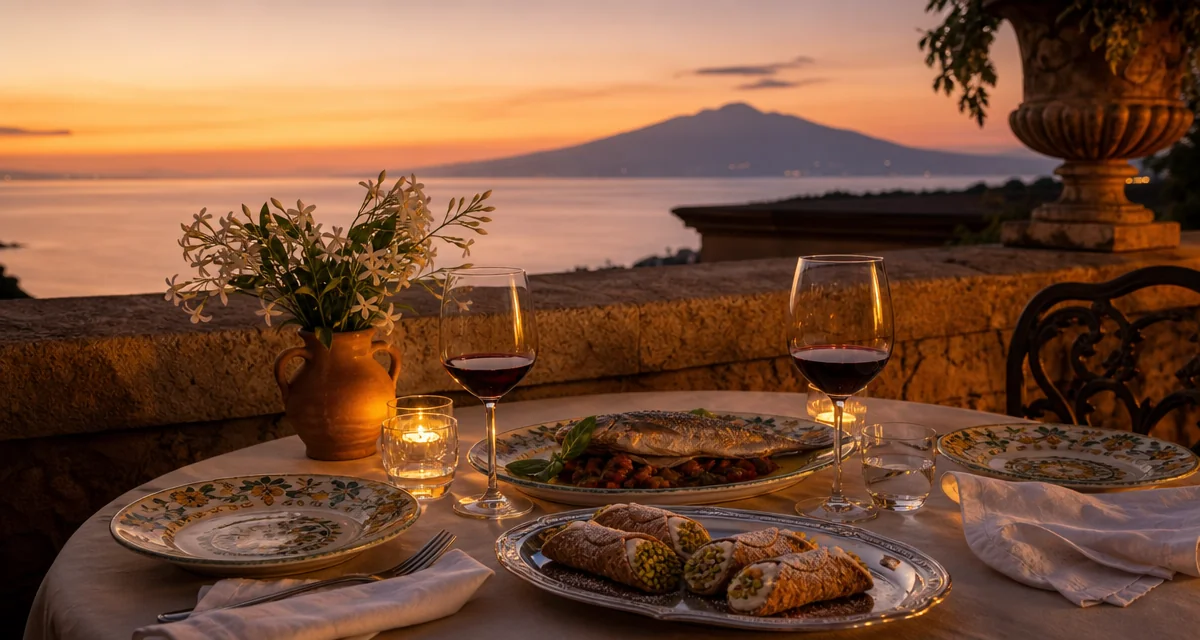
Sicilian cooking is the most layered in Italy, built over centuries from Greek, Arab, Norman and Spanish hands, and a good class lets you taste that history. The pasta lesson usually centres on busiate twisted around a rod, dressed in pesto alla trapanese, with a short shape such as maccheroni or fresh anelletti for the second sauce. Anelletti are the little pasta rings Palermo bakes into a timbale; in Catania the long-pasta hero is instead pasta alla Norma, a dish of tomato, fried aubergine, basil and salted ricotta salata named after Bellini's opera. Beyond the pasta, the chef walks you through the antipasti that define the island: caponata, of course, and often a tray of arancini. Many guests ask to learn a sweet, and here Sicily is unbeatable. There is the cannolo, the crisp fried tube of pastry filled to order with sweet sheep's-milk ricotta so it never goes soggy, and in summer granita, the semi-frozen crushed-ice dessert Sicilians famously eat at breakfast with a warm brioche, in flavours from almond to Etna pistachio to lemon. You take none of this home as a recipe sheet, and you do not need to: you take away the technique, the muscle memory of winding busiate and the rhythm of frying the perfect arancino, plus whatever photos you snap along the way. That is what stays with you, far longer than paper would.
Can the chef stay for several days of your villa holiday?
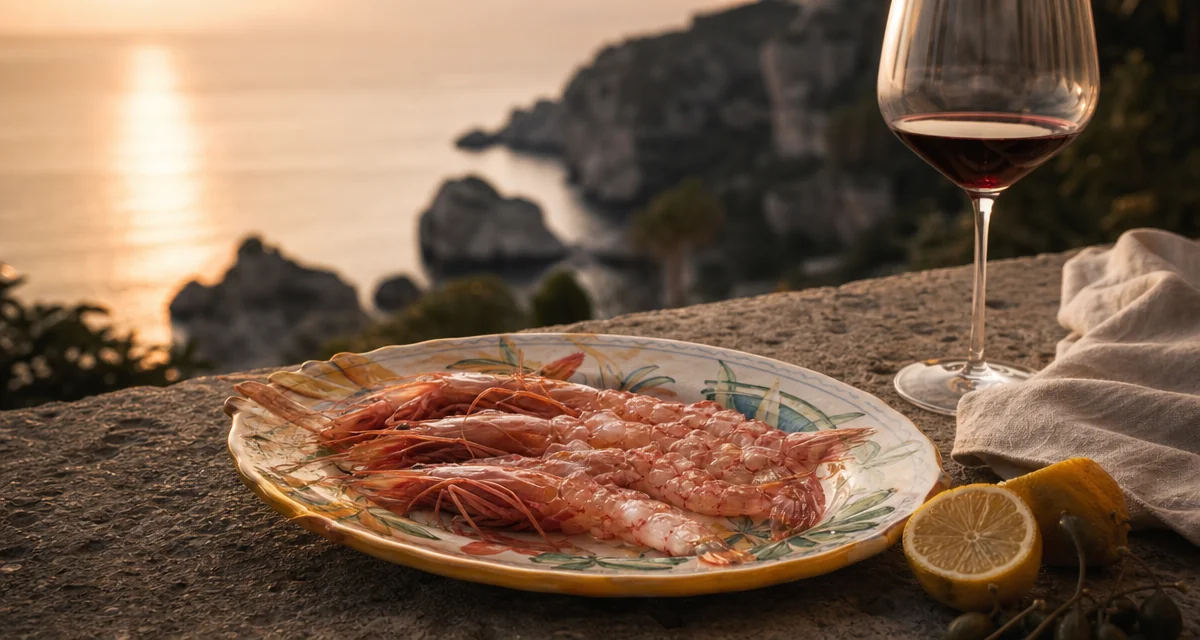
Yes. Beyond the single class, our multi-day service lets a chef accompany your party across a 3 to 7 day stay, and for each day you choose which meals the chef cooks; most groups land on a pattern of two or three dinners and one long lunch across the week rather than every meal every day. Pricing here is always custom because it depends on the lodging arrangement, and there are three configurations to know about. First, the chef can stay at the property if your villa has spare chef quarters, which keeps the daily rate lowest because you absorb the lodging. Second, in busier zones such as around Catania or along the Taormina coast, a local chef can commute in daily and drive home after service, so there is no accommodation cost at all. Third, if your countryside villa near Noto or Ragusa has no chef room and no resident chef is available, the chef books a room nearby and the quote line-items that surcharge transparently. Daily market shopping is part of every multi-day arrangement, so the chef is at the morning fish stalls or the Catania pescheria before cooking. Every quote is built up from the per-meal cost plus a per-day retainer that reflects which of those three arrangements applies, so we never quote a single mythical per-person multi-day rate. A cooking class on the first night followed by relaxed dinners later in the week is one of the most popular shapes our Sicily guests ask for.
Why this matters for your Sicily holiday
Sicily rewards the traveller who slows down: baroque Noto, the temples of the Valley of the Temples, Marsala's wine cellars in the far west, the markets of Palermo loud with vucciria, and Etna brooding over it all. Most visitors spend their evenings hunting for a restaurant table with a view their own villa terrace already offers them. The quieter pleasure, the one our guests come back to, is letting the island come to you: a chef on your terrace, your children twisting busiate, a tray of arancini you fried yourself, and a dinner that lasts as long as the conversation does. Chef On Demand operates a verified network of vetted private chefs across Sicily, many drawn from Michelin-starred kitchens and Gambero Rosso-rated restaurants, with a 4.7 out of 5 Trustpilot rating across 800+ guests served since 2025. If you are still deciding where to base yourself, our broader network of private chefs across Italy and the dedicated chefs serving villas all over Sicily can shape an evening around whichever property you have chosen. Browse the Sicilian chef network, send us a photo of your terrace, and picture Etna fading to violet while the busiate you shaped comes to the table you are already sitting at.