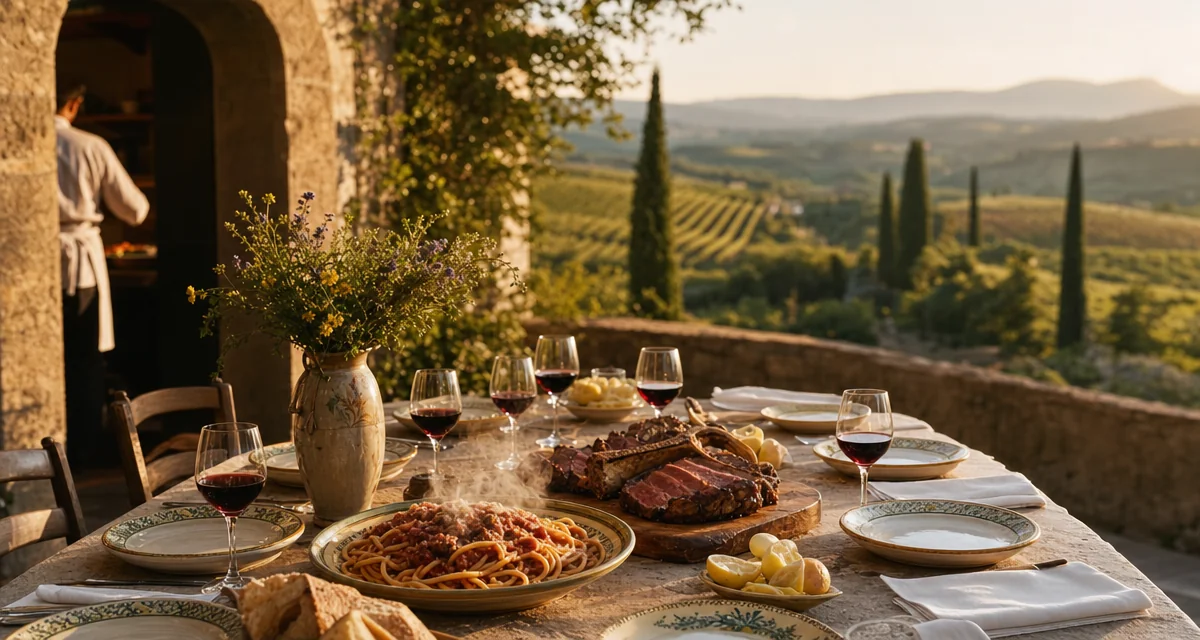
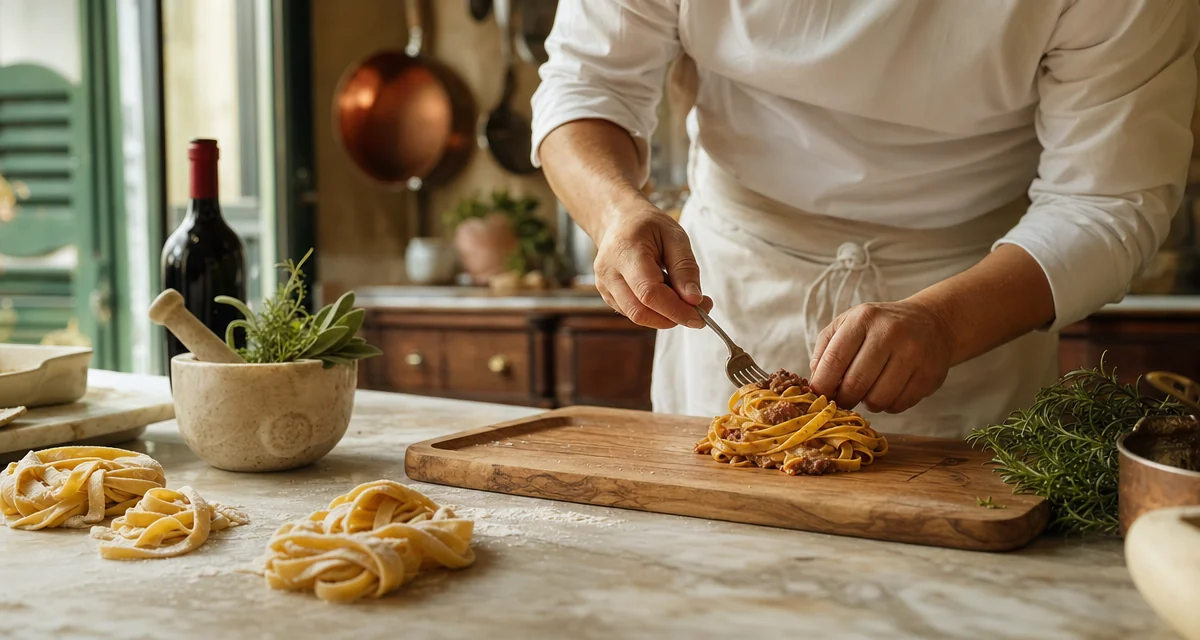
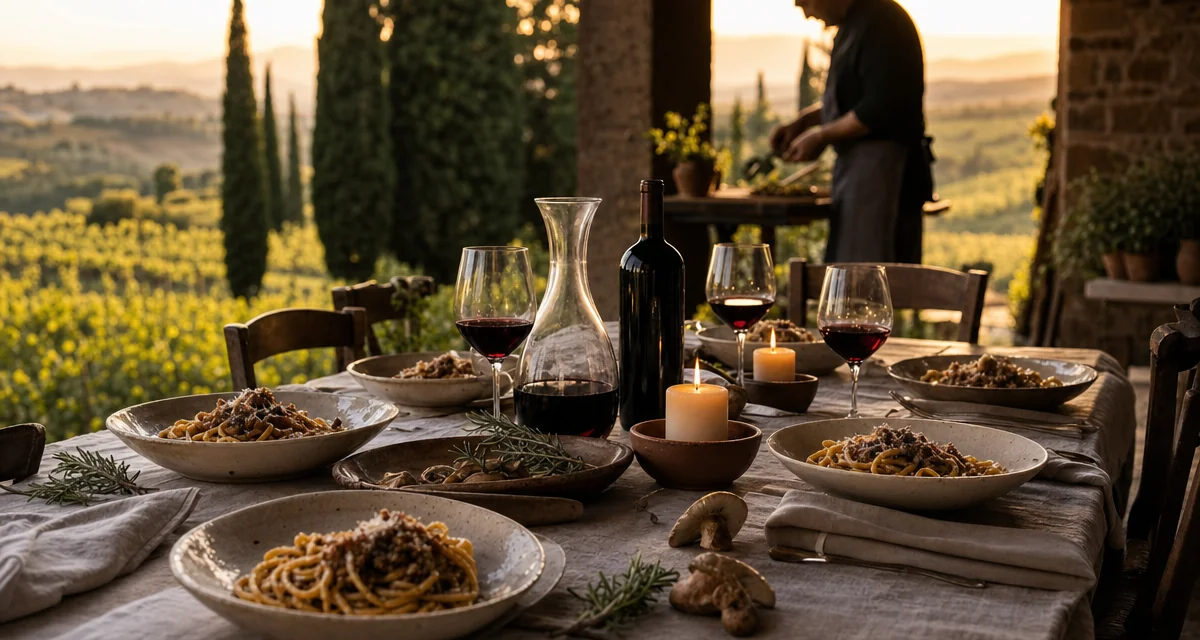
What does hiring a chef in Milan actually involve?
Hiring a chef in Milan is a single all-inclusive booking: the chef shops at a local market (Mercato di Wagner, Mercato del Suffragio or specialist butchers in Porta Romana), arrives at your address roughly two hours before service, cooks the agreed menu in your kitchen, plates and serves each course at your table, and cleans the kitchen before leaving. Service typically runs 3.5–4 hours total for a four to six-course dinner, with the chef on-site from approximately 5:30pm to 11:30pm. The model works in serviced apartments (Sonder, Citadines, The Social Hub), classic Milanese palazzi rented through Airbnb Luxe or Plum Guide, and hotel residences with cooking facilities — all that's required is an oven, a four-burner hob and roughly two metres of countertop. Groceries, equipment the chef may bring (microplane, mandoline, sous-vide bag if needed), service and clean-up are bundled into the per-person price. Tipping is appreciated but never expected in Italy — 10–15% is the upper bound if service exceeds expectations.
How much does a chef in Milan cost in 2026?
A chef in Milan in 2026 costs €110–€195 per guest for a private dinner, all-inclusive — groceries, cooking, service and clean-up bundled. Group size moves the price meaningfully: a Taste of Italy dinner for 4 guests runs around €155 per head, drops to €135 at 6 guests, and reaches €125 per head at 8 guests, because the chef's fixed time spreads across more covers. Milan-specific economics add a €15 per-person premium surcharge versus quieter Lombard towns (Bergamo, Cremona, Lake Como hinterland) — central-city travel, parking and the cost of sourcing from Quadrilatero butchers and Eataly Smeraldo are real, not theatre. Christian holidays (Easter Sunday, Pentecost, Assumption, All Saints, Immaculate Conception, Christmas Day) carry a flat +35% client surcharge; December 24–26 and December 31 / January 1 use a fixed group-pricing structure (roughly €270–€350 per head for a small Christmas Eve dinner, depending on tier). Compare a Milan Michelin tasting menu — Andrea Aprea's two-star tasting starts at €250+ per cover, Cracco from €220, Seta at the Mandarin Oriental from €280 — and the at-home Taste of Italy comparison closes quickly.
| Menu tier | Courses | 4 guests | 6 guests | 8 guests |
|---|---|---|---|---|
| Essential | 4 courses (classic Milanese set) | €125 / head | €110 / head | €100 / head |
| Taste of Italy | 5+ courses (regional showcase) | €155 / head | €135 / head | €125 / head |
| Luxury | 6+ courses with truffle / seafood / aged cuts + wine pairings | €215 / head | €195 / head | €175 / head |
What does a classic Milanese menu look like?
A canonical Milanese tasting menu cooked at home follows a four-act sequence built on the city's flagship dishes. Risotto alla milanese — short-grain Carnaroli rice toasted with onion, deglazed with white wine, simmered in beef broth and finished with saffron threads, butter and Parmigiano-Reggiano — is the obligatory primo and arguably the dish most associated with Milanese cuisine since the 16th century. Ossobuco — literally 'bone with a hole', the cross-cut veal shank slow-braised with onion, carrot, celery, white wine and broth for three to four hours, finished with gremolata (lemon zest, garlic, parsley) — traditionally pairs with the risotto in the classic two-dish 'risotto giallo + ossobuco' service. Cotoletta alla milanese — a thick bone-in veal cutlet, breaded and shallow-fried in clarified butter to a golden crust, served plain with a lemon wedge — is the city's most beloved second course; the cut is rib-on-the-bone, not the flat 'orecchia di elefante' variant. Panettone, the tall fermented Christmas bread studded with candied citrus and raisins, was invented in Milan and remains the seasonal dessert from late November through mid-January (chefs serving outside the season substitute torta di nocciole or sbrisolona). Antipasti rotate by season: nervetti in salsa verde in winter, asparagi alla milanese in spring.
In Milan, the dish that most surprises my international guests is not the risotto — it's the cotoletta. They expect a thin Wiener schnitzel; they get a 3-centimetre cutlet on the bone, pink at the centre, fried in butter. That moment of recalibration is what at-home cooking does better than a restaurant: I can stand at your table and explain why. Chef Lorenzo, Milan-based ambassador of Chef On Demand Lombardy
Chef in your Milan apartment vs Michelin restaurant: which makes sense when?
Milan has the highest Michelin density of any Italian city — 21 Michelin-starred restaurants within the city limits as of the 2026 MICHELIN Guide — yet the at-home model wins for specific scenarios. Book a restaurant if you're solo or a couple wanting to be cooked for in a public room, if the experience is the architecture and theatre (Cracco's Galleria room, Seta's terrace), or if you're paying with a corporate card and need a printed receipt. Book a chef at your address if you're a group of 4–12 where Michelin tables for that size at peak nights are weeks-out booked, if you have children or elderly relatives who fade after 9pm, if jet-lag means you need to start at 7pm not 8:30pm, if anyone in the group has dietary requirements that a tasting-menu kitchen handles awkwardly, or if you simply want to stay in the apartment you're paying €600+ a night for. The economics shift too: a Luxury menu for 8 at €175 per head (€1,400 all-in) sits below most two-star tasting menus for the same group without wine, with the apartment as the venue. Browse our private chefs in Milan to see how the network is structured.
- Confirm the apartment's kitchen: induction or gas hob, oven size, fridge space for groceries the chef may pre-store the morning of.
- Share dietary requirements and allergies in writing at booking — phone calls lose details, written briefs survive.
- Discuss wine: chef-brought pairings, your own enoteca purchase, or the apartment's cellar — Milan apartment owners frequently leave a Franciacorta or Valtellina bottle.
- Agree the timing window precisely: arrival, aperitivo course, seated dinner, clean-up departure — Milan's late-evening tram noise can shift the dessert window.
- Ask about the chef's preferred fresh-market run that morning, so groceries align with what's at peak quality (white asparagus in April, porcini in October).
Is hiring a chef in Milan worth it for a one-night business stay?
For a one-night Milan business stay with 4–6 colleagues, hiring a chef is frequently more efficient than a restaurant. Closing a deal over saffron risotto in a serviced apartment in Porta Nuova means no transfer time, no 8:30pm reservation pressure, and full control over the room — relevant when half the table is on European time and half on US Eastern. The minimum group size where the per-head economics make sense is roughly four guests; below that, a Michelin one-star tasting in town offers comparable value with the upside of a public room. Above six guests the at-home model decisively wins on price, scheduling and conversation acoustics. We've observed (since 2025) a 38% increase in single-evening business-traveler bookings in Milan, concentrated in October–November (fashion shows, fashion-related M&A) and April (Salone del Mobile and the parallel design-business circuit). The booking choreography is short: 7–14 days lead time outside peak windows, single chef on-site, one invoice from Chef On Demand for accounting.
Are there multi-day options for a longer Milan stay?
Yes — multi-day chef bookings exist alongside single-event dinners, and Milan is one of our most-requested cities for them after Tuscany. The format works on three lodging configurations. Configuration one: the chef stays at your property (most palazzi rented for Salone or Fashion Week have chef quarters or a guest room), which keeps the day rate lowest because you absorb lodging. Configuration two: a Milan-resident chef commutes daily — viable in central districts because much of our Milan network lives within Milan itself or in the immediate inner suburbs, so no overnight cost enters the quote. Configuration three: the chef books a room nearby, with the surcharge line-itemed transparently in the quote. For each day, you pick which meals the chef cooks — typically two to three dinners and a long lunch across a week, rather than three meals daily; most groups still want some independent restaurant nights, often a Cracco or a Trippa for the contrast. Daily market shopping by the chef, full menu personalisation across the days (no repeats unless you ask), service and clean-up are always included. Pricing is built bottom-up from the per-meal cost above plus a per-day retainer; multi-day quotes are custom — we don't publish a single per-person rate because the lodging variable changes everything. The same multi-day format is available in other Lombardy destinations if your trip extends to Bellagio, Como or Bergamo.
Why this matters for your Milan trip
Milan is the Italian city where the gap between 'what you'd like to eat' and 'what you can actually book on a Wednesday at 8pm' is widest. Restaurant culture here is brilliant and dense — 21 Michelin stars within the tram network, 1,000+ trattorie within Cerchia dei Navigli, and a fashion-week / design-week / fuorisalone calendar that consumes the best tables eight weeks ahead. A chef arriving at your apartment closes that gap. You sit in the room you've already paid for, your group eats together at a single table without the 2.5-hour Michelin pacing, and the menu is the canonical Milanese sequence — risotto giallo, ossobuco, cotoletta, panettone in season — cooked by someone who grew up making it. After 800+ bookings across Italy since 2024, the Chef On Demand network in Milan now spans 15+ verified chefs, most with backgrounds in Michelin-starred or Gambero Rosso–rated kitchens, with a 4.7/5 Trustpilot rating across the wider platform. Explore the full private chef network across Italy if your trip extends beyond Lombardy, or anchor your Milan dates first and add chef nights for Florence, Rome or Lake Como later. The decision rarely fails on the chef side — it usually fails on the lead time. Start your Milan chef booking when flights are confirmed, not when you're packing.