What food is Sicily most famous for?
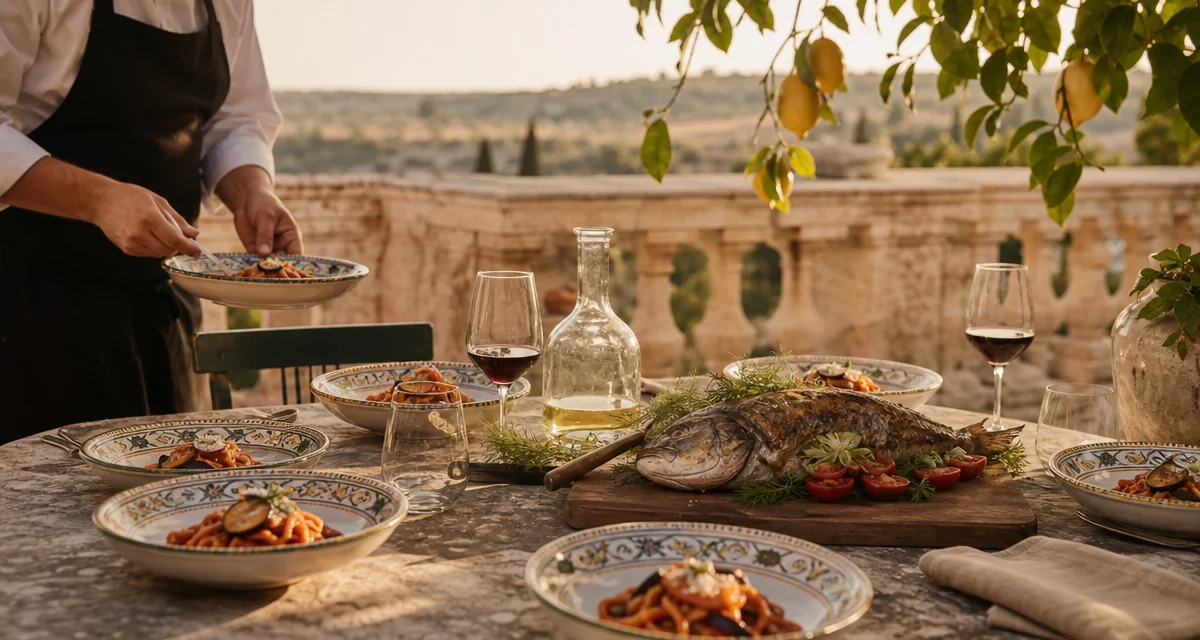
Sicily is most famous for arancini, pasta alla Norma, caponata, and cannoli, four dishes that together sum up an island of rice, eggplant, ricotta and sweet-and-sour flavour. Arancini are deep-fried rice balls, usually stuffed with meat ragù, mozzarella and peas or with ham and béchamel, and they date to the Arab period when rice and saffron first reached the island. In Catania they are cone-shaped and called arancino, in Palermo round and arancina. Pasta alla Norma is Catania's own dish: short pasta (traditionally maccheroni or rigatoni) with tomato sauce, fried eggplant and a snow of salted ricotta, named after Bellini's opera. Caponata is the quintessential Sicilian appetiser, a cooled eggplant stew balanced with celery, capers, olives, vinegar and sugar in the classic agrodolce (sweet-and-sour) style. And cannoli are crisp fried pastry tubes piped to order with sweetened sheep's-milk ricotta, the ends dipped in pistachio or candied fruit. A good rule: never buy a cannolo that was filled before you ordered it, because the shell turns soggy within 2 minutes.
Where are the best cities to eat in Sicily?
The best food cities in Sicily are Palermo and Catania, with Trapani, Noto and the hill towns close behind. For the best food in Palermo, head straight to the historic markets: Ballarò and Vucciria are open-air street-food arenas where vendors shout their abbanniata (a sing-song sales cry) over sizzling pans, and you can eat panelle, sfincione and grilled offal for a handful of euros. Palermo's Arab-Norman core joined the UNESCO World Heritage list in 2015. Catania, at the foot of Etna, is smaller, cheaper and less touristy, with the roaring Pescheria fish market and the best arancini and granita on the island. Trapani, on the far west coast, cooks with a North-African accent, and couscous alla trapanese with fish broth is the local signature. Inland, the Baroque towns of the Val di Noto (a UNESCO-listed cluster of golden-stone cities rebuilt after the 1693 earthquake, including Noto, Modica and Ragusa) pair grand architecture with Modica chocolate and almond sweets. And glamorous Taormina, perched above the Ionian Sea, is where you go for a sea-view table rather than a bargain. You can browse our verified private chefs across Sicily by the town you are staying in, whether that is Palermo, Catania or Taormina.
In Sicily we do not cook to impress you, we cook to remember. Every recipe carries an invader who once passed through: the Arabs left us rice and citrus, the Spanish left us chocolate. When I cook caponata at a villa, I am serving a thousand years on one plate. Chef Salvo, Catania-based ambassador of Chef On Demand Sicily
What is Sicilian street food and where do you find it?
Sicilian street food is some of the oldest and cheapest fast food in Europe, found in the open markets of Palermo, Catania and beyond and priced at €1 to €5 a portion. The essentials start with pane e panelle, thin chickpea-flour fritters stacked in a sesame roll, a legacy of Arab cooks who brought chickpea flour to the island. Next is sfincione, Palermo's thick, spongy street pizza topped with tomato, onion, anchovy, oregano and crumbs of caciocavallo cheese. The bravest order pani ca meusa, a soft roll filled with veal spleen and lung simmered in lard, dressed with lemon and caciocavallo. Lighter options include crocchè (fried potato croquettes) and stigghiola (skewers of grilled lamb intestine sold at street corners in the evening). Because street food is best eaten standing up and freshly fried, it is the one Sicilian experience you should chase in person rather than recreate at home. Wander Vucciria after dark and you will find the market has quietly turned from a fruit stall into an open-air kitchen. Save the sit-down feasting for later, and pace yourself: portions are small, so you can graze across five stalls in one evening.
Which Sicilian desserts should you not miss?
Sicily has arguably the finest pastry tradition in Italy, built on ricotta, almond and candied fruit. The famous Sicilian desserts begin with the cannoli already described, then move to cassata siciliana, a domed sponge cake soaked in liqueur, layered with sweet ricotta and wrapped in a bright green marzipan shell studded with candied fruit, a recipe perfected in Palermo's convent kitchens. Granita con brioche answers the common question of what Sicilians eat for breakfast: a semi-frozen dessert of water, sugar and fruit (lemon, almond, coffee or the prized black mulberry gelso), scooped into a bowl and eaten with a soft, tufted brioche col tuppo bun, especially in the summer heat of Catania and Messina. Frutta martorana is marzipan hand-sculpted and painted to look uncannily like real fruit, made for the November feast of the dead and named after a Palermo convent. And the chocolate of Modica is a grainy, cold-worked chocolate made with an Aztec technique the Spanish carried across from the New World, so the sugar never fully melts and the cocoa stays raw and intense. Between them, these four are your dessert itinerary.
- Order a cannolo only when the shop fills the shell in front of you, so the pastry stays crisp.
- Try granita in at least three flavours, and always pair it with a brioche col tuppo at breakfast.
- Buy a bar of Modica chocolate in the Val di Noto, ideally the cinnamon or chilli version, as an edible souvenir.
- Taste cassata in Palermo, where the convent recipe originated, rather than from a supermarket counter.
- Ask for frutta martorana if you visit in late October or November, when it is made fresh for the feast of the dead.
Which Sicilian wines pair best with the food?
Sicilian food and wine belong together, and the island now produces some of Italy's most exciting bottles. Etna Rosso is the star: a pale, high-altitude red from Nerello Mascalese grapes grown on the volcanic slopes of Mount Etna up to 1,000 metres, often compared to Burgundy for its finesse, and it earned DOC status back in 1968. Nero d'Avola is the island's flagship dark red, bold and velvety with black-cherry fruit, named after the town of Avola and a natural partner for caponata or grilled meat. Cerasuolo di Vittoria, Sicily's only DOCG wine, blends 50 to 70% Nero d'Avola with the light, floral Frappato grape and pairs beautifully with tomato-based pastas like alla Norma. For dessert, two fortified and sweet legends: Marsala, the amber fortified wine from the west coast that the English merchant John Woodhouse commercialised in 1773, and Passito di Pantelleria, a honeyed sweet wine pressed from sun-dried Zibibbo grapes on a windswept volcanic island, which matches cassata and Modica chocolate perfectly. A knowledgeable chef will build the pairings into the menu, but even at a market trattoria, asking for the local vino sfuso (house wine by the carafe) rarely disappoints.
| Tier | Courses and a sample Sicilian menu | Price per person (6 guests / 8 guests) |
|---|---|---|
| Essential | 4 courses: caponata, pasta alla Norma, swordfish involtini, cannoli | €95 / €85 |
| Taste of Italy | 5 courses: panelle, arancini, busiate al pesto trapanese, pesce spada, cassata | €120 / €110 |
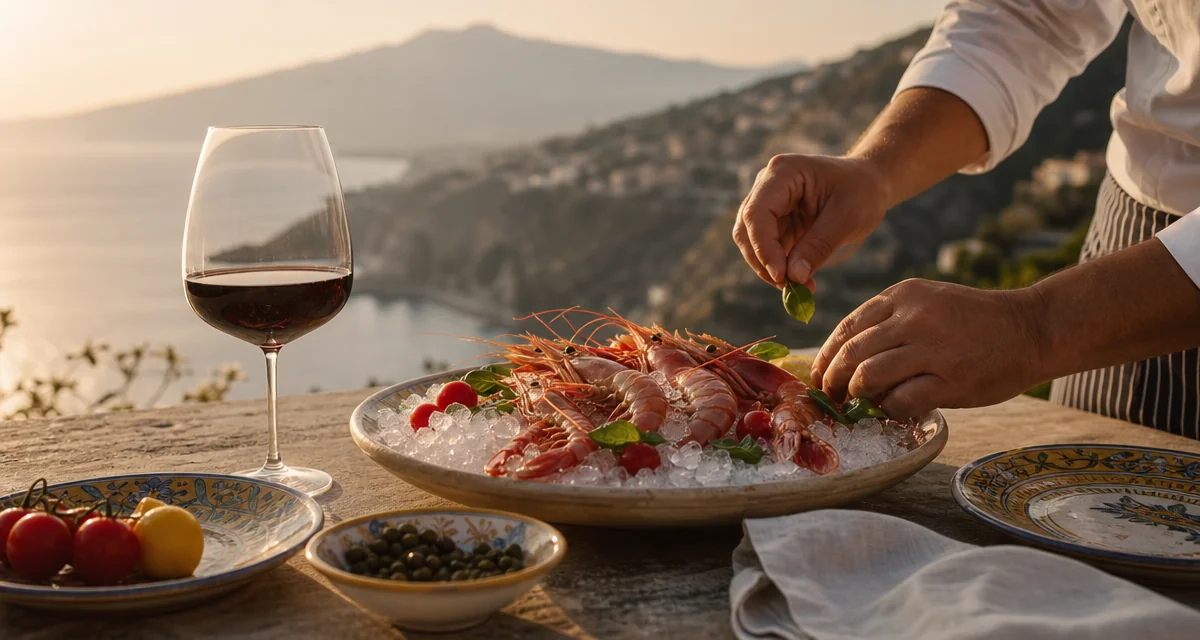
| Luxury | 6+ courses: Mazara red prawn crudo, tuna tartare, sea-urchin pasta, aged beef, cheese, dessert flight with wine pairings | €180 / €160 |
How much does a private chef cooking Sicilian dishes at your villa cost?
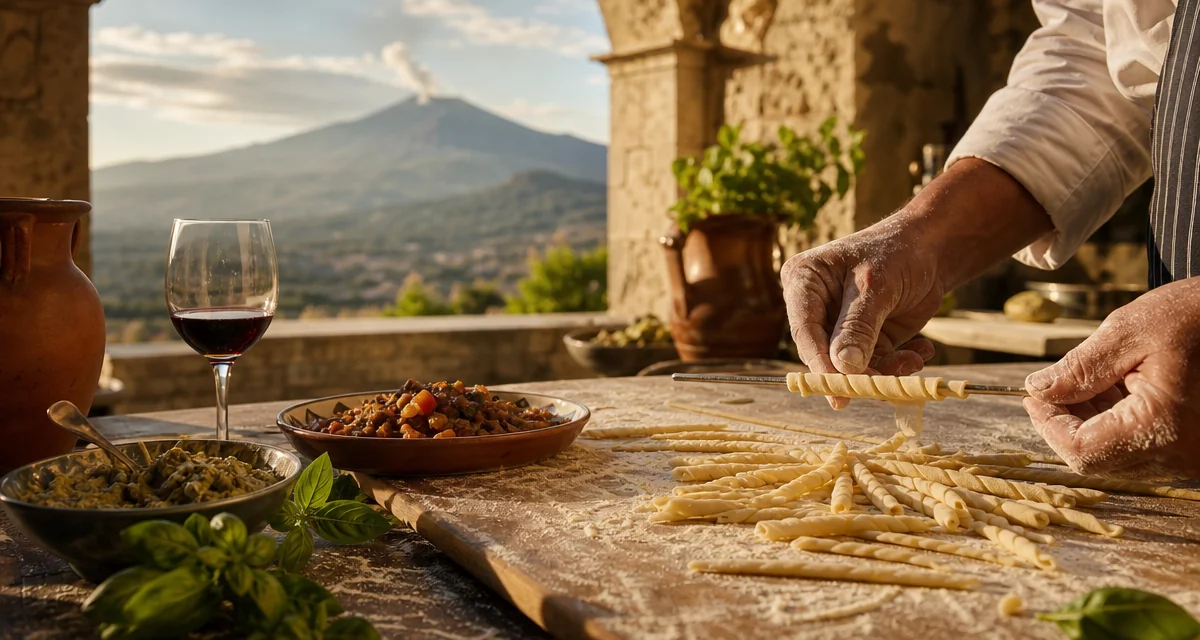
A private chef cooking Sicilian dishes at your villa costs from around €85 to €180 per person in 2026, depending on the menu tier and group size. Chef On Demand structures single dinners in three tiers. Essential is a classic four-course set menu at roughly €95 per person for 6 guests, falling to €85 at 8. Taste of Italy, the signature five-course showcase, runs about €120 per person for 6 guests and €110 at 8. Luxury, six or more courses with red prawns, tuna and wine flights, sits near €180 per head for 6 guests and €160 at 8. For every booking the chef arrives at your villa, shops the local market, cooks on-site, serves and cleans up, typically over 3 to 4 hours. Most villa dinners we cook are for 4 to 12 guests. If you want the island to last across a week, a multi-day chef is quoted custom, and the day rate depends on whether the chef stays at the property, commutes daily from a nearby town like Catania or Palermo, or books lodging close by. There is also the Pasta Class and Dinner experience, a booking of up to 5 hours held entirely at your villa where the chef teaches two fresh-pasta shapes then serves a full seated dinner of both pastas, antipasti and tiramisù, from about €150 per adult. For a full breakdown, see our Sicily private chef network and the dedicated Sicily cost guide.
When is the best time to visit Sicily for food?
The best time to visit Sicily for food is late spring and early autumn, when the weather is kind and the calendar is thick with harvests and sagre (village food festivals). May and June bring bluefin tuna from the Egadi Islands, the first swordfish, and the early stone fruit that flavours granita. July and August are peak granita and gelato season, though the heat pushes lunch late and dinner later. September and October are the connoisseur's months: the Etna vendemmia (grape harvest) fills the volcanic vineyards, mushrooms and chestnuts arrive from the highlands, and towns hold sagre for everything from the Bronte pistachio (a bright-green, protected pistachio grown in the black lava soil around Bronte) to the Avola almond. Even winter has its rewards, with citrus at its peak and the November marzipan of frutta martorana. Book chefs early for the June to September window: across our network the average lead time in peak season is 7 to 14 days, and the best Sicilian chefs fill fast around Ferragosto (the August 15 holiday). Whenever you come, eat with the season and you will eat well.
Why this matters for your Sicilian holiday
Sicily rewards travellers who eat with intention. The dishes are not interchangeable Italian classics; they are the edible memory of Greeks, Arabs, Normans and Spaniards, each tied to a town, a market or a saint's day. Chase the granita at breakfast, the arancini at a Catania kiosk, the pasta alla Norma under Etna, the cannoli filled to order, and the Etna Rosso poured by someone who farmed the vine, and you will understand the island in a way no restaurant checklist can teach. The one experience that ties it all together is a chef cooking these recipes in the kitchen of the villa you have already rented, with a menu matched to the province you are in and the season you arrive. That is the quiet luxury we built Chef On Demand around: a verified network of talented Sicilian chefs, a 4.7 out of 5 Trustpilot rating from more than 800 guests served since 2025, and menus that taste of the exact place you are standing. Start with our private chef hub, then explore what our chefs cook across Sicily, and let the island come to your table. The sea will still be silver at breakfast, and the granita will still be waiting.