How does a private chef for a week in Tuscany actually work?
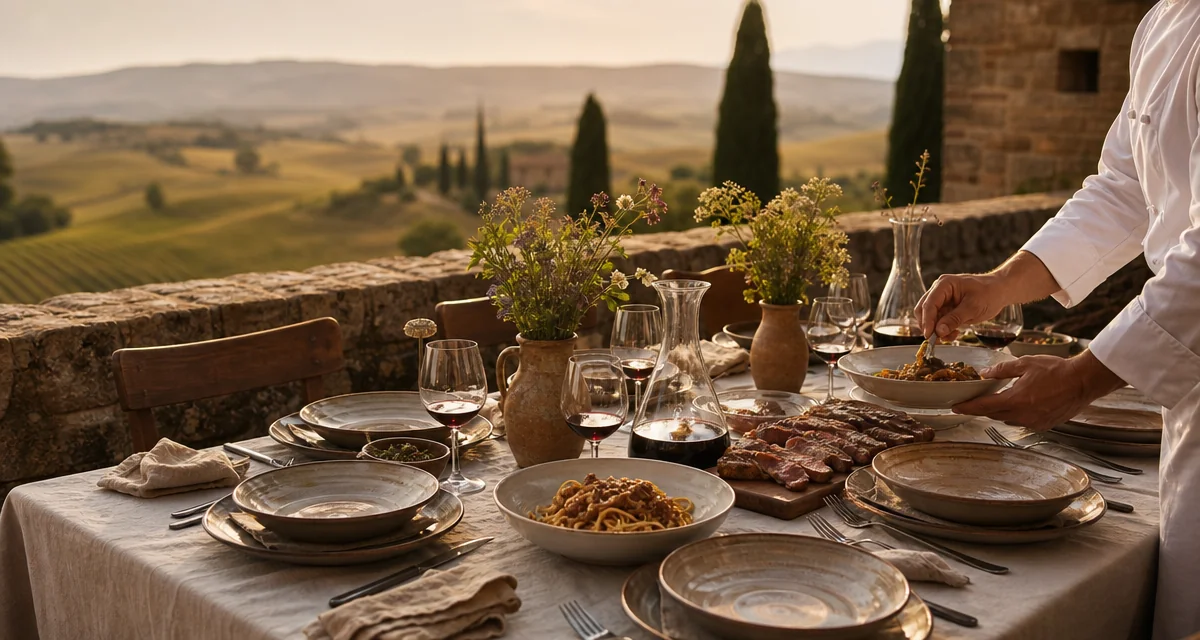
A weekly booking is the multi_days service: one chef accompanies your group for the whole stay, shops fresh each morning, cooks on-site in the villa kitchen, serves and clears up. You pick, day by day, whether that means breakfast, lunch, dinner or nothing at all, and the chef only charges for the meals actually cooked. Three lodging set-ups decide the daily chef rate, and they are worth stating plainly before anything else: the chef can stay at the property (cheapest, if your villa has a spare room or chef quarters, because you absorb the lodging), a local chef can commute daily from home (no accommodation cost at all, and very common in Chianti where our resident chefs live within 30 to 45 minutes of most properties), or the chef books a room nearby and the surcharge is line-itemed transparently in the quote. Those three configurations are the whole mechanics of multi-day pricing anywhere in Italy, and we have taken them apart at length in our guide to how a multi-day villa week works. What follows is the part no generic Italy article can give you: how a Tuscan week is actually sequenced, market by market, season by season. For the regional overview, start with our private chefs across Tuscany.
How much does a private chef for a week in Tuscany cost?
Price the meals you actually want, then add the daily chef rate for your lodging configuration. That is the only method that survives contact with a real quote. Per-meal pricing across our Tuscan network in 2026 follows three tiers. Essential is a 4-course set menu of classic regional dishes, and for 6 guests it sits around €95 per head, dropping to roughly €85 at 10 guests. Taste of Italy, the signature 5-course regional showcase, runs about €120 per guest at 6 guests and near €100 per head at 10 guests. Luxury, 6 or more courses with truffle, Chianina beef or a multi-pairing wine flight, is around €180 per guest at 6 guests and €150 at 10 guests. So a multi-generational party of ten booking three Taste of Italy dinners and one long Essential lunch is pricing 4 meals per head, not 7 meals, plus the chef's day rate for the days worked. Children are counted at half in the chef fee and never in your per-head menu price, which matters when four of your ten guests are eight years old. Every figure here comes from live network pricing rather than a rounded guess, and the weekly total still lands as a custom quote because the lodging line moves it. For the single-night comparison, our breakdown of what it costs to hire a private chef in Tuscany sits alongside this one.
Villa with a private chef in Tuscany: what a rental with staff changes
Some Tuscan estates advertise themselves as fully staffed, with the cook already written into the rental contract. That is a different product from booking your own chef, and the trade is usually flexibility for convenience: an in-house cook typically works a fixed house menu and fixed hours, while an independent chef builds around your group's allergies, your children's earlier dinner, and the fact that on Thursday you would rather eat at nine because everyone is coming back from Florence. If you are still choosing the property, our piece on Tuscan villa rentals with a chef covers how to read those listings. One practical filter: ask whether the villa kitchen is a working kitchen or a display one. Restored farmhouses photograph beautifully and sometimes hide a 2-burner hob behind the marble.
How does a chef plan seven days of Tuscan menus without repeating?
The trick is not variety of ingredients, it is variety of register. Tuscan cooking is a narrow, deep repertoire, so a chef who simply cooks 'Tuscan food' 4 nights running will serve 4 plates of pork, bread and beans, and you will notice by night three. A well-sequenced week moves deliberately between four registers. There is the bread and vegetable register, the poor-kitchen dishes that made the region famous: panzanella (a cold summer salad of stale bread soaked and squeezed, then tossed with tomato, cucumber, red onion and basil) and ribollita (a thick winter soup of black kale, cannellini beans and bread, boiled twice, which is what the name means). There is the fresh pasta register: pici, a fat hand-rolled spaghetti from the Siena hills made with nothing but flour and water, or pappardelle, wide ribbons cut for wild boar ragù. There is the grill and roast register, which is where Chianina and Cinta Senese live. And there is the sea register, which most visitors forget Tuscany has at all, though the coast at Livorno gives you cacciucco, a red stew of at least 5 kinds of fish. Rotate those four and a seven-day week never doubles back, even before the market forces its own hand.
People ask me for the week's menu on the Monday and I never give it. I give them Monday. What Siena has on Wednesday morning decides Wednesday night, and if the artichokes are finished I am not going to serve you sad ones because a printed menu said so. Chef Elisa, Siena-based ambassador of Chef On Demand Tuscany
Which market day shapes which dinner?
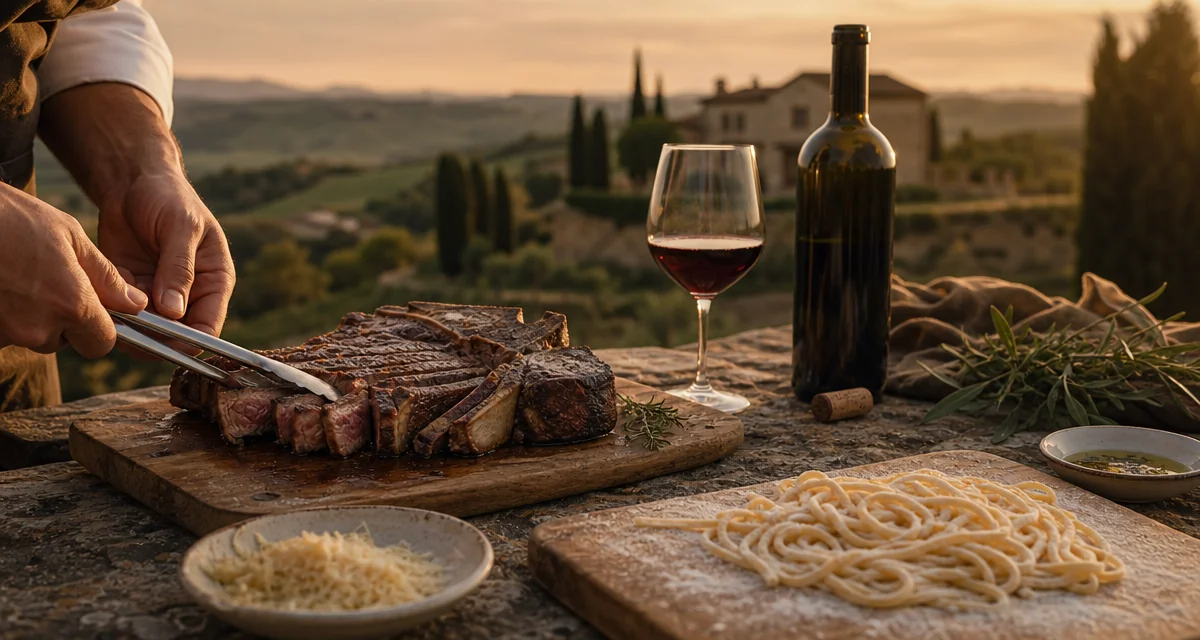
Every Tuscan town holds its weekly open-air market on a fixed day, and those days do not overlap by accident: neighbouring comuni space themselves out so the same producers can work a circuit. For a chef staying a week, that calendar is a gift, because it means seven days of genuinely different sourcing within a 40 km radius, most of it drivable in under 45 minutes. Siena runs on Wednesday, wrapping the walls of the Fortezza Medicea from 8am to about 1.30pm and counting as one of the largest markets in the region. Thursday belongs to Montepulciano (8am to 1pm) and to San Gimignano, which also runs a produce market on Saturday. Friday is Montalcino and Pienza, which is the pecorino run. Saturday morning is Greve in Chianti, 8am to 1pm in the piazza, plus Cortona. Lucca holds market twice, Wednesday and Saturday. A chef who knows the villa's position reads that grid backwards: if you are ten minutes from Greve, Saturday is the day for the big Chianina and Cinta Senese buy, so Saturday night is the bistecca night and Friday stays light. Get the villa two valleys away and the whole sequence shifts.
| Market day | Town | What the chef comes back with | The dinner it sets up |
|---|---|---|---|
| Wednesday | Siena (Fortezza Medicea, 8am to 1.30pm), Lucca | Young pecorino, cured meats, seasonal greens, fresh eggs | Pici with a simple sauce, then a vegetable-led secondo |
| Thursday | Montepulciano (8am to 1pm), San Gimignano | Vernaccia, farro, saffron, early or late-season vegetables | A lighter, white-wine evening after a day out |
| Friday | Montalcino, Pienza | Pecorino di Pienza DOP at three ages, honey, cured pork | A long antipasto board and a slow-cooked secondo |
| Saturday | Greve in Chianti (8am to 1pm), Cortona, San Gimignano produce | Chianina beef, Cinta Senese pork, wild herbs, seasonal fruit | The grill night: bistecca alla fiorentina or roast pork |
| Any day | Roadside farm shops and the villa's own estate | Olive oil, wine, eggs, vegetables, sometimes cheese | The improvised long lunch nobody planned and everybody remembers |
What does a week taste like in April, July and October?
The same villa, the same chef and the same budget produce three genuinely different weeks depending on when you come. April is the green week: wild asparagus from the hedgerows, artichokes, baccelli (young broad beans eaten raw with shavings of fresh pecorino, which is the most Tuscan snack there is) and the first fresh sheep's cheese of the year, made after lambing. Portions feel lighter and dinners start later as the evenings stretch. July is the tomato and stone-fruit week: panzanella, zucchini flowers fried in a thin batter, melon with prosciutto, figs, and a great deal of grilling because nobody wants an oven on for 3 hours at 34 degrees. This is also when the children eat best, because July food in Tuscany is basically pasta, tomato, cheese and fruit. October is the richest week of the three: porcini from the chestnut woods, the vendemmia (grape harvest) still finishing in the vineyards, cavolo nero coming into its own, game appearing on menus, and if you are late enough in the month, the first pressing of olio nuovo, unfiltered new olive oil, cloudy and peppery enough to make you cough. Ask for it on grilled bread. A week timed to any of those three is a different holiday, and telling your chef which one you have booked is more useful than telling them your favourite dish.
A private chef cooking class in Tuscany as the mid-week afternoon
For a family group, the strongest mid-week variation is the Pasta Class plus Dinner experience, and it happens entirely at the villa you have rented, never at a cooking school. The chef arrives with every ingredient, board, rolling pin and cutter, and teaches two fresh-pasta shapes over roughly 2 hours, inside a total experience of 4 to 5 hours, one long (pappardelle or pici) and one short (maltagliati or orecchiette). While the dough rests on your own worktop, the chef builds two sauces, one for each shape, plus a few regional antipasti and a homemade tiramisù. Then everybody sits down at your table, on your terrace, and eats what they made. It works for a multi-generational party precisely because it is at home: only your group, no cohort of 12 strangers, no drive of 40 minutes each way from a rural Chianti villa, no parking for 9 people. Children can knead for 20 minutes and then go and swim. Grandparents who do not want to cook still sit down to the same dinner. You start when your group is ready and linger as long as you like, with wine you bought at the local enoteca. What you take home is technique: the feel of correctly hydrated dough, and the way the sauce is finished in the pan with the pasta rather than poured over it.
How do farmhouse and agriturismo kitchens shape the week?
This is the constraint nobody warns you about, and it shapes a week more than any preference sheet. Restored Tuscan farmhouses and agriturismi (working farms that also rent rooms and serve meals from their own produce, which Italian law requires to remain genuinely agricultural) tend to have beautiful, under-powered kitchens: one oven, four burners, a wood-fired grill outside, a single sink and, very often, no dishwasher. A chef cooking for 10 guests in that room cannot run three oven dishes at once, so the week gets built around it. Oven-heavy nights (roast pork, baked pasta, a slow shoulder) alternate with burner nights (risotto, fresh pasta, seafood) and grill nights outdoors, and the long lunch usually lands the day after a big dinner because the kitchen needs the reset. It is also why an honest chef asks for photographs of your kitchen before quoting a week, not to judge your rental but to sequence it. Groups deep in the Val d'Orcia or the Maremma should expect one big shopping run rather than daily ones, simply because a drive of 50 minutes each way twice a day eats the afternoon.
A Tuscan villa with a chef and a pool: how the setting changes service
A pool changes the shape of the day. With children in the water from 11am to 7pm, the useful pattern is an early kids' dinner at around 6.30pm, simple and fast (pasta, a plate of prosciutto, fruit), then the adults' table at 8.30 or 9pm once everyone is dry and the light has gone gold over the vines. It saves the evening. The other request worth making is one long, slow lunch laid outside, which is the best meal of a Tuscan week and the one most groups forget to book.
- Send the villa's exact comune and a photo of the kitchen, so the chef can sequence oven, hob and grill nights across the week.
- Choose the shape of the week, not the dishes: pick which nights you want cooked and leave the market to decide the rest.
- Name your arrival month, because an April week and an October week are different holidays on the plate.
- List every allergy and dietary preference as bullet points, along with the children's ages, rather than in prose.
- Ask which lodging configuration your quote assumes and whether a nearby-lodging surcharge is line-itemed.
- Book 7 to 14 days ahead for peak season (June to September), and 3 to 4 weeks around Easter, Ferragosto and Christmas.
- Reserve one long lunch, ideally the day after your biggest dinner, and one earlier kids' service if you are travelling with young children.
How does the wine rotate across a Tuscan week?
Rotating the wine by denomination is the simplest way to make seven days feel like seven places, and Tuscany makes it easy because four benchmark appellations sit within an hour or two of each other. Chianti Classico DOCG is the Sangiovese-based red from the hills between Florence and Siena, marked by the black rooster on the neck of the bottle, bright with sour cherry and made for tomato, pasta and grilled meat. Brunello di Montalcino DOCG is 100% Sangiovese from a single hilltop town, aged at least 5 years before release, darker and more structured, with black cherry, leather and tobacco, and it belongs on the bistecca night rather than the Tuesday pasta. Vernaccia di San Gimignano DOCG is the region's serious white, crisp and faintly almond-bitter on the finish, which is what you want with the sea register or a warm July lunch. Morellino di Scansano DOCG comes from the Maremma on the southern coast, softer and rounder than its inland cousins, an easy weekday red that nobody has to think about. Spread those four across the week, add a Vin Santo (the sweet dried-grape wine Tuscans dip cantucci biscuits into) for one dessert, and the wine tells the same story as the food. A chef will buy to a per-bottle brief, or pour what you brought back from the Florence enoteca. Most of the chefs in our Tuscan chef network will walk you through the four denominations in about 10 minutes on the first evening.
Why this matters for your Tuscan week
A week is worth more than a single dinner for a reason that has little to do with the food being better on night five. By Wednesday nobody in your party is thinking about lunch. The teenagers have stopped asking where you are eating, your mother has stopped worrying about whether the restaurant will do something plain for the youngest, and the low-grade administrative hum of feeding 9 people in a foreign country has gone. What fills the space is the thing you actually came for: an afternoon that goes nowhere, a table under a pergola, a chef back from Greve at half past ten with a box of peaches and a story about the man who sells them. Chef On Demand runs a verified network of 12+ private chefs across Tuscany, rated 4.7/5 on Trustpilot across 800+ guests served since 2025, and many of them have come out of Michelin-starred and Gambero Rosso-rated kitchens before choosing villa work. If you are still deciding between regions, or between a week and a single evening, browse the wider private chef network across Italy and then come back to book a Tuscany private chef experience when your villa is confirmed. The best moment to send the address is the day you sign the rental, not the week before you fly. By then the good weeks in Chianti are gone, and the market will still be there on Saturday, but somebody else's chef will be walking it.