Is a private chef in Italy worth it for your group?
A private chef in Italy becomes financially worth it at around six guests and clearly worth it at eight or more, because chef pricing is per person and falls as the group grows, while restaurant pricing per head stays flat or rises. The value case at two or three guests is emotional, not economic, and we would rather you knew that now. Here is the mechanism, because it is not obvious. A chef's cost is mostly fixed: the shopping trip, the drive, the four or five hours of work, the equipment in the boot of the car. Spread that across 10 people and each person absorbs a small slice of it. Spread it across 2 and they absorb half each. That is why a Taste of Italy menu, which is our 5-course regional showcase, is €120 per person for 6 guests, €110 for 8, and €100 for 10 or more, while the identical menu is €200 per person for a couple. A restaurant works the other way round. Your bill per head is roughly the same whether you are 2 or 12, and above about six people the restaurant starts charging you in ways that do not appear on the bill at all: the 7pm slot instead of the 8.30 one, the fixed group menu, the table by the service door, the deposit.
Private chef vs restaurant: where the break-even actually sits
Run your own arithmetic rather than trusting ours, because your restaurant baseline is personal. Take a group of eight in a Chianti villa. A private chef dinner at the Taste of Italy tier is €110 per person, so €880, and that figure already contains the shopping, the cooking, the serving and the clean-up. Now build the restaurant side honestly. Say your group eats at a proper Tuscan restaurant rather than a tourist trap, so a starter, a pasta, a main and a dessert lands somewhere around €55–€75 a head. Add wine: two or three bottles for eight people at restaurant markup, which is conventionally 2.5–3x what the same bottle costs in the enoteca down the road, and you have added roughly €25–€40 per person. Then add the part nobody budgets for, which is getting eight people from a farmhouse down a white gravel road into town and back at midnight. Two taxis, each way, in rural Tuscany, is not a rounding error. The chef number holds steady while the restaurant number keeps accumulating, and somewhere around six guests the two lines cross. Below that crossing point, book the restaurant with our blessing.
| What you are paying for | Private chef at your villa | Restaurant in town |
|---|---|---|
| Food and cooking | €110 per person (Taste of Italy, 5 courses, 8 guests) | Roughly €55–€75 per person for a comparable 4-course meal |
| Wine | Bring your own from the enoteca, so a €25 bottle costs €25 | Typically 2.5–3x retail markup, adding roughly €25–€40 per person |
| Getting there and back | Nothing, you are already home | Two taxis each way from a rural villa, plus a designated driver or nobody drinks |
| Shopping, service, clean-up | Included in the per-person price | Included, but so is the 22:30 last order |
| Table for 8 in August | Whenever your group decides to sit down | Often a fixed group menu, a deposit, and the early sitting |
| Where it wins | Groups of 6+, villa stays, mixed ages, long evenings | Couples, groups of 2–3, travellers who want a different town nightly |
What do you actually get that a restaurant cannot give you?
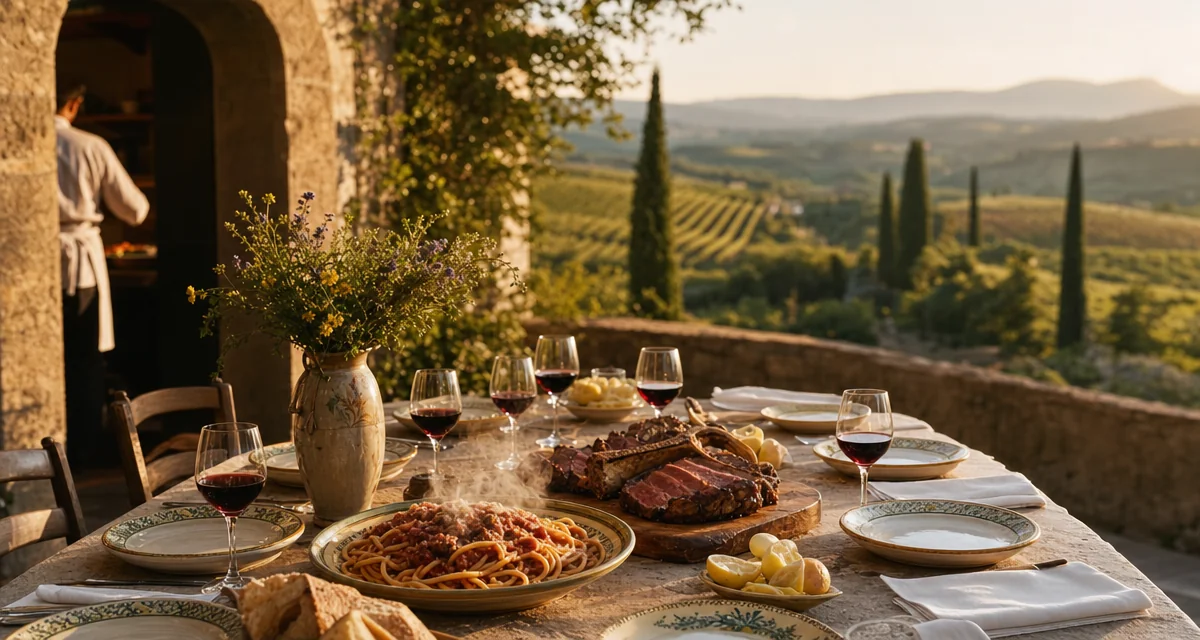
You get three things a restaurant structurally cannot sell you: your own setting, your own clock, and a menu built for the exact people at your table. The setting is the one travellers underrate and then talk about for years. You have already paid for the terrace, the view over the vineyard, the long table under the pergola, and on a restaurant night you abandon all of it to sit in a room with strangers. The clock matters more than people expect too, because Italian kitchens close, and a group of ten that wants to sit down at 21:00 and still be talking at 00:30 is a group that will be politely swept out at 22:45. The menu is the third piece. Our chefs shop that morning, which in practice means the dinner is decided by what the market had rather than by what was printed in spring. That is how you end up eating pici, the thick hand-rolled Sienese pasta that looks like fat, uneven spaghetti and is traditionally dressed with garlic and breadcrumbs, made on your kitchen table two hours before you eat it. It is also how a group with one vegetarian, one coeliac and a four-year-old who only eats plain pasta all sit down to the same dinner without anybody being handled as a problem.
People book me thinking they are buying a dinner. What they remember a year later is that nobody had to drive, and that the grandmother stayed at the table until midnight because the table was thirty steps from her bed. Chef Lorenzo, Florence-based ambassador of Chef On Demand Tuscany
When is a private chef in Italy not worth it?
A private chef in Italy is not worth it in four specific situations, and this is the section our competitors leave out. If you are two or three people, if your stay is under two nights, if the whole point of your trip is eating your way through a different town every evening, or if you have rented a city-centre apartment with a two-ring hob, the honest recommendation is to spend the money elsewhere. Take them in order. At 2 guests our 5-course Taste of Italy menu is €200 per person and the Luxury tier is €250, which buys a genuinely excellent restaurant dinner in Florence with change left over. At 2 nights, the chef arrives roughly when you have finally worked out where the light switches are, and the experience needs a little more slack than that to land. If you are the sort of traveller who researches trattorie for months, a chef is actively taking something away from you, and we would rather not sell it to you. And the kitchen point is not snobbery: a chef cooking five courses for ten people needs worktop, hobs and an oven that works, and a beautiful Trastevere apartment with a galley kitchen is a hard place to do that well. Ask us and we will say so before you book.
- Count your adults first. Under four, compare against a restaurant before you go further, because the per-person figure will be roughly double what an eight-person group pays.
- Check your villa's contract for a chef exclusivity clause or a pre-approved list, ideally before you fall in love with the idea.
- Photograph your kitchen and send it with your enquiry. Worktop, hob rings and oven decide what is realistic more than your budget does.
- Decide which nights you actually want to stay in. Most groups of eight want two or three chef dinners across a week, not seven, and that mix is usually the right one.
- Ask whether your dates fall on a Christian holiday. Easter, Christmas and Pentecost carry a 35 percent uplift on the client price in Italy, so a €110 per-person dinner becomes roughly €149.
- Buy your wine yourself. Walk into an enoteca in Greve or Montalcino, tell them the menu, and let them sell you the bottle a restaurant would charge you triple for.
How much does a private chef in Tuscany cost, and what moves the number?
Four variables move a Tuscan quote: group size, tier, location and date. Tiers are the easy part. Essential is 4 courses and runs €95 per person at 6 guests, falling to €85 at 8 or more. Taste of Italy is 5 courses at €120 for 6 and €110 for 8. Luxury is 6 or more courses with truffle, seafood or aged cuts, at €180 for 6 and €160 for 8. Those are per-person client prices, all inclusive of shopping, cooking, service and clean-up, and they are quotes rather than a menu board: every booking is priced for your group. We are not going to re-derive the full tables here because we have already done it properly in our 2026 guide to private chef costs in Italy and, closer to this pillar, in our breakdown of what a personal chef costs in Tuscany. What matters for the worth-it question is the direction of travel: every extra guest lowers the per-head number, and every step up the tier raises it. If you want to see who would actually cook for you, browse our Tuscan chef network before you compare anything.
Villa with a private chef in Tuscany: why the countryside costs less than Florence
A villa with a private chef in Tuscany is cheaper per person than the same dinner inside Florence, by exactly €15 a head, because Florence carries a premium-zone surcharge that Greve in Chianti and the Val d'Orcia do not. Rome, Venice, Capri and the Amalfi Coast towns sit in the same premium band. So a Taste of Italy dinner for 8 is €110 per person in a Chianti farmhouse and €125 per person in a Florence apartment. This inverts the usual holiday logic, and it is worth sitting with for a second. The countryside is where the chef format is cheapest and also where it is most useful, because a farmhouse 20 minutes down a gravel track from Siena is precisely the place where a restaurant night costs you two taxis and a designated driver. The Val d'Orcia, the UNESCO-listed valley of cypress-lined ridges south of Siena that appears on every Tuscan postcard, produces pecorino di Pienza DOP, Brunello di Montalcino DOCG (a 100 percent Sangiovese red aged at least five years before release, all black cherry, leather and tobacco) and Vino Nobile di Montepulciano DOCG within a 30 km radius, which means a chef shopping there in the morning has an unfair advantage over almost any restaurant kitchen in the world.
The private chef cooking class in Tuscany that changes the maths
If you are weighing a chef dinner against a cooking class, our Pasta Class + Dinner format collapses the choice into one booking at €150 per adult and €60 per child, and it happens entirely at the villa or apartment you have rented. The chef arrives with every ingredient and every tool, from dough boards to pasta cutters, and works in your kitchen. The class runs about two hours and teaches two fresh shapes, one long such as pappardelle or pici and one short such as maltagliati. While the dough rests on your worktop the chef builds two sauces, one for each shape, plus a few regional antipasti and a homemade tiramisù. Then you sit down at your own table and eat what you made, plated and served, with the clean-up included. The reason this matters to the worth-it question is that a cooking school sells you a fixed menu in a room with eleven strangers, on their clock, and then you leave. Here there is no transfer, no cohort, no rigid shift. Children can drift in and out, a grandparent who has no interest in kneading dough still sits down to the same dinner, and you drink whatever you bought at the enoteca. You take away technique and muscle memory rather than paperwork: the feel of correctly rolled pici under your palms is the souvenir.
What do travellers actually say after the dinner?
The pattern in traveller reviews is consistent and slightly unexpected: people rarely rate the food as the best part. Search the Rick Steves forum, the Tuscany boards on TripAdvisor, or the private chef Tuscany threads on Reddit that so many travellers read before booking, and the same three notes recur. First, the re-booking tell: groups who hire a chef once on a week-long villa stay very often hire the same chef again later in the same week, which is the most honest review a service can get. Second, the clean-up, mentioned with a kind of disbelief, because guests expect to find a wrecked kitchen and instead find it better than they left it. Third, and this is the one that matters for the worth-it question, the comparison people volunteer unprompted is not against another chef but against the restaurants they went to on the other nights. Chef On Demand holds a 4.7/5 Trustpilot rating across 800+ guests served since 2025, and the chefs we work with across the region come from Michelin-starred kitchens, Gambero Rosso-rated restaurants, MasterChef and Top Chef Italia. One footnote on vocabulary, since it confuses people comparing quotes: personal chef and private chef mean the same thing in Italy for this format. What matters is not the job title but whether the quote includes the shopping, the service and the clean-up. Ours does.
Is it worth booking a chef for several nights of a villa stay?
For stays of three nights or more, the multi-day format is usually where the value peaks, mostly because the chef stops being an event and becomes part of the week. The chef accompanies your group across the stay, and for each day you choose which meals they cook: breakfast, lunch, dinner, or any combination. In practice most groups of eight land on two or three dinners plus one long lunch across a week rather than three meals a day, because everyone still wants a few independent nights out, and that mix is the right instinct. If one of those nights is a milestone, we have set out separately how a villa birthday dinner in Italy is put together. Daily market shopping is part of it, so the menus follow what Montalcino or Greve actually had that morning, and no menu repeats unless you ask. Cost depends heavily on one variable people never think to ask about: where the chef sleeps. There are three configurations. The chef may stay at the property if there is a spare room, which carries the lowest day rate because you are absorbing the lodging. A local chef may commute daily from home, which works beautifully in dense areas like Chianti or the Amalfi Coast and adds no accommodation cost at all. Or the chef books a room nearby, and that surcharge is line-itemed openly in the quote. Multi-day quotes are built bottom-up from the per-meal cost plus a daily retainer, so there is no single per-person rate to quote you, and anyone who gives you one is guessing.
Why this matters for your Italian holiday
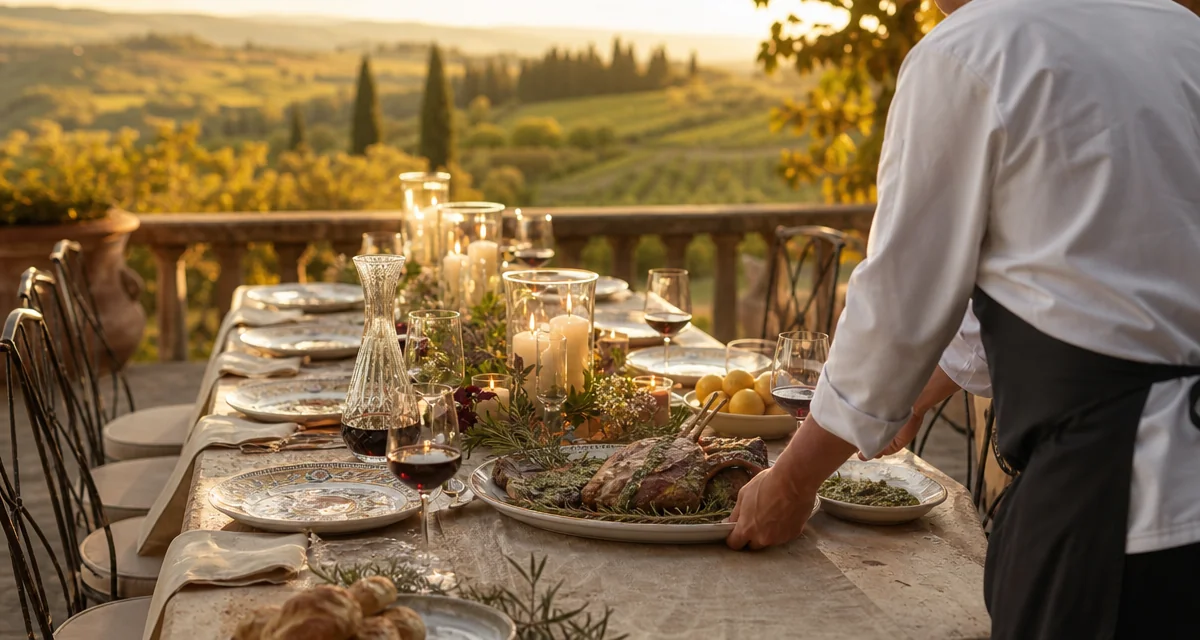
The reason this question comes up at all is that hiring a private chef feels like a luxury purchase, and luxury purchases make sensible people nervous. What the numbers show is something duller and more useful: for a group of six or more in a villa, it is mostly a logistics decision that happens to taste extraordinary. You are not buying opulence. You are buying the removal of the two taxis, the 22:30 last order, the group menu, the wine markup, and the small ongoing negotiation about who is driving. What you are left with is the thing you flew here for. A long table, a bistecca alla fiorentina (the thick T-bone from Chianina cattle, grilled rare over hardwood embers and finished with nothing but salt and Tuscan olive oil) coming out on a board, a bottle of Chianti Classico DOCG that cost you what it costs a local, and nobody looking at a watch. That is a version of Italy that restaurants, through no fault of their own, cannot sell you. If your group is smaller than four, take our advice, walk into town and eat somewhere with a handwritten menu, and come back to us when the cousins join. If it is bigger, start with our private chef network across Italy or go straight to the chefs who cook across Tuscany, tell them how many are sitting down, and see the real number before you decide anything.