How long do cooking classes in Rome last?
Cooking classes in Rome last between 1.5 and 5 hours, with the typical class running 3 hours. The length depends on three things: how many dishes you make, whether a market visit is bundled in, and whether you sit down to eat what you cooked. A 90-minute express class teaches a single dish; a 5-hour half-day starts at a market and ends over a long, wine-paired lunch. Most travellers do not realise that roughly an hour of any group class goes to introductions, washing up, and waiting for water to boil for twelve people, so the headline number overstates the hands-on time. A 3-hour class gives you about 2 hours of real cooking, while a 5-hour market tour might give you the same 2 hours of cooking wrapped in shopping and eating. Roman cuisine is built on a handful of deceptively simple plates, the four pasta classics being cacio e pepe (tonnarelli tossed with Pecorino Romano and cracked black pepper, emulsified with starchy pasta water), carbonara, gricia and amatriciana, so even a short class can leave you genuinely able to reproduce something at home. The table below maps each duration to what it realistically includes.
| Duration | Format | What you make | Best for |
|---|---|---|---|
| 1.5 hours | Express class | One pasta shape or one dessert (tiramisu, gelato) | Jet-lagged arrival day, tight schedules |
| 2.5–3 hours | Standard pasta class | Two fresh pasta shapes plus sauce, often a starter | First-time visitors, the most popular choice |
| 3.5–4 hours | Pasta class with market visit | Two to three dishes after a short market walk | Food-curious travellers with an open morning |
| 4–5 hours | Half-day market and cook | Multi-course meal, market tour, sit-down lunch | A dedicated open day, deeper immersion |
| 4–5 hours | Private Pasta Class + Dinner (at your accommodation) | Two shapes, two sauces, antipasti, tiramisù | Groups and families wanting privacy and a seated dinner |
What does the 3-hour standard pasta class include?
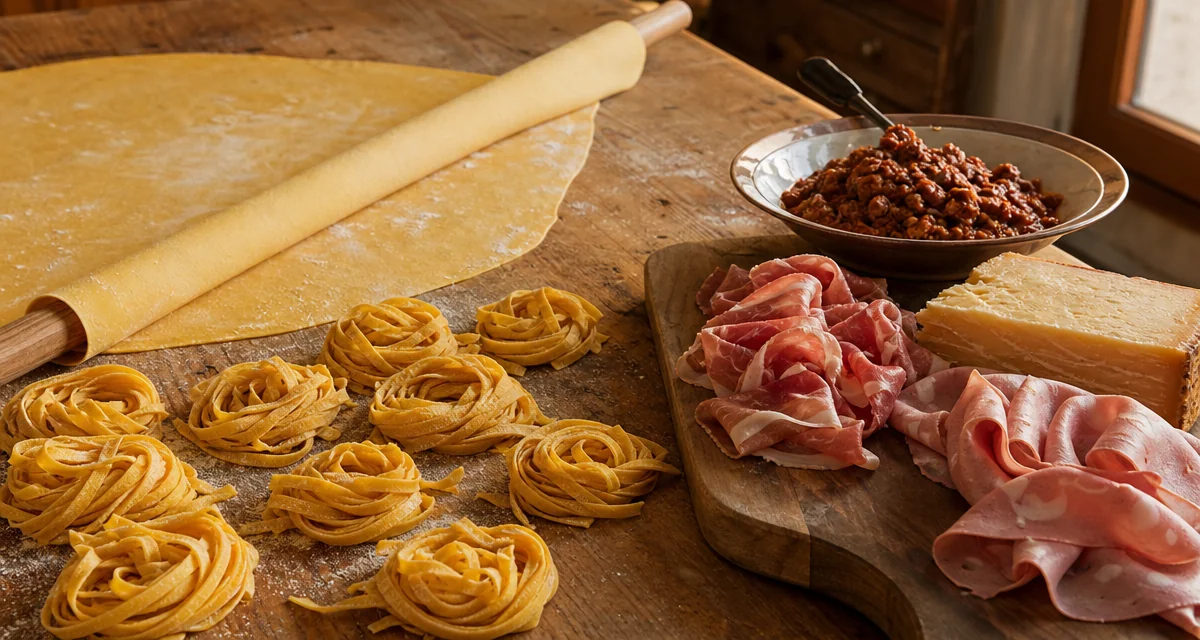
The 3-hour pasta class is Rome's default format, and it includes hands-on dough making, two pasta shapes, a sauce or two, and a sit-down meal of what you cooked, usually with wine. Expect roughly 2 hours at the work surface and 45 to 60 minutes eating. You will typically learn one long shape (such as fettuccine or tonnarelli, the square-cut spaghetti that carries cacio e pepe) and one short or filled shape (ravioli or maltagliati), then toss them in a Roman classic. Many classes near the centre cap groups at 8 to 12 people and run in a restaurant kitchen off-hours or in a converted studio in a neighbourhood like Monti, the village-feeling quarter behind the Colosseum, or Trastevere, the ivy-draped medieval district across the Tiber that draws the city's biggest concentration of trattorias. The phrase travellers search most, cooking class rome how long, almost always lands them on this format, because it is the sweet spot between learning something real and not surrendering an entire holiday day. If you only do one class in Rome, this is the one to default to. The skill ceiling is high enough that you leave able to make fresh pasta unsupervised, and the time cost is low enough that you keep your evening open for an aperitivo and dinner out.
People obsess over which dishes they will cook. I tell them to think about the clock instead. Three honest hours with your hands in the dough beats five hours where half the time is spent on a bus to a vineyard. Chef Lorenzo, Rome-based ambassador of Chef On Demand
How long is a Rome cooking class with a market tour?
A Rome cooking class with a market tour runs 3.5 to 5 hours, because the morning shop adds 45 to 90 minutes before any cooking begins. These are the half-day experiences, and they usually start at a working market: Campo de' Fiori, the historic central square that has held a daily produce and flower market since 1869, or Testaccio, the old slaughterhouse district whose covered Mercato Testaccio is where many Roman chefs actually buy their ingredients. The chef walks you past the stalls, explains what is in season, and helps you choose produce before you head to the kitchen to cook it. The rome market tour cooking class format is the most immersive option Rome offers, but be honest about your appetite for a long block: a 5-hour experience that begins at 9am will eat most of your morning and stretch into a leisurely lunch. The trade-off is context. You understand why guanciale, not bacon, goes into amatriciana, and why a true carbonara never sees cream. If you have one fully open day and you genuinely love food, the half-day is worth the time. If you are squeezing the class between the Vatican and a 6pm dinner reservation, it is too much, and the standard 3-hour class will serve you better. If you would rather have a chef bring the market produce and the lesson to you, our network of private chefs in Rome handles the shopping so your only job is to cook. To go deeper on choosing between the dozens of options, see our guide to how to choose the right cooking class in Rome.
- Match the duration to your day, not your ambition: an express 1.5-hour class for arrival day, a 3-hour class for a busy day, a 4–5 hour half-day only when the day is otherwise empty.
- Confirm the maximum group size before booking, because two classes of identical length deliver very different hands-on time at 6 guests versus 16.
- Check whether the meal at the end is included in the stated duration or tacked on, so a 3-hour class is not secretly a 2-hour class plus eating.
- Ask whether transfers (to a vineyard or countryside kitchen) are counted in the total, since 90 minutes of round-trip travel can hide inside a 6-hour listing.
- If you are a group of 4 or more, compare a public class against a private Pasta Class + Dinner at your own accommodation, where the 4–5 hours are entirely yours.
How long is the private Pasta Class + Dinner at your accommodation?
The private Pasta Class + Dinner is a bundled 4 to 5 hour experience that takes place entirely at the villa, apartment or holiday rental you are staying in, with no transfer and no shared cohort. The chef arrives at your accommodation with every ingredient, board, rolling pin and pot, so you never visit a cooking school or a restaurant kitchen. The structure splits cleanly: a 2-hour pasta-making class teaching two shapes, one long (such as fettuccine or pappardelle) and one short (such as maltagliati or ravioli), then the chef cooks dinner with two pasta sauces, a selection of antipasti and a homemade tiramisù while you relax. You sit down at your own table, terrace or garden to eat what you shaped. Because it is private, the menu, the pace and any allergies bend entirely to your group, which is impossible in a public class of strangers working from a fixed recipe. There is no recipe card and no follow-up email with recipes; the takeaway is the technique itself, the muscle memory of rolling pasta under the chef's hands, the two shapes you learned, and the dinner you shared. For families this is the format that works, because children can join the class, nap, or play in the next room while everyone still sits down to the same meal. It is the natural counterpart to hiring a chef for a meal, and you can book a private chef in Rome for either.
How does class length map to price in Rome?
Class length and price move together, but not in a straight line, because what you pay reflects the meal, the wine and the group size as much as the hours. Public group classes in Rome span a wide band depending on duration and inclusions, and longer market-and-cook half-days sit at the top. The private route is priced differently. A private Pasta Class + Dinner through Chef On Demand is built around the per-person experience cost, which works out at roughly €150 per adult and €60 per child for the full 4 to 5 hour class-plus-dinner, so a family of two adults and two children comes to around €420 for the whole experience at your accommodation. Compare that with hiring a chef purely for a meal: a Taste of Italy dinner of 5 courses runs about €120 per person for 6 guests in Italy and drops to roughly €100 per head at 10 guests, while the entry-level Essential 4-course menu is closer to €95 per person at 6 guests and €85 at 10. The longer private experience costs more per head than a simple dinner because it includes the two-hour lesson, but it gives a group of four or more something a public class cannot: a private kitchen, a flexible pace and a seated dinner, all in the home you are already paying to stay in. You can compare both routes when you browse our private chef experiences in Rome. If you want to avoid the tourist-trap versions entirely, our guide on avoiding tourist-trap cooking classes in Rome is a useful next read, and the broader overview of cooking classes in Italy for tourists sets Rome in context.
Why this matters for your Roman holiday
The hours you spend learning to make pasta in Rome are not time taken from your holiday; they become the part of it you talk about for years. But a cooking class is the rare Rome activity where the length genuinely changes the memory. Book three honest, hands-on hours and you leave able to make tonnarelli for friends back home, with your afternoon still ahead of you. Book five rushed hours in a crowd and you remember the waiting more than the cooking. The right call is almost always the one that respects the rest of your trip, the morning at the Borghese, the slow evening over an Aperol in a Trastevere piazza, the day you simply wander. Chef On Demand operates a verified network of private chefs across Rome, holds a 4.7/5 Trustpilot rating from 800+ guests served since 2025, and many of our chefs come from Michelin-starred kitchens and Gambero Rosso-rated restaurants. Whether you want a public class to slot into a packed itinerary or a private Pasta Class + Dinner that brings the whole experience to your apartment, the decision starts with one honest question about how much of your day you are willing to give. You can explore options and chefs across the country through our private chef network in Italy. Choose the length that fits, and the rest of Rome stays yours, the way a good holiday should be: the city outside the window, fresh pasta on the table, and no clock you have to watch.