What makes the food in Puglia different?
Apulian cooking is a vegetable and wheat cuisine that happens to sit between two seas. Where Tuscany built its identity on meat and Emilia on butter, Puglia built hers on durum wheat, legumes, wild greens and olive oil, a tradition Italians call cucina povera, literally 'poor cooking', meaning food designed around what the land gave away rather than what money could buy. The region grows roughly 40 percent of Italy's olives and around 12 percent of the world's olive oil, so oil here is not a cooking fat but a finishing ingredient, poured raw over everything from fava purée to grilled fish. The other defining fact is the flour. Puglia's grano duro semolina is hard and high in protein, which is why local pasta holds its bite without a single egg, and why Pane di Altamura became in 2003 the first bread in Europe to earn DOP status. Put those together and you have the pattern behind nearly every Apulian speciality: a starch, a vegetable, a great deal of oil, and nothing hiding behind a sauce.
Which dishes should you eat first in Puglia?
Orecchiette con cime di rapa
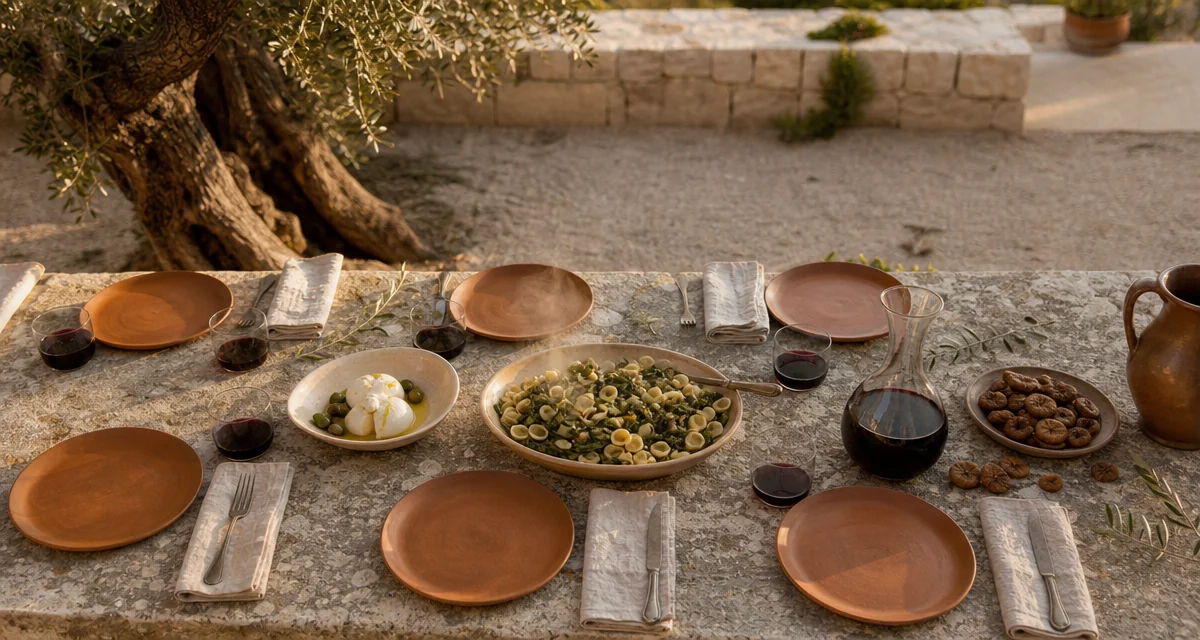
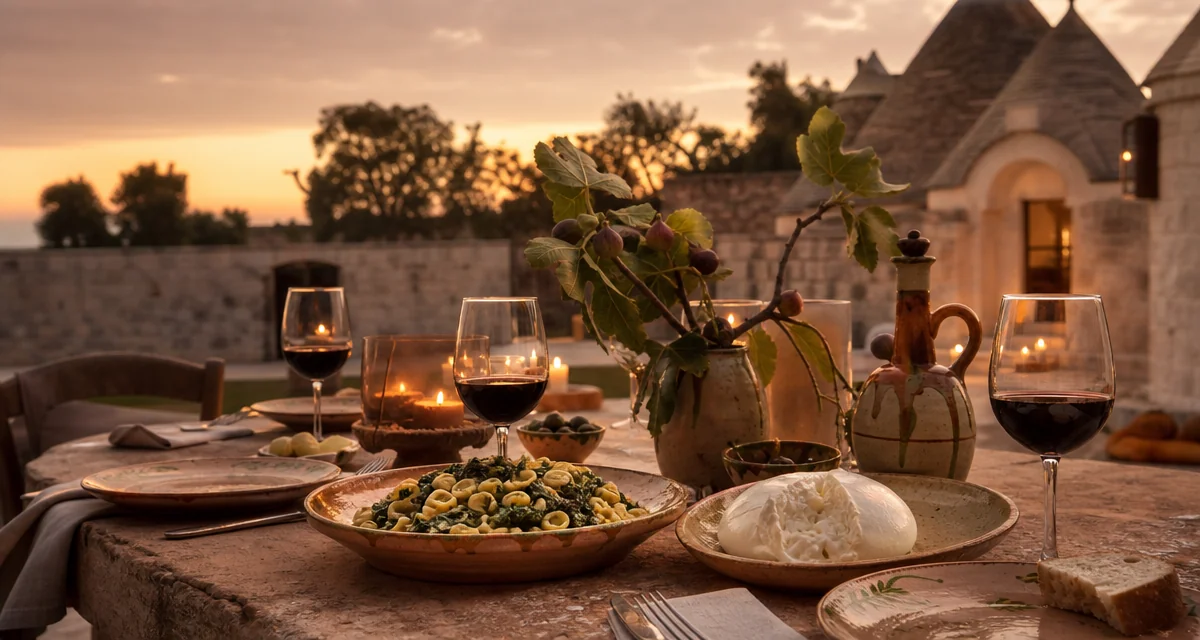
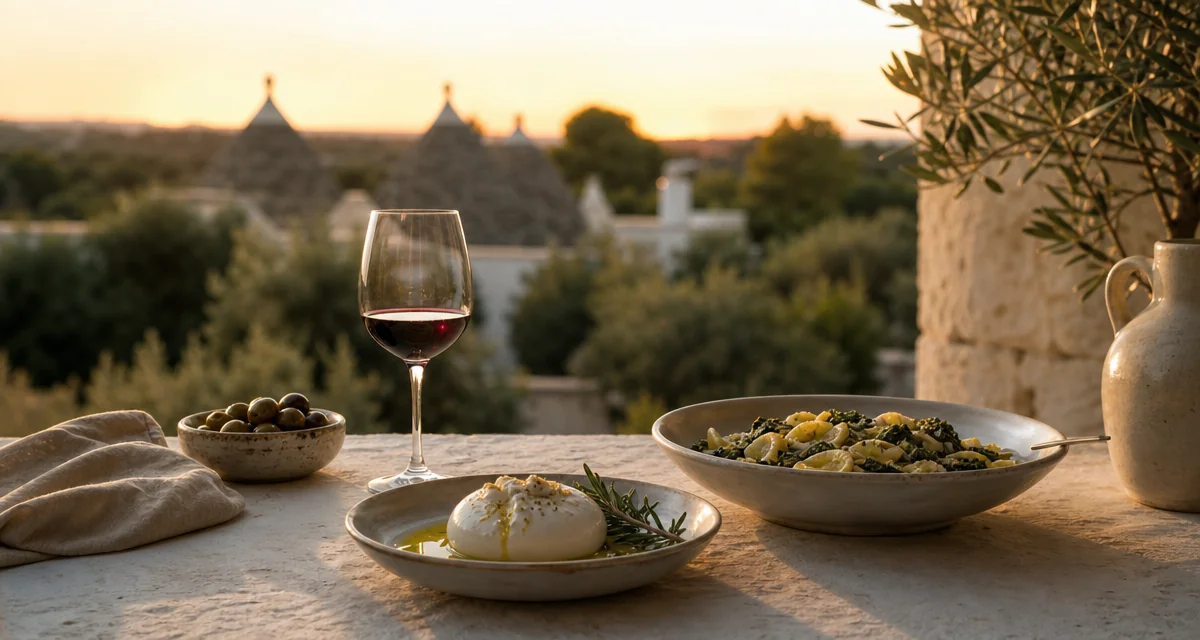
Orecchiette are small concave discs of semolina pasta, shaped by dragging a knife across a rope of dough and flipping the curl over a thumb. The name means 'little ears'. Made with only durum wheat and water, they cook in the same pot as cime di rapa (broccoli rabe, a bitter leafy green with small florets), then get tossed with garlic, chilli, anchovy and raw olive oil. The bitterness against the chewy pasta is the most Apulian flavour there is. You can still watch women hand-shaping them on wooden boards in Bari Vecchia's Via dell'Arco Basso, and a plate in a working trattoria runs €8 to €12.
Bombette di Alberobello and the fornello pronto
Bombette are thin slices of pork neck rolled around caciocavallo cheese, sometimes with pancetta or parsley, then skewered and grilled over wood embers until the cheese runs. They belong to the Valle d'Itria, the trullo-dotted plateau around Alberobello, Cisternino and Martina Franca, and they exist because of the fornello pronto: a butcher's shop with a grill at the back, where you choose your meat at the counter, pay by weight, and sit down while it cooks. Expect €18 to €25 per kilo, which feeds two people generously. Go after 8pm, when the whole street smells of smoke.
Burrata di Andria and the cheese counter
Burrata is a pouch of stretched mozzarella filled with cream and shredded curd, invented around 1900 in Andria to use up the offcuts from mozzarella production. It carries IGP protected status and has a shelf life measured in hours, which is why the version you eat here bears no relation to the one flown to London. Eat it at room temperature, with nothing but oil, salt and bread. Alongside it you'll meet stracciatella (the creamy filling sold on its own) and capocollo di Martina Franca, a lightly smoked cured pork neck recognised as a Slow Food Presidium.
Focaccia barese, Pane di Altamura and friselle
Focaccia barese is a thick, oil-soaked round of dough made with boiled potato in the mix, studded with cherry tomatoes and olives and baked until the base is almost fried. A wedge from a Bari bakery costs €1.50 to €2.50 and is the correct thing to eat standing up at eleven in the morning. Pane di Altamura is the opposite register: a dark-crusted sourdough loaf of remilled semolina that keeps for the better part of a week and was historically stamped with the family's initials before going to the communal oven. Then there are friselle, twice-baked rings of hard bread you dip in water for ten seconds before piling on tomato, oregano and oil.
Ricci di mare and raw Adriatic seafood
Ricci di mare are sea urchins, split open at the quayside and eaten raw with bread and nothing else, and they taste like cold seawater and cream. Along with raw prawns and polpo arricciato (octopus tenderised by swirling it against wet rock until the tentacles curl), they form the Apulian crudo tradition you'll find on the harbours of Monopoli, Polignano a Mare and Bari. Two caveats. Urchin harvesting is regulated with a seasonal ban, so plan on autumn and winter rather than August. And raw seafood from an unrefrigerated stall is a genuine risk, so buy from a licensed fishmonger.
What to eat in Lecce: pasticciotto and caffè leccese
The Salento has its own pastry grammar, and Lecce is its capital. A pasticciotto is a small oval tart of lard-based shortcrust filled with vanilla custard, baked until the top blisters, eaten warm at 8am for around €1.50. Legend puts its invention in Galatina in 1745. Beside it in every bar sits the rustico leccese, a puff pastry disc filled with béchamel, mozzarella and tomato, and the caffè leccese, an espresso poured over ice with almond syrup that is the only sensible way to drink coffee in a Salento July. In Lecce, follow whichever bar has the longest local queue.
What should you drink with it? Puglia food and wine pairings
Puglia is one of Italy's three largest wine regions by volume, and for decades it shipped most of that volume north as anonymous blending wine. That changed in the 1990s, and two grapes did it. Primitivo is a dark, warm, high-alcohol red, genetically identical to California's Zinfandel, at its most serious in the Primitivo di Manduria DOC in the Ionian Salento. Think black plum, dried fig and a soft bitter-chocolate finish, and pour it with bombette or anything off the grill. Negroamaro is the other pillar, an older Salento variety whose name reads as 'black bitter', giving a leaner red with cherry, tobacco and a saline edge, bottled most famously as Salice Salentino DOC. It handles tomato, aubergine and lamb better than Primitivo does. For whites, look to Verdeca and Bianco d'Alessano from the Valle d'Itria. And do not skip the rosato: Puglia has been making dry rosé from Negroamaro since the 1940s, decades before Provence made it fashionable. Most estates take tastings with 48 hours' notice, at €10 to €20 per person.
People ask me for a truffle menu because they think that is what a private chef means. In Puglia the luxury is the opposite. It is a fava purée that took four hours and cost me three euros. Chef Vito, Ostuni-based ambassador of Chef On Demand Puglia
How does the food change as you move across Puglia?
What to eat in Monopoli and along the Adriatic
Puglia runs about 400 km from the Gargano to the very heel, and the cooking shifts every 40 kilometres or so. The coast from Bari through Monopoli to Ostuni is seafood country, and its signature is tiella barese, a baked layered dish of rice, potato and mussels seasoned with pecorino, tomato and a lot of oil. Monopoli's old harbour still lands its own catch, so the trattorie do raw platters, grilled scorpion fish and spaghetti with sea urchin in season. Polignano a Mare, twenty minutes north, holds the restaurants with a view that fill Puglia's photographs, including one built into a sea cave. They are spectacular and expensive, so treat them as one evening rather than a strategy. For everyday eating, the fish market and morning produce stalls in Bari tell you more about the season than any menu.
The Valle d'Itria: fire, dairy and masseria country
Twenty minutes inland the sea disappears and the cooking turns to fire and dairy. The Valle d'Itria, the limestone plateau between Alberobello, Cisternino, Locorotondo and Martina Franca, is where the bombette, the capocollo and the caciocavallo live, alongside gnumerèdde suffuchète (small slow-cooked lamb offal rolls) for the braver eater. This is also masseria country: fortified stone farmhouses, many built between the 16th and 18th centuries against Ottoman raids, most now converted into agriturismi and villa rentals. If your group is staying at a masseria or a trullo, this valley is your larder, and it's why our Puglia chef network sends more cooks into this 30 km radius than anywhere else in southern Italy.
The Salento: bitterness, pastry and the Ionian side
South of Brindisi the food gets both sweeter and more bitter. The Salento eats ciceri e tria, a chickpea and pasta dish in which part of the pasta is fried rather than boiled and scattered over the top like croutons, and pittule, small deep-fried dough balls served plain, with cod, or rolled in sugar. Gallipoli on the Ionian coast gives the region scapece, fried fish layered with saffron-stained breadcrumbs and vinegar in wooden barrels. If you're choosing a base for food alone, the honest answer is the Valle d'Itria for variety and the Salento for character.
- Eat bombette on your first evening, in Cisternino or Martina Franca, after 20:00 when the fornelli pronti open their grills.
- Buy focaccia barese by weight from a bakery rather than a bar, and eat it within twenty minutes while the base is still crisp.
- Ask any trattoria for the antipasti della casa: in Puglia that usually means eight to twelve small vegetable plates for €12 to €18, and it's often the best value on the menu.
- Book a masseria or agriturismo lunch at least 48 hours ahead, since most cook a single fixed menu from their own produce and stop when it runs out.
- Taste Primitivo and Negroamaro side by side at one estate rather than visiting two, so you learn the contrast rather than two separate wines.
- Save one evening for a chef at your own property, ideally the night you arrive or the night before you leave, when nobody wants to drive.
Restaurant table or private chef at your masseria?
For a couple, restaurants win almost every time. For a group of six or more staying in a villa, masseria or trullo outside town, the logistics tilt the other way fast. A table for eight in a good Apulian restaurant in August needs a booking made weeks earlier, two cars, a designated driver on an unlit country road, and a 45-minute drive back at midnight with children who fell asleep during the secondo. The alternative is that the chef drives instead of you, arriving with the shopping already done from that morning's market, cooking in your kitchen, serving at your table or on the terrace, and cleaning up before leaving, all inside a 2 to 4 hour window.
| Factor | Restaurant table | Private chef at your property |
|---|---|---|
| Booking lead time | 2–4 weeks for a good table in August | 7–14 days across our network in peak season |
| Getting there | Two cars, a driver who cannot drink, 20–45 min each way | None, the chef travels to you |
| Cost per person | €45–€90 for three courses and wine in a mid-range trattoria | €85–€180 per head depending on tier and group size |
| Menu control | Fixed menu, allergies handled at the table | Menu agreed in advance around your group |
| Children and older guests | Fixed sitting, late finish | Own house, own bedtimes, dinner at your pace |
How much does a private chef dinner in Puglia cost in 2026?
A private chef dinner in Puglia is priced per person, per tier, and the per-head figure falls as the group grows. For a Taste of Italy menu, our signature format at 5 courses, expect around €120 per person for 6 guests, dropping to roughly €100 per head at 10 guests. The Essential tier, a fixed 4-course menu, sits near €95 per person at 6 guests and €85 at 10. Luxury, meaning 6 or more courses with premium seafood, aged cuts and a multi-wine flight, runs about €180 at 6 guests and €150 at 10. Those figures cover the shopping, the cooking, service at your table and the cleanup. Christian holidays such as Easter carry a surcharge of roughly 35 percent, and the Christmas and New Year window is priced as a group total rather than per head. Our Puglia cost guide breaks down every variable, and the regional roster sits on our private chefs across Puglia page.
| Tier | Courses | 6 guests | 10 guests |
|---|---|---|---|
| Essential | 4 courses, classic Apulian set menu | around €95 pp | around €85 pp |
| Taste of Italy | 5 courses, curated regional showcase | around €120 pp | around €100 pp |
| Luxury | 6+ courses, premium seafood or aged cuts, wine flight | around €180 pp | around €150 pp |
Two other formats come up constantly here. The first is a multi-day stay, where the chef accompanies your group for 3 to 7 days and you choose meal by meal which days they cook, most often 2 to 3 dinners plus one long lunch across a week rather than three meals daily. Cost depends on lodging, and there are three configurations: the chef sleeps at the property in a spare room, which carries the lowest day rate; a local chef commutes from home, realistic in the Valle d'Itria where our resident network is densest, with no accommodation cost at all; or the chef books a room nearby and the surcharge is line-itemed in the quote. Daily market shopping is included in all three, and quotes are always custom. The second is the Pasta Class + Dinner Experience, a 4 to 5 hour bundle held entirely at your villa or masseria. The chef arrives with all ingredients, boards and tools, teaches your group two fresh pasta shapes over two hours, one long and one short, then prepares two sauces, a set of antipasti and a homemade tiramisù, and serves it as a seated dinner on your own terrace, at €150 per adult and €60 per child. The takeaway is technique: the muscle memory of dragging orecchiette across a board, the feel of the dough, the logic of which sauce belongs to which shape. We do not send recipes, printed or digital.
When is the best time of year to eat your way through Puglia?
May, June, September and early October are the sweet spot, with sea temperatures still workable, tomatoes at their peak and restaurants not yet cooking for a hundred covers a night. July and August are the tourist peak, and while the food is lovely, tables tighten and coastal prices climb by roughly 20 to 30 percent. The counter-intuitive answer is winter. Cime di rapa, the green that defines the region's signature pasta, is a cold-weather crop running November to March, so orecchiette con cime di rapa is genuinely better in January than in August. The olive harvest runs from late October into December, and the new oil, cloudy and peppery enough to catch the back of your throat, is at its best within weeks of pressing. Add the Christmas pittule and cartellate, honey-drizzled fried pastry spirals, and a winter week in a heated masseria makes a serious case for itself. Average booking lead time across our network is 7 to 14 days in peak season, closer to 4 or 5 days from November to March.
Why this matters for your Puglia holiday
Most people arrive in Puglia with a list of towns and leave with a list of meals. That is not an accident, it's the structure of the place: the region never built its identity around monuments the way Florence or Rome did, so what it offers instead is a set of very local pleasures that reward you for slowing down. A wedge of focaccia eaten standing up. A butcher who cooks your dinner while you drink a beer at a plastic table. Burrata that is four hours old. None of that needs a Michelin booking, but it does need a little structure, because the good things here run on seasons, opening hours, and Monday closures nobody advertises. That's the gap a chef fills. Not white tablecloths, but somebody who knows which fishmonger in Monopoli is worth the detour and which greens are at their peak this week, and who will cook them in the kitchen you're already paying for. Base yourself once, in the Valle d'Itria or near Ostuni, and drive out. We've written separately about cooking in a masseria kitchen and about the tighter constraints of a converted trullo. Our private chef hub maps the network across Italy, and you can book a Puglia private chef experience for one evening or an entire stay. The image to hold onto is the one every guest sends us afterwards: a long table under a fig tree, the coals still ticking, and nobody in any hurry to clear it.